Hashtags

#Hashtags: Looking towards 2012

#Hashtags: Viral Thoughts on Politics, Arts, and Culture

#Hashtags provides a platform for longer reconsiderations of artworks and art practices outside of the review format and in new contexts. Please send queries and/or ideas for future to hashtags@dailyserving.com.

A corner of a long-ago building, the wall borders the edge of the Ecotrust Building parking lot, located in one of the most renovated and redeveloped commercial sections of Portland, OR.  It should do what all walls do:  create a boundary, or support a series of hidden, internal structures of unknown weight and gravity.  Perhaps, and I know I’m getting radical here, perhaps keep some things out and let others in?

Yet everything this wall has to offer flies in the face of such simple aspirations, and for that reason alone, I love it.  Structurally, the wall is useless.  It supports nothing, contains nothing. It simply stands, a ruined fragment with several sets of windows, all empty of glass, their rusted-red shutters thrown open.  The door to an old loading bay gapes like an open mouth. Aesthetically and metaphorically, however, the wall transcends its structural ineffectiveness, making it—to my mind—a metaphor for the best of all art.
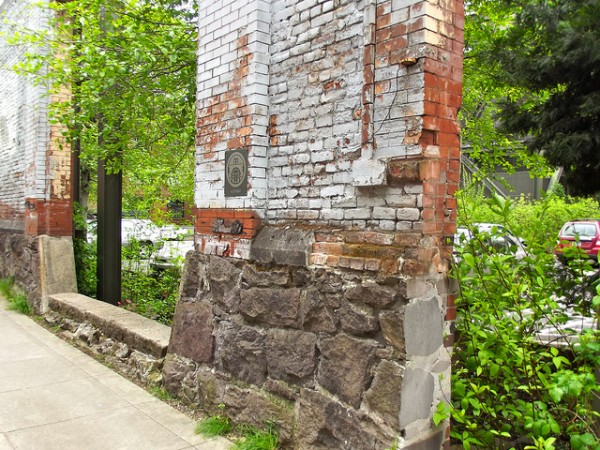
The wall of the Ecotrust Building in Portland OR. Photograph by Rosa Say, courtesy of Flickr.

When you stand outside a building and peek in the window, you expect an inside view, a chance to be a voyeur to something at once internal and intimate.  Instead, the architects responsible for letting this ruined wall stand (Holst Architecture PC) create an entirely different kind of experience.  The interior has gone missing, replaced by a row of cherry trees planted on the other side. The psychological experience vacillates between feeling like you’re looking into the eyes of a soul mate and a pair of mirrored sunglasses that reflect only yourself back.

Read More »

Share

Help Desk

Help Desk: On Collaboration and Curating

Help Desk is an arts-advice column that demystifies practices for artists, writers, curators, collectors, patrons, and the general public. Submit your questions anonymously here. All submissions become the property of Daily Serving. Help Desk is co-sponsored by KQED.org.

Your friendly counselor, hard at work.

Question: Both my girlfriend and I are artists. Neither of us are particularly successful with our art careers (yet!). In the past, we’ve worked separately in our studios, but we are thinking that we may be stronger working together. I’m a little nervous to start this process. Do you think it is a good idea to mix art and love?

Two creative minds are often better than one, and the examples of Jeanne Claude and Christo and Ed and Nancy Keinholz tell us that art and love can surely be mixed. But before you run out to buy matching smocks and berets, consider the reality of working on tasks that you already do together. When you cook, does one of you tend to take the lead, dictating the selection of dishes and the proper ways to prep, add, and stir? Or are you happily slicing and dicing like synchronized surgeons? When you’re running errands in the car, do you argue about routes and where to park? Or does one drive and the other assume co-pilot duties with nary a cross word between you? Your everyday activities will tell you a lot about how a collaborative relationship might proceed.

Oh yeah? Well I have 20/20 vision, so I get to choose all the paint colors!

And that’s not to say that a bickering duo should never work together; friction is productive both in and out of the studio. But in the interest of household harmony, you might want to start small with one piece or a limited-run project. Lay out the terms in advance: how much time and money you’re going to spend, who decides on which aspect, how you’re going to negotiate a disagreement. Talking about the issues will prepare you for what’s ahead and alert you to any sticking points in advance. If you can agree to the basics at the verbal level, then you’ll know that working together is worth a try. And if your short-term project doesn’t pan out as well as you’d like, you’ll have an easy out that’s not as damaging to true love in the same way as saying, “You’re a pain in the ass and I don’t think we should work together anymore.”

Read More »

Share

Article

From the DS Archives: TEXT/URAL

Language is a thing that can easily be something we all take for granted. Today from the DS Archives we take a look back at the exhibit TEXT/URAL from OKOK Gallery. LACMA is currently exhibiting A is for Zebra, a group show “about alphabets making sense and non-sense.”

The following article was originally published by Rebekah Drysdale on August 3, 2009:

Michael-Waugh-8-3-08.jpg

OKOK Gallery’s current exhibition, TEXT/URAL, presents the work of seven national and international artists whose text-based works illustrate the expressive potential of language. The infinite mutability of letters, words, and their meanings allow these artists to explore, both formally and conceptually, the role of language in art. The exhibition features works by Michael Waugh, Kay Rosen, Kim Rugg, Will Yackulic, Ewoud Van Rijn, Annie Bradley, and Grant Barnhart.

Michael Waugh’s labor intensive drawings are executed in ink lines of tiny handwritten script. Waugh selects his text from dozens of Presidential inaugural addresses, commission reports, and speeches to Congress. Thousands of words are written out by the artist, and the text becomes large images, as seen above in one of two works on display in TEXT/URAL. The images created from the sprawling text are often loaded with religious and political allegory.

Kay Rosen-8-03-08.jpg

Kay Rosen has been working with language since 1969. Her wall painting, HALFULL, will be on display at OKOK Gallery. She articulates the meaning of this work in her essay, The Center is A Concept, where she states “referencing the proverbial glass, HALFULL offers a verbal shortcut for viewing the world in two ways, positively or negatively, through a simple linguistic choice involving the letter F”. Rosen uses the predictable palette of 1 Shot brand of sign-painters lettering enamel, an arbitrary system with an infinite combination, similar to the alphabet.

Kim-Rugg-8-3-08.jpg

Kim Rugg renders our print and media culture unintelligible by meticulously dissecting pages of newspaper with an X-ACTO knife. She cuts out every letter and alphabetizes them on the page, all while preserving the dignity in presentation and formality of the newspaper format. She cuts the pictures into small equal sized pieces,and arranges them by color into what resembles television static. Three works will be included in this exhibition utilizing the front pages of the New York, Seattle, and L.A. Times. Rugg was recently reviewed by the L.A. Times and described as “a vandal of the highest order, a tamperer, an interventionist.”

Will Yackulic’s works on paper combine text with obsessively rendered micro-landscapes that recall rudimentary digital imagery. His work was featured in 2007 on DailyServing. Ewoud van Rijn’s epic drawing, Reality, will be included in the show as well. The image, whose gushing lettering suggests both water and sperm, contains a bold statement “reality has no mistress it has a master me.” New Zealand-based artist Annie Bradley is presenting her audio video animation, Sodding G. Monolith, in the project room. This work is inspired by the names spammers use to circumvent e-mail filters and comments on the incessant flow of information. Grant Barnhart, another previous DS feature (and was interviewed by DS in 2007), is presenting work that combines text with adolescent ephemera, such as Playboys adorned with forged Babe Ruth signatures. He is also displaying the sleeping bag in which he received his first kiss, creating an awkward homage to innocence lost.

TEXT/URAL will be on display at OKOK Gallery in Seattle until September 7, 2008.

Share

London

The Future of Contemporary Art

I must admit I am often plagued by skepticism walking into ‘best of’ exhibitions – the ones, like  the recent Bloomberg New Contemporaries 2011: In the Presence, that promise to clairvoyantly open up a window onto the future of contemporary art. Often, these group exhibitions seem plagued by too many artists, who are represented by a single work, thrust together in a curatorial jumble that proves great challenge to navigate.

Since 1949, Young Contemporaries, or the now-named Bloomberg New Contemporaries, has been presenting its view of the future of contemporary art, selecting recent graduates from art schools across the UK. This year, spread across the ICA in London, are 40 artists who span the genres of painting, sculpture, photography, video, installation, conceptual art and performance. With the likes of the Chapman Brothers, Anish Kapoor and David Hockney included in past incarnations, there is always the hope that amongst the chosen, the next great British artist is lurking.

With no text to accompany the exhibition, the work must stand on its own merits. While I appreciate that the viewer is encouraged to form unbiased opinions based on the formal, aesthetic and narrative properties inherent in the work, I can’t help but think that we might be missing something, and that much of the work would benefit from further contextualisation – and perhaps a better hang. So what might the future hold?

Noel Hensey, Death is Here, 2009, c-type print on aluminium, 42 x 60 cm. Courtesy of the artist and Bloomberg New Contemporaries.

1. Death by Photography

Tucked away in a less-than stellar location on the stairwells is the work of two artists whose muted photographs capture constructed moments of intrigue. Noel Hensey’s Death is Here is an unsettling and eerie image in which the perfectly balanced, slick composition if offset by the unsettling, and perhaps prophetic, narrative that one envisions may play out in a suburban nightmare.

Read More »

Share

LA Expanded

The Damned Don’t Cry

L.A. Expanded: Notes from the West Coast
A weekly column by Catherine Wagley

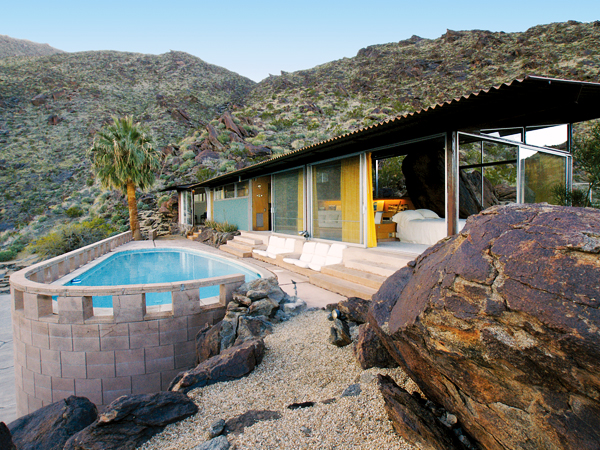
The Kaufmann House in Palm Springs. Photo by Tim Street-Porter.

The Christmas arsonist began setting fires under cars in L.A. the day after his German mother’s extradition proceedings due to fraud allegations, including the charge she falsified the down payment for her breast implants. In a courtroom, he purportedly went on an “anti-American” tirade, then went out on a particularly anti-L.A. crime spree, targeting cars in a city that’s unusually dependent on them. He set fifty fires before being apprehended the day after New Year’s by a reserve deputy who is an Iranian immigrant. By Wednesday, news had circulated that the arsonist was wanted for a fire set in Germany as well, and he was put on suicide watch. “If this didn’t exist, someone would have created it in fiction,” said Denise Hamilton, a crime writer who, when interviewed on public radio, suggested twice that noir novelist Nathanael West might have written these very characters, given the chance.

I heard about the arsonist’s arrest while driving home from Palm Springs, after a New Year’s weekend that started with a perfect desert dinner in a mod strip mall and ended in the emergency room when a friend’s fall cut short a hike up the hill the Frey House is built on.

In a way, Palm Springs feels like an even more fitting setting for L.A. noir than L.A. itself, partly because it’s where L.A. goes to vacation and its modernist monuments feel especially exclusive and portentous because they’re set out in the desert, nearly 100 miles from the big city.

The Frey House in Palm Springs.

All we knew of the Frey house before climbing was that it was tucked into the hill, and was orange, delicately angular and equipped with tennis courts — which you see perfectly, if you venture off the Palm Springs Museum Trail at just the right spot. I found out later that the house, designed by the Zurich-born Albert Frey who apparently all but invented “desert modernism,” had been home to the architect up until his death in 1998, at age 95.

Read More »

Share

Frankfurt

Gabríela Friðriksdóttir: Crepusculum

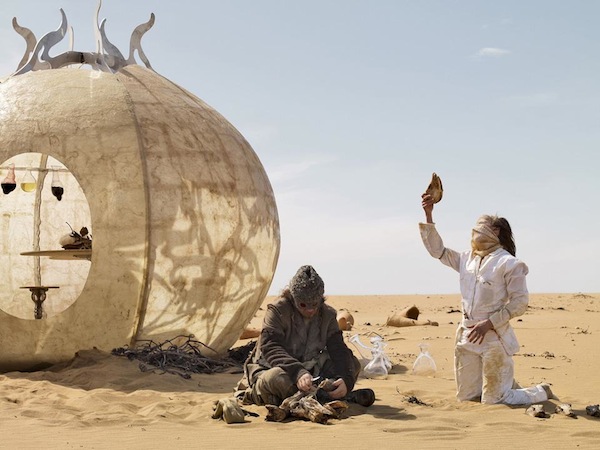
Gabríela Friðriksdóttir, Crepusculum, 2011. Photo from Video, 29:00 mins / ed. 5 + 2 AP. Courtesy of the artist © Schirn Kunsthalle Frankfurt, 2011 Photo Jirí Hroník.

Comprising only a large installation at the Schirn Kunsthalle, Gabríela Friðriksdóttir’s Crepusculum – Latin for “twilight” or “dusk” – is a mixed-media, polyphonic, physical exploration of metaphysical structures that govern the human psyche, and speculates that an enigmatic and irrational system of signs, meanings and forms counterbalances the deceptively ordered exteriors of our existence.

Gabríela Friðriksdóttir, Crepusculum, 2011. Photo from Video, 29:00 mins / ed. 5 + 2 AP. Courtesy of the artist © Schirn Kunsthalle Frankfurt, 2011 Photo Jirí Hroník.

Above all, it is an experiential and tactile show that prioritises evoking a multitude of emotions over engaging the intellect. A large, white spherical entity around which alchemical instruments are scattered sits on a pile of sand; music seems to leak out from all sides of the wall, surrounded by glass-protected ancient Icelandic calfskin parchments that record supernatural accounts of a medieval Scandinavian world inhabited by witches, trolls and dragons. The installation is populated with elemental components of the earth such as dust, dough, fire, blood, burlap and fur, but also overlaid with textures that are fur- or hair-roughened. An accompanying video bolsters the already-surreal installation as a narrator weaves a showy mythological universe with his droning words: a man guts slimy fish, a figure lithely unfolds itself out of clay “legs” and “helmet”, a figure wrapped in tattered cloths hikes laboriously across a sandy wasteland with another strapped to his back towards the self-same spherical entity.

Read More »

Share

Fan Mail: Lee Yujin

For this edition of Fan Mail, Berlin-based artist Lee Yujin has been selected from a group of worthy submissions. If you would like to be considered, please submit to info@dailyserving.com a link to your website with ‘Fan Mail’ in the subject line. One artist is featured each month—the next one could be you!

Fire has always mesmerized me; as a child, I was frequently chastised for playing with matches and open flames. Until last winter, when I came upon a burning apartment building, my experience was limited to these tame interactions. Within moments, the flames engulfed the structure, sending giant plumes of orange and yellow and black smoke into the night sky. The scene led me to pause with a combination of horror and awe.

Over the past two years Lee Yujin has produced sumptuous drawings that examine the tension between the beauty and violence of smoke. In Cloud Series – the first body of work to investigate this subject matter – she isolates found images of bombs and explosions, divorcing these potent indicators of turmoil and violence from their original contexts. While these works in pencil present smoke as a static phenomenon, the dynamism of Lee’s meticulous mark-making breathes energy into these forms.

Lee Yujin. “Volcano Eruption 2." Pencil on Paper. 110 x 218 cm. 2010. Courtesy of the Artist.

Lee Yujin. Detail from “Volcano Eruption 2." Pencil on Paper. 110 x 218 cm. 2010. Courtesy of the Artist.

When viewed from the perspective of form and shape, these drawings reveal themselves as arresting abstractions. I was immediately reminded of Alfred Stieglitz’s Equivalents, a series of small-scale, black and white photographs of cloud-filled skies. Stieglitz viewed these photographs as “vision[s] of life,” a visual “equivalent” for human experience. Lee views smoke in much the same way. She explains, “there is something beautiful about smoke because it is something we cannot take control over. It is intangible and ephemeral. Its shape is unexpected and transformable. In this sense, ‘smoke clouds’ can be an allegory for life…”

Lee Yujin. "I am a Telescopic Viewer, You are a Telescopic Viewer, We are Telescopic Viewers (Telescope Series)." A series of 100 drawings; each drawing with frame 43 x 43 cm. Charcoal and conte on paper. 2011. Courtesy of the Artist.

While these pencil drawings are particularly notable for their incredible precision, her most recent series, I am a Telescopic Viewer, You are a Telescopic Viewer, We are Telescopic Viewers, approaches the subject with a more fluid gesture, using charcoal and conte to produce drawings that introduce color. The quietude of her earlier drawings is in stark contrast to these new works which, when exhibited en masse, allude far more evidently to the violence underlying these images.

Lee was included in several solo and group exhibitions in Berlin in 2011, including “One Night Stand” at Kims Bar, “Benumbed” at Takt Kunstprojektraum, and “We Can Start a Process” at Kreuzberg Pavilion. You can stay apprised of her upcoming projects through her website.

Share