Los Angeles

“Out, damn’d spot!”: Damien Hirst’s latest strike

Damien Hirst, "Isonicotinic Acid Ethyl Ester," 2010–11. Household gloss on canvas, 99 x 147 inches. Image courtesy of Gagosian Gallery.

When Lady Macbeth said “Out, damn’d spot!” she was referring to stains of blood, not brightly-colored enamel paint, but I’m sure there are more than a few art critics out there who echo her thought this month. The reason? What to make of “Damien Hirst: The Complete Spot Paintings 1986–2011”, now on view at eleven Gagosian galleries worldwide.

The spots at Gagosian LA range from the size of a ladybug to the size of a car door, and the canvases stay proportional, meaning that huge spots live on huge canvases, and vice versa.  The enamel colors are glossy and bright and yet flat, to such an extent that at the opening, I had several conversations that followed the ‘why spend your time laboring over what a computer can do’ track.

Damien Hirst, "Cefaclor," 2009. Household gloss on canvas, 21 1/8 x 16 3/8 inches. Image courtesy of Gagosian Gallery.

Perhaps the most unique perspective came from an art consultant, who professed his love for one painting in particular—a smaller piece in the second room that had actually been painted by Hirst (Hirst turned the labor of painting the spots over to his assistants in 1993). The spots on this canvas are slightly less uniform, the paint just a bit more uneven, and I swear you can see holes where the point of the compass bit in.

Read More »

Share

Help Desk

Help Desk: Extracurricular (!) Activities

Help Desk is an arts-advice column that demystifies practices for artists, writers, curators, collectors, patrons, and the general public. Submit your questions anonymously here. All submissions become the property of Daily Serving.

What advice would you have for artists who are separated from the university realm to keep themselves sharp (in terms of criticism and general growth)? Have you found specific groups or events that have helped keep you on track beyond academic circles?

Good for you for wanting to stay sharp! The instantaneous peer network and programming that a school provides helps to keep you on your toes, and once school is over it’s hard to maintain that momentum outside of an institutional setting. Groups and events do different things, so you’ll definitely want both in your life: a group will keep you connected and supported, and events will keep you informed and thinking. For groups, the network you’ve already established is a good start: with any luck, you still have the contact information for some of your old classmates. Why not email them to suggest a get-together? I recommend keeping it short and informal at first if you haven’t seen them in a while—maybe just a one-beer meetup at a bar or even an email list—because too much pressure to commit will drive shyer folks away. When you settle in with some like-minded people you could start a crit group or a reading club, go to openings together, or even just host a few fun, gossipy dinner parties.

First, find a group of people who share your interests.

Read More »

Share

Article

From the DS Archives: Histories continuing in a variety of ways

So, normally the weekly look back into the DS articles delves deeper into archives…today could more aptly be described as ‘From a Few Weeks Ago.’ The article chosen is Agitated Histories, and was originally published on December 20, 2011 by Rebecca Najdowski. The exhibit Agitated Histories closes today, and acts as a fortuitous introduction to the upcoming exhibit The Forgetting of Proper Names at Calvert 22 in London. The exhibition, opening on January 25th,  “explores the artists’ varied approaches to re-imagining historical events. Here investigations into the relationships between live events and objects, the use of the body as subject in performance, and the use of sound as a narrative tool form recurring threads.” (e-flux)

If you’re lucky enough to have been in New Mexico last month while planning to be in London next month, maybe you’ll see both exhibits. If not, take another look Nadjowski’s article and keep an eye out for The Forgetting of Proper Names.

Agitated Histories:

Grasping the nebulous zone of art and politics can be arduous at best. The curatorial project of Agitated Histories attempts to do just that by compartmentalizing the political narrative. The Re-enactment, The Archive, The Persona, and The Intervention give some scaffolding from which the viewer can approach the work. The artists in this exhibition engage with the political, the social, and the personal through formal concerns and artistic research. We are looking at history (recent) here, through a distinctly political lens.

THE RE-ENACTMENT

Yoshua Okón,

One of the most compelling pieces in the exhibition is Mexican artist Yoshua Okón’s Octopus (2011). Created during a residency at the Hammer Museum, the 4-channel video piece grapples with what is both humanizing and alienating. Day laborers re-enact the civil war in Guatemala, wearing in black or white clothing, depending on which side they had fought for. On the set of a Home Depot parking lot, the laborers replay scenes from their country’s history, but now the opposing sides point invisible weapons at an invisible enemy, not at their historical foes. “Octopus” is Guatemalan slang for the United Fruit Company, alluding to the company’s ambiguous role in Guatemalan politics and complicating the narrative further.

THE ARCHIVE

Sam Durant and Zoe Leonard & Cheryl Dunye

Sam Durant,

The pliableness of the document becomes evident through Zoe Leonard & Cheryl Dunye’s The Fae Richards Photo Archive (1993-1996). A fictional African American performer is created through an archive of snap shots, film stills, and head-shots. Photography’s role in the construction of history becomes clear as we are left to conjecture about the possibilities of this figure.

Read More »

Share

New York

One man’s rabbit is another man’s…

On my first interview for graduate school, I unerringly identified each slide shown to me: Warhol, Matisse, Pollock, Smithson. I left confident for my next interview the following day. I waltzed into the building and calmly road up to the eighth floor.  There, I was completely caught off guard. Instead of Rauschenberg, Duchamp or Hirst, I was presented with a photograph of a man clad in a bright pink costume, resembling equal parts rabbit and penis. Needless to say, I was not familiar with Maurizio Cattelan’s Errotin le vrai lapin (Errotin the true rabbit), a costume commissioned by the artist for his notoriously sex-crazed dealer Emmanuel Perrotin, which he wore during the workday for two weeks of Cattelan’s exhibition at his gallery. As I sat silently – stunned by discomfort and disappointment with my inability to identify this phallic performance piece – I discovered that the situation had not yet sufficiently devolved: my interviewer then informed me that he believed the work clearly referenced the popular “rabbit” device and asked if I agreed. And thus I was first introduced to the oeuvre of Cattelan.

Maurizio Cattelan. "All." Solomon R. Guggenheim Museum. November 4, 2011 - January 22, 2012.

People seem to either love or despise Cattelan’s retrospective All, on view through January 22nd at the Solomon R. Guggenheim Museum. Roberta Smith of The New York Times suggests, “[w]hatever their strengths, the individual works are radically decontextualized and diminished in this arrangement.” The arrangement to which Smith refers is the suspension of 128 works – the entirety of Cattelan’s artistic production (apart from two works owners refused to loan) – within Frank Lloyd Wright’s iconic open rotunda. Works ranged from giant slabs of carved granite and models of dinosaur skeletons to photographs, canvases and the smallest of sculptures, subtly and unexpectedly placed throughout. Anyone looking at this exhibition cannot deny that – at the very least – it is a feat of engineering genius.

Read More »

Share

LA Expanded

Not a Person Today

L.A. Expanded: Notes from the West Coast
A weekly column by Catherine Wagley

An image Miranda Grosvenor sent to a beau

In one of the snapshots Miranda Grosvenor sent to her famous beaus, she appears blurry and blond, sitting in a convertible parked with its front end in the street and back end on the grass of somebody’s manicured lawn. In this and other photos, she is always alone, and always suspiciously attractive, naïf-like as a young Nastassja Kinski in a two-piece bathing suit or full-bodied as Marilyn Monroe. None of these actually were her; she clipped the photos from magazines or catalogs. Her name did not officially belong to her either. In addition to Miranda, she went by Ariana, Briana and, on rare occasion, her real name, Whitney.

She would call up famous men and, in her “mellifluous, accentless voice,” seduce them within 20 minutes, according to Bryan Burroughs who wrote about mythic Miranda for Vanity Fair in 1999. Buck Henry, who co-wrote The Graduate and now makes guest appearances on 30 Rock, first heard from her in 1980 or ‘81, when she called him long distance in the middle of the night, name-dropping and charming him with her exquisitely vast knowledge of his career and of that of many other men in his bracket. She knew where Henry ate lunch and with whom, and, sometimes, when Henry was on calls with her, Senator Ted Kennedy or some other impressive personality would beep in.

Read More »

Share

Interviews

Intersections and Boundaries: Interview with Whitney Lynn

I can’t remember exactly how I found the website of Whitney Lynn—one of those following links of links things—but as soon as I saw images of her sculptures of pillow fort/military bunkers I knew I wanted to talk with her. Luckily for me, she was about to install a solo show at Steven Wolf Fine Arts in San Francisco. I went over to the gallery to talk with her about the new work, a series of traps entitled Sculptures Involontaires.

Whitney Lynn, Death Parties (2011) Plastic, glass, alcohol, chrome-laminated birch shelf, 21 x 36 x 6 in.

Bean Gilsdorf: How did this new body of work begin?

Whitney Lynn: It started with Southern Exposure in 2009, they had a show called “Bellwether” and they were asking artists to predict or envision the future. I was looking at the way in which do-it-yourself and sustainability movements overlap with survivalism. I started picking up these images about how to trap your own food, skin your own squirrels, eat your own rats, and those sorts of things. Then when I was doing a later project I was also thinking about containment, and I started thinking about trapping systems. I was not quite sure what I was going to do with all of it, and then there was the realization, oh, there’s a project here.

BG: Do you think of your work as post-apocalyptic? Has anyone ever framed your work that way?

Read More »

Share

Berlin

Utopia, Romance, and “Young Art” at the Hamburger Bahnhof Museum

Tomás Saraceno, Cloud Cities, installation view, image courtesy Berlin Art Link

This winter the Hamburger Bahnhof’s exhibitions are (mostly) devoted to artists influenced by utopian architecture, a decision made to coincide with Tomás Saraceno’s Cloud Cities, an investigation into sustainable living that borrows heavily from the language of visionary architects and futurists like Buckminster Fuller.

Saraceno’s “biospheres” are fun, enormous and inviting, with long lines of art-goers waiting for a moment of awkward repose over the Bahnhof’s hangar.  They allude to the plasticity of our “futures” (Saraceno prefers the plural) but they also seem kind of garish, like giant floaties at an eighties-themed pool party in West Hollywood.

When compared to Saraceno’s epic balloon opera, the drawings and models of early German modernist architects like Bruno Taut and Hanzel Weblik are pleasingly modest.  These are displayed downstairs, in small dark alcoves as part of the sprawling Architektonika exhibition.

Architektonika offers up a few real gems, among them Dieter Roth’s scrappy and feral Gartenskulptur, a garden-environment-installation that was added to, catalogued and maintained for thirty years by the artist and his son. Then there are photographs and remnants of Gordon Matta Clark’s 1977 Office Baroque in which the artist sliced open a building in Antwerp and created a teardrop shaped hole in the façade (which was slated for destruction).  The result emits a bodily pathos unusual for the inanimate.

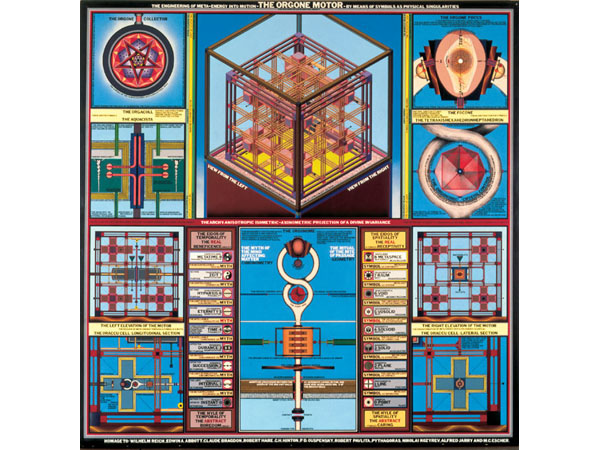
Paul Laffoley, The Orgone Motor, 1981, courtesy of Kent Fine Art, New York

Upstairs Paul Laffoley offers his take on utopia as part of the Hamburger Bahnhof’s new Secret Universe series.  I’m really excited about this exhibition series, which will last for three years and focus on visionary artists whose multi-disciplinary practices may have been overlooked by the larger art community.  Finally, we can see what the weird uncles of the art world are up to.

Read More »

Share