Toronto

Stan Douglas: Entertainment: Selections from Midcentury Studio at The Power Plant

Stan Douglas, Flame, 1947, 2010. Digital silver print mounted on Dibond aluminum. Courtesy the artist and David Zwirner, New York

To make the images for Midcentury Studio, a selection of which are at The Power Plant in Toronto until 4 March, Stan Douglas not only constructed a working period studio stocked with authentic equipment from the post-war North America that these images ‘document’, he also invented an impressively resourceful fictional character, a working photojournalist of the time, to make them. Douglas cast himself in the role, and in an extended interview with David Balzer, he talks about the photographer of these pictures in the third person, discussing the work with a distance that is disorienting and fascinating.

Installation of Stan Douglas: Entertainment at The Power Plant, Toronto, 10 December, 2011 - 4 March, 2012. Photo by Toni Hafkenscheid.

With characteristically intensive research and attention to detail, Midcentury Studio looks at the years just after the war, 1945-51, a time still twinged with darkness and desperation, but one looking forward to the optimism of 1950s  America, when a working hack with a camera might just as easily shoot a murder victim  or a brawl to sell to the papers as he might a cricket match or a magician to run in a magazine feature or as a print advertisement. Vancouver stands in, as it does so well, as anytown, its Hollywood North reputation perfectly matched for this exercise in projection and role-play.

Read More »

Share

Hashtags

#Hashtags: The Culture of the Copy

#Hashtags: Viral Thoughts on Politics, Arts, and Culture

#Hashtags provides a platform for longer reconsiderations of artworks and art practices outside of the review format and in new contexts. Please send queries and/or ideas for future to hashtags@dailyserving.com.

“Cameras are the antidote and the disease, a means of appropriating reality and of making it obsolete.” – Susan Sontag

In her 1977 essay, “The Image-World,” Susan Sontag wrote that the practice of photography – and the overabundance of images that come along with it – leave us desensitized to the “real” world. Despite the fact that photographs are considered traces of their subject, we typically see photographs as independent, material objects – separate from their original subjects and somehow more palatable. They even occupy a specific moment of time, different from our own, turning the present into the past and the past into the present.

But Sontag was writing about the role of the photograph as she knew it, which never included sculpture, or photographs functioning not just as traces of objects but as actual simulations, or three-dimensional copies.  The last year has seen a rise in artists working with photography in sculpture, with more than a few of these artists choosing to juxtapose “real” objects with their 2- or 3-dimensional, photographic copies. Is there a difference between images functioning like this in the world and “the image-world” that Sontag describes? Or are they one and the same?

Jerry McMillan, "Wrinkle Bag," 1965. Black and white photographic bag construction with shelf and Plexiglas cover. 12.75 x 11.75 x 7 inches.

Ironically, even as Sontag was puzzling over “The Image-World” and the rest of the essays that would become On Photography, searching to delineate a niche in the fine art world for photography, curator Peter Bunnell took an even larger step. In 1970, Bunnell launched “Photography into Sculpture” at the Museum of Modern Art, “the first comprehensive survey of photographically formed images used in a sculptural or fully dimensional manner.”

Read More »

Share

Help Desk

Help Desk: Not Enough/Too Much?

Help Desk is an arts-advice column that demystifies practices for artists, writers, curators, collectors, patrons, and the general public. Submit your questions anonymously here. All submissions become the property of Daily Serving.

Your counselor, hard at work.

Some galleries provide artists with information on who is purchasing their artwork…others do not. What’s up with that? I feel like smaller galleries are super paranoid of artists selling out from under them while bigger more stable galleries offer full contact information to artists.

I’m not a gallerist, so I asked around to see if anyone could help me shed a little light on this subject. Catharine Clark, of Catharine Clark Gallery in San Francisco, generously provided this information for me to share:

Read More »

Share

From the DS Archives: Innovations in Film

Since the invention of the motion pictures, films have captivated their viewers. Today we pay tribute to the innovation of precedents such as Stan VanDerBeek, and look forward to the innovators of now (who have some seriously big shoes to fill, ones that are often left completely empty). The 2012 Sundance Film Festival, New Frontier, opened in Park City, Utah yesterday, and features two of Daily Serving’s oft-reviewed artists, Ai WeiWei and Marina Abramović, among others. “Presenting work of artists, journalists, game designers, and media scientists, New Frontier 2012 explores the integration of human forms with the techno-sphere and ushers in a media environment of the future that nourishes the cornerstones of our humanity—our social nature, vulnerability, and creativity.”

New Frontier 2012 will be on view from January 20, 2012  January 28 and at the Salt Lake City Art Center through May 19.

The following article was originally published by Catherine Wagley on January 22, 2010:

L.A. Expanded: Notes from the West Coast
A weekly column by Catherine Wagley
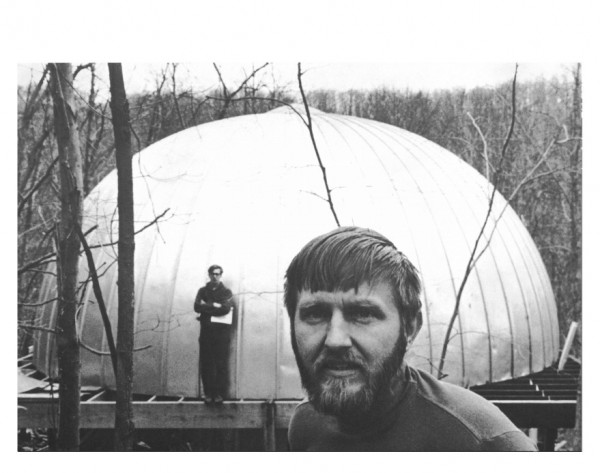
Stan VanDerBeek with his Movie-Drome, Stony Point, NY. Courtesy Yale School of Architecture

Making films is not easy. Most people know this and almost as many find the difficulties of movie-making enthralling, which explains the proliferation of articles, TV interviews, and radio specials on the subject. Just last week, I nearly pulled off the freeway to better concentrate on radio host Elvis Mitchell’s interview with Oren Moverman, the directed of The Messenger (who, apparently, had 3 different directors, including Sydney Pollack, walk away from the picture before he took the helm himself), and I don’t think I’ll ever tire of Quentin Tarantino’s story (told most recently on Tuesday’s Tonight Show with Conan O’Brien) about how his hands, and not the hands of Nazi Colonel Hans Landa, came to strangle Diana Kruger’s character in Inglourious Basterds.

Read More »

Share

Chicago

Memoria (Memory): Bibiana Suárez at Hyde Park Art Center

Bibiana Suárez, Aves raras (mexicanos) no. 1 / Strange Birds (Mexicans) no. 1, 2005-2011, archival inkjet print on aluminum panel (map courtesy of the University of Chicago’s Special Collections), 24 x 24" & Bibiana Suárez, Aves raras (mexicanos) no. 2 / Strange Birds (Mexicans) no. 2, 2005-2011, archival inkjet print (map courtesy of the University of Chicago’s Special Collections), 24 x 24"

2012 has arrived and it can mean only one thing: the apocalypse. Will the End Times be ushered in by the Mesoamerican Long Count Calendar reaching its end date? We can’t be sure until late December! What has become painfully certain, however, is that we are in an election year. And, while the economy looms large on the minds of most Americans, immigration is not far behind. Will America eventually choose a candidate who would grant “amnesty” (read: anything resembling legal status or *gasp citizenship!) to the millions of undocumented people living and working in this country, ushering in the likely demise of the U.S.? Or, will we the people elect a man patriotic enough to send all the illegal Cuban, Chinese, Honduran, and Southeast Asian immigrants back to where they came from; namely Mexico? The fate of the country and the soul of freedom hang in the balance!

At least that would seem to be the choice as presented by the Republican candidates during the never-ending cycle of G.O.P. primary debates. The language surrounding immigration, espoused by the candidates as well as other jingoist hardliners, has become so vitriolic and so reduced that hyperbole strategically crowds out any sober dialogue that addresses the complexity of the issue or pathos for the individuals most effected by immigration enforcement.

Bibiana Suárez’s exhibition entitled Memoria (Memory) at the Hyde Park Art Center attempts to catalyze that discussion through playful moderation. Tracing the influence of Latino culture in America, Suárez expresses hope and frustration while eluding anything that would resemble rhetorical bombast. The show is such a disarmingly tempered analysis of themes of Pop culture representations, identity, labor, and the dynamics of integration that it takes all the steam out of this hot button issue.

Bibiana Suárez, Ai pledch aliyens no. 1, 2005-2011, acrylic paint and digital transfer on aluminum panel, 24 x 24 inches

In order to create her large-scale installation of mixed media paintings and ink-jet prints, Suárez borrows the format of the game “Memory” in which players selectively turn over cards placed face down in order to find pairs of matching cards. The gallery walls are filled with one hundred and eight “playing cards” sized 23.5 inches by 23.5 inches with images depicting maps, body parts, historical images, or various phrases in English, Spanish, and Spanglish. Text boxes featuring an assortment of inclusive and derogatory names for the Latino Diaspora are meant to depict the “backs” of the playing cards. The game aspect of the installation invites viewers to seek connections within the available images. It also serves as a metaphor for the ever-shifting boundaries of integration within American culture as well as the gamesmanship of the national debate.

Read More »

Share

LA Expanded

Burnt Church and Other Sacrilege

L.A. Expanded: Notes from the West Coast
A weekly column by Catherine Wagley

Banks Violette, "Untitled (Church)," 2005

I have a checkered brown and white shirt with sleeves and a collar that looks like something Ashton Kutcher would have worn in That ’70s Show. I still wear it, though I bought it at a thrift store when I was in high school. I had written a play about U.S. college students trying to find their true selves in the years right after the Vietnam War and devoted weeks to finding vintage or faux-vintage, orange, green, brown and denim clothing. I also found a vintage record player, which was playing The Beatles’ “Golden Slumber,” from Abbey Road, when the protagonist offed herself at the end of Act I (Act II was all about her friends coming to terms with her death, and, of course, about finding faith in the face of despair and other such sublime ideas).

Friends and I staged the play in a sanctuary because my father was a minister and the church was the closest thing to a theater we had at our disposal. The suicide took place at the altar. We’d covered a pew with cushions and blankets to make it look like a couch, and that’s where the poor actress was, spread out with hand hanging limply toward the floor, when her roommates emerged from the sacristy to find her dead. It didn’t seem sacrilegious at all, suicide and The Beatles on the altar, since, really, the whole play was about hope, despair, belief, disbelief — all concerns that are supposed to get hashed out at altars, right?

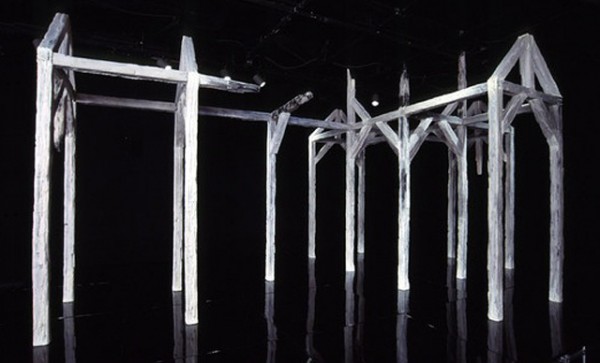
A new exhibition of Banks Violette’s opened at Blum & Poe gallery in Culver City last week, which, like his past shows, grapples with over-belief and explores the place where reverence and sacrilege meet. Violette’s exhibition features big black steel speedway railings and the number 88 sculpted and drawn, after race car driver Dale Earnhardt Jr. who drives the No. 88 car, whose father died in a Daytona 500 accident 11 years ago, and who has been voted “Most Popular Driver” for 9 years now.  The sculptures have the same minimalist stoicism of the sculpture he installed at the Whitney seven years ago, a salt-covered, burn-wood and polyurethane skeleton of a  traditional church. “It’s almost the platonic representation of burnt church,” said Violette, whose piece was informed by a series of church arsons perpetrated by heavy metal fans who took the Satanic musings in their music as clarion calls.
jk;

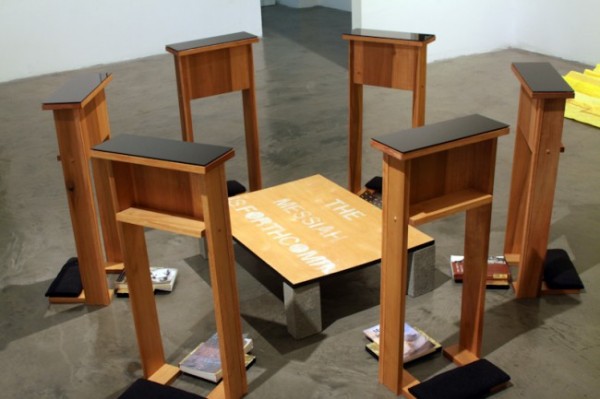
Nikki Pressley, The Messiah is Forthcoming, 2011, mixed media, dimensions variable

Even though it depicted the ruins of a sacrilegious crime, Violette’s burnt church felt nearly reverent. It acknowledged that religion, like music (and art) had power over us and it set up religion, pop, and fine art to interact on the same level. Another piece that I saw this week, by Nikki Pressley in the group show “Go Tell it On the Mountain” at Charlie James Gallery, has a similar effect. It’s an installation of six narrow communion railings  with cushions for kneeling set up around a platform that says “The Messiah Is Forthcoming,” and laid in front of the railings are theoretical books. Among them are writings by Frantz Fanon, the incisively combative post-colonialist, who ended his book Black Skin, White Masks with this exquisitely reverent, hopeful line that’s more or less the message of Pressley’s sculpture: “My final prayer: O my body, make of me always a man who questions!”


Share

Frankfurt

Kienholz: The Signs of the Times

The Ozymandias Parade, 1985, Kienholz: The Signs of the Times Exhibition view. © Schirn Kunsthalle Frankfurt. Photography: Norbert Miguletz

When Edward Kienholz died of a heart attack aged 65 in 1996, his burial arrangement could have been one of his own installations: his embalmed body was stuck into the front seat of an old brown Packard coupe; he drove off into the good night with a dollar and a deck of cards in his pocket, accompanied by the ashes of his dog in the back and a vintage bottle of Chianti beside him. If the stance of aggressive defiance followed him to the grave; such must have been the confrontational quality and persistent rebelliousness of Kienholz’s oeuvre when he lived and worked that his accusatory cries of a reality gone sour are still heard far, loud and wide nearly 2 decades after his death.

Kienholz: The Signs of the Times is an extensive survey of Edward Kienholz’s and Nancy Reddin Kienholz’s collaborative works spanning three-dimensional smaller objects to the conceptual room-filling tableaux in their horrifying, squalid glory at the Schirn Kunsthalle. While not quite a retrospective, it is a show that captures the antagonistic spirit (in variations of form, material and structure) of rebellion (buoyed by the angry years of the 1960s and 70s) that Kienholz is best remembered for, broadcasting generally, a similar theme of humanity’s fallen state.

Edward Kienholz, The State Hospital, 1966, Inside view. Plaster casts, fiberglass, hospital beds, bedpan, hospital table, goldfish bowls, black fish, lighted neon tubing, steel hardware, wood, paint 245 x 360 x 295 cm. Moderna Museet, Stockholm © Kienholz. Photography: Moderna Museet, Stockholm.

Above all, there is a visceral, scabrous rage that palpably underpins this exhibition which reads like an extended exercise in the finer points of accusation. Here, subtlety, as it seems, holds no place of honour in art that has been created for the purpose of indictment. The installations rail against the perennial injustices Kienholz thought assailed and fractured American society at that time: ethnic conflicts, the Vietnam war, the sexual exploitation and commodification of women, the manipulation of the unsuspecting middle-class through by media conglomerates, and the treatment of those who lived on the margins of “acceptable society”. The State Hospital (1964-6) presents a constructed cell of a psychiatric ward, drawn from Kienholz’s own memory of his work as an orderly, in which a naked mental patient with a fishbowl for a head lies strapped to his bed. In the bunk above, an identical figure lies in a similar state of dismal existence, a reinforced symbol of an already broken institution.

Read More »

Share