Los Angeles

Judy Chicago Revives ‘Sublime Environments’ For Pacific Standard Time

Today’s article is brought to you from our friends at the Huffington Post.
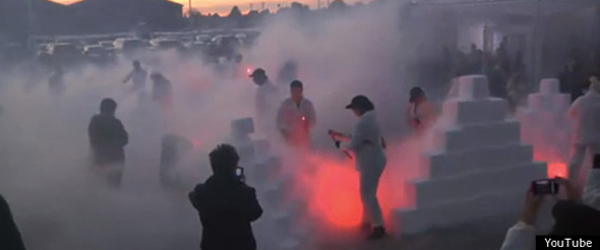
Do you remember your first time you saw dry ice? Mine was in a punch bowl as part of a Halloween school dance. There was something inherently magical about the material; when I first encountered it I kept blinking, waiting for what looked like an illusion to reveal itself. Watching Judy Chicago’s revival of ‘Disappearing Environments as Sublime Environment’ revives that initial excitement and gives it poetic understanding. Chicago teamed up with Materials & Applications to revive her 1968 ‘Disappearing Environments as Sublime Environment’ performance, originally by Chicago, Lloyd Hamrol, and Eric Orr. The piece consisted of 25 tons of dry ice into pyramid formations that shrouded the surrounding environment in a hazy fog. At sunset, the installation was incited with road flares and left to disintegrate over the following four days until it disappeared.

Chicago described the medium of dry ice as “a metaphor for the preciousness of life.” The performance piece alters the landscape of the Santa Monica Barker Hanger, turning an airport structure into an outdoor dream laboratory in which an experiment had gone awry. The dry ice creations are a combination of architectural pyramids and apocalyptic wedding cakes. Continuing in Chicago’s language of confusing typically masculine and feminine fields, traditionally male pyrotechnic flares gave way to a pinkish rolling fog that softened and feminized the landscape. The piece was a stunning addition to the Art Los Angeles Contemporary art fair, and can be seen in all its glory in the video below:

Share

Los Angeles

Eugenia is coming: LAND shows off Eugenia Butler in “Perpetual Conceptual”

It’s been said that over the course of four short years – from 1968 to 1972 – the Eugenia Butler Gallery set the bar for conceptual art in Southern California. Butler, whose own mother fled home to work as a Harvey Girl, left Bakersfield, CA, to serve in the United States Marines, eventually becoming a Master Sergeant. After the war, Butler married James Butler, a lawyer and military pilot who made a small fortune by conducting the first lawsuit against Thalidomide, a drug with known negative side effects, on pregnant women. Perhaps due to the fact that she did not need the gallery to turn a profit, or (more likely) due to her innovative tastes, Butler took chances on work that others couldn’t, and her roster of artists grew to include Allen Ruppersberg, William Leavitt, Eric Orr, John Baldessari, James Lee Byars, Ed Keinholz, Dieter Roth, and her own daughter, Eugenia P. Butler. Yet somehow Butler’s story has remained largely unwritten, with nary a Wikipedia entry to speed things along.

Installation view, a LAND Exhibition: "Perpetual Conceptual: Echoes of Eugenia Butler." Photograph courtesy of Danielle Sommer.

Thanks to the Los Angeles Nomadic Division (LAND), the Getty Center, and Pacific Standard Time, for the next three months, Butler’s influence will be on display in three West Hollywood exhibition spaces, at 8126 – 8132 Santa Monica Boulevard, just about a mile from the Eugenia Butler Gallery’s original location, 615 La Cienaga. Titled Perpetual Conceptual: Echoes of Eugenia Butler, the show is both a primer — with works from Paul Cotton, Lawrence Weiner, Ed Keinholz, et al — and an homage, with curatorial stylings that recall many of the makeshift exhibition spaces of EBG’s era. In short, LAND, “a public art initiative committed to curating site- and situation-specific contemporary art projects,” chooses exhibition locations based on specific projects rather than maintaining a single venue. Perpetual Conceptual‘s three venues are located one right after another on the edge of WeHo, in a small, unassuming strip mall, right next to a donut shop.

Read More »

Share

Help Desk

Help Desk: The Answer is No

Help Desk is an arts-advice column that demystifies practices for artists, writers, curators, collectors, patrons, and the general public. Submit your questions anonymously here. All submissions become the property of Daily Serving.

I am a curator and was recently contacted by an artist whom I have never met, who was recommended to me by a mutual acquaintance (another artist). The artist is inviting me to do a studio visit, but after looking at the artist’s website, I know that I am completely uninterested in seeing the work in person. I would like to decline the request in a way that is honest but kind, without necessarily making an explicit value judgment about the work. (I realize that expressing an opinion from my position holds a specific kind of weight.) I want to avoid wasting anyone’s time by doing a studio visit that will not yield anything for either of us. From an artist’s perspective, how can a curator best handle this situation?

This is a great question, one that many of us on the receiving end have thought about long and hard. Personally, I take my rejections straight up (with an escapist murder-mystery chaser), because the perennially used and ever-ambiguous “I’m very busy right now,” leaves me wondering, Do I ask again later? How much later? Or should I understand somehow that “busy” actually means “go away forever”? One might spend days second-guessing the intention of such messages and ultimately end up more depressed than if there had simply been a polite “No, thank you.”

Read More »

Share

Article

From the DS Archives: Post-Communism

There are only so many things you can do to deal with years of oppression. In the case of former Soviet states, there is a tendency to look to humor (albeit a dark humor most often) and the absurd. Today we look back at Bean Gilsdorf’s take on the Polish world of dwarves and how they kept moral high.

Want more post-communist artistic expression? This year’s FotoFest in Houston, TX  ‘explores  modern and contemporary Russian photographic history over the last five decades from the post-Stalinist period of the 1950s to the present day’.

The following article was originally published by Bean Gilsdorf on September 17, 2011:

Dwarves, videos, homemade t-shirts and cardboard tanks: this is what you’ll find in Happenings Against Communism by the Orange Alternative at the Galeria Miedzynarodowego Centrum Kultury in Krakow.  It’s a multi-roomed tour of Polish protest in the 1980s, the retrospective of a social practice movement that swept an entire country.  Although the tone of the exhibition is playfully iconoclastic—that’s the whole point—I often found myself moved nearly to tears by the many video works scattered throughout the space.  It’s not often that art changes the world, but when it does it is extremely poignant and inspiring.

An uncredited photograph from the exhibition Pomaranczowa Alternatywa Happeningiem w Komunizm (Happening Against Communism by the Orange Alternative) at the Galeria Miedzynarodowego Centrum Kultury.

Some background: various political and economic factors plunged Poland into a period of deep decline around 1980, and on December 12, 1980 martial law was declared.  Both an immense buildup of Soviet military at the borders and the arrest of union members and intellectuals precipitated an economic sanction by the US and other nations.  Rapidly, Poland became a nation of fear and scarcity.  Working with the influences of the Surrealist and Dada movements, “Major” Waldemar Fydrych decided to take matters into his own hands.  As a former art history student at the University of Wroclaw, Fydrych had co-organized the Independent Students Union and a massive peace march as well as cooperatively publishing a student newspaper called Orange Alternative, so he was no stranger to both art and politics.  When he saw all the patches of white paint the government was using to cover anti-regime graffiti, he had an idea that eventually shaped itself into a revolution.  His goal was to protest the brutality and militarism of the regime without replacing one dogma for another by shouting political slogans or creating formal hierarchical structures.  From the moment he picked up a brush, Poland became a site for the absurd pushing against the militaristic.  Enter the dwarf.

Read More »

Share

San Francisco

Making Events of Objects: [2nd floor projects], Glass, house, and THE THING Quarterly

As part of our ongoing partnership with Art Practical, Daily Serving is sharing Patricia Maloney’s article Making Events of Objects on [2nd floor projects] and THE THING Quarterly in San Francisco.

Image: Scott Thorpe (left) and Brett MacFadden at the wrapping party for THE THING Quarterly, Issue 15: MacFadden and Thorpe.

A central tenet to emerge from Conceptual art in the 1960s was the perception of language as an object: a visual form of signification that requires us to negotiate its materiality in order to locate its meaning. In this process of negotiation, language was no different than any other artistic medium. The tactile quality of a page and typographical arrangement of text were recognized to be as active in creating meaning as the words printed on them. If reading was a set of physical gestures that unfolds linearly—left to right, top to bottom, from one page to the next—the interruption or reordering of any of these gestures led to a reconsideration and new consciousness of the act. In other words, language was set in motion, built, excavated, or incanted instead of written, and to read these texts was to experience them spatially.1 The inheritance we’ve received from these investigations into language as object is an inherent understanding of the performative nature of reading and, concurrently, of a reader’s role as co-conspirator in creating meaning.

As art historian Gwen Allen notes in the introduction to her book Artists’ Magazines: An Alternative Space for Art, beginning in the 1960s, art magazines went beyond their documentary purpose to become alternative sites that presented works of art. They placed the materiality of art and the materiality of language into congruous relationships and transformed those relationships into performative experiences. For example, 0 to 9, a mimeographed poetry magazine published by poet and performance artist Vito Acconci and poet Bernadette Mayer between 1967 and 1969, aspired to explore language as a visual, phonetic, and kinetic form and featured contributions from both poets and conceptual artists. The magazine’s issues featured pages densely covered in text or left nearly blank, typesetting that suggested motion across the page, and even, for the cover of Issue 5, a sheet of paper crumpled and then flattened again. Preceding his transition from poet to performer, Acconci made experiments with typography and layout, motivated by what he described as a restlessness with the page that compelled him into a state of action. (“I couldn’t be on the page any more. Language took me out onto the street. I was moving on the page, now I wanted to move on the sidewalk, on the street. I was more thinking of the street as a field of activity rather than the page.”2)

Read more >>

Share

Los Angeles

Kissing, Architecture, and Mohair that Saves the Day

L.A. Expanded: Notes from the West Coast
A weekly column by Catherine Wagley

Pipilotti Rist, Pour Your Body Out, 2009, installed at MoMA.

“A kiss puts form into slow and stretchy motion,” writes Sylvia Lavin. A kiss “renders geometry fluid.” Our relationship to buildings can be like that too — slow, stretchy, fluid. So Lavin suggests in Kissing Architecture, her new book with a bright pink cover and a delightfully sensual take on architectural criticism.

Lavin is interested in that problem that plagues design disciplines “as a net result of convergent histories of capital and culture”: should contemporary architecture establish itself as autonomous or work to engage its public, and which aim is nobler?

Kissing Architecture begins with a description of Pipilotti Rist’s Pour Your Body Out, an embracing 2008-2009 installation in MoMA’s atrium, where a fleshy, floral, 25 foot high video projection played out. Visitors could sit on pillows on the ground or on a round seating “island” the artist designed. The installation occupied space designed by architect Yoshio Taniguchi as an addition to MoMA in the late 1990s, which is, argues Lavin, decidedly banal and meant to push people through (the “peripatetic visitor” becomes almost an obstacle). Pour Your Body Out didn’t subvert Taniguchi’s banally tall white walls, though; it just offered a “vivid moment,” a “pulsating pink swerve.”

Read More »

Share

Interactions Between Representations of History

An exhibition of two adjoining shows by Slavs and Tatars and Lonnie van Brummelen & Siebren de Haan is on at Kiosk, Ghent till 22 January 2012, featuring works that deal with interpretations and associations surrounding historically significant events.

Friendship of Nations: Polish-Shi’ite Showbiz by Slavs and Tatars presents a re-imagination of an Iranian Polish Solidarity. Even to an eye unfamiliar with Iranian and Polish traditions, the strong reference to craft is apparent. On entering the dome-shaped gallery, the works appear to be part of a commemoration, with large and colorful handcrafted banners and woven objects.

Installation with banners by Slavs and Tatars, 'Friendship of Nations: polish shi'ite showbiz'. Courtesy the artists, Kraupa-Tuskany, Berlin. © Yana Foque

‘Pajaks’, crafted according to local customs and hang from the ceiling, are part of an annual Polish harvest celebration. In context of local customs, several of these ‘pajaks’ are made with Christmas lights, yarn, glass balls and even a Christmas tree.

Read More »

Share