Interviews

Complicated History: Interview with Olaf Brzeski

Olaf Brzeski’s work spans many different media, but his practice is unified by a central sense of iconic situations having gone awry. For Brzeski, the hunter becomes the hunted, the superhero-savior is hideously deformed, the stately bust is bloated and misshapen. Brzeski’s work has been included in solo and group shows throughout Poland and in Prague, Copenhagen, Budapest, and Lille. We met up in Tarnow, Poland, where he was installing work for the citywide exhibition Tarnow: 1000 years of modernity.

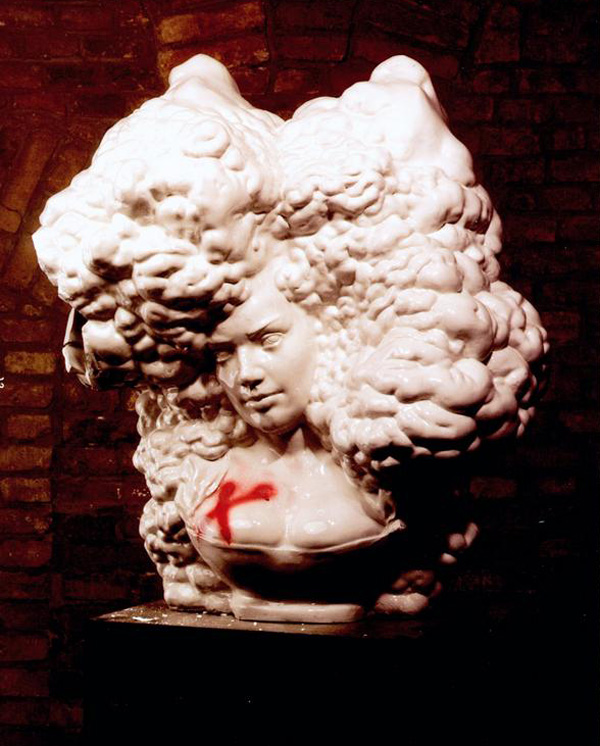
Olaf Brzeski, Hunter’s Fiancee, 2006. Ceramics, wood, spray enamel

Bean Gilsdorf: You work with a lot of ethereal, evocative forms: smoke, destroyed objects, things that seem uncanny…

Olaf Brzeski: Uncanny is a good word, yeah.

BG: Tell me about that. What are your feelings toward these objects?

OB: To explain how I feel you need to know that I was born in the south of Poland, in Wroclaw. This city has a complicated history because it’s very near the border and it changed owners: Czech, Polish, then German, now it’s Polish again. Before the war it was a German city, and after WWII the borders were changed and [Poland] got it. The atmosphere there, the architecture of bunkers and tunnels, there’s a constant presence of the fear of war, even in dreams. In my childhood it was so present—my grandparents’ stories, on the television, in propaganda—I didn’t just put that away. So now I use it. Some of my work comes from this kind of sinister premonition of what might happen.

BG: Like the video installed at the Casino [one venue of the exhibition Tarnow: 1000 years of modernity].

OB: Yes, In Memory of Major Josef Moneta.

Olaf Brzeski, In Memory of Major Josef Moneta, 2008. Installation with video and plaque

BG: That work also has an anxiety to it. The visuals are sinister, as you say, and the sound heightens that. How did you come to make this work?

Read More »

Share

Hashtags

Here Be Dragons: Google Earth As Omniscient Atlas

#Hashtags: Viral Thoughts on Politics, Arts, and Culture

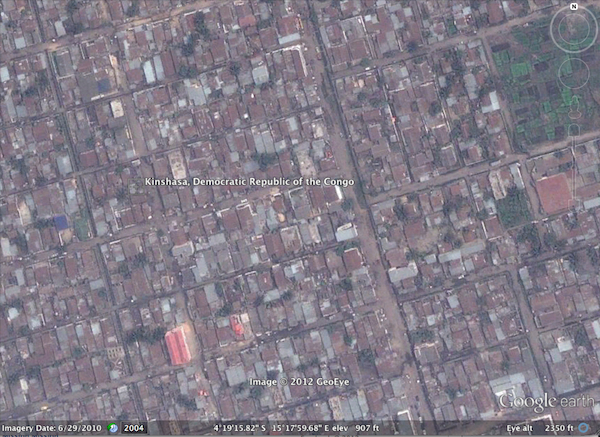
Kinshasa, Democratic Republic of the Congo. Screen capture using Google Earth.

When I was a child, I spent countless hours poring over a Cold War–era National Geographic photo atlas. I traced every road and river, in every country, some which no longer existed or were currently in the process of brutal disintegration (à la balkanization). Sometimes, when I was really lucky, a country would be represented by two or three photographs. Some countries earned no photographic representation. Nonetheless, these photographs helped me learn that Thai women had really long fingernails, Brazilian men wrestled anacondas naked, and Africa was an untamed land bereft civilization and modernity. This photo atlas provided a seven-year-old me with irrefutable evidence about my world, but it also left so many questions. Malawi and Kyrgyzstan had no photos; what were they like? As I grew older these questions became more nuanced: Are all Algerians really Tuaregs? Might South Americans actually wear clothes? Are Western Europe and the United States as idyllic and perfect as the amber waves of grain imply? As much of a colonial travesty as that book was, it sparked an intense interest in the world and provided me with enough information to later deconstruct its own narrative.

Jump forward a few decades. Croatia is firmly established as a tourist hotspot, Dubai is megalopolis, and Burma is now Myanmar. So much has changed. We also now have a qualitatively different kind of atlas: Google Earth. This new atlas—a seven-year-old technology that allows me access to every nook and cranny of the planet’s surface—ostensibly offers a potential antidote to the inaccuracies of older atlases. This computer software exposes the mysteries of the world; every single village, building, and street on the planet is immediately viewable to me, save those hidden beneath thick canopies.

Read More »

Share

Help Desk

Help Desk: School Daze

Help Desk is an arts-advice column that demystifies practices for artists, writers, curators, collectors, patrons, and the general public. Submit your questions anonymously here. All submissions become the property of Daily Serving.

Bruce High Quality Foundation wants you to skip school and hang out at LACMA instead.

I am considering getting a MFA in sculpture/new media, but it is very difficult for me to get a complete sense of the different MFA programs both in the U.S. and abroad. Unfortunately my best resources have been asking friends and old teachers. From them I get a mix of old information, rumors and myth. Can you tell me the top three MFA sculpture programs in the U.S. and the top three abroad? If not, can you tell me about some resources that can help me learn about these schools beyond their, nearly useless, websites?

To begin, let me tell you how glad I am that you’ve already figured out how useless a school’s website can be. From the un-navigable layouts to the endless paragraphs of self-aggrandizing prose, a school’s website can be really ineffective if you’re looking to understand the culture of the institution or the kinds of students who attend. I have first-hand experience with this dilemma myself: when I was applying to grad school, I did a lot of preliminary research online; but when I visited the schools in person, my experience on campus often contradicted my initial impressions. One website made me fall deeply in love, until I interviewed the school’s students and they all were so sad and burned out and disinterested. Another institution seemed very scholarly—important to me because I like art theory—but the second-year students who toured me around talked about how little time they spend reading and writing. You’re right to be suspicious of websites, and also prudent to ask your colleagues and old professors.  But mostly I’m glad you wrote in, because I’m going to share some hard-earned wisdom with you. Come lean a little closer to the screen because I’m going to tell you a secret about the top three art schools:

They don’t exist.

Oh, yes, websites can extol the virtues of the mega-famous faculty and the students who win awards, or the number of curators who troll the MFA show every year, and you can try to impress me with studio size, or student-to-teacher ratios, or just plain old Ivy-League-ness, but I insist—“best” is a racket.

Now before everybody tries to shout me down about how important it is to make “contacts” at Yarvard University/StanArts/School of the Art School of L.A., I want you to consider this: the Best School Ever is the school that is best for you, which is to say that it matters much less how supposedly awesome the school is by some supposedly objective measure, and much more how it fits you and your goals and your learning style. Is it of great consequence to have art-star faculty if they are crappy teachers, or always flying off to biennials and don’t have time for you? Do you need a first-class media lab if you’re a studio potter? Does it matter that representatives of commercial galleries roam the halls if you’re a performance artist? If you don’t care about research, do you want to go to a school that requires a lengthy written thesis? Probably not.

So the Top School is the school that will best suit your needs, and I’m going to help you find it. Start by making a list of your goals. What do you expect to accomplish in an MFA program? What would the most awesome dream program have? Be honest, and write it all down because it’s going to help you find the right place. Now, based on that list, check out the websites. Are there faculty who are doing what you want to do? Does a school have the right kind of facilities to produce your work? Is it in area you want to live? Take a look at the courses they offer. Which are required? Do any sound interesting? Most schools also post photos of student work. Is any of it good or does it suck? You can do this basic research online without too much trouble, and you should be able to come up with a list of about five or ten schools that interest you.

Now contact the schools. Email admissions and tell them you want to come for a visit. Ask them if you can meet with some faculty members, the ones you dug up online. Make appointments with two or three instructors, the director or program chair if possible, and at least two students. Meeting students is important because you want to know what kind of student goes to that school. This goes double for small programs! If there are only six artists admitted every year, you should find out if the year ahead of yours is a bunch of pretentious dickheads, because you will have to see these people every day. Check out the studios, too. Yes, it’s nice to go and admire the facilities, but what you want to discern here is whether or not the students are encouraged to be active. Are the studios empty? Or is the hive buzzing? What are they working on? Is it any good?

I promise that meeting people face to face will help you find the best school. It also signals to the school that you are an enthusiastic student, and as an added bonus, faculty and administration will remember you when they see your application. Yes, it’s expensive to fly around and do this kind of research, but look at it this way: you can pay now to find the right fit, or you can waste $60,000 on two years of being completely miserable. If you really can’t afford to travel, try Skyping; and at least make it to one of the three national Graduate Portfolio Days, where many schools have representatives to meet with you and answer your questions.

And as a final word of advice, I’d like to add that after you’ve been out of school for two or three years, no one but your mother cares where you went anyway. It’s more about what you make and where you’ve shown it that counts. So grad school should be a time to focus on making your work better, and there’s a great institution out there that will meet you where you’re at and then help you advance. Good luck!

*          *          *

I have about completed my BA in Studio Art with a concentration in photography, but at my school there is really only one digital photo class so I feel ill prepared both for grad school and the “real world.” Ultimately I prefer working in film but I am wrestling with myself over the eternal dilemma of being true to your work vs. selling out. I am definitely interested in going to grad school and earning an MFA in photography but I am afraid I will be “behind” the other students who went to schools with more developed programs. What are your thoughts?

Let’s break your question into its constituent parts: first, you feel ill prepared for grad school (I’m not sure I know which “real” world you’re talking about, so we’ll set that part aside). Second, you feel that working with digital (since you prefer film) is selling out. Third, you’re worried that your skill set will leave you at a disadvantage in regards to your classmates in the hypothetical grad school in your mind.

I’m going to begin by answering your digital dilemma. Here it is: if you feel you need to build skills in digital photography, you can easily find classes (usually cheap ones) at the local community college, photo center, or camera store. You may not love digital, but if your aim is to support yourself as a photojournalist/sports or wedding photographer then you’ll have little choice but to get on board with the prevailing technology. Really, it’s that simple.

As for your art practice, if it is truly the case that your work must be in film to be fully realized then go ahead and shoot it with film. You should use whatever medium best suits the work and your practice—to quote McLuhan, the medium is the message and the fact that your work is in film will actually be part of the content. However, in terms of grad school (and hopefully the long life you lead afterward), your work is going to change; knowing as much as possible about the various tools available will allow you to experiment with clarity and confidence.

It’s true that most grad programs don’t teach technical skills. The MFA is more about your willingness to engage fully with your work on an intellectual level. However, that doesn’t mean that technical knowledge can’t be gained as part of your studio practice if you are diligent and motivated. Graduate school in the arts is largely self-directed, and it’s up to you to pursue your interests and be guided mainly by your own lights. This also applies for any “real world” you might encounter after you leave grad school. The learning cannot stop when you toss your mortarboard up in the air.

Acquiring a new skill set is not “selling out.” In an MFA program you’ll be too busy figuring who the heck you are and what the heck that person makes. You can worry about selling out when you have a buyer, but until that moment comes I wouldn’t give it a second thought. Good luck!


Share

From the Archives

From the DS Archives: David Shrigley

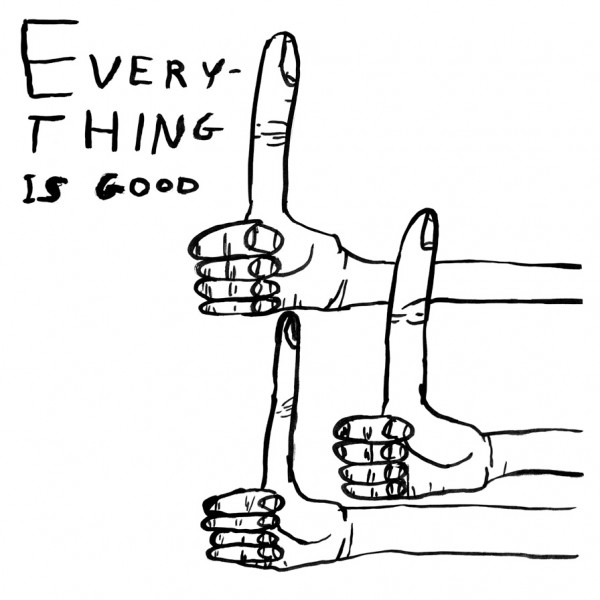
Today in our fearless adventure through the DS Archives, let’s take another look at David Shirgley. Trained as a fine artist, Shirgley makes a point to break away from the expected fine art aesthetic. Think less Sistine Chapel and more your scarily clever thirteen year old little brother. The work is full of wit, satire and irony, all boiled down to a state of low context and high content…but only if you pick up on the joke. Shirgley’s new exhibition, Brain Activity at the Hayward Gallery is on view from 1 February 2012 to 13 May 2012. The exhibition is Shirgley’s first major show in London and will feature works extending beyond drawing to include photography, books, sculpture, animation, painting and music.

The following article was originally published on September 3, 2008 by Seth Curcio:


Opening next week at the Baltic Centre for Contemporary Art will be works by artist David Shrigley in his latest self titled exhibition. Shrigley is best known for his dead pan humor and intuitive drawings that illustrate simple yet absurd situations. The exhibition will also feature the artists object-based sculpture, which often plays with scale and have included items such as stuffed animals, doors, ladders, tents and sleeping bags. The artists has exhibited internationally and gained much popularity through a series of weekly illustrative contributions to The Guardian, since 2005. Shrigley has exhibitions this year with BQ in Cologne, Anton Kern Gallery in NYC and CASM in Barcelona, and a forthcoming exhibition at Galerie Yvon Lambert in Paris next year.

Want even more David Shrigley? Check out the more recent coverage of his work in the group show, ‘The Curtain Call’ at the Roundhouse. The article below was originally published on August 18, 2011 by Michelle Schultz:

Summer tends to be a time of spectacle in London – massive installations, blockbuster shows, international festivals and grand theatrical events. With smaller galleries closed and many leaving for a break from the claustrophobic city and intellectual rigour, the spectacle is relied upon to attract the attention of the audience who remain.

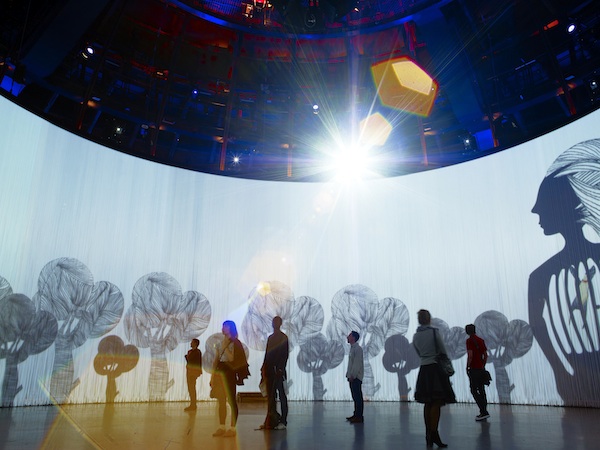
Israeli designer Ron Arad’s massive undertaking at the Roundhouse, aptly titled Curtain Call, is at the height of the spectacular – a three-storey high circular curtain comprised of glowing amoeba-like silicon tubing which serves as fluid canvas for artists to work with. With a transparent sheath, the 360 degree screen, onto which videos are looped, can be viewed from the outside – but most do choose to push aside the swaying curtain and experience the work from within.

Ron Arad, Curtain Call, 2011. Installation at the Roundhouse. Credit Stephen White.

It is a stunning architectural structure – technologically magnificent and psychologically affective due to its vast size – but it is void of any prolonged engagement. However, it is interesting to see how artists have used this unique backdrop and translated their work through it. Shape and scale take front row here – the directionless circular structure of the screen requires a rethinking of the linear quality of video, and the enormous size forces the viewer into a land of giants.

Read More »

Share

Fan Mail

Fan Mail: Interview with Irina Rozovsky

For this edition of Fan Mail, Moscow-born, Brooklyn-based Irina Rozovsky has been selected from a group of worthy submissions. If you would like to be considered, please submit to info@dailyserving.com a link to your website with ‘Fan Mail’ in the subject line. One artist is featured each month—the next one could be you!

I was immediately taken with Irina Rozovsky’s current body of work, In Plain Air, a series of photographs taken in Brooklyn’s Prospect Park. There is something quietly transcendent about these vignettes – a tranquility rarely evident in public space. I was so pleased to have the chance to ask Rozovsky about these recent photographs and how they relate to her consideration of place.

Irina Rozovsky. From "In Plain Air." Courtesy of the Artist.

How do you feel In Plain Air relates to your previous bodies of work? Does it represent a continuation of certain concerns that are central to your practice?

It’s a new way of working for me—I am slowing down, returning again and again to the same location, balancing the vague images I have in mind and the elements of chance encounters.  Previously, I was a shoot-on-the-go photographer, akin to a version of Eggleston’s democratic camera.  But while what I am looking at and the way I go about it has changed, there is a continuation of interests here.  When I was photographing in Israel, I started to think about history and the essence of time that’s encoded in a landscape and permeates the people of the day.  I think land has age-long, entrenched rules and its contemporary inhabitants subconsciously follow these rules, entering a cannon of history.  In a way, nothing in Israel has changed since it’s beginning. And the park, constructed in the 1860s during the artistic movements of Realism and the visions of democracy, is still running on the same agenda.  It’s simple but profound stuff.  I think it was Gerry Badger that stated by clearly photographing the present, you can access a larger human realm of time.

Read More »

Share

Los Angeles

The Interruption

L.A. Expanded: Notes from the West Coast
A weekly column by Catherine Wagley

Eleanor Antin as Eleanora Antinova in Before the Revolution at the Santa Barbara Museum of Art, 1979.

“At this moment, my iPad is totally f–ing me up,” said Eleanor Antin last Sunday at the Hammer Museum, in Act V of Before the Revolution, a remaking of her originally one-woman ballet. Act V was actually called “The Interruption,” because the performers were slated to stop performing and the artist to come up on stage and muse about meaning and ownership. The iPad f-up was not scripted, however; the machine really was interrupting the planned interruption. “There’s something here that says ‘undo or cancel,’” she announced. “I don’t want to do either.” She could’ve played it off and attempted to finish her monologue without the script, but, instead she waited until a technician and, I think, her son had made her screen functional again. Then she continued.

Before the Revolution was first performed in 1979, and Antin played all the roles–12 in total–with the help of life-size, two-dimensional Masonite dolls. It told of an imaginary black ballerina (Eleanora Antinova) dancing in Diaghilev’s Ballets Russes, and evoked the great hope that modern art could break down walls that, of course, never quite fell. Antinova, the talented black ballerina hopes to play the real, iconic roles, but is instead offered primitive ones (“For you we will re-stage Pocahontas,” Diaghilev says). Antin has always been interested in the self being more than just one thing, so, in 1974 when the modernist idea of the single identity still festered, impersonating a fictive character that couldn’t have existed felt radical.

Read More »

Share

London

Blinded by the Hype: A Spotty Affair

From the very beginning, Damien Hirst: The Complete Spot Paintings 1986-2011, was always going to be the target of much contempt. An embodiment of savvy self-promotion, Damien Hirst has become the world’s richest living artist, and with that, a scapegoat for the pompous market and inflated celebrity status representing all that is wrong with contemporary art today. This latest publicity stunt – a gargantuan worldwide retrospect of spot paintings – is an exhibition founded in pure megalomania: big gallery, big artist, and even bigger personalities. As with the ostentatious two-day auction held at Sotheby’s in 2008 at the height of the economic crisis, Hirst simply doesn’t do modest. And with eleven galleries worldwide, neither does Gagosian. A few weeks ago DailyServing writer Danielle Sommer offered up two challenges: the first to find something new to say about the work, and the second, to pick a side. I love a good challenge.

Damien Hirst: The Complete Spot Paintings 1986-2011, from Gagosian Gallery website, 28 January 2012. Courtesy of Gagosian Gallery.


First things first – I despise the premise of the show. But I do respect the audacity it takes to try and pull something like this off. This was never the show intended to ignite respect and admiration for Hirst – that show is slated to open at Tate Modern this spring. The Complete Spot Paintings instead feels more like a scientific experiment, one of Hirst’s macabre vitrine works spun out into real-life testing grounds, intended to divide the camps into those who follow and those who resist.

For a few moments, let’s try and separate the works from the madness that surrounds them.

Read More »

Share