Los Angeles

Jennifer Steinkamp at ACME

Last week, I witnessed a birth. I know that it happened at 11:59 am on February 21st, 2012, that her grandmother made her a pink elephant blanket, and that she arrived an “overly punctual” three days ahead of schedule. I know this because she was tagged in seventy-three photos on Facebook; images that linked to her very own profile, created by her parents. Her birth is the first major event on her page’s timeline, and she “checked in” at the hospital about eighteen hours prior to her birth. Madeline’s birth can be observed and verified thanks to a user-friendly platform that archives and shares everything she does for an interactive audience. Those actually present at Madeline’s inaugural breath were ready with cameras and smart phones, uploading photos of her before she was even free of her umbilical cord. We witnessed her delivery through the eye of a camera, or an illuminated screen – documented via the best angles and speediest of status updates. Supposedly, this means the event was real, its verisimilitude acheived through its digital artifacts, its online chronicle – its meticulous documentarians. The world is no longer experienced through rapt attention, but rather through multi-tasking surveillance and a cache of preoccupations. Has the fixation with recording our every exploit replaced our emotional awareness of an actual experience?

Jennifer Steinkamp, "Moth, 5," 2012. Computer generated light projection. Approximately 7.5 x 10 feet.

Standing within Jennifer Steinkamp’s most recent solo exhibition, “Moth,” at ACME (Los Angeles, CA), I was reminded of this detached relationship with actuality. Esteemed for her captivating 3-D animation projections and installations, the new media artist has steered away from her recent room-engulfing environments for something quieter, though still digital. A few swatches of tattered fabric are suspended by unseen pins, silently fluttering and twisting in a simulated breeze. Their pastel hues evoke a Southern spring, like garments abandoned on the clothesline for the alluring indulgences of a lazy afternoon. Steinkamp’s mastery of movement simulates the kind of nostalgic hypnosis found in nature’s many gestures – a beckoning tree branch or a nodding lilac coax you to stay for awhile, like a child meandering through the park. “Moth” is alluring in its unpretentious grace, the cloth reminiscent of a neglected, tangible past, elegant despite its imperfections. Hinting at the nettlesome insects of the same name, “Moth” brings to mind abandonment, or human experience left to decay in favor of e-simulacra. Consumed by a persistent need for a personal repository, we often overlook the ephemeral in our desperate plight for eternal imitation – a notion best illustrated by Steinkamp’s moth-eaten textiles, which reveal a reoccurring choreography after several moments.

Read More »

Share

Help Desk

Help Desk: On Titles and Talent

Help Desk is an arts-advice column that demystifies practices for artists, writers, curators, collectors, patrons, and the general public. Submit your questions anonymously here. All submissions become the property of Daily Serving.

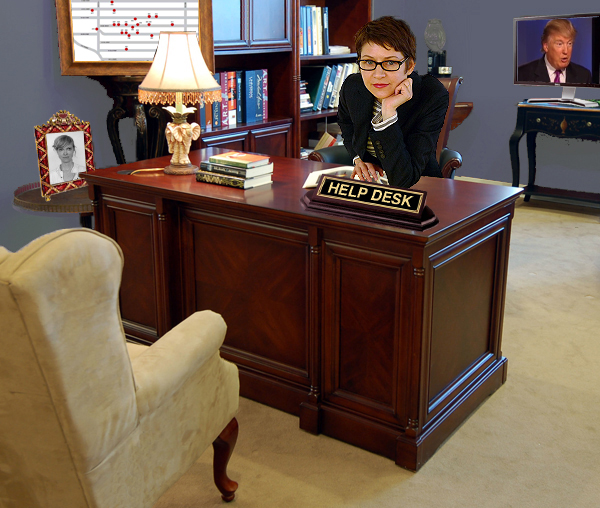
Your counselor, hard at work.

I’ve always had a problem titling my artwork. My question is how much should an artist “give away” through the title of an artwork? And when viewing a piece of art, how much should the title alter your overall perception?

Down with shoulds! There’s no one-size-fits-all way to go about making titles (or anything else) in art. What you might do, instead, is think about what questions your work sets out to answer, or what the work explores or implies, and then title it accordingly. If you work in series, you can go the #1, #2, #3 route to give the viewer a clue to your methodology. Likewise, if the collected works of Lewis Carroll inspire you, you could name your pieces after characters in his stories. If your work is about the rejection of systems, refuse to title it. Artist Nina Beier reserves the right to change the title of her work long after it has left her studio, proving that it’s possible to think outside the white box of tradition.

Yes, a title can alter the viewer’s perception of the work. Done skillfully, a title will enhance the comprehension of a work because it will shine a light on the artist’s thinking or working process. It can be used to add a kind of value, to denote homage, or—if you’re really good with words—as the punch line to a joke.

Nina Beier, Modify, as needed, 2011. Installation view, MoCA Miami SONB/IV 2011, Photographer: Steven Brooke

I know I am not that talented. But I am driven to be an artist. Money is not a problem. I’ve queried my friends and it seems as though nobody else has a dirty secret like this. They all seem very confident in their abilities. What would your advice be for me? Changing careers is not an option.

What a horrifying and complicated dilemma. Here you are, financially secure but artistically faltering, asking your friends if they’ve ever felt anxious about their talent in order to commiserate, and none of them will own up to a moment of fear. How sad.

Read More »

Share

From the Archives

From the DS Archives: A History of Video and the Art of Deceleration

In the past decade we have seen an explosions of technological advances in consumer products, most of which boast having qualities that are faster, smarter, smaller, thinner, longer…the lists goes on. Thankfully, as Sir Issac Newton said, each action always has an equal an opposite reaction. So in response to this feverish drive to accelerate into the future, there has also been a long-standing movement to slow down. On view now at Kunstmuseum-Wolfberg, the exhibit The Art of Deceleration: Motion and Rest in Art from Caspar David Friedrich to Ai Weiwei catalogs artists who investigate the desire “relaxation techniques, slow food or slow communications” and presents a truly all-star cast including many of Daily Serving’s oft-featured artists such as Christian Marclay, Bill Viola and two from today’s featured article, Nam June Paik and Bruce Nauman. Not to mention some other heavy hitters like Douglas Gordon, Marcel Duchamp, and Tacita Dean.

Today’s article was originally published by Marilyn Goh on June 29, 2011:

Bruce Nauman, Going Around the Corner Piece, 1970, © Coll. Centre Pompidou. Photo: Georges Meguerditchian

In the self-explanatory show entitled Video, an Art, a History 1965 – 2010, the history and evolution of the video art genre are recounted through 50 video works and installations, drawn from the collections of both the Singapore Art Museum and Centre Pompidou. Having developed in tandem with the apparatus of television and the analogue and then digital video cameras, video art’s reconfiguration of the politics of image-making and its ability to place the spectator as an indispensable agent in a work’s existence are significant tenets on which the exhibition is established. The infinitely widening scope and scale for the production and interpretation of (moving) images, the mode of their dissemination, and the documentation of performances (technical or otherwise), pose several key but general questions around which the works are grouped.

The pertinence of such questions however, falters in the collaborative effort that has shown up more differences than similarities. Reconciling the inventory of the Singapore Art Museum with the Centre Pompidou’s reveals the tentative forays into the processes of historicisation that are only beginning to develop in Southeast Asia and the inevitable rift in the standpoints of Western art and Southeast Asian art history. The Pompidou’s international collection stretches back 4 decades to the genesis of video art; the Singapore Art Museum’s inventory spans approximately a decade that really began with the Asian Financial Crisis (1997-8) and is focused on works produced in the surrounding geographical region. The wider ramifications of this collaboration go beyond an overwhelming inventory imbalance and the expanded visual vocabulary that video technology provides; indeed the emerging ideological differences become apparent when speculative comparison – the attempt at a comparative video-art history, should it even exist – inevitably sets in.

Pipilotti Rist, A la belle étoile (Under the Sky), 2007, © Coll. Centre Pompidou. Photo: Georges Meguerditchian.

Read More »

Share

Barcelona

Rithika Merchant

Rithika Merchant, Titanomachy, 2011. Gouache and Ink on Paper. Courtesy of the Artist.

Walking in Barcelona’s Espai B Galeria, Rithika Merchant‘s playful yet precise lines are immediately captivating. She depicts creatures that are humanoid in flat and floating world. Her repetitious line is used to build up pattern and fill in form rather than rendering them in space. Her large drawings are made on sheets of paper set in a grid or geometric design that symmetrically break apart the compositions with solid white lines.

A recent transplant to Barcelona, Rithika’s drawings seem at home here with the vibrant mosaics and whimsical architecture of the city. Beginning in the late 19th century, the Modernisme movement defined a Catalonian aesthetic in Barcelona. With a rich history of tile work of Moorish influence integrated with a visionary use of organic forms inspired by Art Nouveau, a fanciful urban space pouring with detail defines the present-day city. Being born in Mumbai, having studied in New York, and now living in Barcelona, Rithika has a unique worldview that is both conceptual and crafty.

Rithika’s characters are set in simple landscapes, allowing her obsessive ornamentation to shine. God-like creatures are repeated through her drawings, and build up to form narratives and reveal a personalized mythology.

Titanomachy, or the Titan War, makes reference to the Greek stories of battles fought between the family of gods before the existence of man. There is no clear winner in Rithika’s drawing, and the gods exist in a static moment before the action of battle has been resolved. Here, the gods are a green woman-creature and a woman on bucking horse. There are two seem like opposing forces, one trampling the other, but both make reference to the natural world. The greenish woman has big eyes like an owl, a woodland creature of the night. The reddish woman seems to ride with the sun, filling the night sky. An octopus, a creature known for its intelligence, blocks her sight. The horse seems to be taking the place of her female sex organs, and her body appears muscular, looking like a man entering battle. The rearing horse seems very phallic in this reading, its mouth spitting a cloud in ecstasy.

Rithika Merchant, Deus Otiosus, 2011. Gouache and Ink on Paper. Courtesy of the Artist.

Rithika’s Deus Otiosus, Latin for neutral or idle god, makes reference to the concept of an unacting or hidden god who takes no part in ruling the world. Here, the greenish woman-creature is seen again, and her depiction as a kind of bird in a nest is clear. Her hands form an open circle, at the spot of her Sacral Chakra, also the center of the image where four corners of paper converge. She sits in a region above the blue sky, in some kind of radiant vortex illuminated by her head. Her decorative face makes her immediately recognized as the trampled character from Titanomachy. Her face is distinctly labial, and sits in waiting or meditation.

Read More »

Share

Los Angeles

Idea People

L.A. Expanded: Notes from the West Coast
A weekly column by Catherine Wagley

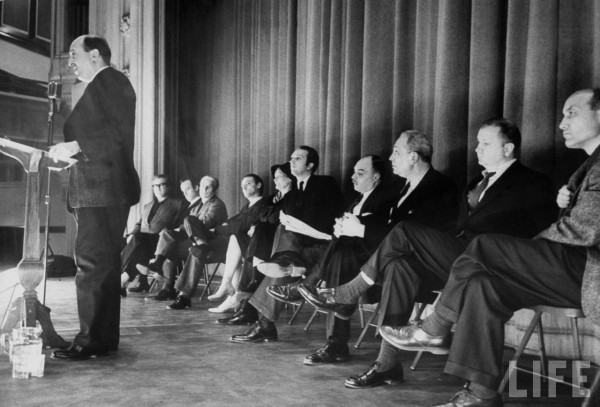
Clement Greenberg speaking in 1961.

In 1983, art historian T.J. Clark delivered his paper, “More on the Differences Between Comrade Greenberg and Ourselves” at the Vancouver conference, Modernism and Modernity. Clement Greenberg, the critic who named kitsch “the epitome of all that is spurious” and had a Pollock hanging in his bathroom, was in the audience. I do not know if Greenberg participated in the Q&A, or spoke up for himself at all when Clark finished speaking. Certainly, he was not sitting center stage as Rosalind Krauss was yesterday in the L.A. Convention Center, when Benjamin Buchloh delivered his paper, “More on the Differences between Comrade Krauss and Ourselves.”

Annually, the College Art Association Conference, underway in L.A. right now, honors a distinguished scholar by assembling a group of other distinguished scholars to pay well-researched homage (or “femmage,” critic Hal Foster joked badly yesterday). Those assembled in Rosalind Krauss’s honor included, in addition to Foster and Buchloh, Yve-Alain Bois, Harry Cooper, Ewa Lajer-Burcharth, and Briony Fer, all famous within the “art ideas” bubble for some contribution made to art history during the time Krauss has been making hers. All have published in October, the now-renown art theory quarterly Krauss, along with Annette Michelson, co-founded in 1976.

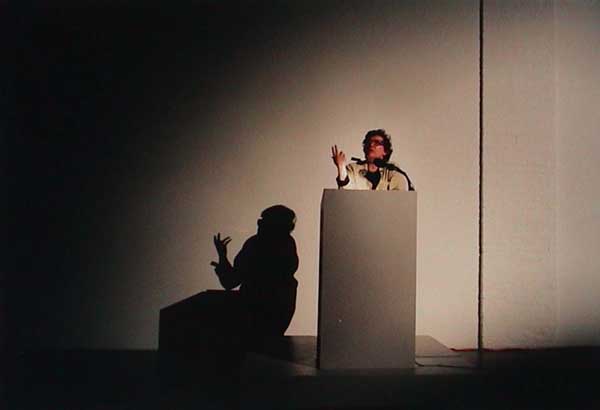
Rosalind Krauss speaking on Bruce Nauman at the Dia Art Foundation, New York, May 23, 2002.

As makes sense for homage, most of what went was said glowed with respect and generous affection, well-deserved for the woman who more or less made art theory a field. Buchloh alone pointedly took Krauss to task. And this, according to him, is something he’s done quite regularly since they met in the 1970s.

Read More »

Share

Glasgow

T Rooms

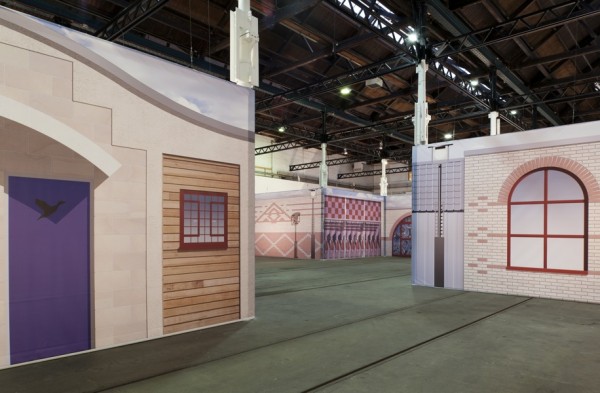
Matthew Darbyshire, T Rooms, Photo: Keith Hunter, Image courtesy of Glasgow Life

T Rooms, an exhibition by Matthew Darbyshire is on show at Tramway, Glasgow and runs till 11 March 2012. In previous exhibitions at the Institute of Contemporary Arts, London (2008) and Herald St, London (2010), Darbyshire has created works critiquing homogenization and non-specificity in design and architecture, provoking questions on the strategies and value of urban regeneration.

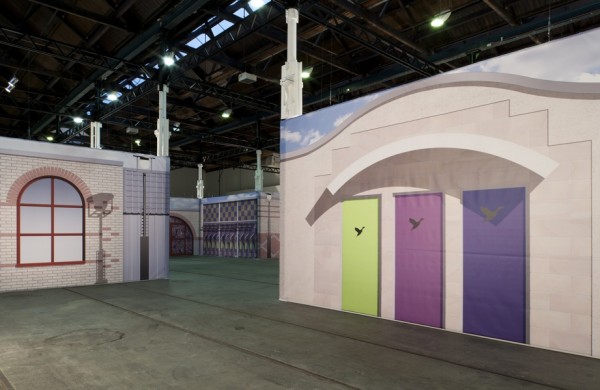
Matthew Darbyshire, T Rooms, Photo: Keith Hunter, Image courtesy of Glasgow Life

These ideas are extended in the installation that Darbyshire has created in Tramway’s large gallery, emerging from a representation taken from forms of disused and neglected spaces that create resonances in the surrounding depressed economic climate. T Rooms presents an imagined future where the neighborhood around Tramway has been taken over by property developers, converting Tramway into a gated residential area under construction.The gallery is partitioned with walls, each wrapped with a banner designed as a façade of a building featuring an assortment of motifs and designs.

Read More »

Share

London

Saskia Olde Wolbers: Visions of Desire and Pathological Lies

‘We all know that art is not truth. Art is a lie that makes us realise the truth, at least the truth that is given us to understand. The artist must know how to convince others of the truthfulness of his lies.’

- Pablo Picasso

Saskia Olde Wolbers’ works are full of lies, half-truths and fabrications. What may at first glance appear to be a sleek digital animation, is actually the result of an lengthy, handmade process. And the aesthetics are only the beginning of her deceptions. Olde Wolbers’ stories conflate fact and fiction in non-linear and time-defiant narratives – reality, and its antithesis, become wholly indecipherable.

Saskia Olde Wolbers, Pareidolia, 2011, HD video for projection with sound, 12 minutes 25 seconds. Courtesy the artist and Maureen Paley, London.

The Dutch-born, London-based artist can spend up to a year constructing one of her short videos. The foreign appearance of her intricately constructed dioramas are achieved using obscure items, such as water bottles, cod-liver oil capsules and cyber-goth hair extensions, dipped in paint, submerged upside-down in water and filmed – a unpretentious low-fi system with futuristic hi-fi aesthetics.

For her latest exhibition at Maureen Paley in London, Olde Wolbers is showing the video Paredolia, recently seen at Secession in Vienna. The title itself refers to the psychological phenomenon in which those things vague and random are interpreted as significant – the basis of the Rorschach test, and the reasoning behind why we might find animals in the clouds, or faces of holy figures in our morning toast – the cognitive propensity to find the familiar in the unfamiliar.

Saskia Olde Wolbers, Pareidolia, 2011, HD video for projection with sound, 12 minutes 25 seconds. Courtesy the artist and Maureen Paley, London.

Paredolia centres around a incident told by German professor Eugen Herrigel in his book, Zen and the Art of Archery (1948), commonly attributed to bringing zen and Japanese culture to the post-war Europe. In the much-debated climax of the book, Herrigel relates an incident in which his teacher, Awa Kenzo, shot two arrows in in the dark, not only both hitting the target, but the second slicing through the first. According to Herrigel, his Master communicated that it was not him that made the shot, but ‘it’, the Buddha.

Read More »

Share