Help Desk

Help Desk: Protection

Help Desk is an arts-advice column that demystifies practices for artists, writers, curators, collectors, patrons, and the general public. Submit your questions anonymously here. All submissions become the property of Daily Serving.
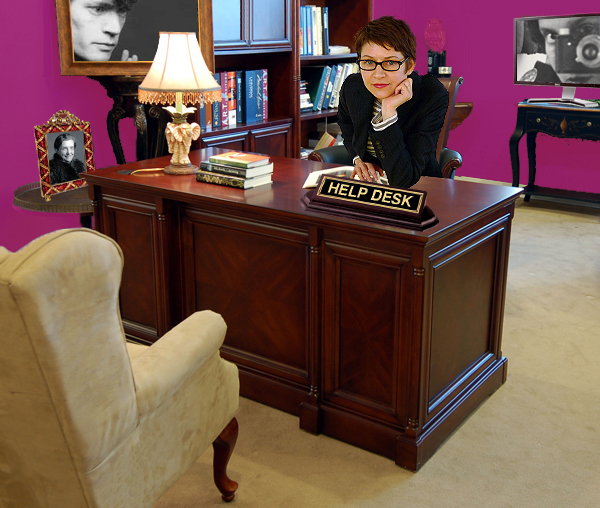
Your counselor, hard at work.

I’m currently a photography student. As I try to figure out how I will make a living after graduation, like many photographers, I’m leaning towards a combination of fine art and commercial work. All that said, I want to make an online portfolio showcasing my work, and I’m stuck on the thorny issues of image size and watermarks. I want to minimize the chances of someone stealing the work from my site, but I also want my images to be displayed in an appealing way. What should I do?

Since I’m not a photographer and don’t have any experience with this subject, I contacted Laura Miller, the co-director of ImageWork SF in San Francisco. Here’s what she said:

“For the record, there are inexpensive website programs/add-ons which can secure images on websites so they cannot be dragged off the site. That program, grouped with a watermark program (also readily available) secures the photos. Even if a watermarked image could be dragged off the website, it would require some Photoshopping to remove the watermark. But if the images also can’t be dragged off, the only way to duplicate would be to take a screen shot, further degrading the image and making watermark removal more difficult. So most definitely, the best way to go is to make the photos unmovable and watermarked.”
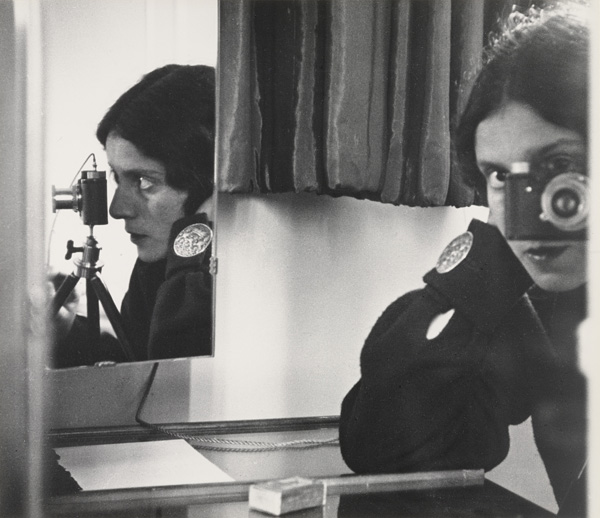
Ilse Bing, Self-Portrait in Mirrors, 1931.

Ms. Miller also very generously took the time to check in with some of the Photoshop instructors who work at ImageWork SF, and continued, “The word is: there is really nothing you can do to prevent image theft from websites. If someone wants an image badly enough they’ll take it. But you can make it much harder and a big deterrent by installing watermark and safety programs. If someone can’t easily drag the image off, and/or has a complicated watermark to Photoshop out, they may just prefer to steal from an easier source. There are many programs available to secure the photos and do watermarks, just do a search and many varieties come up. One program turns the image to a blank white rectangle when dragged off the site; others simply lock the image in place.

Read More »

Share

From the Archives

From the DS Archives – Nedko Solakov has All in Order, with Exceptions

Today from the DS Archives we bring you a serious throw back, from the ancient time of 2007, (it’s crazy how much our review format has changed!) to bring you an update on the Bulgarian artist Nedko Solakov. Solakov’s first major retrospective in Belgium, All in Order, with Exceptions, will be on view from 25 February–3 June 2012 at S.M.A.K.
Museum of Contemporary Art
. And don’t worry, the exhibition will not be lacking in Solakov’s typical ironic, melancholy commentaries.

The following article was published by Seth Curcio on March 14, 2007:

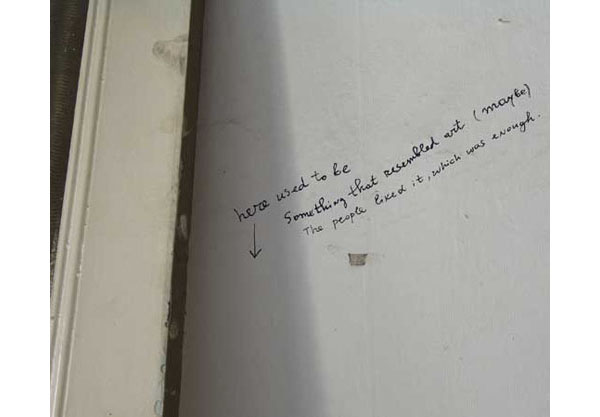
In a piece titled “Art & Life (In My Part of the World),” Nedko Solakov created a piece in a vacant and dilapidated apartment to illustrate a narrative about the distraught life of a piece of art. She, the work of art, felt neglected in this house and thus moved itself into the most well-lit room and on top of several tables. The entire apartment contains text that lets the viewer in on contextual clues that inform of past events. Solakov was born in Bulgaria in 1957 and studied at Hoger Instituut voor Schone Kunsten in Antwerp. While able to take on multiple media, the artist’s work is always centered on a conceptual humor and often stems directly from text. In 2005, Solakov participated in a group show titled “OK:Okay” at the Grey Art Gallery, where the artist used works of de Kooning and Warhol from the Gallery’s collection to create the fictitious hut of an African native who collects Western art. Solakov has received funding from numerous foundations, including the International Studio Program in Sweden (IASPIS), KulturKontakt and the Philip Morris Foundation. Last year, he exhibited with Galerie Arndt & Partner in Berlin and the Museum of Contemporary Art / MNAC in Bucharest.

Share

London

EWX: Material Matters at the Courtauld Institute of Art


Gabriel Dawe, Plexus 11, 2011, thread, thread installation, Courtesy of the Artist, Sponsored by Gutermann, Photo: Andrew Lowkes, 2012.


There is a specific joy that flares when a familiar space is reanimated by art—whether it’s public sculpture appearing at a junction travelled through often, like the new fourth plinth in Trafalgar Square, or something as quiet as a different postcard image on an office bulletin board—it’s a little visual jolt for a view that’s become tired.

When I first arrived at the Courtauld Institute, I was perpetually lost and in a kind of state of wonder walking up and down the Alice in Wonderland staircases, through the tiny doors and along back corridors. For someone whose schooling was mainly spent in North American institutional blocks designed, it seemed, after prison architecture, this was entirely enchanting. A decade later, the building is no longer an unfolding mystery, but the recently launched East Wing X has harnessed that sense of discovery, filling the college with art, and, at a packed private view a few weeks ago, ebullient revelers.


Heringa/ Van Kalsbeek Untitled, 2010-11, ceramics, resin, steel, cloth, porcelain, Courtesy of the artists, Photo: Andrew Lowkes, 2012.


This year marks the tenth instalment of the Institute’s East Wing exhibition, a biennial show of contemporary art that invades the school’s stairwells, corridors and seminar rooms. The tradition began two decades ago when Courtauld student Joshua Compston lamented the lack of contemporary art at the Institute and sought permission to mount a small show, including work by Damien Hirst and Gilbert and George. EW has ever since offered a counterbalance to the official collection, across the arched drive on the Strand side of Somerset House, where the more famous Western half of the building houses the renowned Courtauld Gallery, and a response to the progressive research interests of the student body. The comparison is indeed hard to avoid: while the eighteenth century William Chambers architecture makes a greaceful backdrop to the Impressionist and Post-Impressionist masterpieces on one side, it sits in stark, though aluring, contrast to the contemporary installations. Like the Saatchi Gallery’s old County Hall site, the well-matched convergence of old and new can generate a particular brand of site-specific magic.

Read More »

Share

LA Expanded

This Space is Mine, Again

This was originally published as part of DailyServing’s week-long FORCE OF FAILURE in March 2011. Then, MOCA had opened a show of Rodarte’s Black Swan costumes that coincided with the Oscars and Fashion Weeks around the world, and L.A. performance artist Dawn Kasper had just done a performance in which she revisited Vito Acconci’s 1971 Claim performance. Since Autumn/Winter collections have just debuted in London, New York and Paris, MOCA just opened a new fashion show, and Dawn Kasper is claiming a different space at the Whitney Biennial, this seems a good time to revisit.

L.A. Expanded: Notes from the West Coast
A weekly column by Catherine Wagley

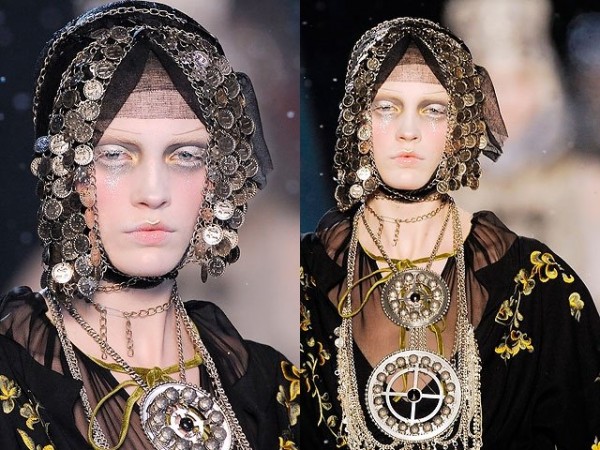
John Galliano, 2009.

John Galliano has a lavish-sounding last name (he shares it with an Italian liqueur), and lavish taste (“He knows, and we know, that no one would ever wear a 12-foot-wide crinoline over a baggy pair of printed drawers with, perhaps, a pair of plastic carrier bags on the feet,” wrote Sarah Mower for Style.com). That he would also take a lavish approach to outbursts, uttering a line of anti-Semitic epitaphs instead of just one or two, isn’t that surprising. So when, days before Paris Fashion week began, Galliano, the first Brit to head a French couture house, let his God-complex spin out and became, at least according to certain headlines, a dissolute failure, his fall seemed more irksome than surprising.

What’s happened since has been predictable; it’s exactly what happens when someone who’s found a certain niche of notoriety takes an egregious misstep and everyone sees. Dior let Galliano go; Naomi Campbell and Kate Moss urged him into rehab; then pregnant, pixie star, Natalie Portman, the antithesis of the punk designer in deportment and pedigree, became unwitting spokesperson against anti-Semitism in general and drunken fashion gurus in particular, refusing to stay on as face of Dior fragrance if Galliano stayed on, too. (In an effort to defend Portman’s spokeswoman clout, articles keep noting that her great-grandparents died at Auschwitz, a serious fact that this fiasco almost trivializes.)

Rodarte, "The Black Collection," 2010. Courtesy MOCA.

It had been rumored, probably baselessly, that Portman would wear Galliano to the Oscars two weeks ago. Instead she wore simple plum Rodarte. Which is more or less where this string of who-did-whats has been heading: the work of the Rodarte sisters, whose somber idiosyncrasy recalls the Brontës, is the subject of a current exhibition at MOCA’s Pacific Design Center. Presented by Swarovski (yes, of the crystals) and curated by Rebecca Morse, Rodarte: States of Matter features a selection of dresses from the designers’ recent Fall and Spring collections and a few costumes designed for the Darren Aronofsky film Black Swan.

Read More »

Share

Berlin

You Killed Me First: the Cinema of Transgression at Kunst-Werke

"You Killed Me First," 1985, Richard Kern, film still courtesy Richard Kern.

You Killed me First (1985), one of Richard Kern’s longer films starring David Wojnarowicz and Lung Leg, could be read as a clear teenage allegory of the Cinema of Transgression itself.  A girl (Lung leg) bristles at the religious directives of her parents, asserting her right to personhood outside demure hairstyles and turkey dinners, constructing voodoo dolls and entertaining other manners of dark drawing in her dank emo-den.

When confronted with the humanity and hypocrisy of her tormentors, the young antihero vanquishes their belief systems (and bodies) asserting, “You killed me first!”

Nick Zedd, in his manifesto describes the Cinema of Transgression’s proponents as “a new generation of filmmakers daring to rip out of the stifling straightjackets of film theory in a direct attack on every value system known to man.”

You Killed Me First: The Cinema of Transgression at Kunst-Werke Berlin is the first exhibition devoted solely to the Cinema of Transgression.  This allows viewers, for the first time ever, to see a remarkable amount of cinematic defiance in one place.  Among the 19 films shown, there is an insistent interest in constructing purposeful rebellion during a time when Reagan-Era family values were becoming a “revitalizing force” in America.

In You Killed Me First, Cinema of Transgression members explore necrophilia, dismemberment, rape, patricide and death-by-impaling.  But (thankfully) these subjects are imbued with a kind of adolescent cheekiness.  According to Zedd and other Cinema of Transgression members, a sense of humor was essential to good art.

"The Manhattan Love Suicides: Stray Dogs" 1985, Richard Kern, film still courtesy Richard Kern.

There is an adolescent charm to much of the Cinema of Transgression.  In the Manhattan Love Suicides; Stray Dogs ( 1985) we see a young man so crippled by passion that he is physically coming apart, a frightening visual metaphor for high-school longing.

Read More »

Share

Barcelona

Paradigmas

Located in Barcelona, Paradigmas is a gallery owned by Brazilian artists, and husband and wife team, Chico Amaral and Angélica Padovani. Their goal is to create a dialogue between Latin American and European artists, displaying paired works from both continents. Ilana Lichtenstein and Levan Tsulukidze were brought together for their last exhibition Casualmente Fotographia (Coincidentally Photography) by curator Gloria Fernández.

Ilana lives in São Paulo and most of her photos in this series “An eruption and another” were taken on the island of Lanzarote, one of the Canary Islands. Levan has lived in Barcelona for 12 years, and was born and raised in Georgia. His photographs document a summer in Barcelona. Ilana and Levan are linked by their desire to document, and to leave the photographs unaltered.

Ilana Lichtenstein, 2011. Courtesy of the artist.

Ilana’s photographs document the small space between photographer and her subject. The images are often textured by the grain of slide film in low light, sometimes made milky as though looking through a window, or catching the shadows of an event. Printed on cotton paper, Ilana’s photos feel soft and intimate. No glass covers the work when displayed so the depth of blackness is not impeded by shine.

Levan Tsulukidze, 2011. Courtesy of the artist.

Levan chooses to step back, sometimes looking at the landscape from above, choosing compositions that are flat with colors heightened by bright light. Though visually in contrast, both artists evade landmarks or monuments, in search of the quotidian reality of place.

When I began contemplating their work, I was inclined to seek out how their cultural identity is revealed in their art, but as Ilana wrote in response, “everything is really an amalgam.” She explains: “I shouldn’t forget that I am at the same time Brazilian, born in the huge city of São Paulo, with Polish roots…I wouldn’t be able to separate or to define with just a couple of words which one should be my identity.”
Read More »

Share

Perth

U-Ram Choe

U-Ram Choe’s animatronic organisms are at once ultramodern and quaintly aesthetic, evoking the antiquated futurism of Jules Verne. Entering the darkened space of the John Curtin Gallery, visitors encounter a fictional ecosystem populated by cybernetic life. Didactic panels convey the data collected by the mysterious U.R.A.M. (United Research of Anima Machines), stating that these mechanical creatures live symbiotically within the urban environment, feeding off human by-products such as electromagnetic energy and atmospheric pollutants.

Choe, U-Ram, "Urbanus Female" 2006, metallic material, machinery, metal halide lamp, electronic devices (CPU board, motor). Image courtesy of the artist.

The lifecycle of the sky-dwelling Urbanus species is presented through an interactive installation. The visitor’s movements trigger the reproductive spasms of Urbanus Female, a flower-like creature which discharges electrically charged light particles from her genitals. Her gaping, ferocious-looking petals open wider and wider as her internal light whirrs ecstatically. We are told that the male Urbanus flock around her to absorb the photons she emits, and we observe the Urbanus Male Larva, a diminutive specimen which flutters delicate petals resembling Art Nouveau fans. The Urbanus Female Larva is even more delicately wrought, fanning filigree-like leaves in response to the activity around her.

Choe, U-Ram, "Urbanus Male Larva" 2006, metallic material, machinery, acrylic, electronic devices (CPU board, motor). Image courtesy of the artist.

The monumental scale, meticulous engineering and luxurious design of these kinetic sculptures is powerfully seductive. Decorative motifs rendered in shining chrome take the work far beyond the utilitarian copper and leather flavours of Steampunk, which could be compared to Choe’s aesthetic of nineteenth century gadgetry. His work possesses an unashamedly popular appeal, captivating the general public as well as art audiences. This is primarily due to the spectacular qualities of the sculptures, but the frame in which he presents the work is also one which most audiences will be familiar with: the natural history museum.

Read More »

Share