Help Desk

Help Desk: Personal Development

Help Desk is an arts-advice column that demystifies practices for artists, writers, curators, collectors, patrons, and the general public. Submit your questions anonymously here. All submissions become the property of Daily Serving. Help Desk is co-sponsored by KQED.org.

Your counselor, hard at work.

Lately I’ve been seeing works of contemporary art that aren’t really aesthetically pleasing, most of them are just really simple and plain. I’ve seen a lot of beautiful art pieces that are unrecognized and have a lot of meaning behind them. Why do galleries/art blogs publicize contemporary art that is so simple but not the ones that obviously take more time and provoke deep meanings/thoughts?

You’re forgetting that perception is extremely subjective. To reply to your question, I’m going to rephrase it. Read it slowly (and then please read it again) and you’ll have your answer:

Lately I’ve been seeing works of contemporary art that aren’t really aesthetically pleasing to me. I think that most of them are just really simple and plain. I’ve seen a lot of things that I thought were beautiful art pieces that are unrecognized but I believe that they have a lot of meaning behind them. Why do galleries/art blogs publicize contemporary art that I think is so simple, but not the ones that I obviously think takes more time, and provokes deep meanings/thoughts for me?

John Baldessari, I Will Not Make Any More Boring Art, 1971. Lithograph, 22 1/2 × 30 inches (image: whitney.org)

If you still don’t get it after two readings, I suggest you open your own art gallery and stock it with the work you believe is unrecognized. Many artists will be grateful, and you can look at what you want all day long.
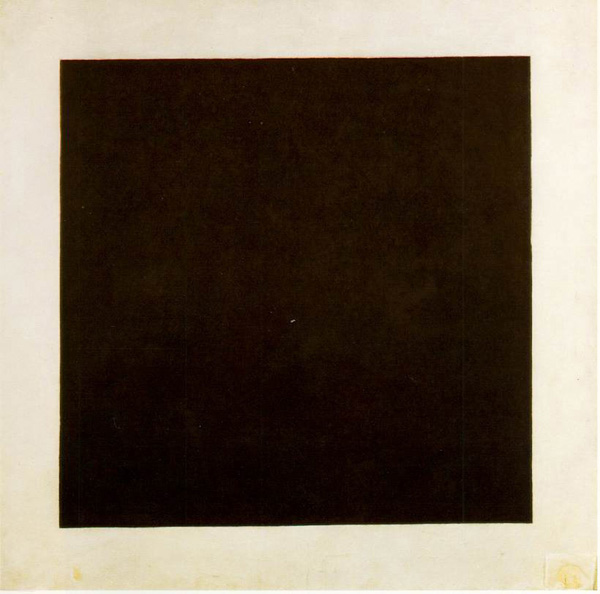
Kasimir Malevich, Black Square, 1929. Oil on canvas, 42 x 42 inches (image: paulcorio.blogspot.com)

I am studying sculpture and painting in college and recently quit my job to focus on my art.  I believe I can support myself with my work, but so far I have not made much money.  I have pieces in several galleries and I paint small commissions every now and then, but I’ve turned my focus to exhibitions with cash prizes. I have some great ideas for submissions, but they are a far cry from the normal work I produce for the galleries around town. I worry that I will spend too much time on a piece that doesn’t win the exhibition and won’t make it into the gallery.  My question is, as a beginning artist, which is more important for survival: producing pieces that will sell in a gallery setting, or producing pieces for exhibitions? I assumed galleries would be safer than relying on the possibility of a cash prize, but I’m not so sure now.

If survival is your first concern, I strongly recommend that you get a job again, one that is not too taxing on the brain or the back, and one which provides a steady income so that you can pay your bills and eat decent food and sleep in a warm, dry place.

Read More »

Share

From the Archives

From the DS Archives: Kehinde Wiley’s ‘World Stage’ Continues

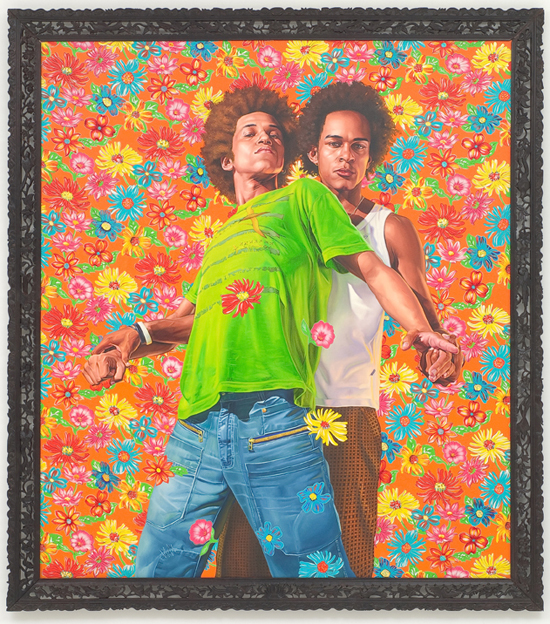
Kehinde Wiley’s beautifully ornate paintings feature young men of different ethnicities and religions surrounded by detailed decorations based on traditional patterns and designs. The men depicted carry themselves in the classical, self-confident poses found in European portrait paintings. Daily Serving previously covered Wiley’s project ‘World Stage: Brazil,’ which was the third installment after China, and Africa, Lagos-Dakar. His newest iteration of the project, World Stage: Israel, is on view at the Jewish Museum in New York from March 9 – July 29, 2012.

The following article was originally posted by Allison Gibson on May 5, 2009:

Kehinde Wiley is back in his hometown of Los Angeles, and the city is welcoming him with open arms. As an artist whose name evokes recognition, and even conversation, beyond the periphery of the contemporary art world, the Brooklyn based artist draws a crowd of eager devotees (the author not excluded) to any venue at which his work is being exhibited or discussed. With a recent lecture at the Getty Museum, and a new exhibition on view at Roberts & Tilton, Wiley is introducing the public to Brazil, the latest series within his larger body of work, The World Stage. Continue reading below for a full review of Brazil by DailyServing’s Allison Gibson.

KehindeWiley_Marechal Floriano Peixoto.jpg
Courtesy of Roberts & Tilton, Culver City, CA

Read More »

Share

Elsewhere

Unnatural Communities

Sophie T. Lvoff & Nathan T. Martin, "Untitled (Primary)", 2012. Archival pigment print on newsprint. Courtesy the artist. Photo: Sophie T. Lvoff.

One of the most informative moments in SPACES, the latest exhibition at the Contemporary Arts Center in New Orleans, is a timeline of the birth of the St. Claude art scene handwritten in black charcoal pencil on the wall.

Born out of the reinvigoration of community action in post-Katrina New Orleans, bolstered by the adrenaline shot of Prospect.1, hard working artist collectives popped up across the city in 2008, including Press Street’s Antenna Gallery, Good Children, and The Front, which aggressively show many artists from the St. Claude District. While worlds of change have occurred in the microcosm of New Orleans in the last half-decade, the genuine and honest dedication to making and showing art by these three cooperatives has remained the same.  That is why SPACES, an exhibition bringing the work of these three collectives together under one roof, is disappointing; not for the art but for the lack of curatorial inspiration that should have highlighted this positivity.

SPACES showing Dave Greber "The Front on Display", 2012; Chris Saucedo "Pencil King", 1996 and Lala Raščić in cooperation with Sophie T. Lvoff "Posing Process", 2012. Courtesy the Contemporary Arts Center, Photo: Angela Berry.

While there is a boot-strap spirit to each of these organizations, they operate with very distinct tones. This highlights the first part of the problem with this exhibition: there is no clarity of form within the show.  Artists from each organization are scattered around the room, lacking a clear tone to unite the work. The exhibition brings together disparate conversations that are often at odds with each other.  For example, Sophie Lvoff and Nate T. Martin’s Untitled (Primary) is a lush archival pigment print of a purple tavern at dusk. Sophie Lvoff’s photograph speaks to the vibrancy of early American color photography through lens of New Orleans surfaces. Writer Nate T. Martin adds a short vignette that sketches a child’s perception of driving in a rental car with her father and waiting outside a bar. The combination of text and image paints a visceral picture of innocence and vulnerability in a mundane world. Lvoff and Nathan’s work is located next to Ryan Watkins-Hughes cynical installation See St. Claude. Audiences of the show are prompted to step up to the photo, snap a shot of themselves photo booth style and email the photo to see-stclaude.tumblr.com.  At this site the artist writes: “The See St. Claude photo booth allows gallery visitors to see the St. Claude arts District from the comforts and safety of the CAC.”  This satirical approach to bringing art lovers to St. Claude directly references the insulation of certain neighborhoods in the city. The combination of the work of Watkins-Hughes and Lvoff and Nathan is certainly thought provoking, but leaves the viewer in the uncertain position of attempting to connect these two very disparate attitudes.

Read More »

Share

LA Expanded

A Queen and a Stone

L.A. Expanded: Notes from the West Coast
A weekly column by Catherine Wagley

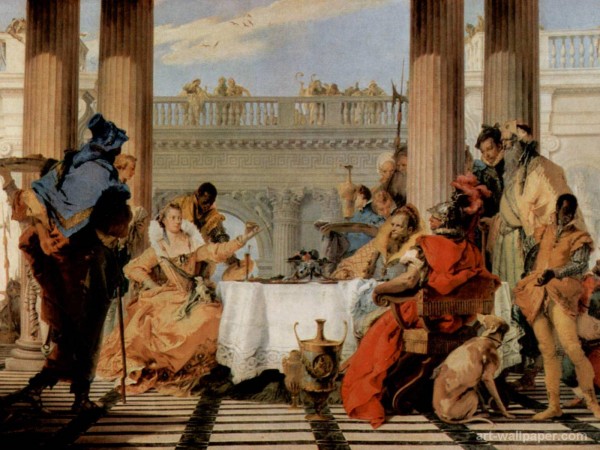
Giovanni Battista Tiepolo, "The Banquet of Cleopatra," 1740s. Courtesy National Gallery of London.

The word stature is one of those that’s meaning and sound do not completely agree. Say “stature,” and it sounds like you mean something serious, like stature is the same as status: “Her stature alone commands attention”; “He was a man of great stature.” But of course, someone could have small, wimpy or weak stature. When writer Judith Thurman reviewed a Cleopatra exhibition the Guggenheim hosted in 2007, she wrote, “There have been other great queens, but none of [Cleopatra’s] stature.” Then, in the next paragraph, she wrote, “That stature was petite — aristocratic women of her time were about five feet tall…”

So she was small, maybe even femininely delicate, but still commanding enough to prompt the Romans to inscribe on a stele carrying her depiction, “The queen himself.”

I have been thinking about stature because Michael Heizer, an artist of great stature (who is significantly taller than Cleopatra probably was) known for his earthworks and his secret City in Nevada, is making a work of stature. This work, if you have not heard, will be on the Los Angeles County Museum of Art’s campus and will involve a rock of great stature — 340 tons — that recently had to be moved from its point of origin in Riverside to L.A. This move, of course, involved street closure and hassle and quite a bit of spectacle. By the time it reached it’s destination, tens of thousands had come out to see the rock, which will ultimately sit behind the museum above a big concrete slot that viewers can descend into.

Night view of Michael Heizer's rock in transit, about to leave the Bixby Knolls neighborhood of Long Beach.

The rock has prompted extraordinary amounts of media coverage, but very little art criticism yet, understandable seeing as the work isn’t quite built. Christopher Knight of the L.A. Times finally did stick his neck out and offer some art critical thoughts on the rock and related fanfare. He’d wanted to dispel some of the rock-associated economic frustration, as the price tag hovers somewhere around $10 million — no taxpayer dollars were spent, LACMA and city officials assured the public as the route wound through the region. After making his money point, Knight wrote, “Besides money, what else draws easily distracted eyeballs toward budding celebrity? Ask Paris Hilton and Kim Kardashian. Sex, in the case of the rock, requires a bit of explanation.” By “budding celebrity,” he meant the 340-ton rock; he referred to the whole transport as “the boy-toy.” He continued,

As a source of public fascination, art’s psycho-sexual position in American life matters. Art has a gender in popular consciousness, and that gender is female. Like it or not, art is presumed to be feminine, not masculine. Under those circumstances, if art in a patriarchal society is to have a prominent public life, femininity just won’t cut it.

Read More »

Share

Singapore

Gérard Rancinan

Gérard Rancinan, Metamorphosis IV - The Big Supper, Argentic print mounted on plexiglas in artist’s frame 180 x 300 cm - 70.9 x 118.1 in. • Edition of 3

Gérard Rancinan’s thematic series of photographs – Metamorphoses, Hypotheses, Specimens, Wonderful World and Portraits – at the Opera Gallery Singapore are visually seductive and epically provocative representations of the contemporary issues that assail the twenty-first century. Exploring a complex web of interconnected issues – such as human rights, freedom, immigration, globalisation and capitalist culture – that would take more than bulletin news and politicians’s blustery promises to unravel, Rancinan’s photographs undertake this daunting task with interrogative aplomb, consistently alluding to the malaise of insatiable appetites that contribute to (and are subsequently reinforced by) today’s cultural vernacular.

Gérard Rancinan, Metamorphosis I - The Raft of Illusions Argentic print mounted on plexiglas in artist’s frame.

The Raft of Illusions reworks the cheerless, murky tones of Théodore Géricault’s Raft of Medusa (1818-9), an iconic painting of French Romanticism depicting barely-alive survivors in the aftermath of a shipwreck that precipitated a political scandal of his day. In its current incarnation, modelesque figures are depicted as refugees clad in branded scraps of fabric, who writhe on a raft hailing a partially submerged Hollywood sign and the Eiffel Tower in turbulent waters. These survivors, recast as fashion victims, desperately flail for rescue, yet look to the powerlessness of these selfsame drowning symbols for help.

Gérard Rancinan, Metamorphosis VI - Las Meninas Argentic print mounted on plexiglas in artist’s frame 180 x 234 cm - 70.9 x 92.1 in. • Edition of 3

If the female personification of a bare-breasted Liberty heroically leads her people with a bayonet and the tricoloured French flag in patriotic solidarity in Eugène Delacroix’s La Liberté guidant le peuple (1830), Rancinan’s Freedom Unveiled utilises the enduring legacy of the French Revolution and the idea of patriotic militarism to emphasise the mixed-bag of signs that characterise the excess and detritus of consumerist culture. Liberty is, for Rancinan, a woman in a black hijab who stands with ragged street urchins and handcuffed bodies against an apocalyptic backdrop of underground graffiti art, McDonald’s distinctive arches and television images of Mickey Mouse and Christian media evangelism.

Read More »

Share

Perth

The lure of the animal

The Hijacked series of exhibitions and publications, currently in its third iteration, juxtaposes the work of Australian photographers with their international contemporaries from the USA, Germany, and now the United Kingdom. Hijacked III brings together thirty-two artists from geographically distant but historically linked places, and the diversity of work is pronounced. However, there are some discernible themes at play: the performance of identity within the urban landscape, the legacy of history in contemporary life, and the unreliable power of the photographic image. A number of artists in Hijacked III also demonstrate a shared interest in the constructed nature of human-animal relationships.

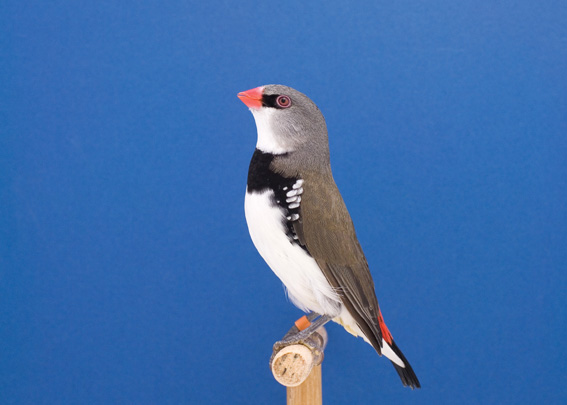
Luke Stephenson, 'Diamond Sparrow', 2009

Luke Stephenson’s ongoing series The Incomplete Dictionary of Show Birds attempts the impossible task of mapping domestic bird pedigrees in images that lie somewhere between portraiture and still life. The series shows the birds’ physical characteristics to their best advantage, emphasizing color, stature and markings, however, the intimacy of the scenes belies the formal beauty of the photographs.  Stephenson is drawn to the eccentric world of breeders, chipping away at the encyclopaedic task of documenting their labors with equally fanatical vigor. Small details like the bright yellow leg ring of a grey finch or the curious gaze of a parrot remind the viewer of the birds’ captive lives and the relationship that binds them to the breeder, and allows them to be viewed as both objects and subjects.

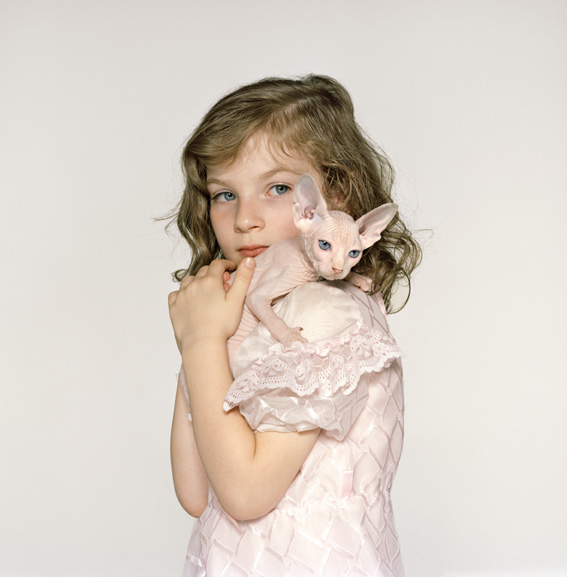
Petrina Hicks, 'Emily the Strange', Lightjet print, 2011

In Petrina HicksEmily the Strange, a young girl cradles a hairless sphinx cat, which clutches her shoulder with a wrinkled paw. A motif of mirroring seems to identify an otherworldly symmetry between the pair; girl and cat each have crystal blue eyes and wear the same pale shade of pink. These unlikely twins comprise a swathe of luxurious textures and vulnerability, and would fulfill that convention of female portraiture in which the subject holds some trinket or fancy that marks her as just one of many ornaments, were it not for the grotesque beauty of the wrinkled cat.

Read More »

Share

Hashtags

#Hashtags: The art of being female

#Hashtags: Viral Thoughts on Politics, Art and Culture

#Hashtags provides a platform for longer reconsiderations of artworks and art practices outside of the review format and in new contexts. Please send queries and/or ideas for future to hashtags@dailyserving.com.

Screenshot taken from an attack ad against Congresswoman Janice Hahn, 2011.

If you’re young and female, I hope you’re introduced to a positive mentor early enough to build a strong sense of self-worth, because in 2012, American society still refuses to make it easy for you to maintain one.  Looking at the last few months, women’s rights seem to be in retrograde, with the obvious example being the tone of the Republican campaign. But if you need more proof: so far this decade we have seen Hillary Clinton and a female aide photoshopped out of situation room documentation of the moment Osama Bin Laden’s death was announced, Fox News’ Greta van Susteren’s decision to ask Sarah Palin on-air whether she’d gotten breast implants, and an attack ad against Los Angeles City Councilwoman Jan Hahn comparing – even conflating – Hahn with a pole dancer.

And then last week there was that little Rush Limbaugh thing.  You know, where he repeatedly attacked, on air, a woman that he first identified as “Susan Fluke.”  Sandra Fluke, a Georgetown law student, had argued in front of Congress that private health insurers such as her own should be required to make birth control available at affordable rates.  Fluke collected the stories of friends and fellow students, ultimately testifying that women rely on birth control not just for contraception, but in their treatment of other health issues, like ovarian cysts.  For her trouble, Limbaugh called Fluke a slut and a prostitute, demanded that she put her sex videos online, and even suggested that by forcing insurers to provide this option, the taxpayer would take on the role of pimp.

Screenshot of Sandra Fluke speaking on "The View," March 5, 2012.

Unfortunately for Limbaugh, Fluke turned out to be nothing like his stereotypes – he had her pegged as a ditzy undergraduate, not the articulate and thoughtful speaker that she is.  Fluke met Limbaugh’s comments with a press tour of her own, putting her remarks (and his) into context and reshaping the narrative that Limbaugh had twisted, so much so that Limbaugh eventually offered a limp apology.

Read More »

Share