Chicago

Just Say Yes

Zachary Buchner, Untitled (JYS 08), 2012. Plaster, acrylic, and tempera on canvas. Courtesy of Andrew Rafacz

Looking at Zachary Buchner’s one-man show of mixed media plaster paintings at Andrew Rafacz Gallery entitled, Just Say Yes, I couldn’t help but think of Julian Schnabel’s sculptural plate paintings from the 80’s. In both cases, the dense treatment of the surface straddles the line between sculpture and image while exploring painting as an idiomatic language. Unlike Schnabel, Buchner doesn’t go in for representation or introduce any narrative or iconographic elements that would distract from the purity of this investigation. He’s not building a surface over which to paint a picture. The way Buchner layers paint and plaster creates an integrated whole that preserves the basic characteristics of each. The materials are always distinguishable from one another. They exist in the same plane – over lapping, covering – though there is never a breach of material autonomy.

Buchner’s work is very much in the tradition of painting about painting. That’s not meant to be a de facto criticism, but it does suggest a strategy for approaching the work that requires a certain openness on the part of the audience.

Buchner’s investigation is distilled to a few key concepts; specifically, the boundaries of integration through material engagement, surface density, the interplay between “neutral” material colors like the white of the plaster or beige of raw canvas with the vivacity of saturated hues – all within the confines of a specific rectangular format. The mark making is generally restrained and absent of much expressiveness or lyricism, and shapes curb toward organic round-ish blobs. Color becomes a real source of energy within the work. In Untitled (JYS 08) (all works are from 2012) a splotchy layer of white plaster rests over tones of warm green, bright yellow, and silver. Shards of blue painted plaster imbedded in and framed by the white pops out in front of the acidic background like icy ruptures.

Untitled (JSY 12) intensifies the use of layered plaster while minimizing the use of color to a few bold strokes. Several irregular plates of white plaster are stacked in a thick ring over grayish purple undertones. In this piece, dashes of forest green contrast dissonantly with bright red-orange rectangles. One of the most dimensional works in the show; the layers of plaster create more of a relief sculpture than a traditional two-dimensional image.
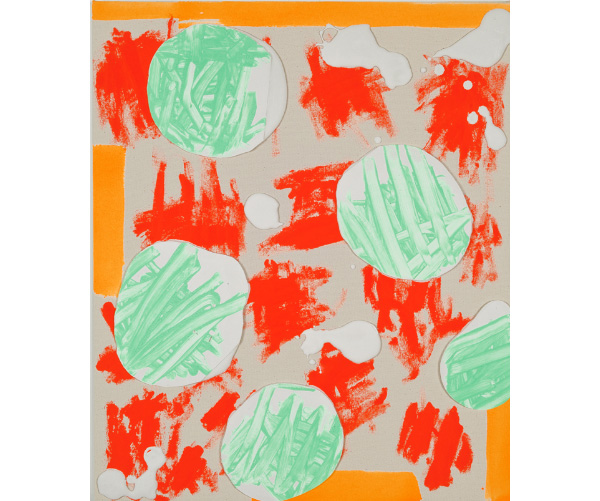
 

Similarities from piece to piece begin to reveal a systematic working method of applying a two or three color underpainting, followed by a layer of plaster topped with dashes of a contrasting color. Individual pieces separate themselves from the group based on the success of how this formula is applied. Untitled (JSY 09) is one of the most finely integrated works in the show. Paint, color, shape, and the mixing of materials all come together with the poetic power of late Cy Twombly. Like Twombly, Schnabel, and countless other artists, Buchner’s work provides one more voice to the ongoing conversation about the sensory pleasures of painting.

Just Say Yes will be on view at Andrew Rafacz in Chicago through May 5, 2012.

Share

Los Angeles

Peter, Don’t You See What You Have Done?

L.A. Expanded: Notes from the West Coast
A weekly column by Catherine Wagley


James Lee Byars, "La figura de la pregunta," 1986.

Unless you really take Lent seriously, and I don’t know many Protestants who do, Easter is a quick event. It’s especially so if you consider all it encompasses: betrayal on Thursday, death on Friday, mourning on Saturday, new life on Sunday. To condense all this into one weekend feels very Christian. We’re fixated on efficiency and the finite. The world is 6,000 years old and the rapture will probably come soon.

The Easter service I attended this April started at 6:30, but should have started earlier. “Pretend it’s still dark out,” said the pastor before asking the music leader to light the logs in the fire pit. “Someone more coordinated should do this,” said the music minister, passing the matches on to a young man in a windbreaker. It was an outdoor service, held in the backyard of a Presbyterian cathedral on Wilshire Boulevard, and they must have known not many would come out so early, because the nomadic, participatory itinerary would have been unwieldy with many more. We’d progress from one station to another, starting at a fire pit like the one the disciple Peter must have sat at when he infamously denied the newly condemned Christ: “I don’t know him.” In Andrew Lloyd Weber’s version, Mary Magdalene, the prostitute Jesus mentored, calls him out: “Peter, don’t you see what you have done, you’ve gone and cut him dead?” “I had to do it, don’t you see,” Peter replies, his singing voice whiny and fearful, “or else they’d come for me.”

Our fire pit must have already burned out all traces of denial, because we used it to light the big Paschal candle (“So much wax,” said the girl next to me), a stand-in for Christ as light of the world. Then, from the Paschal candle, we lit little candles for each of us to hold. We proceeded over to a wooden cross leaning against the easternmost fence. Someone had thought to wrap fishing wire around this cross, and we took turns sticking lilies through the wire after the gospel reading. Some of us tried to slide flowers through with candles still in hand, and hot wax dripped on our fingers.

We moved finally to the baptismal station, where more gospel was read and the Paschal candle officially baptized, bottom down so as not to put out the light of the world. Then we all baptized our small candles in the same manner, and put holy water on each other’s foreheads, saying “may you have new life” while making the sign of the cross with our fingers. A few of these rituals had roots in something traditional; others were likely invented that morning.

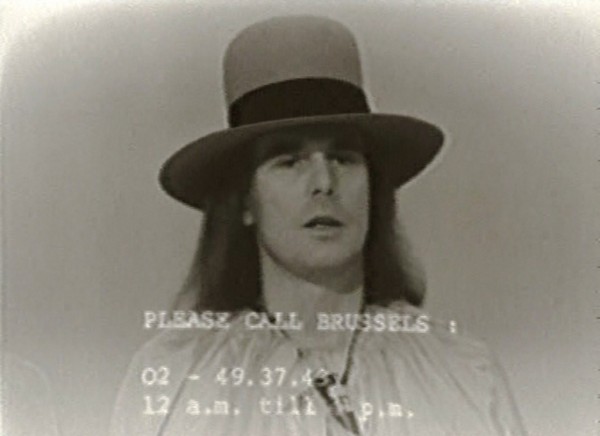
James Lee Byars taking questions on TV in Brussells, 1969.

The James Lee Byars exhibition at Overduin and Kite in Hollywood opened on Easter, which seems appropriate. Byars, a nomadic artist who lived in L.A., Germany, Japan, Egypt, and elsewhere understood sacredness as powerful. During Lent in1995, two years before his death, he installed The White Mass in the Church of St. Peter in Cologne. It consisted of a white ring right in the middle of the altar and then four marble pillars with signs inscribed on them: Q.R., I.P., O.Q., Q.D. Each set of letters stood in for a tenet of Byars’ Philosophy of Questioning, a belief system that really did just center on the conviction that questions — not answers — were all we humans had to push us onward. Q.R. meant “The Figure of the Question is in the Room” while O.Q. referred to “The Figure of the One Question.” No one could enter the installation unless they were participating in the mass.

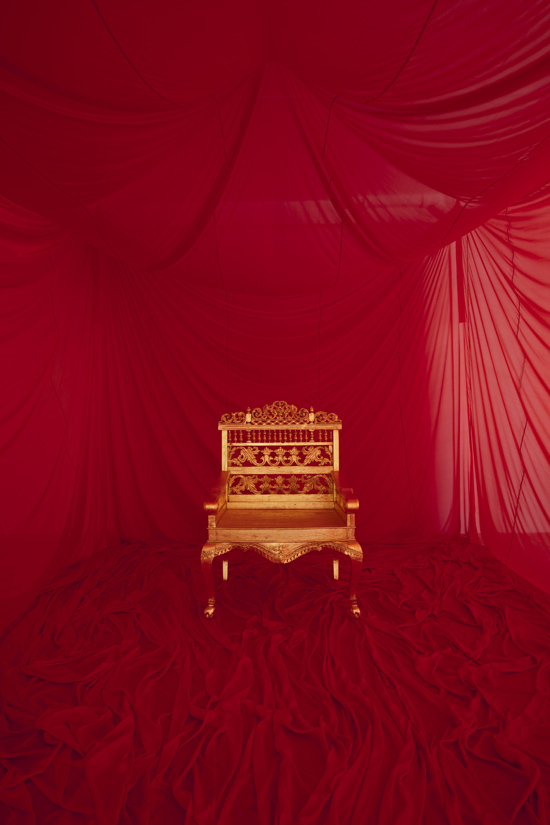
James Lee Byars, "The Chair for the Philosophy of Question," 1996. Courtesy Overduin and Kite.

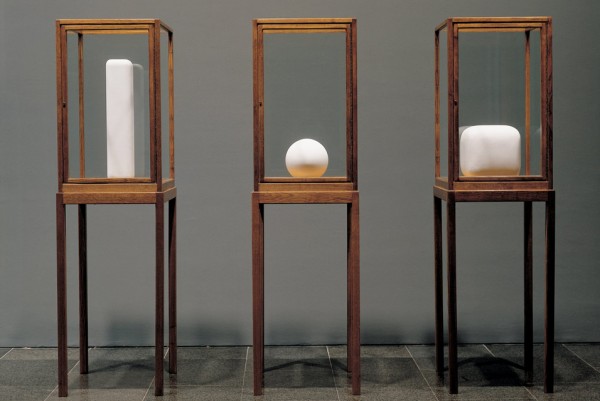
At Overduin and Kite, a collection of marble “books” shaped like sun and stars and encased in glass are like relics from some tasteful, medieval cult. In the adjoining room, a gold nail hammered into the wall recalls the crucifixion, and the Chair of the Philosophy of Questioning is installed inside a red silk tent. It’s not clear what one would do if sitting in that ornate chair; I suppose one would preside over the question-asking of anyone who ventured into the tent. “Basically I try to solve essential questions with questions,” Byars once said. But that makes his questioning feel particularly ritualistic; he’s living out his religion by refusing to ever answer.


Share

Barcelona

Remnants of Revolution: Writing on the Wall in Barcelona

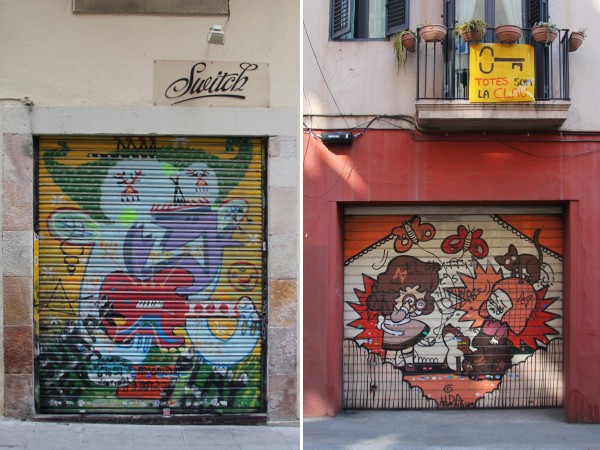
Cities are filled with innumerable details and a foreign land can be barrage of data. In Barcelona, on a walk, I drift from details of leafy building ornamentation to blank walls of flaking stucco, submerged in texture of all kinds. Man’s signs are everywhere, waiting to be decoded. Though I know nothing of graffiti, I am captivated by the drawing, the view of a flat space, and the obscured messages.

Places layer upon each other when moving through an unknown city. I think of Brooklyn one evening, looking for a friend’s house, walking on an empty shuttered street, but here it is mid-afternoon in the neighborhood of Gràcia and the shops are closed. As it was, I became enamored with murals and I had George Orwell‘s Homage to Catalonia in my hands.

“More shots rang out. The bullets from the tower were flying across the street and a crowd of panic-stricken people were rushing down the Ramblas, away from the firing; up and down the street you could hear snap – snap – snap as the shop-keepers slammed the steel shutters over their windows.”

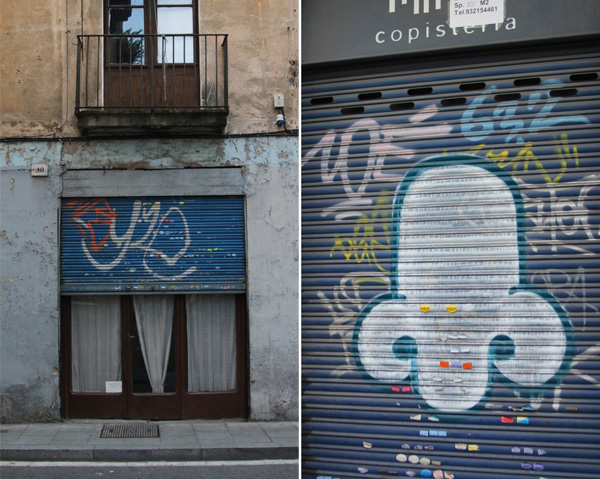
A need to protect property has endowed Barcelona with a kind of blank canvas, the shutters that guard the glass windows of shops. Doors roll down over the whole storefront, blocking the ability to window-shop while the store is closed. Then, there is art that comes to fill the void.

Diverse and striking murals line the streets of Gràcia. With tight streets that give the feeling the old village it once was, Gràcia is located inland from the touristic Ramblas promenade and nightclubs, and outside of wide, octagonal grid of Eixample. The feeling is that graffiti is allowed here; it is tolerated and it is loved.

Within the graffiti world, the opponents of the status quo are often in dialogue and in opposition with each other–murals are painted over, tags are obliterated, layers of messages cake the neighborhood walls.

“For under the surface-aspect of the town, under the luxury and growing poverty, under the seeming gaiety of the streets, with their flower-stalls, their many-colored flags, their propaganda-posters, and thronging crowds, there was an unmistakable and horrible feeling of political rivalry and hartred.”

Graffiti, viewed as vandalism shows a deteriorated neighborhood, but the same image viewed as art endows the neighborhood with a sense of place and identity. Being there is a more valuable experience for some.

The Guardian reported in their December 2010 article “Barcelona shopkeepers face fines over graffiti decoration” that city officials having been cracking down the street art, from graffiti tags to commissioned works, calling it “antisocial behavior” that “degrades urban fabric.” Sometimes the murals are decorative or creative works but often the paintings seems associated with the stores themselves, working as signs. The quality of the murals varies from door to door and even if not great art, they add to the city’s character.

Read More »

Share

Singapore

Zhan Wang: Universe

Zhan Wang, My Personal Universe, Video still, 2012. Image courtesy of UCCA, Beijing.

In The Savage Mind (1962), Claude Lévi-Strauss made a case for “the intrinsic value of a small-scale model” of art, legitimising the art of the miniature because it “compensates for the renunciation of sensible dimensions by the acquisition of intelligible dimensions”. The miniature or the microcosmic representation is, as Lévi-Strauss rationalised, a schematic reduction permitting immediate intelligibility, because it essentially constitutes a bona fide experience between viewer and work on a metaphorical level.

Zhan Wang, 2012, My Personal Universe, Installation and Video View. Photo: Courtesy of UCCA, Beijing.

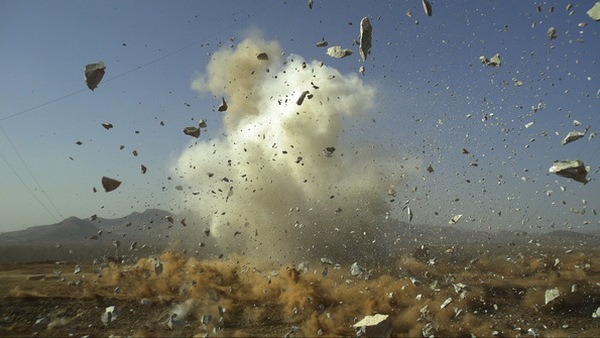
My Personal Universe (2011-12) at the Ullens Center for Contemporary Art in Beijing was Chinese conceptual sculptor Zhan Wang’s endeavour to do just that, in a re-imagination of the first millisecond of the universe’s genesis to its present evolved state, articulating this momentous event in an exhibition through an artistic process whose scale seemed to mirror its colossal significance. As the dominant scientific explanation for the origin of the universe, the Big Bang theory hypothesises that all matter and energy existed in an infinitely small point of infinite density, and in an inexplicable moment, began to expand outward continuously, forming the vast cosmos as we know today. Drawn to the concept of initial states of being, Zhan sought to evoke the earliest moments of our universe through a carefully planned explosion of a boulder in China’s mountainous Shandong province, recording the blast and its aftermath in a two-minute film capturing the event in extreme slow motion. Collecting all 7000 fragments of pulverised rock, Zhan made stainless steel replicas of each one, suspending them in the exact formation in which they landed after exploding.

Zhan Wang, Singapore Tyler Print Institute, image courtesy of STPI.

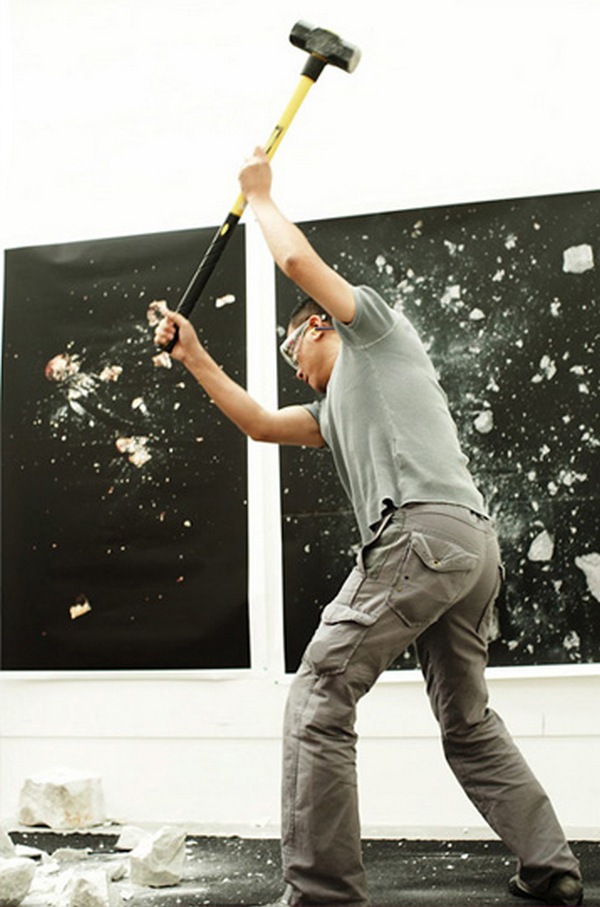
Zhan’s Universe (2012) at the Singapore Tyler Print Institute is materially and thematically fashioned after My Personal Universe, employing – in a vastly scaled-down version – similar artistic processes and reiterations of the physical dimensions of shattered rocks. Lacking the flashy pizzazz of its predecessor and constrained by certain spatial parameters, the mode of production and the materials differ in this show; rocks were shattered with a sledgehammer instead of a dynamite, and later re-assembled as aluminium-coated replicas on paper slabs and on highly polished mirrors. The original rock fragments were pounded by hand into fine sediment and mixed with cotton pulp to produce a solid paper base; the resulting effect is one which reveals the natural mineral pigments of clay, slate and granite.

Read More »

Share

San Francisco

The Captain Has Turned On the Fasten Seatbelts Sign

Nina Katchadourian, "Lavatory Self-Portrait in the Flemish Style #18-19," 2011. C-print. Edition of 8. Diptych: 7.157 x 6 inches each.

The thing about traveling on an airplane is that we take for granted how phenomenally absurd it is. There we sit, unfazed, hurdling through space at 500 miles per hour, 30,000 feet above the ground in a metal tube, surrounded by complete strangers whom in all likelihood we will never see again. There is also the unspoken airplane etiquette that we all hope the stranger sitting next to us will follow: please don’t talk, don’t move, don’t get up…basically please do everything you can to appear as though you don’t exist. With these restrictions, an airplane in flight is a very difficult place to do anything more than sleep, read, stare out the window or watch movies with only the most watered-down content. Unless you are Nina Katchadourian.

For Seat Assignment, her fifth solo show at Catherine Clark Gallery, Katchadourian culled from a body of work made on more than seventy flights over the past two years. Now, artists reading this might be terrified by having their workspace confined to the miniscule square-footage of an airline seat and the plane’s lavatory. For Katchadourian, it is a pragmatic opportunity to bring her “studio” with her. Using only her camera phone and the materials at hand, she creates everything from improvised classical Flemish self-portraits to miniature composed landscapes and worlds.

Nina Katchadourian. Excerpt from the Extreme Sports series, 2010. From the Seat Assignment series.

As its title suggests, the series Lavatory Self-Portrait in the Flemish Style uses objects such as inflatable neck pillows, napkins, bits of plastic and whatever else Katchadourian has on hand to make self-portraits in the style of classical Flemish paintings. Window Seat Suprematism references the fundamental geometric forms of the early 20th-century Russian movement. The images in the series, taken of the planes’ wings through the window, create compelling minimalist, geometric compositions that even Malevich could approve of.

Nina Katchadourian, "Meteor," from the Disasters series, 2010. From the Seat Assignment series.

In-flight magazines supply some of the most fruitful material. One work from Landscapes uses black sweater lint to turn a snow-covered mountain into a smoldering volcano. In Disasters, pretzel crumbs become a devastating landslide off mountain road. Black lint makes another appearance, with the addition of other various detritus, in Birds of New Zealand, adorning the heads and bodies of exotic birds and giving them an even more elaborate flare. The strangest thing about these images is how believable the compositions are. While it may be obvious that the pretzels on the road are indeed pretzels and not rocks, or that a bird does not have a cashew shaped appendage on its head in real life, the objects give a genuine moment of pause, plus the feeling that while absurd, it could be real.

Nina Katchadourian, "Wigeon" from the Birds of New Zealand series, 2011. From the Seat Assignment series.

Katchadourian views a situation that most of us find claustrophobic, boring and tedious as a challenge to highlight both the fantastic and mundane aspects of air travel. The sense of humor and improvisational genius that make up Seat Assignment exemplify an artist setting certain parameters for herself and successfully working within them to create work that is both complex and light hearted.

Seat Assignment will be on view at Catherine Clark Gallery until May 26, 2012.

Share

Help Desk

Help Desk: Is It Any Wonder?

Help Desk is where I answer your queries about making, exhibiting, finding, marketing, buying, selling–or any other activity related to contemporary art. Submit your questions anonymously here. All submissions become the property of Daily Serving.

david-bowie-fame

How do you become a famous artist? I am an artist and make lots of art (performance, paintings, drawings, etc.) but I never went to art school. What should I do to slowly but surely become better known in the art world?

Fame, huh? Without a doubt, you must already know that there is no way to “surely” become “better known in the art world,” especially if you are going to do it slowly. Fame strikes like lightening, white hot and irrefutably blinding those in its immediate path. If fame is your goal, why bother trying to climb the ladder rung by greasy rung? Why not charter a helicopter and get airlifted to the top? Since my job as an advice columnist is to answer the queries set before me, here is a short list of actions that others have tried in pursuit of fame:

-Kiss (with lipstick on) the museum-hung artwork of an already-renowned artist. When you are arrested, explain to the press and the jury that it was a form of homage and that you were simply overcome by the power of the art. Alternately, if you are the fighter-not-a-lover type, you could punch, kick, stab, or otherwise wound an artwork you find objectionable or offensive.
-Sleep with someone powerful. It’s pretty well tested as a means to gain recognition, so why not give your favorite rock star/politician/A-list dealer a bounce? And then he or she can give your career a boost in return.
-Make a complete spectacle of yourself: do buckets of drugs while making art, have sex in the gallery, don’t bathe, etc. Be the wild and crazy guy who publicly justifies all the stereotypes of the tortured artist. Bonus points if you are a.) attractive and b.) from an old-money family.
-Two words: reality show.

Read More »

Share

From the Archives

Always Be Ready For Your Close Up

Exposure can mean very different things to different people. Think, scientific discovery vs. Britney Spears. For today’s look into the DS Archives we hope you will agree that in the art world, if nothing else, exposure means something interesting. In the two exhibitions, Exposed: Voyeurism, Surveillance, and the Camera Since 1870 and Found Footage: Cinema Exposed, we are given priviledged views into worlds that are normally veiled or hard kept secrets. Found  Footage: Cinema Exposed will be on view at EYE International until June 3, 2012. Bean Gilsdorf published this interview with Sandra Phillips, Senior Curator of Photography at SF MoMA, on December 2, 2010.

With a broad mix of photographs from both unknown shutterbugs and internationally recognized artists, Exposed: Voyeurism, Surveillance, and the Camera Since 1870 at SFMOMA examines the images of a culture existing in an uneasy relationship to the camera. The exhibition probes our social connection to surveillance, pornography, and physical and emotional violence. Last week, Daily Serving’s Bean Gilsdorf sat down with Senior Curator of Photography Sandra Phillips, who talked about her ideas for the exhibition and her connection to some of the photographs.*

Nan Goldin, Nan and Brian in bed, New York City, 1983; detail from The Ballad of Sexual Dependency; 1979-1996; nine-carousel projection with approximately 700 slides, soundtrack, and titles; dimensions variable; Whitney Museum of American Art, New York; © Nan Goldin; image: courtesy Matthew Marks Gallery.

Bean Gilsdorf: Exposed was ten years in the making. How and why did it begin?

Sandra Phillips: I did a show called Police Pictures: The Photograph as Evidence about twelve years ago because I was very interested in the fact that we ascribe a certain amount of authority to photographs as impartial truth-telling documents. But they can be extremely ambiguous. And it occurred to me that there was another aspect that was about making pictures without people knowing that they were being photographed. There are, in fact, some spy pictures in this show. So that’s how I started.

BG: Did your organization of this show start with any particular pieces? Or was it just a general concept?

SP: It started as an idea, and the beginning of it was looking at the work of Edgar Degas, believe it or not! He was very interested in photography and he made a lot of photographs. He made pictures of his models that he arranged, but they were presented as though they were spied on. I thought that was completely fascinating—why would someone as important as he be interested in the use of photography as a spying medium? It had to do with his own personal aesthetic, but once you get started in that, then you realize how amazingly broad this topic is.

Garry Winogrand, New York, 1969; gelatin silver print; 11 x 14 in. (27.94 x 35.56 cm); Collection SFMOMA, fractional and promised gift of Carla Emil and Rich Silverstein; © Estate of Garry Winogrand, courtesy Fraenkel Gallery, San Francisco.

SP: I also looked at the work of Helen Levitt, and she was interested in making pictures of people who didn’t realize that they were being photographed. So all of a sudden, this idea expanded: how do you explain street photography without actually dealing with the surveillance aspect of it? And then it became a very big subject: it wasn’t only street photography, it’s the ways we look at sex, the ways we understand important people, and then this weird territory where people like celebrities are being aggressively looked at. What does that mean to us as a culture? Where does this come from? Examining the interest that we have in violence is a necessary part of modern life. And the contemporary photographs are all about surveillance, obviously.

Read More »

Share