London

Louise Bourgeois: A Dangerous Obsession

Louise Bourgeois’ life is not just any open book – it more resembles a multi-volume anthology with pages torn out, chapters re-written, and notes cryptically hidden in the margins. While Bourgeois spoke openly about many of the subjects which infiltrate in her work, including the difficult relationship she had with her adulterous father and her traumatising childhood, she did not share unconditionally, and as we have discovered, held to a few of secrets for herself.

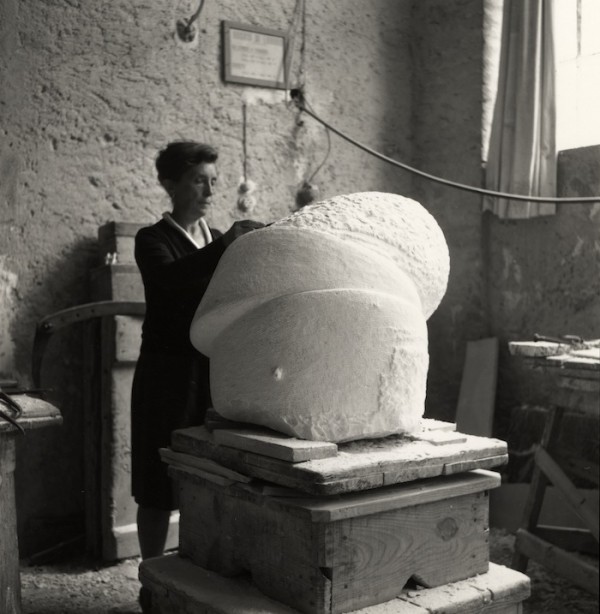
Louise Bourgeois working on Sleep II in Italy, 1967. Photo: Studio Fotografico, Carrara. © The Easton Foundation.

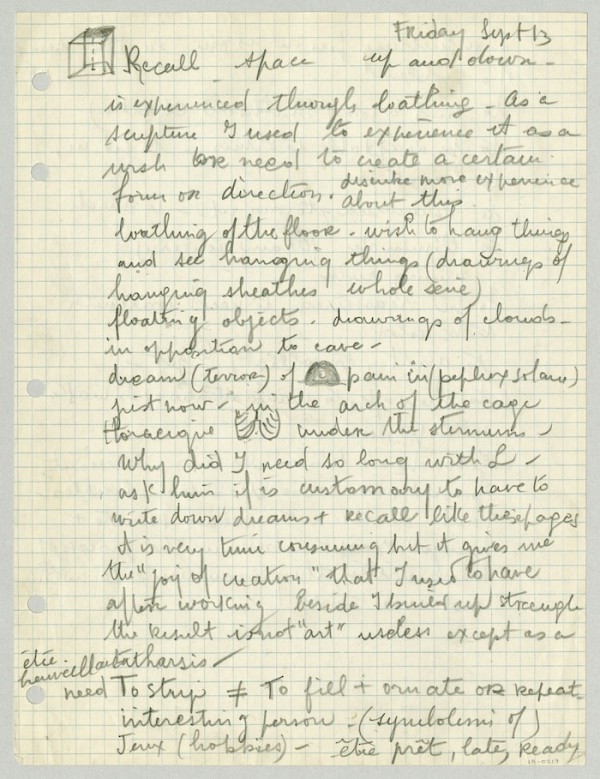
In 2004, two boxes of what have been labelled Bourgeois’ ‘psychoanalytical writings’ were discovered by her assistant in her Chelsea home, and a further two in 2010. These thousands of loose-leaf sheets of paper recorded Bourgeois’ inner conflicts, dream recordings and self-probing analysis, commencing during the period when the artist began undergoing intense psychoanalysis at the hands of Dr. Henry Lowenfeld, a follower of Sigmund Freud.

Louise Bourgeois, loose sheet, 13 September 1957, 26.7 x 20.3 cm. LB-0219, Louise Bourgeois Archive, New York. © The Easton Foundation.

With these in hand, curator Phillip Laratt-Smith published a volume of Bourgeois’ writings, and conceived the exhibition, Louise Bourgeois: The Return of the Repressed. Currently tucked away in residential North London, the works could not have found a more suitable site than The Freud Museum – a home firmly entrenched in psychoanalytic history, where both its patriarchal namesake, and his daughter Anna, remained until their deaths.

Read More »

Share

Los Angeles

Extreme Friendship

L.A. Expanded: Notes from the West Coast
A weekly column by Catherine Wagley

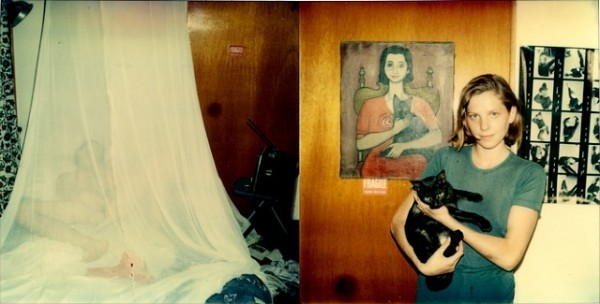
Michel Auder, Cat Stranglers, 2009. Courtesy Kayne Griffin Corcoran.

I had a lazy Monday afternoon two weeks ago. A friend defended her dissertation and then we all migrated from the Inland Empire to my place, where I tried to show video art to one friend while another, the dissertation defender, slept. The internet connection was slow, and so we never finished watching any one work, but the sleeping friend woke and wandered into the living room while Kenneth Tam’s I no longer worry about shoes being worn inside the house was faltering along. “We’re watching two men do invented yoga-like moves,” I said. “But they didn’t know each other — they met on Craig’s List.”

“If they knew each other, it wouldn’t be video art,” she said. “It would be friends doing Yoga.” This was a joke, but one I thought about, because, off the cuff, I couldn’t name any art I’d seen and liked recently that dealt comfortably and explicitly with the familiar. In most new art that compels me, artist hurl themselves into the unfamiliar.

There’s Leigh Ledare and Michel Auder, whose recent, respective exhibitions at The Box L.A. and Kayne Griffin Corcoran mined the eccentricities of their own biographies. But those exhibitions confront you with an idea of intimacy that’s unsettling because of how confessional it is, and how near it veers toward psychological fiction. In some of Auder’s films, he uses hired actors; for some of Ledare’s photographs, he asked women he found through personal ads to pose and dress him so that he embodies their desires.

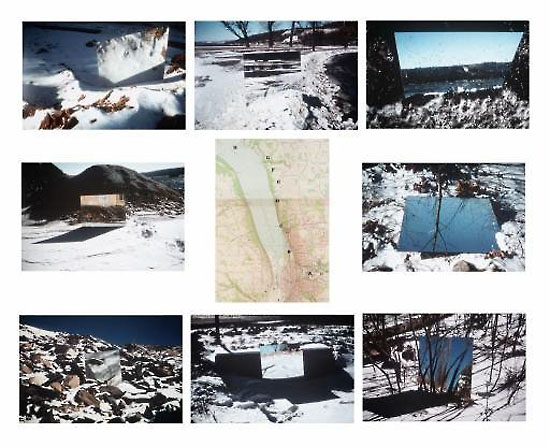
Robert Smithson, Ithaca Mirror Trail, 1969.

Robert Smithson, Ithaca Mirror Trail, 1969.

Then there’s Elizabeth Peyton exhibition at Regen Projects, which is delightful and refreshing, as her work always is, because it’s not at all high concept. Peyton’s portraits, of friends and pop culture icons, are just of people she likes. In her work at Regen, she depicts painter Alex Katz sitting with crossed arms on a couch, and a watery-eyed David Bowie staring  from a 14-inch tall panel. You leave thinking about people’s interior lives, of Peyton’s perception of herself and of others. Does Alex Katz really look as stoic and controlled as figures in his own paintings, or has the artist projected a bit? This question isn’t uninteresting, but it’s not an ambitious one either.

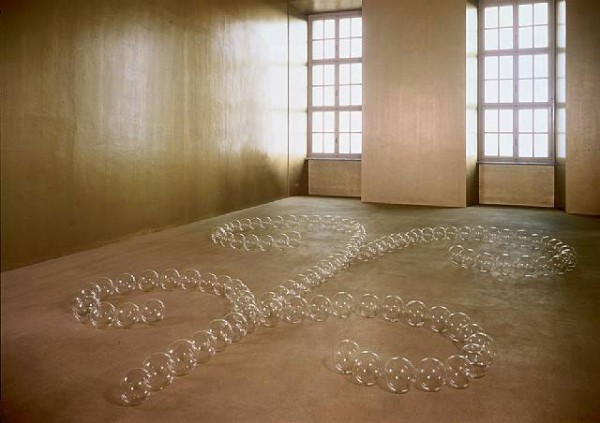
James Lee Byars, The Angel, 1989, 125 glass spheres. Courtesy Michael Werner Gallery.

James Lee Byars, The Angel, 1989, 125 glass spheres. Courtesy Michael Werner Gallery.

Could art about the familiar ever be really daring?

I came across a description of a work James Lee Byars did in tribute to Robert Smithson recently. The two artists, contemporaries in the New York of the 1960s, would have crossed paths and, I imagine, liked each other, but I don’t know how well they personally knew each other. In 1978, five years after Smithson tragic death in a Texas plane crash, James Lee Byars added up the dimensions of all the mirror Robert Smithson used during his career — Smithson used mirrors a lot, lining them up in the landscape to “displace” the earth perceptually or using them in gallery installation. The sum of all Smithson’s mirrors measure 1000 feet by 1360 feet. Byars then took the giant mirror to Smithson’s gravestone, and took a picture of the stone seen through the mirror. This would be “a mirror displacement of Robert Smithson’s soul.” Then Byars purportedly transported the mirror to the Utah desert — I do not know how, or whether any documents exist to prove this actually happened — and used a crane to shatter it across the desert floor. He collected the shards of mirror, packed them in a box embellished with gold leaf, and sent the box to Nancy Holt, who had been Smithson’s wife, as a token of his sympathy. Perhaps this is the ultimate example of the familiar taken to an extreme. Everything about Byars’ tribute speaks to how well he knew and loved Smithson’s art, yet the project is gapingly ambitious.

Share

Glasgow

Back to the Things Themselves

Installation view of Back to the Things Themselves (Lesley Punton & Judy Spark). Image courtesy of Lesley Punton.

Back to the Things Themselves, on show at The Briggait, presents artworks by Lesley Punton (LP) and Judy Spark (JS) who both explore possibilities and limits of translating one’s lived experience of the environment, and the potential for connections between a subjective experience with universal ways of knowing the world.

Magdalen Chua (MC) had a conversation with Punton and Spark, as a second part of a feature on exhibitions presented during the Glasgow International Festival of Visual Art that place emphasis on the process of collaboration and the subjective experience within artistic practice.

Judy Spark, Like punctuation (symphoricarphos), Graphite on paper, 2012, (with Lesley Punton White out receding – Carn Dearg to right). Image copyright and courtesy of artist.

MC: Shall we start off by talking about your individual practices?

LP: My work has always been concerned with landscape issues. In recent years, through the process of walking, it has become more explicit in relation to my lived experience of places that are usually wild and rarely urban. In the exhibition, I have tried to create a diverse conversation between different pieces of work, exploring the limits of experience; and polarities – of night and day, light and dark, and time and duration.

Lesley Punton, Schiehallion, silver gelatin 5 x 4 contact print made after placing a pinhole camera in the summit cairn, pointing South, whilst bivying on the summit of Schiehallion to record the duration of the hours of darkness of midsummer night ’09, 2009-12, with Jim Hamlyn. Image courtesy of artist.

In the past, a lot of the lived experience of my work resulted in long and complicated processes of making. There are works that are directly durational in their actual making, such as Flurry, which marks time. A participatory work is Schiehallion where Jim Hamlyn and I made a pinhole photograph that recorded the duration of midsummer’s night that year at the summit of the mountain. These have a very direct relationship to experiences whilst actually in land. Recent works respond more to reflection and recollections of those experiences. Some have literary connections. Gravesend is the place where the narration of ‘Heart of Darkness’ starts, with Marlowe sitting and recounting the tale of his experience with Kurtz up the Congo.
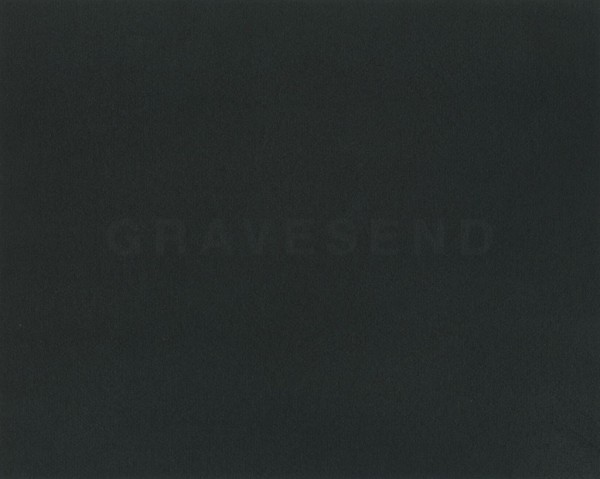
Lesley Punton, Gravesend, graphite on paper, 2010. Image courtesy of artist.

MC: Could you talk about the Duration pieces? They make me think of a journey, where the days refer to the duration, or the process of making the work.

LP: The duration refers to polar night and polar day and the idea of time as something that is not quite fixed. I’ve always been interested in aspects of time – deep time and geological time – probably from the experience of spending a lot of time in hills.

Lesley Punton, Duration 2, oil & gesso on board, 2010-12 (photo credit L Punton). Image courtesy of artist.

MC: When did you start looking at the idea of the lived experience and venturing into remote places?

LP: I’ve always believed that you would make something that has some relationship to how you connect with the world. The intensity of the experience of walking and climbing mountains was something important and I became a bit obsessed with it. It felt unnatural not to do something with it.

Judy Spark, The things themselves, Two FM radios / transmitters with digital soundtracks, 2012. Image copyright and courtesy of artist.

JS: My route to making work about lived experience was through a concern with mechanisms like environmentalism that are established to get people to recognize the value of their surroundings. Environmentalism of any kind – whether related to ecology, renewable energies etc., – depends upon the scientific mechanisms that have created the problems that we’re facing in the first place. In the last 5 or 6 years, I’ve begun trying to find ways to think about how people engage with their surroundings. Conversely to Lesley, my landscapes might be right under my feet. It tends to be urban because that’s the environment I’m treading on all the time, and that’s how things come to consciousness.

MC: Could you explain the basis of your philosophical approach. It seems to be about being within a certain environment, perceiving what is around you, and letting these surface.

Judy Spark, Instructions for creating a gap, Printed text, 2011 – 12. Image copyright and courtesy of artist.

JS: A big influence was a Master’s in Environmental Philosophy in 2006 which broadened my thinking. There doesn’t seem to be much between the poles of not really caring about the place that you inhabit, and having a code of rules that are scientifically directed on how you should behave. We’re not used to working out anything in-between that is more personal. Trying to find a subjective response to things might actually turn out to have wider relevance than “just my own personal subjective response”. I became interested in the phenomenology movement and the idea of trying to describe actions or processes in a way that allows people to find something more direct and new. I think there are parallels with more indigenous or Buddhist experiences of the world which I can’t be a part of. I’d love to be, but I would only be putting my own Western perception onto them.
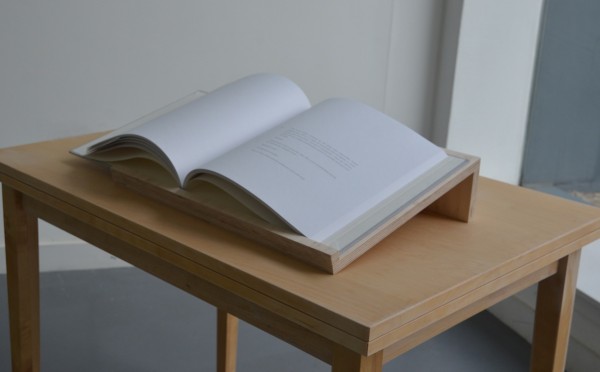
Judy Spark, Listening in the gap, Bound, printed text. Image copyright and courtesy of artist.

MC: I had a conversation with Sarah Forrest and Virginia Hutchison, and we spoke about the subjective experience and values. When there is an objective framework such as environmentalism, it is easy to subscribe to it because it is clear what kind of values there are. When we move to the subjective, it opens the question of whether there are still values within this realm.

LP: As much as I might prioritise a lived experience and the subjective, my relationship with the audience is more objective. I’m always looking for a distancing mechanism. The act of translation in the artwork gives the potential for objectivity or a poetics of space, which the viewer could enter into with their own subjective experience. If I thought for one second that what I was making was self-indulgent work, I would run for the hills, literally. At the same time I have no interest in creating distanced work. While my work might be incredibly minimal, I hope that there is a poetic layer that subverts that sparseness.

JS: The notion of value is an interesting one because of the distancing that you talk about. I know that I have a bit of a drum to bang in some way, but I can’t use my artwork for that and I wouldn’t want to try. It really is about putting something out there and if it allows viewers to think about their own response to things, then great.
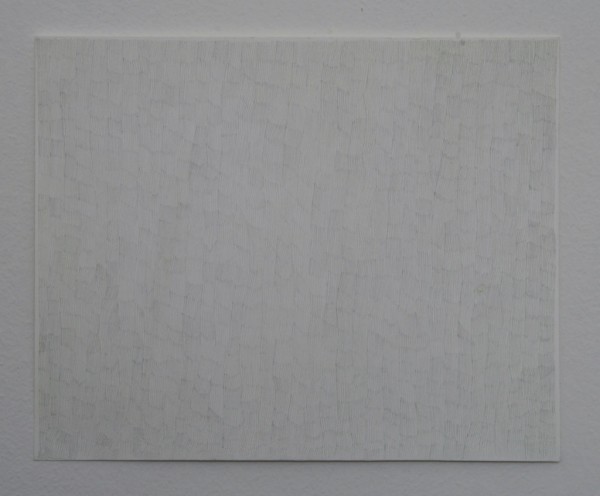
Lesley Punton, Flurry, silverpoint & gesso on paper, 2008. Image courtesy of artist.

MC: How did you meet and what led you to decide to collaborate on this exhibition.

LP: A mutual friend was planning on hillwalking in 2004 and we started regular weekend walks.

JS: We did talk about the possibility of showing work together for years and have had many conversations. When we secured the show, I became very busy. Lesley has a young son and we both work. The collaborative aspect probably starts now in the debriefing of what we’ve done.

LP: As we have individual practices, it was probably important that we had our time to make our own work.

JS: Now that we have put our work in proximity like this, maybe this is the beginning of the next stage

LP: Walking is a very interesting way to collaborate and to build friendships. There are extended periods of silence and these are different from the conversations you have when you meet somebody in the pub. You actively experience something together. I have made some works where I have collaborated with Jim Hamlyn, my partner. The notion of collaboration is still quite new for me in the actual making of artworks together. Up until very recently I’ve not formally collaborated.

Judy Spark, Orrery (gallium aparine), Graphite on paper, 2012. Image copyright and courtesy of artist.

JS: I’m usually a very isolated practitioner. I teach in an art school and that’s maybe where I get a lot of my energy. Collaboration is something I haven’t made a decision not to do. It seems to be closely connected to that thing of value. Maybe if I meet another artist whose work or practice, or something they say to me about my work or practice, chimes in a way. Maybe it’s to do with being a friend first.

LP:  I think collaborations grow organically. I don’t think you can just put two people together and say collaborate, do it now. It doesn’t work that way.

MC: Perhaps you need a lot of trust. It starts off from conversations and knowing that those conversations can take place even without the art.

LP: …and equality as well. If there’s an imbalance there, I don’t think you can collaborate, and that’s where your idea of trust comes in.


 

Share

Glasgow

In the Shadow of the Hand

In the Shadow of the Hand and Back to the Things Themselves are two exhibitions presented as part of the Glasgow International Festival of Visual Art that runs till 7 May 2012. The process of collaboration between two artists and an exploration of a subjective experience are central issues in both exhibitions. Magdalen Chua (MC) interviewed the artists behind the exhibitions to find out about their individual practices and their collaborative approach to examine the place of subjective experiences as alternative ways to respond to artistic production and knowledge about the world.

Sarah Forrest / Virginia Hutchison, In the Shadow of the Hand: cymbal (cast lead cymbal on stand). Image courtesy of artists.

These interviews will be published in two editions–check back in with us tomorrow for our interview with the artists from Back to the Things Themselves. This post features In the Shadow of the Hand which is on show at Market Gallery and presents new work by Sarah Forrest (SF) and Virginia Hutchison (VH). Reflecting on the process of evaluation and critique in the development of artistic practice, both artists create texts for each other that are cast in lead. The lead is then melted and recast into an object by each artist in response to the text, forming part of a series of exchanges exploring subjective responses to an objective call, and the relationship between object and text.

MC: Could you talk a bit about your individual practice? I saw Sarah’s work in the exhibition P is for Protagonist and couldn’t help but think of that exhibition when I entered gallery 1.

Virginia Hutchison, Excerpts from 7 sunsets (temporary intervention with gold leaf, IOTA public art projects, Inverness, 2010). Image courtesy of artist.

VH: A lot of my work is site or context-specific interventions in the public realm. Quite often it is objective or brief-led. Recent projects have required interaction between the work and people, and an exchange of skills. What has become more important for me has been the dialogue in the making of the work, for example with people installing the work and having conversations about the space and the work.  Through the conversations, I’ve become interested in the different roles, of whether I am the artist, or they are the artists because they help to make the work come to full cycle. That was what made us decide to collaborate. Both of us were dealing with relationships between viewer, artist, object, audience, and how all these roles shift. I was at the point when I was really quite keen to just reflect on all the work that I was doing.

SF: My practice is much more gallery-based and I do creative writing with texts published independently of the visual work. I was in an exhibition at Transmission Gallery and my starting point for my work was the voices of objects. In the run-up to the exhibition, I was undertaking a lot of research on the voices of objects and I became so lost in theory that I almost lost myself. The work I presented, Part 1: for the voice, was a white sculpture narrating with a pair of headphones. Everything had gone white, and it was about a voice that was missing. By that point, I had a desire to move away from intellectualizing, come back to a much more subjective space, and find different ways to talk about a creative practice. That was when we began speaking about evaluation and critique, in relation to the art object. I am interested in creative writing as a response to a visual experience and I think that’s when our conversation started.

Sarah Forrest, Part 1: for the voice, (2010), installation with a framed text, a monitor playing a video, a white sculpture made of plaster, paper, wire mesh and gloss paint which had headphones emitting a female voice attached to it. Duration 10.23 minutes. Exhibited in Days, a three-person show at Transmission Gallery, Glasgow. Image courtesy of artist.

VH: I haven’t done a lot of creative writing myself but what I like is how it made me think differently about the projects I was doing. I thought that it was important to find a way to present a narrative of the conversations I was having. When we started off, I thought it was going to be very linear, when we had text, object, text, object, and one would follow one from the other. In reality, when responding to Sarah’s text, I was thinking of my text, and I was also thinking of what object she might be making in response. So many things started to feed in, including our conversations.

SF: We started off with texts that each of us had written or appropriated that were cast into lead letters in Edinburgh. We would respond to each other’s text with an object.  The size and weight of the object was dictated by the size and weight of the texts. It was a really simple relationship between text and an object, and a playful way to work and structure a collaboration. There was a point when I was making a symbol that was in response to the the the and I was asking for advice. We spoke about ideas of repetition and rhythm, the the the being like a stutter almost, and talked about the idea of making an object like a stutter. We began to collaborate in the making of the object.

Read More »

Share

Hashtags

Rites of Spring: #MayDay

Human animals have at least as many seasonal habits as our less verbal counterparts (ahem, other mammals). We stuff our faces to prepare for winter, sleepwalk all the way through “the dark season,” and then hop straight into cleaning, organizing, and mating when the sun finally comes out again. One other rite of spring: Americans’ blissful ignorance of International Workers’ Day – aka today, May 1st – in favor of fall’s supposedly more benign Labor Day.

Depiction of the Haymarket Riot, 1886. Chicago Historical Society.

International Workers’ Day, as you may or may not know, commemorates the 1886 Haymarket Riot in Chicago, which began with a peaceful protest for the right to an 8-hour workday. At some point during the protest, someone threw dynamite at the police, who then began to fire indiscriminately into the crowd. In the end, over ten protestors and police officers were dead. A few years later, the first congress of France’s Second International, an organization of socialist and labor parties, called for international demonstrations to celebrate the riot’s anniversary, and the modern incarnation of International Workers’ Day (May Day) was born—i.e., celebrated as a holiday by nearly 80 countries outside the United States, but not the U.S. itself.

Read More »

Share

Help Desk

Help Desk: Burning Bridges

Help Desk is an arts-advice column that demystifies practices for artists, writers, curators, collectors, patrons, and the general public. Submit your questions anonymously here. All submissions become the property of Daily Serving. Help Desk is co-sponsored by KQED.org. Also, check it out: Help Desk was interviewed for the Art21 blog!

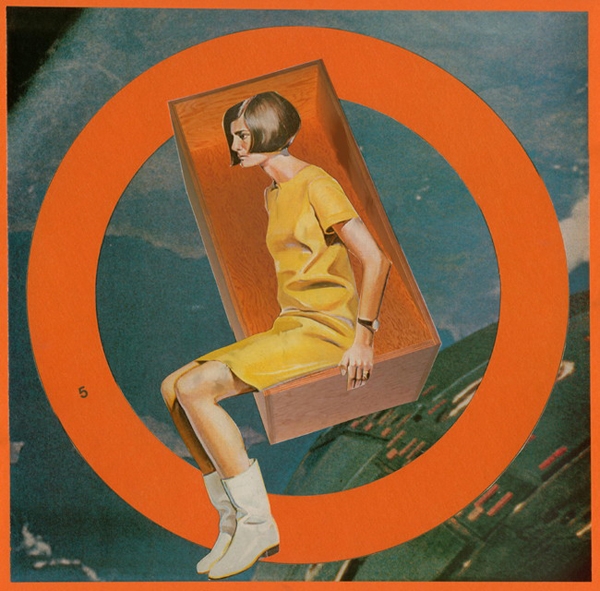
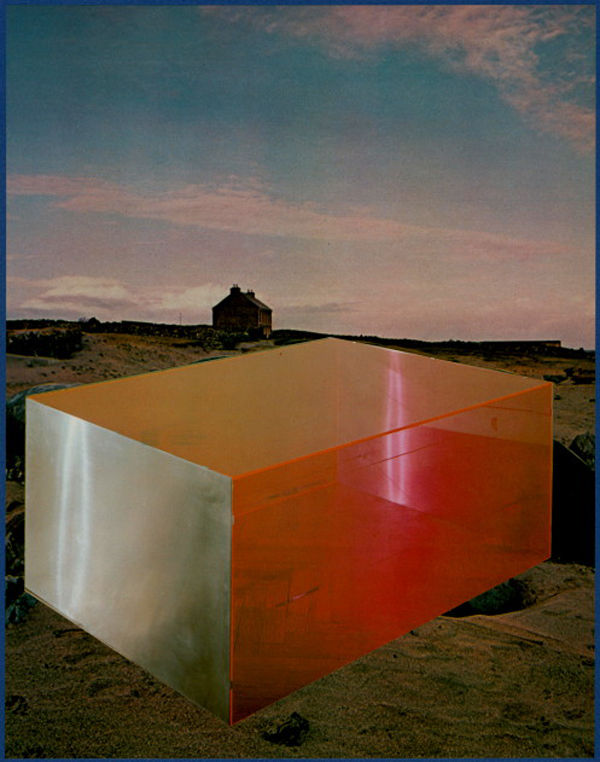
This week’s column is illustrated with collages by Eva Lake, whose solo show “Judd Women Targets” is currently on view at Frosch & Portmann in New York, through June 3, 2012.

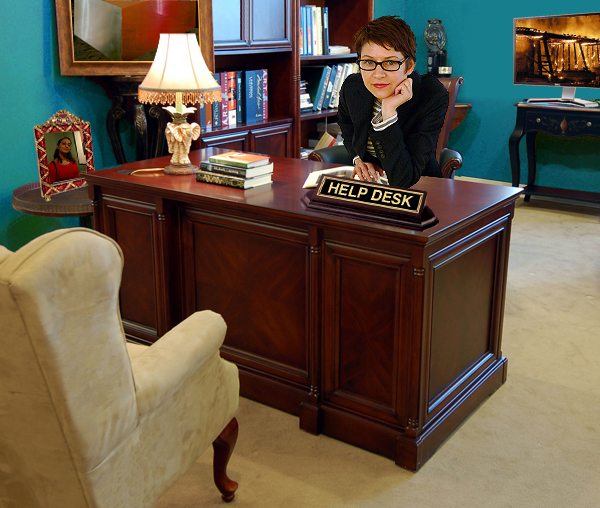
Your counselor, hard at work.

If an artist is attempting to call attention to a particular issue that in some way either oppresses a group of people or includes imagery of unethical actions, is their artwork also unethical if they intentionally include or use oppressive tactics or graphic images to do so?

There is no permanent, fixed equation that we can apply to art—especially art that intends to become activism—and I’m not amenable to making an ultimate pronouncement on work that exists as a hypothetical. It’s better to be aware of the concerns surrounding art and activism in general and proffer judgments on a case-by-case basis. An artist who wishes to take an activist stance in regard to an issue must think very carefully through the problem at hand.

Eva Lake, Target No. 32 (Wayne Thiebaud Painting), 2008. Photomontage, 11 1/2 x 11 1/2 inches

I contacted a few artists that are currently making work that intends to be activist, but for the first time in the brief history of this column, not one of them responded. Perhaps they were afraid to go on record regarding the conflicts and contradictions their work presents? In any case, Anuradha Vikram, Curator of the Worth Ryder Art Gallery at UC Berkeley, kindly shed some light on this matter. She asks would-be activist-artists to ponder some art-world assumptions: “When seeking to call attention to any troubling issue, one key maxim to consider is that of the physician: ‘first, do no harm.’ Too often, artists seem to mistake demonstrating a set of conditions for critiquing them. If the work is replicating unethical behaviors, what is the artist doing besides perpetuating those behaviors? Perhaps, if one assumes that the context for art is a neutral one (the proverbial ‘white cube’) then it could be argued that by isolating and framing such actions, the artist makes the critique implicitly. However, if the last 40 years of art-world controversy have taught us anything, it is that ‘neutrality’ is often interchangeable with ‘privilege.’ Recreating oppression within a space of privilege is simply oppressive. A critique needs to go farther than that, and a sophisticated critique does not need to replicate such dynamics in order to unpack them.”

I agree, and can’t emphasize that last sentence enough: a sophisticated critique is what any artist-activist should be working toward. I also think the issue of commodification is important here. Can art truly make a change if it doesn’t materially aid the victims whose cause it purports to advance? If it only “raises awareness” of an issue by replicating abuse, it’s possible that its main consequence is simply to turn the expression of subjugation into an exchangeable commodity (for money, status, notoriety, etc.) which primarily benefits the artist or the art establishment. And on a personal level, if your activism turns you into a celebrity but does nothing to change the brutality you supposedly decry, your innocent intentions become worse than worldly cynicism. Emancipation cannot be achieved by oppressive means.

Related reading: groundswellcollective.com and the books Art & Agenda and Wild Fire: Art as Activism.

Eva Lake, Judd Montage No. 6, 2007. Photomontage, 8 ½ x 7 ¾

I am in my junior year of a BFA program at a university that I love. My grades have always been stellar, and I feel empowered to make work that extends far beyond the minimal requirements of assignments – work that I would be proud to exhibit; however, my work has been rejected from several local juried shows recently (in the past, I have been accepted to shows and even sold work). In addition, one of my main professors has been giving me lower grades than I am used to. I’m open to criticism, and I know I have a lot to learn, but the direction seems to be simply that I’m not making the work that they expect. 

There is a small part of me that wants to conform and get good grades so I can move on to an MFA program elsewhere. The louder, bossier side of me believes that my Postmodern ideas are valid, but happen to be inconsistent with the traditional Modernist teaching methods of the faculty at my university. Can you give me some ideas about how to make the most of my education without burning bridges or officially ruining my transcript?

There are really three parts to your query: how to make the most of your time in school now, the correlation between grades and MFA programs, and the larger idea of the feedback you’ve been getting. I think they’re all related in the end, but let’s deal with the MFA part first because it might be the easiest. Read More »

Share

From the Archives

From the DS Archives: Martin Creed

In 2010 Martin Creed, along with Richard Wright and the artist team of Kim Coleman and Jenny Hogarth, were comissioned to make pieces to be exhibited in the Edinburgh Art Festival. Creed’s works are currently on display at the Tate St. Ives until July 27, 2012.

The following article was originally published by Kelly Nosari on September 1, 2010:

Each year, from mid-summer to early fall, the arts converge in Scotland’s capital city.  The Edinburgh International Festival and the Edinburgh Festival Fringe are well-known venues for the performing arts.  The Edinburgh Festivals have expanded to include art forms such as film, jazz and blues, storytelling, and books.  The visual arts is no exception in having its own festival platform.  Taking place throughout August and the first week of September, the Edinburgh Art Festival is Scotland’s largest annual festival of visual art.  Daily Serving brings our readers some of its highlights.

Read More »

Share