Help Desk

Help Desk: Putting It Out There

Help Desk is an arts-advice column that demystifies practices for artists, writers, curators, collectors, patrons, and the general public. Submit your questions anonymously here. All submissions become the property of Daily Serving. Help Desk is co-sponsored by KQED.org.

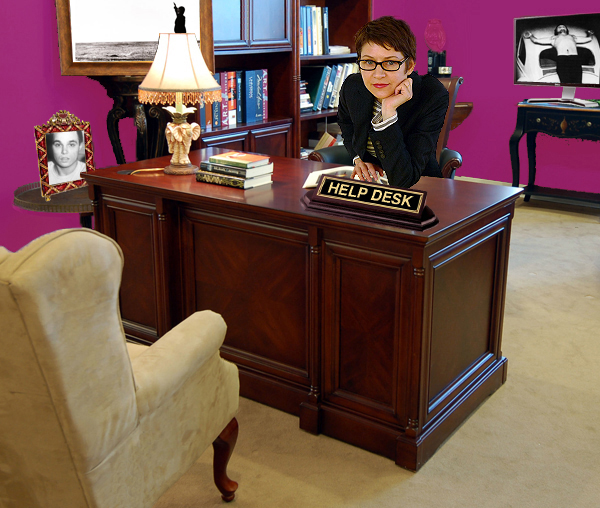
Your counselor, hard at work.

Like two other artists that wrote in [see Help Desk: Location, Location, Location], I also live in a part of the country that doesn’t have the strongest art market. I get to show locally a few times a year and the artistic community, made up of locals and university members, can be creatively stimulating, engaging and supportive. It’s a great place to make art, but a not-so-great place to sell art.

My question is, what value do you see in “alternative” exhibition spaces, both digital and physical (Saatchi Online, White Columns Artist Registry, and New American Paintings as a few examples), for being legitimate avenues that lead to show opportunities at galleries in metropolitan art centers? Can having a strong online presence be enough to catch the attention of curators and galleries that already have a line of hopefuls at their street address?

Acceptance to an artist registry or a curated publication holds the promise of getting your artwork in front of people who are interested in exhibiting, selling or buying it. But does it really work like that? Are there success stories? What are the pitfalls? I asked around to find some answers.
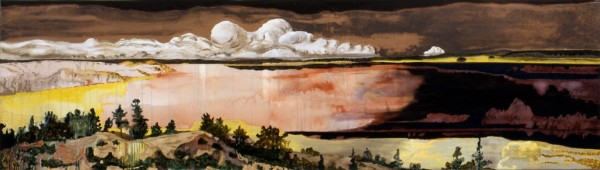
Mamma Andersson, Heimat Land, 2004. Oil on canvas, 31 1/2 x 110 1/4 inches

One artist I spoke with was initially very excited to have his work included in the White Columns Artist Registry. However, he told me that in the few years that have passed since his acceptance, the only result has been an increase in the amount of junk mail he receives. He does still take the time to update his page, but assumes at this point that nothing will come of it. Another artist whose work was accepted for a New American Paintings catalog a couple of years ago told me that it “did not pan out into anything.”

One of the first adopters of Saatchi Online said of the registry, “I don’t think it hurts – but I cannot say it has helped yet. I did receive a query…and they may have found me on Saatchi, but nothing has come of that yet. Otherwise it is such a mixed bag there – most of the artists are not that developed… [but] they do find serious curators for their Showdowns.” She added, “To be frank, nothing is as good as your own website – and this goes for Blogger, Tumblr and the million other ways you can expose your work.”
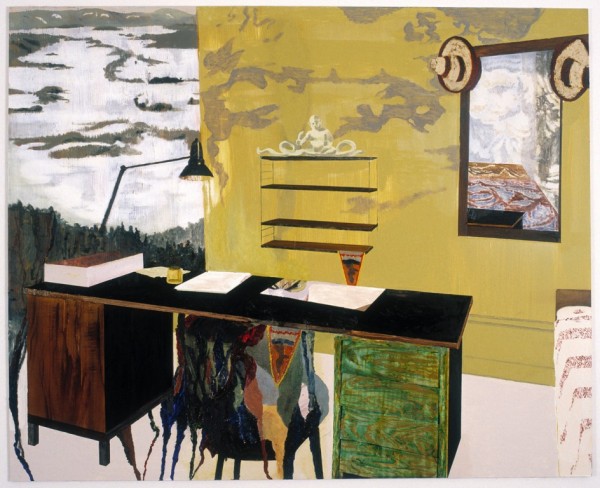
Mamma Andersson, How Green Was My Valley, 2003. Oil on panel, 122 x 152 cm

Granted, these are the accounts of only three random artists among thousands, so it’s hard to say if theirs is the experience of the majority or not. I’d like to believe that the registries are helpful–readers, please note that Saatchi Online was where I found the collages of Irina and Silviu Székely, featured in this column a few weeks ago–but the last part of your question acknowledges the necessity of actually being physically present, at least sometimes, in order to be on a gallerist’s or curator’s radar.

There are no certainties in this game we play. By all means, I think that providing one more place for gallerists and dealers to find your work could prove helpful to your objective of selling. But don’t let the energy you’re putting into an online presence take away from the time you spend connecting to people in real life. The glib phrase “it’s who you know” is not quite accurate—you could be on a first name basis with the pope and it won’t make your work any better—but it’s not entirely inaccurate either. If you do pursue and get your work into these registries, see if you can use that as a very deliberate stepping stone to a face-to-face meeting with a gallery you’ve had your eye on.

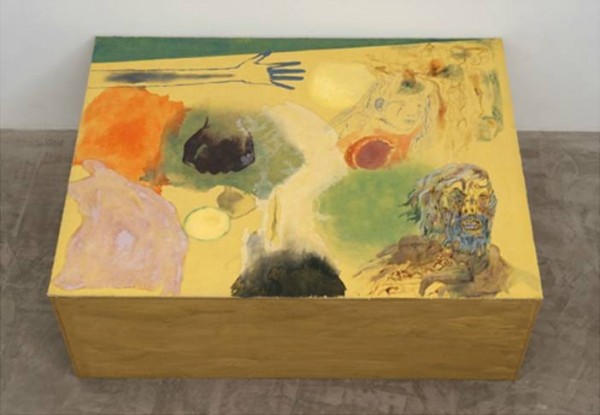
Mamma Andersson, Pigeon House, 2010. Acrylic and oil on panel, 33 1/2 x 48 inches

I’m an artist without an art school background. I’ve made art my whole life but only for me personally, until the last few years, when I began to devote much more of my time to it and to put it out in juried shows and other exhibitions. I’ve had some serious encouragement with a few large sales and two solo shows (one in a high quality art venue, one in a public space) in the four years since I changed course. I remain self-employed in my “day job” which is tangentially related to the art I make in that I carry themes over from one realm to the other. My question is about how to portray myself to galleries as I reach out to them. I want to be honest about my background but I am realistic enough to know that there are some prejudices against those who come later and roundabout to artmaking. I want to emphasize that I am extremely serious about it and hope to make a complete switch if at all possible.

I think you should portray yourself honestly: you have been making art your whole life and have recently produced some bodies of work that have been successful in the marketplace. In terms of gallerists and dealers, why would any other information be germane to the matter at hand? Do I need to know if my dentist has an undergraduate degree in modern dance, or do I want to know if she is experienced, licensed and insured? Capisce? No one (at least no one you’re going to care about) will give a damn about art school if your work is strong and interesting, you present yourself well and have a good statement.

Read More »

Share

From the Archives

From the DS Archives: Simon Starling

Today from the DS Archives we bring you British installation artist, Simon Starling. His current exhibition, Trois cent cinquante kilogrammes par mètre carré, will be on view at La Kunsthalle Mulhouse from 24 May–26 August 2012. The exhibition features new works inspired by the architecture of the building that houses the Contemporary Art Centre, the University of Upper Alsace, and the Mulhouse town archives.

The following article was originally published by Ian Curcio on January 20, 2008:

Simon-Starling-1-20-08.jpg
Read More »

Share

Los Angeles

Don’t Crack a Smile

L.A. Expanded: Notes from the West Coast
A weekly column by Catherine Wagley

Annette Kelm, Untitled, 2012. Courtesy Marc Foxx and the artist.

We had just left Marc Foxx gallery, where Annette Kelm’s delicate C-prints look like illustrations from the most deadpan Children’s book ever, as if everything but tufts of grass had been excised from, say, Make Way For Ducklings. We were still in the little enclave of galleries off Wilshire Boulevard when a woman confronted us in something of a panic. She wore heavy, layered, unwashed clothes and a ribbed pink hat. She had lost her carpet, she said. “It’s blue and has four threads missing,” she said. “It was just here. Please help.” She sounded like someone who’s discovered the kid she’s been charged with wandered away. But everything about her suggested she was unhinged, and we couldn’t engage. “We’re sorry,” we said, in a concerned, confused way, then slipped into ACME gallery.

Lutz Braun, "Akira," acrylic on carpet and wood, 2012. Courtesy ACME.

“This would be a bad place for her to come,” said my friend, when we saw we were in a room full of carpets, some placed on thigh-high wood boxes, one hanging low enough on the wall so it trailed on the floor. Berlin-based Lutz Braun had painted on these with acrylic. The one he calls “Murdering the Season” was grayish with a fire-ravaged forest depicted on it. The one called “Bludgeon” was a white carpet with a watery landscape crossed out in the middle and an abstract triangle on the right. They were expressive in that the marks were loose in an expressionist style, and they had “visceral” iconography like skeletons and burnt trees. It’s also sort of gross to put paint, a gooey liquid until it dries, on carpet. But despite all this, Braun’s paintings managed to feel aloof and disengaged. Each shape, mark and figure — even garish, skeletal ones — seemed to have been rendered with restraint.

Read More »

Share

Fan Mail

Fan Mail: Dave Greber

For this edition of Fan Mail, Dave Greber of New Orleans has been selected from our worthy reader submissions. Two artists are featured each month—the next one could be you! If you would like to be considered, please submit your website link to info@dailyserving.com with ‘Fan Mail’ in the subject line.

A.R.T.I.S.T. S.T.A.T.E.M.E.N.T., 2011

Being a fan of Tim and Eric, and ridiculous and annoying stuff in general, when I found Dave Greber’s The Eleuthromaniacs, I was thrilled. Dave was surprised when I inquired about it, describing the series as “universally disliked by everyone who ever saw it” and told me that it was rejected by almost every film festival except Indie Grits in Columbia, South Carolina. “It’s failures were the reason I became a visual artist.” In 2009, Dave shifted his focus away from the festival scene and commercial viability. He began seeking out spaces to exhibit his work as video installations.

Idea, 2010

I’m excited, 2010 was his first installation which he describes as “a reality show purgatory.” It’s looping and repetitious dialogue inspired more loops, presenting absurd philosophy as collaged ads in his Primer, a 3-channel installation. One of two installations this year, Interior Deterious, a collaboration with Andrea Ferguson, was written about by Doug MacCash of the Times-Picyune who saw the exhibit as part of our 21st century challenge to “reconcile our craving for digital magic and our nostalgia for old- fashioned tactile hand craft.” May’s Art Forum presents a review of Spaces at the Contemporary Arts Center, New Orleans, featuring the work of rising artist collectives in the St. Claude Avenue area, and includes Greber’s parody of his own collective, The Front: on Display, 2012.

Dave Greber, Rise From Your Grave, Interior Deterious, 2012

Is it a contradiction to poke fun at the art world, you know, being an artist?

No, I don’t think it is a contradiction, rather a responsibility of the artist to critique the art-world, as it is an extension of our corrupt societal and institutional structures in general. But, I actually feel extremely grateful that there is still a “vocation” (contemporary artist) in our society where it is acceptable to channel wild spirits and are encouraged think as free as possible, albeit, as long as you can keep your shit together enough to act like an intellectual some of the time.

What is your relationship to the commercial world? Is it okay to love tv?

I worked as a freelance video producer and made local commercials for advertising agencies for a few years after college. That world was so dark. I think when you are in advertising, [you] embrace hatred. Freelancers in advertising are like atheist mercenaries fighting psychic wars in the name of gods they don’t believe in, against unarmed civilians who don’t even know there is a war going on. I felt so much guilt when I made commercials. I had to totally change my paradigm of what I imagined life was about in order cope with my actions day-to-day. Needless to say, “it’s not for me.”

It’s okay to love TV as long as you can also love yourself, your neighbors, and [the] source which gives us life.

You are a graduate of Temple University in Philadelphia, and you were selected for the Oxford American’s 100 under 100 superstars of southern art in their latest issue. Could you tell me what it is to be a southerner, or to make southern art?

I didn’t start making art until I lived in the South. I felt entitled to start making and showing my work because there was a really cool visual arts scene already happening here in New Orleans. I joined The Front, my art collective, through an open call, which opened up my first opportunity to exhibit my own work in a gallery. From my shows at The Front I was invited to be in Prospect 1.5 New Orleans and high-end commercial galleries like Arthur Roger Gallery, all in the course of a few years. I have always been supported by the community here. I guess I’ll never know for sure, but I don’t feel like it couldn’t have happened anywhere else.

Stilllives, 2011

Share

Berlin

The Berlin Biennale 2012

Bottom floor of the Berlin Biennale, "Occupy Berlin," photo courtesy http://universes-in-universe.org

To transport an Occupy movement to the sanitized dominion of a museum is, as my art historian friends would say, problematic.  This year’s incarnation of the Berlin Biennale (the seventh) has thus far received anemic reviews, with some hinting at real vitriol.  The exhibition is partly as curator Artur Zmijewski envisioned it; full o’ problems.  In interviews Zmijewski offers cryptic monologues about equally cryptic solutions.  I think there are plenty of strategies to be found in the Biennale, but they are buried beneath sprawling and lofty ambitions, making it feel, as Frieze writer Christy Lange writes, like “an awkward slog.”

The impulse to undermine traditional artistic hierarchy by including documentary filmmakers, self-identified social activists and other non-artist-artists is good and worthy and exciting.  And there are moments in the Biennale where ideas ignite and excite viewers to imagine a world with a more porous understanding of art and the things it can accomplish.  The Biennale is awash in beautiful gestures: Lukasz Surowiec transplants trees from Auschwitz-Birkenau,  Yael Bartana stages the first ever international congress of the Jewish Renaissance Movement in Poland, Khaled Jarrar creates postal and passport stamps for the non-existent state of Palestine.

But these gestures are at times overshadowed by an exhibition layout at Kunst Werke that is heavy-handed and foggy.  It’s like it was curated by the gruff classist landlord of a turn-of-the-century New York tenement: the poor students and occupy protestors have the ground floor where they take care of the garden, ride a solar revolution bike and lead wacky seminars about street art and self-sustaining garden communities.  They conduct casting calls for a porn movie, make mandalas out of tobacco shavings and read leftist literature on the ragged arms of a hand-me-down couch.  There are no museum guards there (trust!) and the offices of Kunst-Werke employees are conspicuously ajar (transparency!).  It’s a dirty little utopia in the middle of one of the richest streets in central Berlin, a hypocritical, twingy concession in a district full of wealthy patrons and designer yogurt.

Meanwhile, the “real” artists can be found on the remaining 3 floors.   This architectural caste system is no exaggeration; the participatory element ends with the blackboard paint (which covers the entire ground floor).  Suddenly the walls become the shade of primeval white that we as gallery attendees are accustomed to.

 Marina Naprushkina’s oversized comics hang in the stairwells on the way “up.”

*Sorry, I don’t want to indulge in this super easy metaphor; I’m just really tired (maybe the curators were too?).

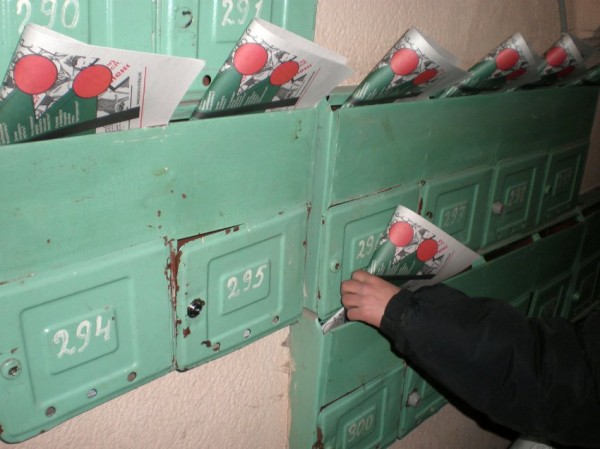
Marina Naprushkina with newspapers © Olga Karatch, image courtesy artnet.de

Naprushkina’s pieces are lovely and sincerely concerned with gender inequity and Russian nationalism in Belarus.  She uses graphic works to disseminate information, and last year created a comic newspaper documenting the police brutality that took place against protestors in Belarus in December of 2010.

Naprushkina is one of few object-makers in the Biennale, as the Biennale is focused largely on ephemeral actions and intervention (and the resulting footage of said ephemeral actions and interventions).  Pawel Althamer combines these pursuits with his beautiful if somewhat staid exercise in communal creation; a draw-in called “A Draftsmen’s Congress” at the St. Elisabeth Church.

Read More »

Share

Los Angeles

Programa Espacial Autónomo InterGalactico

As part of our ongoing partnership with Art Practical, Daily Serving is sharing Danielle Sommer’s article on Riga 23’s Programa Espacial Autónomo InterGalactico, at REDCAT in Los Angeles.

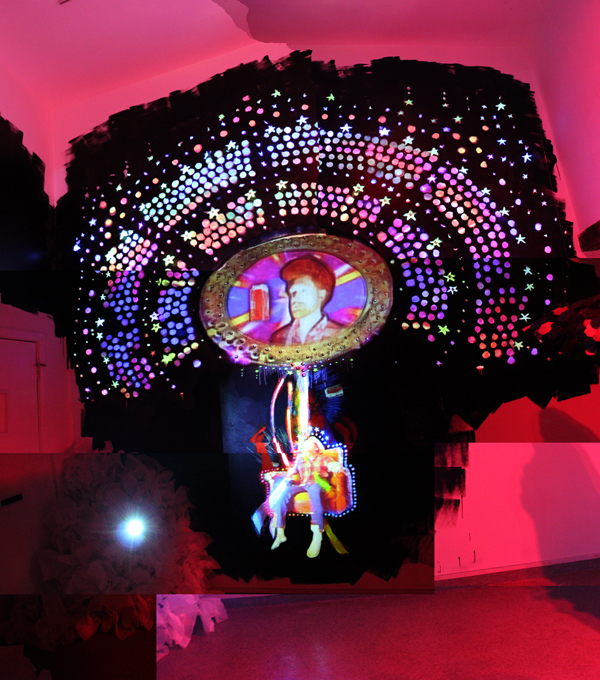
Rigo 23. Autonomous InterGalactic Planetarium, 2009-12; installation view, REDCAT, Los Angeles, 2012. Courtesy of the artist and Gallery Paule Anglim, San Francisco; Pedro Pica Piedra, Beto, Santiago Marcial, Monserrat Blanco, Gabriela, Marcos Sanchez, Domingo Santiz Ruiz, Mia Rollow, Paulina, Adrian Quiroz, Manuel Hidalgo, Ivan Pablo Soria, Pablo Milan, Miguel Hidalgo, Caleb Duarte, Jacobo Lagos, Erwin, Salvador. Photo: Scott Groller.

The Portuguese artist Ricardo Gouveia, or Rigo 23, might be best known for his series of larger-than-life, one-way-sign-inspired murals, painted on buildings across San Francisco, where the artist has lived since the 1980s. For the better part of the last decade, however, Rigo 23 has produced a series of projects with underserved and underrepresented communities. The latest of these, Programa Espacial Autónomo InterGalactico (Autonomous InterGalactic Space Program), has just docked at REDCAT, CalArt’s theater and gallery space in downtown Los Angeles.

The culmination of more than three years of coordination and labor by Rigo 23 and artisans from Chiapas, Mexico, as well as members of the Zapatista Army of National Liberation (EZLN), Programa Espacial represents a convergence of multiple worlds.1 When Rigo 23 met with the members of the Good Government Junta of Morelia, Chiapas, to propose a collaborative art project between himself and artists from the region, he asked, “What would happen if they got an invitation to attend an intergalactic meeting somewhere other than the Milky Way; how would they travel?”2 The junta members accepted this proposal but made it clear that the project was not a priority and would only be accomplished if he won the support of a local artist.

Because Programa Espacial is a collaborative project between an artist and various indigenous communities, and because those communities are under the jurisdiction of the EZLN, the exhibit brings up questions of commodification and appropriation, but these questions seem to have been of lesser interest to Rigo 23 than the question of positionality. The spiraling path a viewer takes through the exhibit evokes (within the limits of California’s fire code) the curve of a snail’s shell, creating interplay between a viewer’s sense of being sympathetically “inside” the EZLN looking out, or an outsider looking in.3

Read more.


Share

Help Desk

Help Desk: With Intent

Help Desk is an arts-advice column that demystifies practices for artists, writers, curators, collectors, patrons, and the general public. Submit your questions anonymously here. All submissions become the property of Daily Serving. Help Desk is co-sponsored by KQED.org.

Your counselor, hard at work.

How important is it to consider the intent of an artist when viewing his or her work?

Your position on this matter depends on how you feel about the artist’s desire for a particular expression versus your own powers of interpretation. On one hand, we might wish to honor—or at least consider—the stated intentions of the artist when viewing the work, even if only to see how it matches up against our own perception. On the other hand, “Works of the imagination are sites of interpretation,” claims artist David Robbins in his book Concrete Comedy. “Indeed they are made in order to be interpreted; art is not simply a matter of ‘appreciation,’ of ‘understanding the artist’s intentions.’ If we accept that the spectator completes the work, then it follows that the audience for imaginative works may interpret them with the same freedom and intensity that informed their creation. Nothing can and should prevent us from offering imaginative interpretations of works of the imagination, since every individual’s relation to their own imagination is sacred—more sacred, even, then is respecting an artist’s intentions. The idea that certain interpretations must be cordoned off and others reinforced without challenge…is a position finally impossible to defend. To do so is to violate an essential principle of human history.”

Sometimes I think a former professor had the last word on pointing out the limits of artistic intent when he asked, “Given how very little most people really know about themselves, why should we trust their stated intentions?”

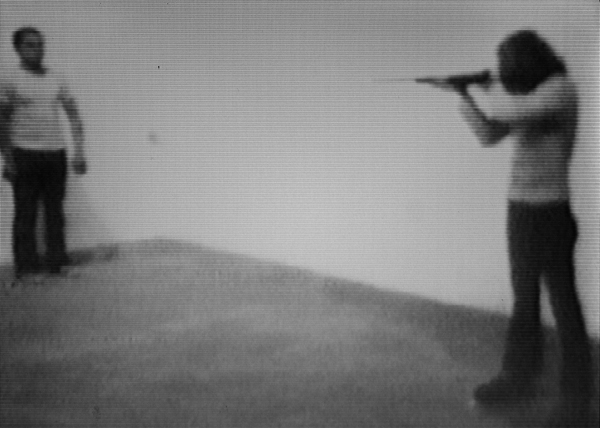
Chris Burden, Shoot, 1971. Documentation of performance.

Do you think that tattooing/tattoo derived imagery (drawings, flash, etc) is a valid form of contemporary art? Would you view it as a fine art, an occupation, or a mixture of both? Do you think a hierarchy of importance should be in place when talking about contemporary art and its applications? Read More »

Share