Elsewhere

Thank You for the Music

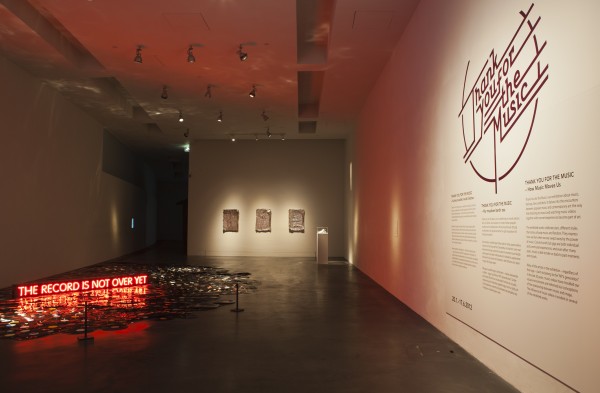
Thank You for the Music, Installation View. Image courtesy of Kiasma.

Thank You for the Music recently ended the second part of its showing at Kiasma, the Museum of Contemporary Art in Helsinki, Finland. The exhibition presents works by artists inspired by music, musicians, and the way individuals and communities experience a place, their past, and themselves, through the myths and rituals surrounding music. In particular, the notion of performance in the construction and reconstruction of an individual’s identity surfaces through several of the works in the exhibition.

Iain Forsyth and Jane Pollard, Kiss My Nauman, 2007. Image courtesy of Kiasma.

Titled in reference to Bruce Nauman’s Art Make-Up  (1967), Kiss My Nauman (2007) by Iain Forsyth and Jane Pollard is a four-channel video installation where the members of Dressed to Kill, a Kiss tribute group carefully paint their faces in preparation for a performance. With a close-up view of each member in surrounding separate screens, one stands within a zone of intimacy, gaining access to the concentration and collectedness of a musician during the period before a performance, where the putting on of a mask conceals yet reveals the bareness beneath.

Read More »

Share

London

Alexis Harding: Substance and Accident

Order and control are nothing but illusions. Underlying even the most structured of appearances, randomness and chance are at the helm, and it is these concepts that prevail in the workings of London-based artist Alexis Harding. Throughout Harding’s work, structures are shown to fail, grids collapse, and hard-edged systems give way to entropy. What began in his practice as an act of figurative negation, evolved to evoke the failures of Modernism and construct a highly performative practice that dances lines between the perception of control and the reality of chaos.

Alexis Harding, Substance and Accident, 2012, installation view. Courtesy of Mummery + Schnelle, London.

Since graduating from Goldsmiths in the 1990s, Harding has been exploring the fundamental properties of paint as the medium for his work. In layering a calculated grid of household gloss upon a base of oil paint, the surface is allowed to slide around the canvas, collapse and fall in upon itself – at times reaching a state of complete destruction as the work crumples to the floor.

In his latest exhibition at Mummery + Schnelle, Harding has traded in the dichromatic grid that dominates many of his earlier works for a spectrum of colours, but the process is still the same. While the medium he works in may be paint, the act is a very sculptural one. First laying the paint on its canvas while flat on the floor, the artist then picks the work up and moves it about his studio – intermittently tilting, turning and adjusting as the paint slides around – only after a period of time fixing into place. While there is a great deal of intervention from the artist, the results are largely dependent on chance – how the work will react and how it will fall can be highly unpredictable.

Alexis Harding, Crack Tip (Unraveller), 2011, oil and gloss on MDF, 244 x 122 cm. Courtesy of Mummery + Schnelle, London.

This process is exceedingly visible in the work – glacial in the way that the path the paint has travelled can be traced through the ridges and scars it has left on the surface below. The lines of colour in these works closely resemble an artists’ colour wheel, or the scientific spectrum of light – a bonafide rainbow collapsed by the forces of gravity.

Read More »

Share

San Francisco

The Past Haunts the Future at San Francisco’s Asian Art Museum

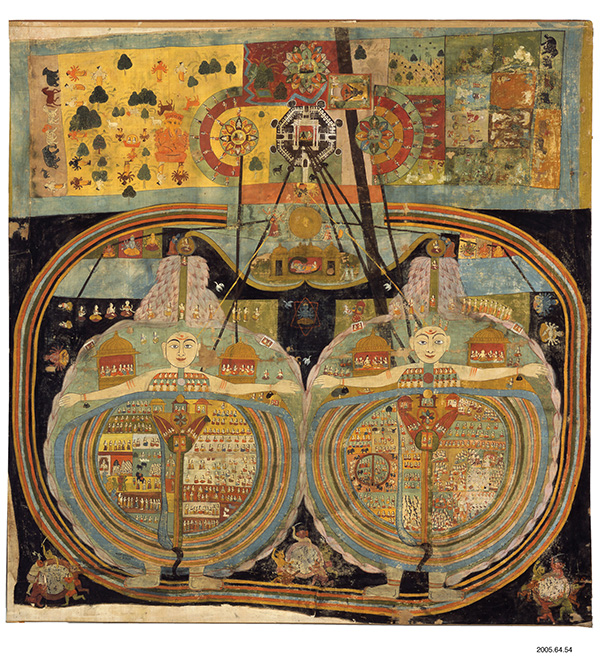
The current exhibition at the Asian Art Museum in San Francisco is my favorite kind of museum show. Phantoms of Asia combines the old, new, profound, weird, classic and kitsch in a lineup of artists that exemplifies the infinite connections between past and present. The 150 works cover such a broad range of media and time that it is hard to not be impressed by the fluidity between the pieces. Maybe this is because, according to Jay Xu, the director of the museum, “All work is contemporary when it’s made.” Or perhaps it’s the truly fascinating patterns and connections that arise when we are given the luxury of retrospection.

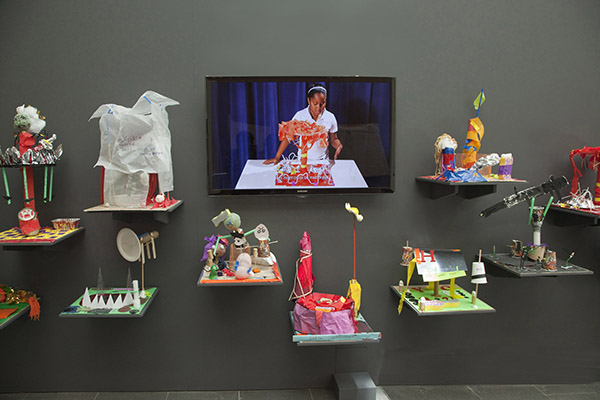
The first piece that caught my attention was Takayuki Yamamoto’s What Kind of Hell Will We Go. Takayuki presented a group of Bay Area children with a painting depicting the Japanese myth of hell, after which each young artist created his or her own hell narrative and accompanying diorama. While I do not think that all children’s art is great (sorry, moms and dads), there is an undeniably profound phenomenon that occurs when the unadulterated freedom of childhood confronts ideas like mortality, or good and evil. In one example, titled “Bad Word Hell,” the speaker of bad words is repeatedly burned and then thrown in with the sharks. The piece alludes to the way in which children cope with the things they learn about the world, and how those ideas can be treated playfully while also acknowledging their seriousness.

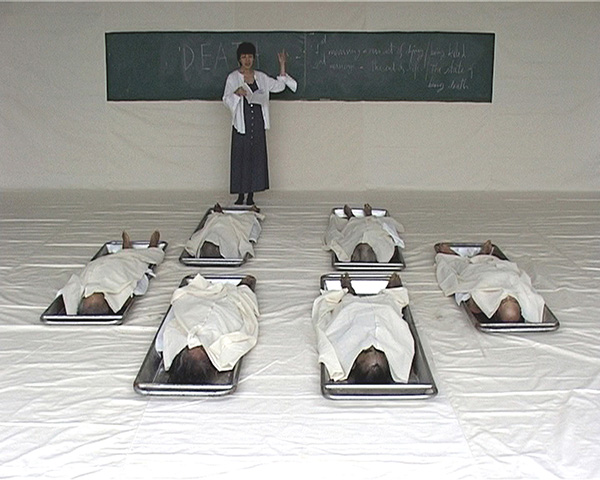
In the adjoining room, Araya Radsjarmrearnsook’s single-channel video, The Class, takes a moment to figure out. The video was shot in an almost featureless room, draped in white cloth, with a long, thin blackboard across which someone has written “DEATH.” The teacher, Radsjarmrearnsook, lectures six figures lying on the ground, which are covered in white cloth. They are dead, and after taking in the scene I began to listen to the content of the lecture. It becomes clear that Radsjarmrearnsook is talking to the cadavers about death. Initially I chuckled to myself, and I’m sure the absurdity is not lost on any of the viewers, but the more I listened, the more I realized that the topics up for discussion were things that we all might like a chance to consider after our hearts stop beating. The video invites viewers to consider the quality of being dead, and the issues a dead person might encounter in a purgatory such as the one created by Radsjarmrearnsook. In a sense, Radsjarmrearnsook enrolls the viewer in an accelerated course, encouraging her students, which now include both the cadavers and the museum audience, to question their notions of self within this life.

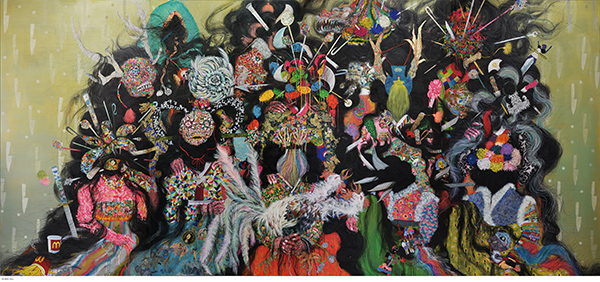
Because of the volume of the exhibit, Phantoms of Asia demands that you clear your schedule before your visit. Not only are there many different works to see, but you’ll want to spend more time examining each work’s intricacies longer than the average twenty to thirty seconds most people allot for looking at art. Hyon Gyon’s painfully detailed, Hello! Another Me, for example, combines traditional and contemporary aesthetics and content in such a way that you could spend hours looking at its mystical monsters, surrounded by everything from sword hilts to McDonald’s fries and soda.

While I’ve only scratched the surface of Phantoms of Asia in this review, suffice it to say that the exhibit succeeds in connecting work made by contemporary Asian artists with the historic and masterful works of their ancestors. Themes of Asian cosmology, life, death, and ritual, as well as the relentless exploration of the unknown, flow from the works exhibited, giving viewers insight into a way of thinking that is very different than what we’re used to in the West. Phantoms of Asia will leave you haunted with a sense of wonder.

Share

Help Desk

Help Desk: Studio Visits, part 1

Help Desk is an arts-advice column that demystifies practices for artists, writers, curators, collectors, patrons, and the general public. Submit your questions anonymously here. All submissions become the property of Daily Serving. Help Desk is co-sponsored by KQED.org.

.

As an independent curator also affiliated with the programming of a commercial space, I often find a strange tension during studio visits as to whom the visit is on behalf of. As clearly as I try to communicate that my interest is for personal projects, I frequently find myself reiterating in future correspondence that I am not in fact offering representation or an exhibition opportunity on behalf of the gallery. What is the best way to navigate this sort of conflict without being misleading to the numerous artists I have the pleasure of visiting? While it seems appropriate to communicate this before we even meet, I also feel conflicted as to how an immediate disclaimer reflects on my attitude/open-mindedness. Any advice as to timing and phrasing would be a tremendous help!

Your position is a tricky one, and I appreciate that you want to be on the level with the artists whose studios you visit. It sounds like the message you impart about your role isn’t always being taken seriously, and I wonder if some of the artists you are visiting have clogged ears or an overdeveloped sense of optimism. Perhaps despite all the evidence to the contrary they think that you are just testing them, humbly disguising your real intentions to offer them a solo show at your employer’s gallery if the visit goes well.

John Baldessari, Man with Blue Shape, 1991. Photograph, 77.5 x 122 cm

In any case, it’s going to behoove you to be confident and direct with your message. I know that artists can sometimes seem misguided, but since you say you feel conflicted about making disclaimers, I wonder if you are really being as forthright as possible? You can avoid confusion or hurt feelings by stating your intentions candidly. By making sure that you convey your specific and limited role when you make the initial contact for the visit (by email, that way it will be in writing), and again in person when you begin the studio visit, you can avoid a miscommunication. You don’t need to feel conflicted about this. Personally—and I suspect I am not alone in this opinion—I would rather work with a curator who speaks plainly about her position and interest.

In writing, you might try something like, “Though I do work for Gallery X, my interest in your work stems from my own curatorial practice, independent of my employment.” In person, you might want to start the conversation with, “Just so you know…” “Before we really get into it, I’d like to make it clear that…” or “Because of some confusion in the past, I want to clarify…” By reiterating your position in person, I hope you’ll drive the message home. If you think you might be uncomfortable saying something like this, rehearse it with a friend or in front of a mirror. When you deliver your lines, check to make sure that the artist is nodding or otherwise indicating comprehension before you move on. If an artist asks you about representation or other opportunities at your employer’s gallery, you can just say, “Unfortunately, I don’t have that kind of decision-making power.”

If you’ve outlined your position twice, in writing and again face-to-face, and yet need to reiterate your intentions to a particular artist it might be a warning sign that this person will be difficult to deal with in the future.

John Baldessari, Two Whales (with People), 2010. Screenprint on paper, 32.25 x 23.60 in, edition of 50

I am an emerging artist in the process of a minor transformation and I could use a little advice. For the past ten years I have made sculptures and installations that are mechanically and technologically very complex. Because of this I have always maintained a large studio/workshop filled with tools, equipment, and materials. Lately I have begun to find this approach burdensome in terms of the resources it requires and the accumulation of physical objects that is its natural result. Therefore I have begun to make work that is immaterial and doesn’t require the infrastructure of a studio, like single channel videos, web projects, etc. These projects are working out for me and I am considering ditching my studio altogether. My question is: Can a contemporary artist expect to be taken seriously if he doesn’t maintain a studio? How might I deal with studio visits with curators/gallerists etc.? Am I being hasty and reactionary?

Many artists have gone through a sea change, abandoning one body of work in favor of something new. In 1970 John Baldessari famously burned all his early paintings and made work from the ashes before turning the bulk of his attention to appropriation and photography. Perhaps you are undergoing the same kind of transformation.

It’s not for me to say if you are being hasty and reactionary—that’s an issue you can puzzle out with the friends who know your practice and your work well enough to judge. In fact, it’s difficult to give you hard and fast advice without knowing exactly how you arrived at your decision to stop making sculptures and installation. You might be going through a phase, or you might be on the verge of a whole new life. How do you feel about commitment? If you like to change your style or job frequently, you might want to wait and see what happens before you dump your studio. If you’ve been rocking the same M.O. since high school and tend to follow a course for a long time, this might be an indicator that your days as a sculptor are truly over. Only you can decide if this is a long-term decision or a temporary state of mind.

John Baldessari, The Pencil Story, 1972-1973. Two B-Type prints on board with colored pencil

Can a contemporary artist be taken seriously without a studio? Well, it depends on what kind of artist you are. I can envision, for example, a social practitioner who claims the world as her studio, and I can see the curators of the next Documenta taking that kind of thing very seriously indeed. If your work is strong you can get away with a lot, and I think you could certainly make a case as a conceptual/non-material artist for not needing a physical studio.

But is there a middle ground here, even a temporary one? If you are making videos and want to show them to curators and gallerists you’ll need some sort of place to meet and talk. This could be a spare room in your house or a cleared-out corner of your apartment. You could also consider renting a small space in a large, shared studio or office where you could put a desk and chairs, a place where you could receive visitors without having to clean your bathroom and tidy up your living area. If you have an exhibition, ask the gallery if you can use the exhibition space as a meeting place during off hours. Then you can tour visitors through the exhibition as well as use your laptop or website to show them images of other work.

Perhaps you can put your tools and equipment into storage for a while. It’s cheaper than renting a studio and you can always go back to it if you change your mind. Like the box you never open after moving, if you haven’t gone to your storage space in, say, a year or two, you might feel comfortable letting go of what’s inside. Good luck.


Share

From the Archives

Next to Nothing/I Can’t Work Like This

The tenuous/fluid/confusing relationship between art works and the art market have been on my mind a lot lately. So for today’s dip into the DS Archives we take another look at the 2011 exhibition, Next to Nothing: On the Price of Nothing and the Value of Everything at SWG3 Gallery in Glasgow and compare it to the upcoming exhibition I Can’t Work Like This at Casco in the Netherlands.

The following article was originally published on November 29, 2011 by :

Next to Nothing: On the Price of Nothing and the Value of Everything is an exhibition by Black Dogs, an art collective comprising members based primarily in Leeds and London that interrogates the notion of art produced for social transformation and develops platforms for art production and presentation to exist outside and against the values of a capitalistic art system. This approach is apparent both through the issues represented in their projects, as well as their methods of self-organization that emphasize collaboration and not-for-profit motives. Next to Nothing, resulted from a series of collective meetings around notions of value and led to the exhibition in Leeds. This second edition is currently presented at the +44 141 Gallery, SWG3 in Glasgow till 2 December 2011.

Lisa Bristow and Christian Lloyd, Destination Goods; Courtesy of Black Dogs

Read More »

Share

New York

On View This Summer at MoMA PS1

MoMA PS1 is an art institution reputable for its exhibitions and events that inspire an unparalleled contemporary dialogue in both the United States and internationally. It’s building – a recovered and repurposed public schoolhouse – alone commands a stamp of novelty. The exterior recalls an architectural era that predates the now ubiquitous rolling glass façades with its sumptuous terra cotta bricks and ornate eaves. It’s interior has been re-appropriated for the use of gallery spaces, but the public school skeleton is still exposed, if not the point for inspiration for the building as it stands today. To refer to it as a museum seems ill fitting, as PS1 functions within its own category of gallery cum project space – and in this way it achieves a unique level of accessibility within the public sphere.

Edgardo Aragon, Family Effects (2007-9), Solo projects by Rey Akdogan, Edgardo Aragón, Ilja Karilampi, and Caitlin Keogh. MoMA PS1, 2012

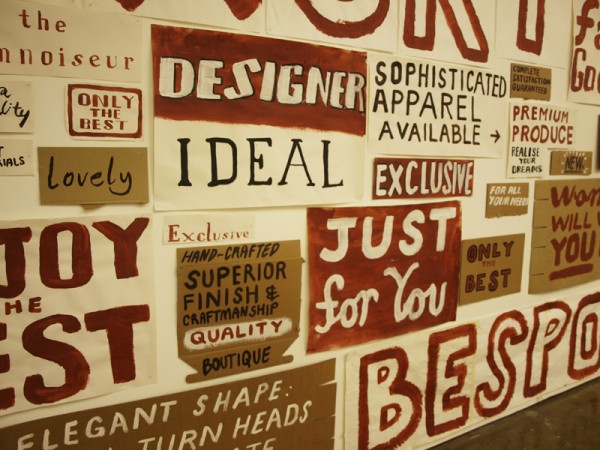
Last weekend, PS1 initiated (or more revived) their concept for a project exhibition space, showcasing solo projects by predominately young emerging artists who have not previously shown in New York. This summer’s PS1 projects are Rey Akdogan’s off set (b. Germany, 1974), Edgardo Aragón’s Efectos de Familia (Family Effects) (b. Mexico, 1985), Ilja Karilampi’s The Chief Architect of Gangster Rap (b. Sweden, 1983), Caitlin Keogh’s Good Value, Fine Quality (b. United States, 1982) are presented in four individual rooms to mimic the notion of the artist studio. Edgardo Aragón’s Family Effects (2007-9) is not to be missed: a 50 minute film projection set in Mexico depicting the younger generation of his family (cousins, nephews, etc) acting out (or rather, reenacting) episodic scenarios in which family members of older generations have been murdered due to drug trafficking, corruption and the like. Some sequences are explicit while some remain abstract in rendering the tales of untimely death attached to illicit wrongdoings that have plagued his family – and symbolically Mexico as a whole – through the actions of his adolescent performers as semi-ignorant puppets. Another noteworthy work is Rey Akdogan’s 35mm slide projection in which she assembles slides by way of collage, rather than photographic processes, from mundane materials such as plastic bags or theater lighting gels. She works with these individual materials until they are exhausted, creating a uniquely varied composition in each slide, allowing the amount of the medium to dictate her end point. He work deals with transparency and the manner in which light adds a happenstance dimension to her deliberate process.

Esther Kläs, (5) RA (2012), Concrete, pigment, wire mesh, 86 1/2 x 12 1/2 x 17 1/2 in, courtesy of MoMA PS1

On the third floor, Esther Kläs:Better Energy  (b.Germany, 1981) presents a solo exhibition of sculptures that reflect the artist’s body. The majority of her pieces mirror the artist’s own height and stand as a vacant rectangle structure. With works such as (5) RA (2012), the sculptures entomb the negative space and thus evoke the body in its body-perfect dimension. Many of her castings include color as an initial process: pigments are added to the setting cement or resin, which adds an aspect of unpredictability to the final piece. The crude structures and abstract sensitbility of her pieces are reminiscent to Phyllida Barlow, Eva Hesse and stylistically l’art brut of Jean Dubuffet.

Read More »

Share

Los Angeles

Slacker Art

L.A. Expanded: Notes from the West Coast
A weekly column by Catherine Wagley

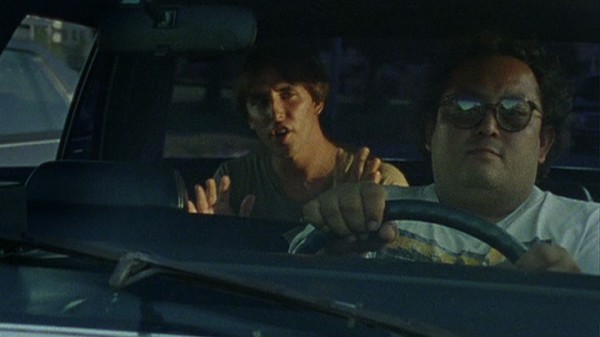
Still from the opening sequence of Linklater's Slackers (1991)

Did you ever read Jack Bankowsky’s 1991 Artforum essay on slacker art? It’s a pretty good one, called “Slackers” after Richard Linklater’s very slack, brilliantly drawn-out film, also called Slackers and out in ’91. Linklater’s film begins with a monologue by a young guy (played by Linklater) with a bowl cut. He leaves a bus station in a taxi, describing a dream he had on the bus to a driver who really doesn’t care: “I was just traveling around, staring out the windows of buses . . . flipping through channels, reading. I mean how many dreams do you have when you read? Man, there was this book that I read — or, it was my dream, so I probably wrote it or something — but the premise was that every thought you have creates its own reality.” So, like, in The Wizard of Oz, when Dorothy and the Scarecrow try to decide which way to go, every way they don’t choose becomes an alternate life path they take in an alternate dimension.

Bankowsky, who was about to be Editor-in-Chief of Artforum then, starts his essay with a description of Linklater’s film and of the slacker in general: “everyone speaks a debased or hybrid argot, worships at their own jerry-built altar, proselytizes for a private religion. . . . The slacker is the flip side of the hyperfunctional persona Madonna presents in Truth or Dare. . . . doomed to wander an affectless void unredeemed.” Linklater’s film is the perfect example of Slacker art because his “camera is just as hapless as the subject it focuses on,” but there are a number of visual artists too who, instead of being the flip side of Madonna, are antidotes to the super slick ‘80s artists of which Jeff Koons remains the best known. These artists — Karen Kilimnik, Jack Pierson, Laurie Parsons — have “a nose for the fissures in this dream of surface.”

Laurie Parsons' sculpture Troubled (1989).

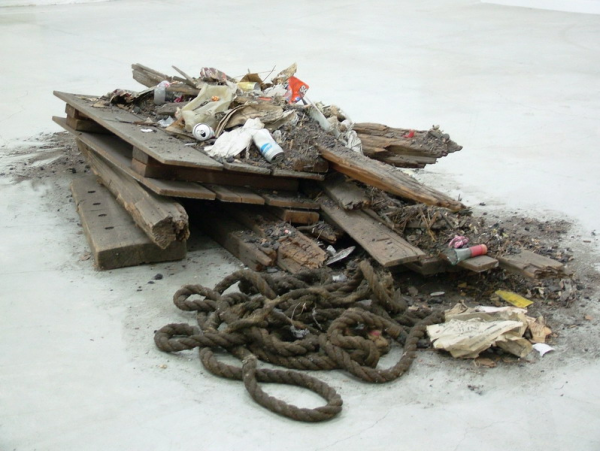
The best part of Bankowsky’s essay comes about four pages in, when he briefly tricks us into thinking Laurie Parsons is the villain of the slacker trend (read the piece “Dematerial Girl” too, by the way, about the disappearance of Parsons from the art world). He has just praised Pierson for seediness and shiftlessness and fracturing, when he turns to Parsons’ 1990 installation “Stuff” of junk from her mother’s closet. He talks about how her installation “screams hippie,” then about how awful she can sound when talking about her art. “When she talks about her work/life, her language is littered with icky humanist sentences,” Bankowsky writes, and gives a few examples about how Parsons uses the word “honest” or talks about working outside the institution of art. But just as soon as he’s made her sound unaware and sappy, he reminds us that slacker art can have no villain since it doesn’t really stand for anything particular. Parsons is caught in the fissures between art and life, which isn’t a bad place for slacker artists to be, and her inability to articulate herself doesn’t matter at all when her art does its job.

So, it has been 21 years since Linklater and Bankowsky mused about the slacker. Slacker art still pops up pretty often though, sometimes so much that it stops feeling like a cracking or fracturing and starts to feel like the status quo. The most recent instantiation has been slacker minimalism, art of found or weirdly unrelated items put together with the elegance of minimal sculpture: Lara Schnitger, Caroline Thomas, etc. Self-conscious underproduction trumps over production. Is this getting old? Is it time to stop slacking?

Alice Channer, Cigarette Pants (purple) and Cigarette Pants (cream), 2012. Cast and powder-coated aluminum and oak dowels, 2-part . Courtesy Cherry and Martin and the artist.

But occasionally I see a new, kind-of-slack project that excites me with its forcefulness. This happened recently, at Cherry and Martin gallery’s current group show, curated by artist Marc Hundley and called Look Here Upon this Picture. In that show, London-based Alice Channer has these Cigarette Pants hung on dowels. Cigarette pants are usually the slim fit slacks like the ones Audrey Hepburn wore in Breakfast at Tiffany’s and Funny Face. Channer’s are cast powdered aluminum ellipses that must be the approximate circumference of a small waist and legs. They hang from the dowels like loose fabric, listless but specific and smartly made. Can you be hyperfunctional and still wandering, sniffing out fissures?

I remember seeing Channer in a video made by Art Review two or so years ago, walking through an exhibition of hers at The Approach in London.  She stopped by some big sheets of water worn paper she had hung two sheets deep. She pointed to the gap between the two papers — “This gap here is important” — then pointed to the gap between the back paper and the wall — “And this gap here is important.” She said so in a way that made you sure the dream of surfaces is still worth undermining.

Share