London

Jacob Hashimoto: Paper Paradise

American born Jacob Hashimoto’s eye-catching exhibition, ‘The Other Sun’ at London’s Ronchini Gallery in Mayfair certainly brings to mind planetary brilliance in colour and splendour. Hashimoto uses traditional kite-making materials and techniques to create singular, modular units collectively arranged into numinous, monumental installations and smaller, woven, three-dimensional wall pieces. Hanging by threads, the thousands of multicoloured translucent kites are hand-made with rice paper and bamboo, each tiny kite delightfully constructed with exacting care. Elegant white, solid gold or patterned, the cascading assemblage of kites moves like a flowing river of shimmering colour, rolling through the space with extraordinary buoyancy and energy. It’s difficult for the eye to focus on an individual kite without getting lost in the whole, all-encompassing space. Some of the more decorated kites are like tiny paintings; each ‘superflat’ composition floats above or below its surrounding neighbour, intrinsically incorporated into the design like the patterned scales of a fish.
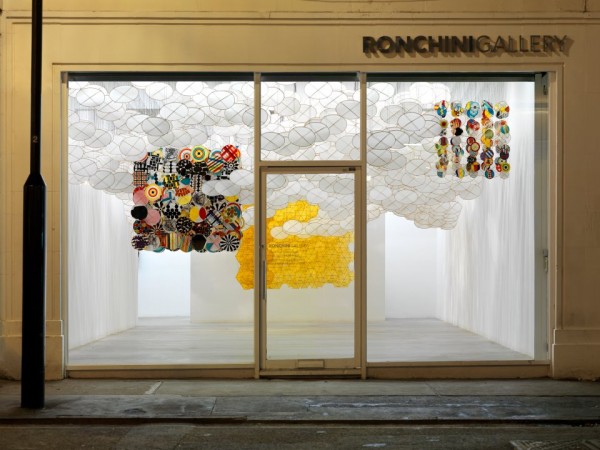
Ronchini Gallery exterior. Photo Courtesy of Michele Roberto Sereni and Ronchini Gallery.

At the entrance to the gallery, Hashimoto’s large-scale installation flows into motion with a subtle, meditative rhythm as I open the glass door and pass underneath. It conveys a sense of wonder and playfulness as the texture, lighting and angle of the work shifts and changes while traveling through the speckled environment. While meandering beneath, the bright, fluttering work reveals itself to be an illuminated, celestial landscape borrowed from traditional Japanese painting or Manga animation – each viewer becoming a figure suspended in a handcrafted paper paradise. The temptation to reach out and touch is too much for most, and many forfeit at least to blow a small breath of wind out, causing a delightful tremble to ribbon through the work.

Jacob Hashimoto installation at Ronchini gallery in London. Photo Courtesy of Michele Roberto Sereni and Ronchini Gallery.

The artist’s smaller works, hanging like wall paintings near the back of the space, are more like high-relief installations with tea saucer sized kites strung to each other, interwoven tightly and tied to wooden rods driven into the walls. Each kite stands at attention from the taught, pulled strings and vibrates and dances with any change in the wind (or the fanciful breath of the playful admirers.) Many seem like cartoonish landscapes, each kite a bulb of a swirling cloud or wave traveling along the surface of a sapphire blue ocean. Among the organic and ovular shapes, another more subtle work stands out in its geometric, dynamic lines like an ice colored, slender vertical waterfall of translucent paper bow-ties, sprinkled with a smattering of colored confetti.

On The Nature of Heroes, 2012 122 x 122 x 20 cm bamboo, paper, dacron, acrylic. Photo courtesy of Ronchini Gallery.

Incorporating craft, design, sculpture, installation and painterly abstraction, Hashimoto’s collective fluttering installations are buoyant, ethereal and celebratory – somehow traditional and modern at the same time. It is refreshing to say the least to attend an exhibition whose primary concern is with experiencing beauty. Hashimoto’s installation seemingly pours out into the street through the gallery’s windows to delight passerby’s and brighten the grey summer days of London.

JACOB HASHIMOTO: THE OTHER SUN

Jacob Hashimoto, in collaboration with Studio La Città, 29 June – 28 August 2012.

Ronchini Gallery, 22 Dering Street – Mayfair, LONDON W1S 1AN +44 (0)20 7629 9188 info@ronchinigallery.com

www.ronchinigallery.com

Share

Sydney

18th Biennale of Sydney Part II: Cockatoo Island and the Museum of Contemporary Art Australia


Jonathan Jones, Untitled (Oysters and Tea cups) 2012, oysters and teacups, dimensions variable, Courtesy the artist

Disembarking visitors to the 18th Biennale of Sydney at Cockatoo Island first encounter fog rising from a crevice between sandstone cliffs and the island’s abandoned buildings. A site-specific work by Fujiko Nakaya, it exemplifies the intentions of the artistic directors  – to open our senses to water, wind, and earth. Jonathan Jones, of the Wiradjuri and Kamilaroi nations, created a midden of oyster shells and porcelain teacups,  a poignant reference to the original inhabitants, the Gadigal and Kameraygal people, and to their colonisers. It speaks of memory and loss embedded in the landscape, and of how everyday objects attain a significance beyond their materiality. Ed Pien’s ethereal ‘Source: Corridor of Rain’ provokes a sense of wonder. A labyrinth of interconnected chambers with walls made of translucent paper, onto which shadowy changing images are projected , it is an immersive and magical environment. Peter Robinson’sSnow Ball Blind Time’ is an enormous structure of machine parts, wheels, cogs and heavy chains carved, preposterously, from polystyrene. He says of his chosen material, “Its industrial neutrality is fraught with a sense of massive inauthenticity.”

Peter Robinson, ‘Snow Ball Blind Time’, 2008 (installation), polystyrene, 250 x 300 x 120 cm, Courtesy the artist and Govett-Brewster Art Gallery, New Plymouth, Photograph: Bryan James

Notions of fragility, disposability and ephemerality imbue many works – there is a dominance of paper and fabric, from yards of silk died with Fanta, to woven textile constructions, to Monika Grzymala’s collaborative project with the Aboriginal artists of Euraba Papermakers, an installation of delicate paper forms swooping from the ceiling, transforming the grimness of the space. In Sachiko Abe’s performance  ‘Cut Papers #11’ the artist silently cuts paper into long strips. The sound of her scissors and the slight movement of the paper in an otherwise silent space make for a mesmerising experience.

Li Hongbo’s ‘Ocean of Flowers’, a room filled with brightly coloured folded paper forms, at first evokes lanterns and Chinese folk art. On closer inspection, however, these objects are revealed to be AK47 machine guns and bullets, inviting us to consider the seductive nature of violence. Jin Nu’sExuviate 2Where Have All the Children Gone’ consists of twenty tiny starched children’s dresses, turning gently in the slightest air current. The artist denies any intentional connection with China’s one child policy, and the many little girls who were never born as a result. But discarded clothing, especially children’s clothing, inevitably evokes  mourning, suggesting the passage of time and the fleeting nature of childhood.

Li Hongbo, Ocean of Flowers, Ocean of Flowers 2012 (detail), paper, dimensions variable, Courtesy the artist

Back on dry land, in the MCA, highlights include ‘Anything Can Break’ by Thai artist Pinaree Sanpitak. As you walk beneath hundreds of origami cubes and breast-shaped glass clouds, motion sensors trigger music. Lee Mingwei’s Mending Project’ invites visitors to bring an item to be repaired with one of the colourful spools of thread attached to the gallery wall. The artist chooses a colour which makes the mend obvious, as a way of celebrating the act of repair. It will then remain attached to the wall by its thread until the close of the exhibition, when it will be returned to its owner.

Read More »

Share

Portland

Thomas Zummer at PNCA

In Thomas Zummer’s partial retrospective of works I should have done, on view at PNCA’s Philip Feldman Gallery, things are not what they seem. For starters, the show is more replete than it sounds. The Brooklyn-based writer, artist, teacher, and curator presents an assortment of drawings, prints, and sculptures spanning his career. The pieces are a motley crew: portraits of robots butt against blurred, interstitial screenshots from well-known films. What binds the show is a sense of translation, addressing the reception and evolution of images rather than their making–an aesthetic further hinted at by Zummer’s titles, which have been scrawled in pencil on the gallery wall.

Thomas Zummer, “Portrait of ‘Elektro’ Smoking,” 2001, graphite, carbon on paper, 22x30 in.

Zummer often blurs mediums, leaving no real distinction between a drawing and a photograph. Photorealistic drawings done in carbon, pencil, and pigment dominant the show. The stark, monochromatic photorealism recalls Gerhard Richter and Luc Tuymans, except that in place of their grim imagery, there is often humor. In a sculptural piece titled “An Essay on Potatoes”—an essay literally written on potatoes—Zummer’s scrawls highlight the position of potatoes in past philosophical texts.

Thomas Zummer, "A partial retrospective of works I should have done," 2012, installation view. Image courtesy of PNCA.

All images in the show refer to another source; all are translations of an initial image, a fact made clear in the titles—specifically in a portrait of experimental filmmaker Leslie Thornton, called “Drawing of a Photocopy of a Laminated Passport Photo.” This copy of a copy is hazy and painterly due to all of its iterations. As with much of Zummer’s work, the viewer’s awareness is most attuned to the space between the initial capturing of the image and the reception of the image. To bring home the point, Zummer includes a series of archival inkjet prints featuring interstitial frames from movies like Hitchcock’s The Man Who Knew Too Much and Tokyo DecadenceRead More »

Share

Help Desk

Help Desk: Various Unpleasant Situations

Help Desk is an arts-advice column that demystifies practices for artists, writers, curators, collectors, patrons, and the general public. Submit your questions anonymously here. All submissions become the property of Daily Serving. Help Desk is cosponsored by KQED.org.

I have a collector friend who recently went into a gallery to acquire a new piece for his collection. He was prepared to pay cash and was surprised when told by the gallerist that the piece was not available (there was no indication on the exhibition list.) However, that was incorrect—the piece was available and was then offered to another collector who declined (a friend of the original collector). Why did the gallerist misinform the original collector? (The piece was also never offered to him later.)

It turns out that selling artwork is a little like getting rid of a cat. Some folks will hand the beast over to anyone, and some are more protective and want Mister Mittens to go to a “good home only.” It sounds like your friend fell victim to the latter.

Not one to rely on my own conjectures, I contacted some gallerists to confirm that this is indeed the case. One well-respected New York gallery director suggested that we first consider another possibility: “It’s impossible to know exactly what transpired when the one collector was not able to purchase an artwork which was offered later to another collector. To give the gallery the benefit of the doubt, it’s feasible that the work was on reserve when the first collector inquired and was offered later once the reserve was removed. (That doesn’t explain why the first collector was not contacted in advance of the second collector, of course.)”

David Kramer, My People, 2012

However, he continued, “More likely the gallery was being selective regarding to whom it would sell the piece. Galleries often prefer to sell works to collectors whom they know or know by reputation. If the gallery is representing the work of an artist or estate, it will want to be sure that pieces are placed in collections that are known to be responsible and safe homes. As such, it’s not unusual for a gallery to give preference to certain collectors over others.”

Another long-standing gallerist in Seattle explicated further (in an admirably straightforward manner): “The gallerist was giving the work to a preferred client or to someone who he felt had more potential…This kind of issue is more prominent when an artist is particularly hot or poised for some kind of success. And when a dealer has worked hard to put an artist on the map, they tend to get more guarded about where the work ends up.” And voilà, Mister Mittens now lives with Madame and Monsieur Posh and not with your pal.

If your friend is really serious about collecting work by this artist, he has a couple of options: he could ask again about the same work to see if it remains unsold; or inquire about other works by the same artist; or see if the artist is represented by a different gallery. Call me naïve, but I think it might not hurt to have another (polite) conversation with the original gallery. If one needs to prove one’s seriousness as a collector before being admitted to the inner sanctum, one must start somewhere. Bonne chance!

David Kramer, exhibition view of “Untitled (Because I am not Richard Prince…” at Galerie Laurent Godin, Paris, 2010

I recently moved to a new city to start a full-time university teaching job in my field that a lot of people had been competing for. I was relatively unknown among the local arts community before arriving and was surprised to find a lot of antagonism directed at me from people I had never met before. Most people that know me or have worked with me like (or at least respect) me and I think that if these new people at least give me a chance, they would find that I’m not so bad. Instead, I’ve had vicious rumors spread about me (about inappropriate affairs with students), extremely uncomfortable lectures and studio visits with students at other local institutions, and a general sense of ill will. I wonder if there is anything I can do to smooth things out, but it seems weird that I should have to go out of my way to placate people who are giving me a hard time for no reason. Ultimately my feelings are just kind of hurt.  Can I really write this off to professional jealousy?

Let’s just cut to the chase: yes, it is weird to placate a bunch of meanies. Of course you are hurt. And yes, you could write this off—but you’re not going to.

Read More »

Share

From the Archives

Let’s Talk Brazil

Today from the DS Archives we bring you many things Brazil. First we point you to the huge group exhibition Art of Contradictions. Pop, Realisms and Politics. Brazil – Argentina, 1960 on view at Fundación Proa from July 14–September 2012 and features 100 works by 58 artists. Next we revisit the 2011 article We Operate in the Vacuum, and Other Tales which discusses temporary art spaces in Brazil.

The following article was originally published on July 30, 2011 Written by :


Ronald Duarte and Abel Duarte, Images courtesy of Pedro Victor Brandão

Read More »

Share

Kassel

dOCUMENTA (13) spaces: Kulturbahnhof

Functioning as an “exploded museum,” as curator Carolyn Christov-Bakargiev calls it, the hundreds of artworks of the dOCUMENTA (13) are housed in venues near and far. Beyond Kassel, Germany there are dOCUMENTA happenings in Kabul, Afghanistan, Cairo, Egypt, and in Banff, Canada. Within Kassel, the exhibitions are taking place in the Karlsaue park, at the historic Fridericianum (claiming fame to being the first public museum in Europe), at the Neue Galerie, the documenta Halle, and the Hugenotten Haus, to name a few. One appropriately less conventional exhibition space is the Hauptbahnhof, also known as the Kulturbahnhof.
Kulturbahnhof Kassel
The Hauptbahnhoff of today is a cold and minimalist structure, much changed since its original Romantic Classic style build in the mid 1850s. What was once Kassel’s main train station was largely destructed during the bombings of WWII after which it was reconstructed in a more modern mid-century style. When Kassel’s main train lines relocated to the Wilhelmshöhe train station in 1991, the Hauptbahnhof was abandoned and left with plenty of unused space. In the mid-1990’s the central station became known as the Kulturbahnhoff and was converted into a space for cultural events: galleries, a cinema, and an architecture office.  The documenta has utilized the venue before, but never quite as creatively choreographed as the dOCUMENTA (13).The raw and gritty aesthetic of the Kulturbahnhof lends to a fitting contemporary feel for the cutting-edge works on view here. The unrefined architecture is like a neglected warehouse and the art has plenty of breathing room. Christov-Bakargiev greatly concerned herself for conceptual and physical space in her curation, her attraction to empty rooms and transition areas is evident in each dOCUMENTA venue. At the Hauptbahnhof one encounters the works as individual exhibits and is allowed time for digestion and reflection on walks between train tracks.

One of the most exciting and applauded works at the Hauptbahnhof is The Refusal of Time by South African artist William Kentridge. The multi-media video installation utilizes five channel projections, megaphones, and a breathing machine (referred to by Kentridge as an elephant). The piece runs a duration of 24 breathtaking minutes and beckons multiple viewings for the full experience. This audio-visual work is overwhelming in the best way. All of the senses are stimulated through the combination of a quickening metronome beat, flashing lights, flickering typography, working machinery, and a choppy narrative. Kentridge tells his story through silent film, an assortment of instruments, African ritual dance, scraps of paper, and various maps. The fear of passing time is expressed by the ticking metronome, the manipulation of untimely events in the silent films, and the alternation of audio-visual chaos with eerily soothing hymns and whispers. A must-see at the dOCUMENTA (13), this work has soul.
Share

Los Angeles

Free Chalk for Free Speech

L.A. Expanded: Notes from the West Coast
A weekly column by Catherine Wagley

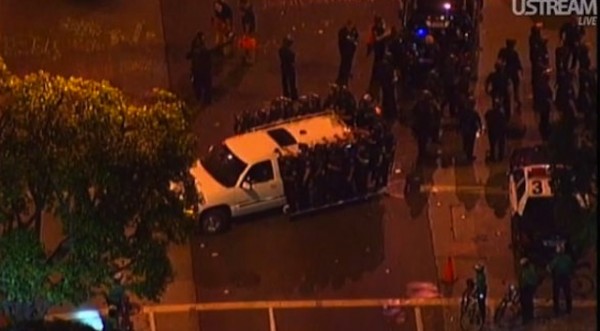
A U-streamed image from the July 12 Art Walk mayhem.

I wasn’t there last night when L.A.’s downtown Art Walk, held monthly, turned into a stand-off with police. Instead, I was on my couch, three miles away, watching it all on CBS News’ U-stream and following updates on twitter. I dozed off when there were hardly any stragglers left on the street, just a line of police across Spring Street, waiting for orders on what to do next. The voice narrating the U-stream, who sounded like the kind of guy who always sides with the underdog but isn’t always sure which side the underdog side is, was frustrated by the whole situation (“They’re going to find out this is all a big misunderstanding,” he said). He was listening to police scanners, and telling us what he heard: “What they’re saying is, they’re just going to walk away. The cops are going to leave and let the traffic come through.”

Organizers affiliated with the Occupy L.A. movement had apparently decided to stage a peaceful, creative demonstration during the July 12 Art Walk. Some activists had been arrested for chalking political messages on sidewalks in previous weeks, and a pastel colored invitation distributed via facebook said, “Free Chalk for Free Speech, Come Decorate at Chalk Walk.”

The story, according to reports published online this morning, is that Chalk Walk did indeed happen – people wrote messages like, “Prisons are overpopulated and chalking is harmless” on Spring Street sidewalks, between 5th and 6th  Street. Then there was melee, but I still can’t quite fill the gap between the chalking and the rubber bullets, injured cops, LAPD choppers and arrests. Yesterday, the forced resignation of MOCA’s chief curator caused famed artist John Baldessari to leave the museum’s board, so artist Dominic Quagliozzi jokingly tweeted, “Artworld rioting over Schimmel firing, set off by Baldessari resigning from MOCA board.” But of course, no one there was there because of Schimmel. Tweeted Charles Davis, “It’s cool how LAPD is flying multiple helicopters with searchlights because people drew on the ground with chalk.” A moment later, he tweeted again: “And just got jabbed hard in the back by a cop while complying with their order to vacate the intersection. #occupyla #Chalkwalk

Karen Finley in front of the Supreme Court.

When I went to look for news about last night’s craziness, I went first to the L.A. Time’s arts page, just instinctively – Art Walk, chalk; it’s all art-related. But of course, the newspaper’s not-so-helpful stories appeared in the local news section.

Because artist Karen Finley will be performing in Chinatown a week from tomorrow as part of the more-or-less annual Perform Chinatown event, I spent part of yesterday reading old news stories about the National Endowment for the Arts controversies she had been involved in. It’s perverse to have nostalgia for 1990, when NEA grants were being taken away because senator Jesse Helms and friends were complaining about art’s obscenity, but I do want to see more art on front pages or in section “A.”

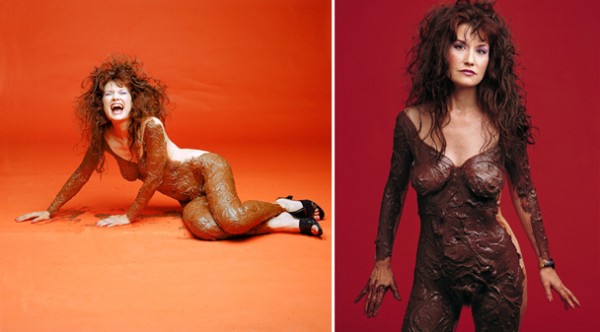
Timothy Greenfield Sanders, from "The Chocolate Shoot" with Karen Finley.

In the Karen Finley performance that made Jesse Helms particularly mad, Finley–moved by the story of a 15-year-old who was raped, covered in feces, than accused of making it all up–covered her own body in dark chocolate. Helms found this gross and indecent, and even disrespectful to women, as if Finley was committing an assault by responding to one. In 1998, after Finley lost her funding, and after she and other artists who had challenged the law that required “public values” be upheld by work receiving government grants, she did a reprise of the chocolate performance and she held a news conference during it. Still covered in chocolate, she said she had cried when she heard the ruling. “Having a start in the arts is going to be more dependent on coming from inherited wealth or making propaganda,” she said, according to the New York Times, “or being a straight white male.” Young artists who want to take risks will suffer most, she said. Has this happened? Has art retreated into safety, taking on the role of cushioned commenter more often than out-there actor?

Share