London

Uncommon Ground at Flowers East

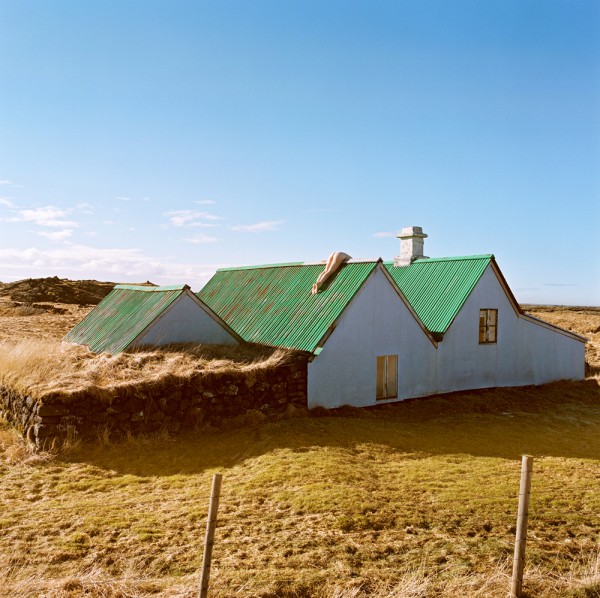
Scarlett Hooft Graafland, Green 1, 2004 C-type print, 120 x 120 cm, courtesy of Flowers, London


The state of the environment – activated by observation, exploration and intervention – is the common subject taken up by eighteen photographers included in the current exhibition at Flower East. The show’s framework is intentionally broad, stretching the term ‘environment’ to encompass both urban and rural landscapes and surveying ecological, anthropological, political, architectural and aesthetic concerns. The wide berth also allows Chris Littlewood, the gallery’s Director of Photography and the show’s curator, to bring together work by heavyweight gallery artists (including Edward Burtynsky, Andy Goldsworthy and Robert Polodori) into proximity with images from a younger generation of artists.


Installation view: Andy Goldsworthy, Street Dirt-Afternoon, West 57th between 11th and 12th Avenues, New York, March 11, (detail), 2010, Suite of 22 unique inkjet prints, courtesy of Flowers, London


Installation view: Tom Lovelace, Forms in Green, Hackney 1, 2, 6 & 9, 2011, Unique photograms, 50 x 98 cm, courtesy Flowers, London


Taking over entirely the two sprawling floors of gallery space, pictures with related concerns but drastically different approaches generate a pace and balance that grounds and elevates the newer work, on one hand, while also putting the more established images into relief, suggesting both their significant legacies and the shifting energies that seem to destabilize their authority. Without a prescribed political stance or dominating aesthetic linking the work, the relationships between images feels instinctual, agile and light-hearted.


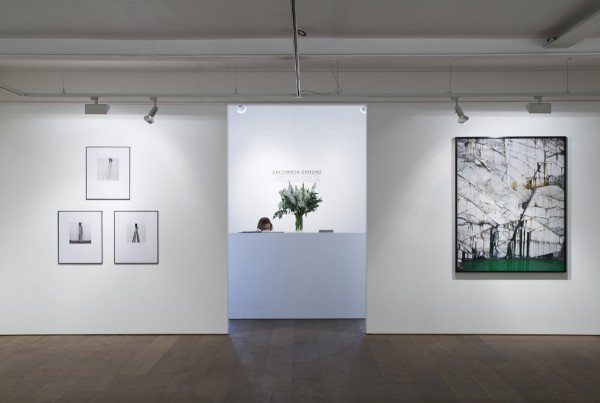
Uncommon Ground installation view


Edward Burtynsky, Rock of Ages #4, abandoned section, Adam-Pirie Quarry, Barre, Vermont, 1991, Chromogenic colour print, 152 x 122 cm, courtesy Flowers, London

This is especially true in the main space on the upper level, where work by Burtynsky, John Maclean and Tom Lovelace triangulate the space. In the corner, the swath of water below the sheer cliff wall in Burtynsky’s Rock of Ages, 1991 is a stunning racing green, an anchor for the room. It’s also a perfect foil for the work of John MacLean, opposite, which infuses flares of colour into the geometric rifts in snowy landscapes.  Read More »

Share

Hashtags

#Hashtags: Going Up at SFMOMA

#Hashtags provides a platform for longer reconsiderations of artworks and art practices outside of the review format and in new contexts. Please send queries and/or ideas for future columns to hashtags@dailyserving.com.

It was miraculous to me, only because I had never seen the space behind the doors. Yet, it was shameful, as if I had seen something I ought not to have seen and, worse, had relished the view. As if the question “Should I look?” had been answered by the act of looking before my mind could complete the question with “or not?”

The scene is precisely what a museum is not about: uncurated looking. It is also precisely what a museum is about: serendipitous discovery. The space behind the doors was as mundane as it was miraculous, usually hidden precisely because the space and its goings-on were judged more mundane than miraculous. My inspection of the space was unsuitable, because it was the equivalent of bringing the attention I should bring to the art to a trash can in the museum’s lobby. “Nut,” you might mutter had you seen me gazing, or “Poseur.”

The poster for “Stage Presence: Theatricality in Art and Media at SF MoMA,” July 14 through October 8; Photo: Saul Rosenfield, ©2012, with permission of the San Francisco Museum of Modern Art.

It seems a coincidence that the second time I saw the space, the San Francisco Museum of Modern Art was also staging an exhibit on performance art—Stage Presence: Theatricality in Art and Media. More than a coincidence, a serendipity, because when closed, the doors of the miraculous space supported the enormous welcoming poster for Stage Presence, and when opened, they revealed—what?—a tableau, a stage! And to paraphrase Chekhov’s observation—that a gun introduced into a drama must surely go off—a tableau revealed to the world must surely contain a drama, even if the plot is only in my head, even if the stage-in-waiting masquerades as a freight elevator cab.

The SFMOMA freight elevator, 4th floor landing, revealed; Photo: Saul Rosenfield, ©2012, with permission of the San Francisco Museum of Modern Art.

Moments before I saw the space, I had watched the video of Andrea Fraser’s Official Welcome (2001), a coincidence because Fraser is both a leading performance artist and a practitioner of institutional critique. Had Fraser seen the elevator space, might she have read its normally concealed, and benighted, status as diagnostic of the state of contemporary art and art museums? In Official Welcome, Fraser embodies presenters and recipients at an art awards ceremony, but she is most famous for incarnating “Jane Castleton,” the docent-character documented in the video Museum Highlights (1989). Castleton narrates for her real-life tour group the banalities of the Philadelphia Museum—the cafeteria, a water fountain, the admissions desk—as her sibling docents might have narrated the innovations of Monet, Cézanne, Jasper Johns, or Robert Adams, also on view at the museum in 1989. Jane might, I believe, reveal SF MoMA’s freight elevator cab as “a hidden gem, a space of intrigue and metamorphosis, a room in the process of becoming, whose subjects—carpenters, electricians, preparators, among others—foster the becoming throughout the museum.” Her satire might hang on the characterization of the normally unacknowledged and undervalued efforts of exhibition creation and museum maintenance as being as magical and wondrous as art creation, itself. It might also suggest that the museum is a storytelling institution, in both senses of the word: weaving truth from a conjunction of events and characters, and fiction from the assertion of a narrative truth that, alas, is always partial.

In a sense, though, the elevator performance is an opportunity not only for institutional critique, but also for the sort of possibility inherent in the museum operation itself. So, although I might criticize the strictures of the museum—the forced march structured by signs, images, and spaces: wall plaques and labels, the sequence of numbered artworks, the route from one gallery to the next—it is also true that the museum offers endless opportunities for unexpected juxtaposition and revelation. It is easy to follow the pathway in a kind of structured trance, but not so difficult to deviate, even, and especially, accidentally.

Cindy Sherman, Untitled #92, 1981; chromogenic color print; 24 x 47 15/16″ (61 x 121.9 cm); The Museum of Modern Art, New York, The Fellows of Photography Fund; ©2012 Cindy Sherman.

My experience unfolded, coincidentally, on the day I viewed the Cindy Sherman retrospective, in particular the Centerfolds series, which Sherman produced in 1981. Sherman is the consummate performance artist, although that is not how she is catalogued, and, in the Centerfolds, she appears the master of the pregnant moment, each image a one-act play depicting its climax. These vulnerable moments both encode the plot and expose my own vulnerability. They also ask, coincidentally, “Should I look—or not?” Looking, it is impossible not to feel that something is violated, whether it is the privacy of Sherman’s subjects (as the wall text observes), or of Sherman (who plays the model playing the character, but with the feeling of a subject), or, most of all, my own privacy. Yet, looking seems the only option at a museum. Certainly, it seems the only option when the freight elevator doors slide open—and, even more, when someone walks on stage.

The centerfold pictures are not, however, just about the danger of seeing. They are also about the inevitability of framing, about the constant stage-potential of living. Which is also what the elevator cab unwittingly, magnificently, enacts when it opens its doors to reveal a Chekhovian tableau. I find myself hesitating, I resolve to gaze, and the story unfolds.

The show goes on in the SF MoMA freight elevator, 4th floor landing; Photos: Saul Rosenfield, ©2012, with permission of the San Francisco Museum of Modern Art.

Even without characters, the set—an assemblage of a pallet, a sign stand, dollies, carts, a portable crane, ladders, wall panels, cardboard tubing, a chair—performs the hard work that all successful theater undertakes. It suspends audience disbelief, hanging it upon what seems to be our inclination to tell ourselves stories. It combines donated material—the set, the props, the characters, even the plot—with each spectator’s material—imagination, preoccupation, predilection—thereby achieving the feeling of consistency. The same consistency as a material that gets called “truth.” So, in the freight elevator named Stage Presence, there appears a Beckettian set, containing the instruments of our mundanity: a cell standing in, I guess, for life, furnished with the tools standing in, I guess, for the never-ending work of living, and inhabited by a character, an everyperson, standing in both for the “me” who watches and for the watched person who performs the work. Performs it apparently without complaint, accepting even the gaze of a photographer as if it were part of the task. As if his task were not even the task that requires the tools but the task that requires the gazer.

In 2006, at UC Berkeley’s CalPerformance presentation of the Dublin-based Gate Theater’s production of Waiting for Godot, I had the strange sensation of incredible hopefulness. Four people wait. For Godot. Who never comes. At least not today. Waiting, it seems, is just another word for living. The accidental companions of our waiting—geographic coincidences—are, it seems, all we have. The stage is all but barren, the language all but repetition, the action all but inert. Yet my subconscious recognizes this condition as the world that I inhabit, a world not only absurdly repetitious and pointless, but also familiar and comforting.

Waiting for Godot by Samuel Becket, performed by the Gate Theater Dublin at Cal Performances, Berkeley, November 2006; courtesy of Cal Performances.

As the elevator curtain comes down, the everyperson’s eyes glance up and then forward. The quiet repose he assumes as he sits looking out seems to represent the state of peaceful coexistence with life that I suspect we all try to pull off. Yet, as the fantastical figure pasted to the elevator door swallows the man, it also swallows that illusion: we must settle, as a last resort and at least in public, for impersonating the appearance of the peaceful by staging the impassive. In any case, that’s my story.

The experience at SF MoMA was compensation for the performance that I had failed to document at the Los Angeles County Museum of Art in February 2012. A group of, black-clad, white-gloved perpetrators—I mean preparators!—sat at a black-robed table facing the blocked entry to a large gallery, like a panel of inquisitors facing a prisoner. Each of their movements was articulated by work lights focused precisely on their hands as they cleaned the glass of pictures for the exhibition, Robert Adams: The Place We Live. If the elevator play is Beckettian, the glass-cleaning performance was Kafkaesque. Later, wandering through a different exhibition, I came upon the backside of the future Adams show, and there under the equally dramatic light, I spied framed photographs, propped up or arrayed flat, jockeying for position. A single image had made it to the wall. The performance was complete.

It surprises me that the museum has not taken advantage of the performative possibilities of the freight elevator. Imagine this procedure: the scene is set on the third floor, props and actors gathering in place in the elevator cab; the elevator rises to the fourth floor, actors on their marks; the doors rise signaling the beginning of the action and fall signaling its end. I have imagined requesting the space for a performance piece myself. There is, though, something precious about the impromptu performance I observed that would be lost in a planned performance, something startling, improvised, not by the elevator inhabitant—his action seemed planned, repeated a dozen times before—but by me. My mother, who accompanied me, thought the elevator man was engaged in a performance piece. In any case, that’s her story.

The dénouement; Photo: Saul Rosenfield, ©2012, with permission of the San Francisco Museum of Modern Art.

Rob Marks writes about the nature of the aesthetic experience and the effect of the aesthetic experience on self and society. He received master’s degrees in journalism from UC Berkeley and in visual and critical studies from the California College of Art, and is the Publications and Training Manager for the Alliance Health Project of the University of California, San Francisco.


Share

Help Desk

Help Desk: Appropriation and Appropriateness

Help Desk is an arts-advice column that demystifies practices for artists, writers, curators, collectors, patrons, and the general public. Submit your questions anonymously here. All submissions become the property of Daily Serving. Help Desk is cosponsored by KQED.org.

If you were intrigued by last week’s Q&A regarding negative reviews, check out this well-argued example on Art Practical.

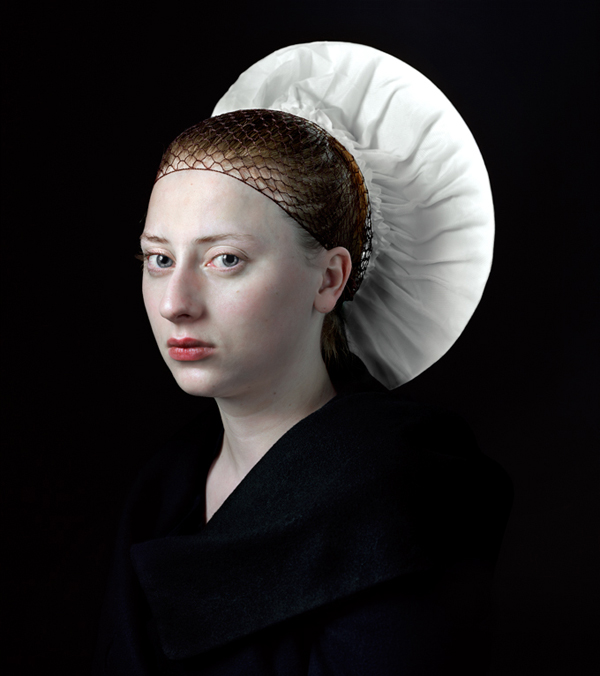
I’ve been noticing recently that there is a lot of portrait photography based off of or inspired by paintings, often times without anything changed or altered. What is accomplished by this? What new ideas can copying an existing piece of art bring to the table? I was thinking of Hendrick Kerstens’ series of his daughter based off of Flemish Dutch paintings, or perhaps Cindy Sherman’s history portraits.

Kerstens’ work is an interesting example. He uses his daughter as a model to restage 17thcentury Flemish paintings, but I would argue that even though there is an obvious reference, quite a lot is changed. Despite the similarities in the model, costumes, light, poses, and backgrounds to traditional Flemish painting, Kersten wraps his daughter’s hair in contemporary items such as bath towels, dinner napkins, toilet paper, and plastic shopping bags. Although these are arranged to reference the head coverings worn by Vermeer’s models, it’s clear that the works are photographs and a product of our age. The same goes for Nina Katchadourian’s recent series of photographs taken in airplane lavatories during long-haul flights. Her photographs appropriate or interpret the style of Old Master paintings without actually copying them verbatim—that’s a blow-up neck pillow she’s got on her head.

Nina Katchadourian, Lavatory Self-Portrait in the Flemish Style #18-19, 2011. C-print, edition of 8, diptych: 7.157 x 6 inches each

But even ignoring the props that place these photographs in modern times, can we really say that little has been changed or altered in the making of these works? I don’t believe so. First, there is the change of medium from painting to photography. Photography, of course, has an implied “truth value” that painting lacks. It’s also flat and reproducible, which means that an editioned photo is quite removed from the implicit singularity and “the mark of the hand” of a painting. Each medium has its own message and charge, so to substitute one for the other alters the work substantially.

Second, there is the change in authorship. A simple change in the name associated with the creation of an object means a lot these days. Like it or not, the way an artwork is considered and evaluated depends a lot on the background information available. Knowing the name of the creator, the medium, and the date helps us situate the work within the trajectory of art history, popular culture, the artist’s oeuvre, and so on.

There is a continuum of copying and appropriation, a spectrum along which most art arguably falls. Though there is a long-standing myth that artwork is something inherently original, one could contend that there are no new forms—but there are new ideas. To take an extreme example, consider the somewhat controversial decision by Sherrie Levine in 1980 to re-photograph pictures from an exhibition catalogue of Walker Evans’ work and present them, unaltered, as her own work. In this case, not even the medium was changed because the originals were photographs. However, in (re)photographing these pictures, Levine’s action spoke volumes about how images operate in our culture, and it is her decision and action that is the central content of the work, not necessarily the images themselves. In short, when the artist copies something, she interferes with the power held by the original.

Installation view of Nina Katchadourian’s solo exhibition “Seat Assignment” at Catharine Clark Gallery, 2012

The same can be said for Cindy Sherman, though the conceptual basis for her work is quite different from Levine’s. Some of Sherman’s photographs resemble Old Master paintings but it is difficult to imagine anyone being deceived. The resemblance is not a case of plagiarism, but an art historical quotation that invokes the authoritative aura of canonical works that she incorporates as part of the content of her work. What does it bring to the table? Only the very fundamental question of how we make, adopt, receive, and value images, both historical and contemporary.

This is by no means a complete answer to your question because reference, quotation, excerptation, and reframing—appropriation’s main actions—are intrinsically complex. I refer you, instead, to the essays in the exhibition catalog The Pictures Generation, 1974-1984 and an additional essay by Jan Verwoert, “Apropos Appropriation: Why Stealing Images Today Feels Different,” both of which should serve to further enlighten you if you chose to pursue this inquiry. For a last thought, I leave you with this quote by artist Ben Kinmont, recently posted on SFMOMA’s Open Space blog by Joseph del Pesco:

“From musical compositions to recipes to instruction pieces, people have been sharing their making, meaning, and authorship with others. When a pianist follows a score, a chef cooks a dish, or a person follows an instruction piece, variations and interpretations are made and shared. In this way a sound, a taste, or an idea is passed on, appreciated, and yet also changed by this new maker, perhaps with new instruments and ingredients and within a new context. Whether the others involved are an audience, those around the table, or visitors to a museum, this experience takes on a broader meaning due to its place in a progression, an atemporal community of makers connected through their consideration of a given idea. But by acknowledging these other composers, chefs, and artists who have worked with the idea before, we can see authorship as residing in a multitude of makers and participants, and perhaps from this loosening of the idea of the single author, we can better get to the content of the work at hand. Perhaps this will make it is easier to say, sit back and enjoy the show, enjoy the meal, enjoy the idea we are passing on.”

Hendrik Kerstens, Red Rabbit IV, (n.d.). Limited edition C-type print, 80 x 100 cm.

I work at a museum space and am always unsure of the best way to advise parents that there may be potentially inappropriate work on view. I certainly don’t want to impose my opinions about what is appropriate on others, but I also am not keen to field angry comments. Any thoughts on the best way to broach this difficult subject?

My friend Melisa, who homeschooled her three children and took them to countless museum exhibits, said, “What a great question! I think most parents would appreciate knowing beforehand about potentially challenging works. Ideally the information would be available well before the family shows up at the door (something included in the exhibit’s web page?) so parents can make an informed decision about the appropriateness of the material and museum employees aren’t put in an awkward situation.”

Read More »

Share

From the Archives

“Memory is the diary that we all carry about with us”-Oscar Wilde

Memory is a many-splendored, strange, elusive and sometimes infuriating thing. Today from the DS Archives we’re featuring different artists addressing memory in different ways. Spaces of Remembrance at Kunsthalle Düsseldorf is on view from 7 July-9 September 2012 and includes Kader Attia, Mircea Cantor, Dominique Gonzalez-Foerster, Cyprien Gaillard, Anri Sala, Tatiana Trouvé. The archive article features Bibiana Suárez’s exhibit from earlier this year at  Hyde Park Art Center.

The following article was originally published on January 21, 2012 by :

Bibiana Suárez, Aves raras (mexicanos) no. 1 / Strange Birds (Mexicans) no. 1, 2005-2011, archival inkjet print on aluminum panel (map courtesy of the University of Chicago’s Special Collections), 24 x 24" & Bibiana Suárez, Aves raras (mexicanos) no. 2 / Strange Birds (Mexicans) no. 2, 2005-2011, archival inkjet print (map courtesy of the University of Chicago’s Special Collections), 24 x 24"

Read More »

Share

Fan Mail

Fan Mail: Duncan M. Ferguson

For this edition of Fan Mail, Duncan M. Ferguson of Halifax, Nova Scotia has been selected from our worthy reader submissions. Two artists are featured each month—the next one could be you! If you would like to be considered, please submit your website link to info@dailyserving.com with ‘Fan Mail’ in the subject line.

Is painting dead? Need it all be conceptual founded? Need art be unique or is it enough for it just to be useful to the artist? Duncan Ferguson is young, about to graduate college, without a developed career or clear trajectory. Yet, his art (mostly paintings) shows a pursuit of subject matter unconfined by rules, allowing for change and freedom. Building a body of work has allowed him to observe his personal reality rather than define it in advance. I’m amazed that anyone makes it through art school still in wonderment, seeking knowledge and pleasure in their work. Making art as a commercial product is how an artist makes a living and income enables the pursuit of a singular vision. However, there is a warping aspect to commercialism and awareness of the potential viewer that Duncan has so far avoided. His work has vitality.

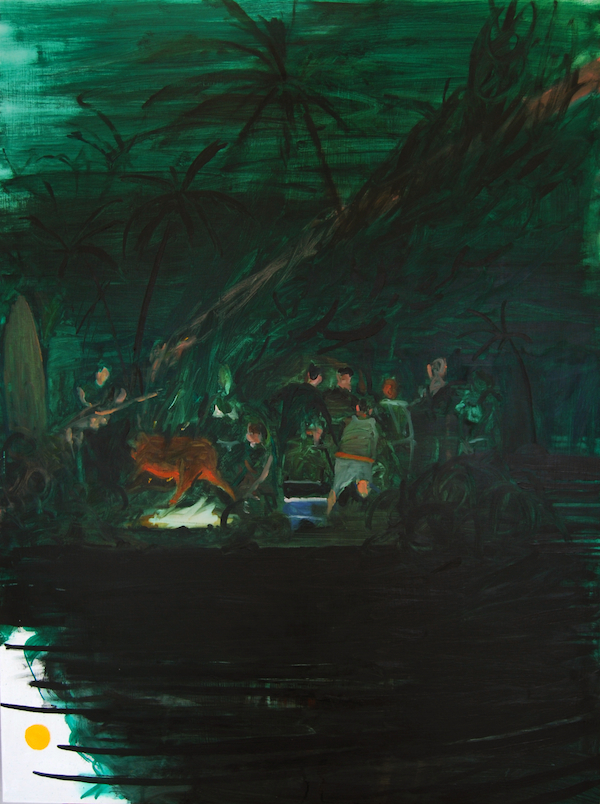
Duncan Ferguson, Beach Party, oil on panel, 3' x 4'

Your work seems funny to me–eclectic yet simple and flat. Your older work is much darker with foreboding landscapes, but newer works are lively.

I have always tried to be succinct in my work when possible. I think humor has the ability to be a very sophisticated form of communication and is able to bridge a lot of gaps. You noticed the distinct jump in my work from 2010-2011. The earlier period was the first time I had ever felt able to properly express myself through making art and was a really satisfying series of work, but I had eventually exhausted a subject matter, and I wanted to make work that had broader implications. I was also tired of black paint.  I think it is true of a lot of people’s practice that the physical production of work happens fairly quickly, but the incubation period is significantly longer. This has been true for a lot of my work, and I find it difficult to to continue making work of a similar variety if I feel as though I have already made my point. Read More »

Share

LA Expanded

Anything but the Kitchen Sink

L.A. Expanded: Notes from the West Coast
A weekly column by Catherine Wagley

The following was originally written for Art21’s Blog and re-posted here with their permission. These musing are all loosely inspired by watching Mary Reid Kelley in theHistory” episode in Season Six of Art in the Twenty-First Century, and by thinking about how family, history and family history play into contemporary art.

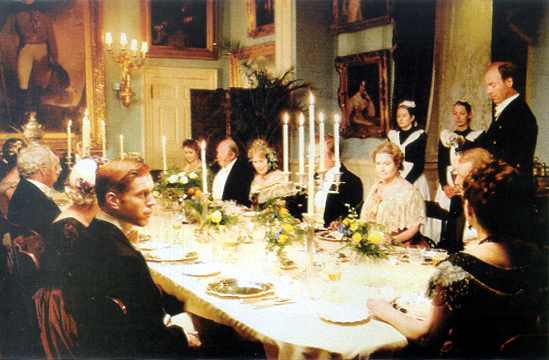
Screenshot from the 2002 remake of The Forsyte Saga.

Novelist John Galsworthy dedicated his Forsyte Saga — five novels, some of them upwards of 800 pages long, about a tangled and divided family–to his wife. He thanked her for encouraging, sympathizing, criticizing, and making him the writer he was. This wife of his, named Ada Nemesis, had been hard to come by. She’d been the wife of his cousin and it had taken her ten years from the time she had fallen for Galsworthy to finagle a divorce. So it’s hard not to wonder if Ada contributed more than encouragement and criticism to the drawn-out, almost-incestuous Forsyte Saga romances.

Netflix recently made the 2002 The Forsyte Saga miniseries available on demand, and nearly every friend I’ve mentioned it to admits to having watched at least part. In it, members of two sides of an estranged London family cannot help but keep falling in love with each other. First, beautiful Irene steals her cousin-by-marriage’s beau, than, before divorcing her difficult husband, ends up tangled with the same cousin-by-marriage’s father. She marries this cousin’s father, a widower whose younger child has already married another estranged cousin, and they have a baby who will grow up to fall in love with the daughter Irene’s first husband has by a second wife.

All of London at their fingertips, and those Forsytes only want each other. This seemed absurd at first, an excessive Victorian soap opera, until I remembered my own family’s darker secrets. Like the great uncle who began an affair with his neighbor’s wife. This neighbor also happened to be my uncle’s wife’s brother. So his child by his brother-in-law’s wife, whom he couldn’t marry until the death of his devoutly Catholic first wife, was the cousin-in-law to his children from his first marriage. Unconscionable family webs might actually be normal.

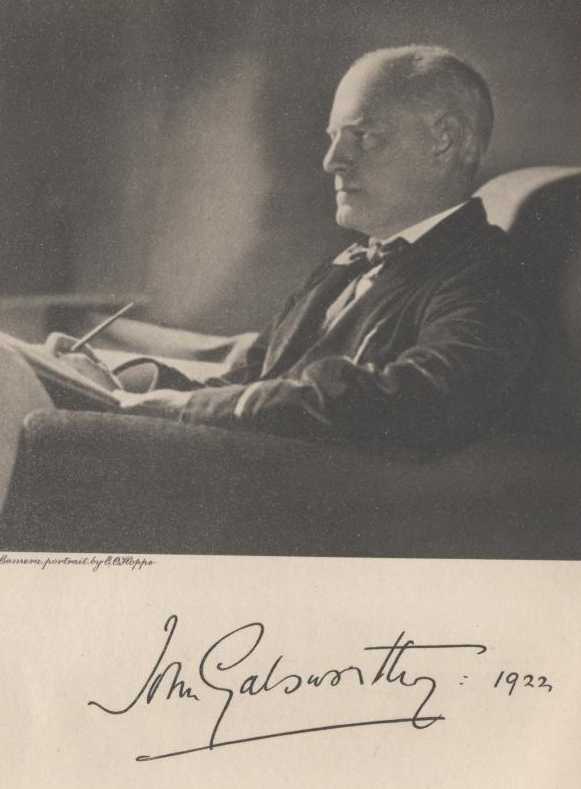
Cover image for "The Works of John Galsworthy" at Gutenberg.org.

If Galsworthy had been in the creative writing class I took senior year of college, the instructor, an insecure 30-something playwright, would have called his family sagas “kitchen sink” dramas. He would have used the term, coined in the ‘50s to describe London painters of domestic scenes, derisively. It hasn’t been okay to just paint or write about domestic family drama for a while, unless you’re also able to step outside of the story and acknowledge we are all cultural constructs. Think of the Pop artists, the appropriationists, the Pictures Generation. Cindy Sherman, Matthew Barney. They all dealt/deal with history from a distance. But the kitchen sink stigma seems now to be fading, or at least certain interesting, young-ish artists have stopped keeping their distance.

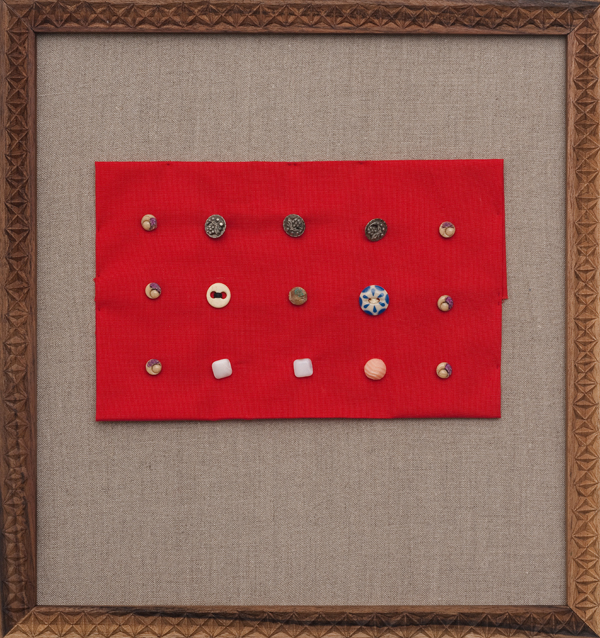
Patricia Fernandez. "From the Collection of Asun: Así se lo conté," 2011. Sewn buttons and fabric. 15 x 13 inches.

Artist Patricia Fernandez, who has work in the Los Angeles Biennial Made in L.A. and [also had work in a June show] at ltd Los Angeles, mines her history for (actual, physical) material. The buttons on her canvases are part of a collection that began after her grandmother bestowed on her some particularly precious buttons. The wood carvings she does are based on instructions from her grandfather, a man whom, I have heard by word of mouth, initially refused to train Fernandez, because wood-carving is for men. Then he realized his is a dying craft and relented. So Fernandez’s art is about what gets passed on and what doesn’t, about what heirlooms tell us and what they hide.

Kenyatta A.C. Hinkle, also in the Made in L.A. biennial, is a writer as well as an artist. She has been working on a project that began with her brother’s name. His first name is “Sir,” so “everybody would have to address him with a title of respect, regardless of the power relations he encountered as a black man living in a turbulent racially liminal Kentuckiana.” The blog for the project, which will ultimately be a prose-poetry book, is a fascinating collapsing of family history, history of a place, and history of race and gender. It’s all tied up together.

Galsworthy said the family is a “clear reproduction of society in miniature,” and he was right, except that each family reproduces a different version of society, which is why delving into those versions seems so fruitful.

Share

Glasgow

Studio 58: Women Artists in Glasgow since World War II

Foreground: Jacki Parry, The Book and the Rose - A New Book (1988), cast handmade paper, linen and cotton rag. Credits: artist and © Janet Lindsay Wilson Photography, Courtesy of The Glasgow School of Art.

From different angles, the view of the successive layers formed by folding a sheaf of handmade paper in Jacki Parry’s (b. 1941) artwork is reminiscent of pages of a book as well as petals of a rose. Displayed on a polished black surface reflecting surrounding artworks and the architecture of the gallery, The Book and the Rose – A New Book (1988) brings to mind what is commonly termed the Mackintosh rose, a motif that appears in the gallery’s building designed by Charles Rennie Mackintosh (1868 – 1928). Occupying a central position in the exhibition Studio 58: Women Artists in Glasgow since WWII, the symbolism that emerges in this context prompts one to think about an altered view of current art historical legacies, for a new book to be written.

Installation view of Studio 58: Women Artists in Glasgow since World War II. Credit: © Janet Lindsay Wilson Photography, Courtesy of The Glasgow School of Art.

Curated by Sarah Lowndes, author of Social Sculpture: The Rise of the Glasgow Art Scene, for the Mackintosh Museum, the exhibition that runs till 30 September 2012 presents artworks and documentation of women artists in Glasgow from the late 1930s. Titled after a studio in the Mackintosh Building that was historically dedicated as a workspace for women students, selected artists had either studied or taught at The Glasgow School of Art. As survey exhibitions tend to be, the way of framing raises questions – from the implication of contextualizing women artists in Glasgow through the lens of their association with the art school, and the absence of women architects particularly given the strong associations between the school and city to architecture. Alongside the exhibition is a publication due for release later in the year together with a symposium, from which these and other issues and themes might emerge. Already, the exhibition’s goal is a challenging one, and developed as a response to the underrepresentation of women’s art in a city that now enjoys a strong presence of women artists, it is perhaps of no surprise that the exhibition features over 100 works by more than 50 artists. These are broadly organised along the themes of landscape / still life and body / self, and the mediums of printed matter and photography / film.

(Top left) Hanneline Visnes, Ardabil With Stripes (2012), acrylic on board; (Bottom Left) Hanneline Visnes, Atomic (2012), watercolour on paper; (Right) Mary Viola Paterson, Lobsters and Sea Shells (c. 1930s), linocut printed on paper, courtesy of The Hunterian, University of Glasgow. (c) Janet Lindsay Wilson Photography, Courtesy of The Glasgow School of Art.

While the works by Hanneline Visnes (b. 1972) and Mary Viola Paterson (1899 – 1981) share thematic representations of elements of nature, the display of the works alongside each other highlights the way artists in different periods have considered their works vis-à-vis the economic aspects of painting and printmaking. An artist whose portfolio includes landscape oil paintings, Paterson also designed patterns for commercial fabric printing, and included in the exhibition are two linocut prints, including Lobsters and Sea Shells (c.1930s). Visnes works with images that shift between ornamentation and meaning, tampering with patterns drawn from decorative objects and materials.

Carol Rhodes, (left to right) Open Ground and Mud Flats (2009), oil on board; Reservoir and Dam (2009), oil on board. Credits: artist and © Janet Lindsay Wilson Photography, Courtesy of The Glasgow School of Art.

Two paintings by Carol Rhodes (b. 1959) with an aerial view of landscapes are also featured in the still life / landscape strand. The origins of the landscapes are ambiguous to the viewer and the view from above instills the sense of vastness that is reached with distance. At the same time, the textures and shades that distinguish the kind of terrain represented gives one an experience of proximity, of being able to navigate across the undulating plains.

Kate Davis, Disgrace V (2012), framed pencil drawing on found image (unique); Disgrace VI (2012), framed pencil drawing on found image (unique); Disgrace VII (2012) framed pencil drawing on found image (unique). Credits: artist and © Janet Lindsay Wilson Photography, Courtesy of The Glasgow School of Art.

Several of the artworks in the self / body strand deal with the possibilities of negotiating established codes in behaviors, language and representations of women. A glance at three recent works by Kate Davis (b. 1977) from a numbered series Disgrace appear to have pencil scrawls on pages of an art catalogue featuring nude studies of the female figure. A closer look reveal outlines of what seems to be a hand, and a foot, hinting at repeated traces of a body in motion. These works recall an earlier film by Kate Davis also titled Disgrace (2008). It assembled stills from a performance where Davis drew her body over projections of female nude drawings by Modigliani, as a recording of how a present body interacts with female representations in art history.  Read More »

Share