New York

Visionary Surreal: The Quay Brothers’ Street of Crocodiles

Quay Brothers, "Street of Crocodiles".

In restless anticipation of the MoMA show Quay Brothers: On Deciphering the Pharmacist’s Prescription for Lip-Reading Puppets  (opened just last weekend on August 12), I have been re-visiting the depths of the Quays’ body of work. The show—billed as “the first presentation of the Quay Brothers’ work in all their fields of creative activity”—promises a comprehensive, considered overview of this inimitable duo’s eclectic œuvre, which encompasses not only films and video but set designs, installations, stage projections, and a variety of works on paper.  For anyone unfamiliar with the Quays, the show should provide an invaluable immersion in their extraordinarily rich creative practice.  For me, an admitted film obsessive, the attendant series of screenings should be a singular opportunity to indulge a longstanding fascination with the Quays’ cinematic work, including the seminal Street of Crocodiles (1986).

Based loosely on the Polish writer/artist Bruno Schulz’s Cinnamon Shops (1934), Crocodiles is an intoxicating mélange of live action, puppetry, and stop-motion animation.  Like so much of the Quay’s work, the film confounds descriptive distinctions between the beautiful and the repulsive, the seductive and the repellant; in fact, the world of Crocodiles is one in which aesthetic definitions are collapsed and diffused, leaving in their wake an intangible yet implacable haze of atmosphere and sensation.  What emerges is a realm of sense and substance that speaks directly to, and of, the most visceral dimensions of being and consciousness.

Quay Brothers, "Street of Crocodiles".

Crocodiles flickers to life with the image of a pallid man crossing an abandoned theatre and, by means of his own saliva, awakening the inner workings of a kinetoscope.  Cutting to the interior of this mechanical world-within-a-world, the Quays’ camera ushers us into an otherworldly sphere that is both overtly constructed and vividly organic.  Quietly yet relentlessly, this world envelops us in its hallucinatory reality, one that defines itself through a dark yet heady play of texture, shape, shadow, and light.

As the Quays’ camera glides abruptly, sharply, throughout the space, we discover a world in which the animate and the inanimate, the real and the unreal, are increasingly indistinguishable:  witness a grim yet lively dance of metal screws, or a brutal prying-open of a pocket watch, whose innards appear as bloody entrails.  Throughout the film, the mechanical is imbued with a living force, and artifice becomes the vehicle for decidedly human impulses, fears, and sensations.  Thus a puppet-boy, facilitating the proceedings with a flashlight, displays a masklike face that is somehow eerily alive; and the film’s central figure, a spindly, gaunt, puppet-man, displays pocked and rotted “flesh” and an anxious mien, both of which suggest not only physical decay but a sense of existential horror.

Quay Brothers, "Street of Crocodiles".

As Bruno Shulz once wrote, “The essence of reality is meaning.  What has no meaning is not real for us.”[i]  Through its intermingling images of life, death, vitality, and decay, Crocodiles seems to externalize the deepest, darkest realms of the subconscious; it envisions a world of beauty and terror, one that arises from and evokes human psychic reality.  The Quays have described Shulz as “the secret catalyst”[ii] of their work.  Much like Shulz, whose writing conjures a vivid realm of the senses, Crocodiles gives us a world that disorients, discombobulates, and utterly mesmerizes.  We cannot help but willingly surrender.


[i] Bruno Schulz, “The Mythicisation of Reality,” essay first published in Studio 1936, Num. 3-4.

[ii]Through a Glass Darkly: Interview with the Quay Brothers,” Senses of Cinema 2002, Issue 19.

Share

Sydney

What the Birds Knew

Ken and Julia Yonetani, ‘Crystal Palace: The Great Exhibition of the Works of Industry of all Nuclear Nations (USA), 2012 , 2.1 X 1.6 metres, Chandelier frames, UV lights, electric components and uranium glass beads Courtesy of the artists, Artereal Gallery, Sydney and GV Art, London Photography: Zan Wimberley

In Kurosawa’s 1955 movie ‘I Live in FearToshiro Mifune plays an aging industrialist so frightened of a nuclear attack on Japan that he tries to move his entire family to Brazil, far away from radioactive fallout. If the birds knew what was coming, he says, they would fly away in terror. His children have him committed to a psychiatric institution. The alternative title for this film, ‘What the Birds Knew’, is also the title of Ken and Julia Yonetani’s provocative show at Gallery 4A, the Centre for Contemporary Asian Art in Sydney.

Through the window one glimpses a gigantic glass chandelier which glows a vivid, poisonous green, filling the darkened space. Entitled ‘Crystal Palace: The Great Exhibition of the Works of Industry of all Nuclear Nations’, it is part of a much larger body of work. The artists plan to make a chandelier for each of the twenty-nine countries in the world which operate nuclear power plants. Chandeliers, so redolent of luxury and the heedless consumption of electricity, are a potent symbol of beauty with a disturbing underlying hint of  the sinister or the decadent. This piece, together with the other works in the show, is made of radioactive uranium glass which glows green under UV light, thus making the invisible visible. Signs in the gallery assure visitors that the works pose no risk to their health or safety, but there is a definite quality of unease in the viewing experience, despite the aesthetic beauty of the work.

Ken + Julia Yonetani What the Birds Knew (2012), Installation view, Uranium glass beads, aluminium wire, UV lights Courtesy of the artists, Artereal Gallery, Sydney and GV Art, London Photography: Zan Wimberley

Ken Yonetani was born in Tokyo, and the artists wanted to respond to the fear and overwhelming helplessness provoked by the Fukushima disaster. In my conversation with him, however, he emphasised that it could just as well be a response to Chernobyl, to Three Mile Island, to Sellafield or indeed to Hiroshima and Nagasaki. In the past these artists have worked with unexpected materials, including sugar and Murray River salt. Seeking an appropriate material for a new work which could embody the sense of environmental anxiety they wished to evoke, they discovered to their surprise that they could purchase radioactive uranium glass, containing depleted uranium, online. Their use of this by-product of the uranium enrichment process means that their work is, literally, recycling radioactive waste.

Ken + Julia Yonetani, ‘Ant’, What the Birds Knew (2012) Uranium glass beads, aluminium wire, UV lights Courtesy of the artists, Artereal Gallery, Sydney and GV Art, London Photography: Zan Wimberley

In the main gallery space a 6 metre-long green ant made of uranium glass beads looms out of the blackness. The work is inspired by the Green Ant Dreaming stories of the Yolngu people in Arnhem Land, from a site near the Nabarlek Uranium Mine. If their sacred sites are disturbed, the story says, the giant ants will emerge from a place of fear and desolation, with catastrophic results for all living creatures. The uranium mined here from the 1970s onwards was sent to Japan, among other countries. The connections with Fukushima are obvious and thought-provoking. Ken Yonetani told me that ‘fear and healing’ lies behind the work, and the connections the artists make between environmental anxieties felt in Japan and by indigenous peoples in Australia suggest that the way forward may lie in dialogue and exchange across language and cultural barriers. Read More »

Share

Kassel

dOCUMENTA (13) spaces: Neue Galerie

Geoffrey Farmer, Leaves of Grass. Neue Galerie.

Living and working in Kassel during the dOCUMENTA (13) I have been in no rush to see all of the works. My abundance of time lends itself to much alleviation when considering the daunting map of exhibitions and thick program book. I have found the installations, sculptures, and ongoing performances to become part of my daily life. Each morning on my walk to work, I pass at least several art houses in Karlsaue park, the arte povera tree of Giuseppe Penone, Song Dong’s Doing Nothing Garden, and Massimo Bartolini’s Untitled (Wave). On a rainy day the tram takes me past the Neue Galerie and the Weinberg bunkers where visitors approach the hill armed with umbrellas and hard-hats. The works are becoming more and more familiar, exposing personalities and revealing new layers over time.

In a situation such as this, it is interesting to find which works call for a second, third, or tenth look. Aside from the public works, I have repeatedly found myself at the Neue Galerie. Many of the works of the dOCUMENTA (13) are housed in historical spaces reconstituted for the exhibition of contemporary art. The Neue Galerie was originally constructed as a museum for the Old Masters in the late 19th century. After the destruction of World War II, the museum lost much of its collection and was closed until 1976. The space was reengineered with the intent to house Modern Masters, such as the German Expressionists, along with Romantic and Impressionist painting. The Neue Galerie underwent a major renovation in 2011 and is perfectly suited to showcase the contemporary works of dOCUMENTA (13).

Among the highlights at this particular venue is Leaves of Grass, the compelling sculptural collage of Geoffrey Farmer. I am consistently drawn to revisit the work; it refuses to deny intrigue to myself and to visitors who brave the line for a closer look. Composed of LIFE Magazine cut-outs from 1935 through 1985, the work extends for 124 feet and is an immaculate visual timeline, a jungle of images spanning all realms of popular culture. In the work we recognize politicians, celebrities, advertisements, and products, the layers and stories of American identity and popular world history.

Geoffrey Farmer, “Leaves of Grass”

Based in Vancouver, Geoffrey Farmer is acclaimed for his sculptural collages as well as theatrical narrative works. Leaves of Grass is the completing piece to his trilogy of works in which he combines fragments from magazines, books, and pamphlets to comment on the roll of photography in history recording. While the general narrative of Leaves of Grass is familiar, each viewer may read the work differently, being drawn to unlike characters and evoked memories. Perhaps it is the nostalgia that keeps bringing me back, maybe it’s the well-designed space and natural lighting, but it is undeniable that Farmer’s intricate work beckons time, contemplation, and close observation.

Film has been a participatory medium at the documenta since its beginning in 1955. As contemporary art enthusiasts and gallery-visitors we are likely to be accustomed to pausing only a few minutes for films. With so much art to see, it is difficult to justify the 20 minutes or more of some films. This is not the case for the 31.49 minutes of Wael Shawky’s Cabaret Crusades. Located in the basement of the Neue Galerie, this work is a must-see and is unlikely to put up a fight with a viewer’s attention span. Shawky’s work is a historical chronicle of the medieval Crusades and based on the 1983 book The Crusades through Arab Eyes by Lebanese author Amin Maalouf. 200-year-old marionettes act out the plot. Accompanied by brief and direct dialogue, it is the truly emotive faces of the bouncing puppets that provide animation for the film. The narrative is set against stunning sets, which paired with the expressive puppets create an aesthetically irresistible experience. Shawky is known for his work that involves dissection and reenactment of historic moments through child actors, puppets, and digital animation to remove esoteric lenses and interact directly with history.

Wael Shawky, “Cabaret Crusades”

Back upstairs are the hauntingly beautiful photographs by South African photographer Zanele Muholi. Through a series of portraits entitled Faces and Phases, Muholi describes the homosexual and queer community in South Africa. Through what the artist calls “visual activism,” these direct and intense black and white photographs tell the stories of different characters within the community: “athletes, cultural activists, dancers, filmmakers, writers, human rights and gender activists, mothers, lovers…” The photographs are accompanied by a film that delves into the lives of these women and transmen on an individual and community basis.

Zanele Muholi, Faces and Phases.

The works of dOCUMENTA (13) concentrate on very real subject matter. Alternating from previous documentas in which fantasy and elusive ideas were more pronounced, these works seem to engage directly with history and documentation in order to comment on and understand the human condition.

Share

Help Desk

Help Desk: Authoring Texts on Praxis, Revisited

Help Desk is an arts-advice column that demystifies practices for artists, writers, curators, collectors, patrons, and the general public. Submit your questions anonymously here. All submissions become the property of Daily Serving. Help Desk is cosponsored by KQED.org.

I think it’s great you’re passing on sensible advice regarding the writing of clear, articulate, open gallery texts, but what I need to know how to write are the kinds of texts that make it look like I know a lot more about the work I make than I actually do. Obviously, no top level Frieze, Armory, Basel, FIAC type gallery would touch my work if I could write clearly about it, so is there some secret template for obfuscation, complex-ification and obscurantism into which I might insert my variables, and hey, Voila! my MFA show garners the attention of several hip galleries at once? This is not a joke! I genuinely need your help.

I love this question because I want to make fun of it and I can’t. Just when I am prepared to argue that we all need to write clearly and concisely in order to reach our audience(s), I get something like this in my inbox, delivered on July 31 from MIT Press: “ARTMargins is a new triannual publication that invites researchers and practitioners who operate under the conditions of neoliberal capitalism to critically reflect on what we call the ‘thickened global margin,’ encompassing historical, geographical, as well as philosophical or theoretical post-peripheries.” The part of me that taught English to high school kids wants to sigh, really?, but to be honest, as examples go this one is not even the worst I’ve seen.

So while I’d love to be dismissive of this issue, there are indeed some facts that need to be acknowledged. The first is that, no matter how many educators (self included) make claims for prose that is accessible and intelligible, the truth is that we do operate in a field with its own specialized vocabulary. The second is that arts writing undertakes the process of expressing the aesthetic experience as text, and like any translation something ineffable gets lost along the way. To try to make up for this loss while still working within the circumstances that produced it means that writers essentially scratch around hoping to find a designation that will come closest to what they are attempting to explain. With something as complex and nuanced as art the best we can hope for is that the arrow, once shot, will graze its target; because in translation a true bull’s eye is nearly impossible.

Anish Kapoor, Leviathan, 2011. PVC, 33.6 × 99.89 × 72.23 m

Your question is complicated, though, because it’s not just about language but perceptions, expectations, and your relationship to your own work. Let’s tackle this one first.  When you say “what I need to know how to write are the kinds of texts that make it look like I know a lot more about the work I make than I actually do” it trips my worry switch. Why don’t you feel that you know about your own work? Didn’t you make it? Aren’t you the captain of this ship? That others may see things in your work that you don’t is a natural consequence of identity and differentiation. My vision of the world is not yours, and that’s a good thing. It’s not your job to think of every eventuality, to meet all-comers. To do so will only guarantee you a lifetime of defensive posturing, and it’s unwise to build a career that requires you to keep your fists up. Additionally, don’t forget that an illogical or overly dense statement can undermine powerful work.

But you requested a template. Though I am skeptical about the power of a mere statement to dazzle a blue-chip gallery, I also want to give you what you asked for. As it happens, because there is an Internet and it is filled with the work of delightful and intelligent people, there is (of course) already a website for this. It’s called Arty Bollocks and you simply click “generate some bollocks” and it will give you a complete statement. Here’s what I got:

My work explores the relationship between the body and counter-terrorism. With influences as diverse as Nietzsche and John Cage, new insights are manufactured from both opaque and transparent narratives. Ever since I was a pre-adolescent I have been fascinated by the unrelenting divergence of relationships. What starts out as undefined soon becomes finessed into a manifesto of lust, leaving only a sense of chaos and the chance of a new synthesis. As shifting forms become undefined through frantic and diverse practice, the viewer is left with an impression of the darkness of our existence.

Anish Kapoor, Svayambh, 2007. Sculptural installation with wax and oil-based paint, dimensions variable

If your results aren’t opaque enough, you can click “Not arty enough for you?” and you’ll get a statement that turns the caliginosity up to 11:

My work explores the relationship between pre-Raphaelite tenets and unwanted gifts. With influences as diverse as Camus and Andy Warhol, new synergies are manufactured from both mundane and transcendent structures. Ever since I was a postgraduate I have been fascinated by the theoretical limits of the human condition. What starts out as vision soon becomes finessed into a tragedy of power, leaving only a sense of dread and the unlikelihood of a new synthesis. As temporal replicas become transformed through diligent and diverse practice, the viewer is left with a new agenda of the limits of our condition.

Are you surprised to find that parts of this statement could fit your work? That’s because it is so vague and meaningless that it could be applied with equal efficacy to nearly any artwork. (And if you still venture down this path, beware: sometimes there are errors in the text. Spell check the statement before you send it off to Neugerriemschneider.)

Read More »

Share

From the Archives

From the DS Archives: Ernesto Neto

Today from the DS Archives we take a look back at Ernesto Neto. The Antiguo Colegio de San Ildefonso in Mexico City is currently exhibiting his  sculptures, drawings, photographs, and objects produced from 1987 to 2011, many of them shown for the first time.

The following article was originally published on February 8, 2007 Written by :

Ernesto-Neto-2-8-07.jpg

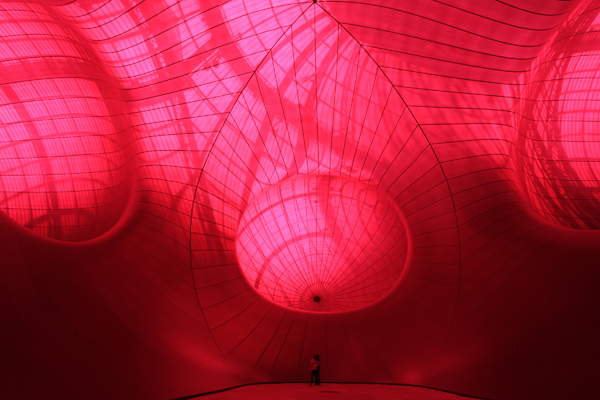
One of Brazil’s most famous artists, Ernesto Neto creates room-sized environments for the viewer to navigate through and interact with. By using light, stretchable fabrics and organic shapes, filled occasionally with scented spices, Neto’s work allows the viewer to experience the work through all senses, creating a spatial labyrinth for the journey through the passages in the room. Currently, Neto is collaborating with Merce Cunnigham on an exhibition called “Dancing on the Cutting Edge,” where his sculptures become sets and costumes for the choreographer at the Museum of Contemporary Art in North Miami. He exhibited with the Fabric Workshop in Philadelphia (2004) and worked with Carnegie International (1999). Neto was the Brazilian artist for both the Biennale of Sydney (1998) and the Venice Biennale (2001). ArtForum has reviewed his work several times, including his exhibition with Galerie Max Hetzler in 2004.

Share

LA Expanded

Dress Attractively or Dress to Attract

L.A. Expanded: Notes from the West Coast
A weekly column by Catherine Wagley

Dorit Cypis, The Rest in Motion 1, 2002, C-print.

Joshua Harris’ book I Kissed Dating Goodbye starts with a nightmare: Anna stands at the alter in her white dress in a pictaresque chapel facing her soon-to-be-husband, David. She’s holding his hand. Then, as they begin to recite their vows, a girl walks up the aisle and takes David’s other hand. Another girl comes too, and takes hold of the first girl’s hand. Then a third girl comes, and so on, until a chain of six girls stand there. Anna wonders if it’s a joke. “Who are these girls?” she hisses.

“These are the girls from my past,” David says. They don’t matter to him now, he assures her, it’s just that they’ve each taken a piece of his heart.

“I thought your heart was mine,” says Anna.

“It is,” he says. “Everything that’s left is yours.”

A scenario like this, Harris will go on to argue, can be avoided. If you kiss dating goodbye.

His book, now sort of a millennial abstinence movement classic, came out in 1997. My mother, who still sometimes warns me to “save my heart” as if it’s a depletable resource, read it before I did. The heart part was only half the story, of course. The body part played a bigger, though less explicit, role. You had to save that too.

Dan Finsel, The Space Between You and Me: You borrow her dress, she borrows your boyfriend, 2012, Black and white photograph.

I picked up a newer book by Joshua Harris recently, called Sex is Not the Problem, and read something that I had heard directed toward women in some form or another during all my growing up years: “The way you dress can either help or hinder men around you who are trying to resist lust.” I mean, clearly there’s truth to that. But here’s what else Harris says: “Sure, guys can resist the temptation to lust, and it’s our responsibility to do so, but your dressing immodestly makes this very difficult.” And he adds, “There’s a difference between dressing attractively and dressing to attract.”

Is there? And is it the difference he thinks it is?

I must have still been an undergrad when I first started experiencing nude exhaustion. Already I’d been in art schools and the art world long enough to have seen too many so-so nude performances, photographs and paintings.  It was impossible to still think nakedness itself was seductive. But what I loved, and still love, are those beautiful, bodily movements that materials — fabric, clay, even industrial stuff like metal armatures and aluminum — can make. Dorit Cypis took a photograph in 2002, called The Rest in Motion, in which the billowing fabric of a curtain looks like a body’s bent-forward backside. You look at it and feel volume, softness. It attracts.


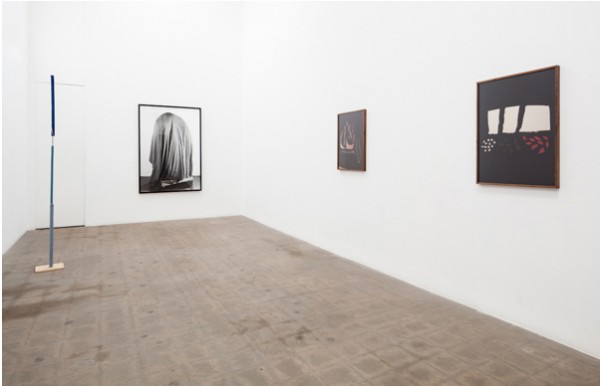
Installation view of Formwandler, Richard Telles Fine Art, 2012.


Another photograph I saw recently had a similar effect. It’s Dan Finsel’s, it’s installed in Richard Telles’ current show Formwandler and it’s called The Space Between You and Me: You borrow her dress, she borrows your boyfriend (2012). A black and white image, it shows a dark cloth over what must be a tall mound of clay. The cloth wrinkles, ripples and falls down, in some places past the wheels of the dolly that the clay rests on.

Finsel knows his large clay mounds, covered or not, look like bodies, and he uses bodies to shape them, often just hands. (“It’s like a romance,” he said in a video interview, while he and a dark-haired woman massaged the clay, their hands next to each other. “We’re barely touching each other, but you have to act like we’re thinking about it.”) Then, in some images and videos, a nude blond woman lays on red clay, shaping it with her weight. But in The Space Between You and Me, there’s no flesh visible. There’s not even clay visible. It’s fully dressed and the fabric alone suggests its bodily weight. It’s better, more sensual and suggestive, than any sheer skirt or spaghetti-strap top I’ve ever seen.

Share

London

Yoko says…

Yoko says…make a wish

Yoko says…cut

Yoko says…step on the painting

Yoko says…smile

What ever Yoko says, one must do. It’s an irresistible game. A walk through Yoko Ono’s exhibition, ‘To the Light…’ at the Serpentine Gallery in the heart of London’s Hyde Park, is very much an extension of the park itself. Play and wander and, moreover, do what Yoko says. Simple and surreal, personal yet universal, Yoko Ono creates a series of playrooms for grown ups and kids alike in which viewers are encouraged to dream, think, remember and, of course, feel.

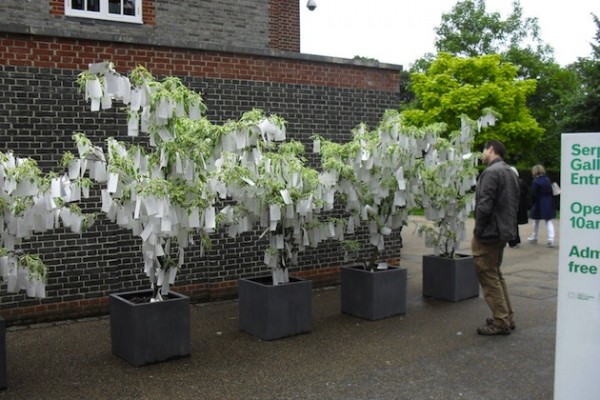
Art exhibitions can be intimidating to the general public; many people don’t cross the threshold of a grand gallery or museum entrance if they are not an art world regular. Yoko Ono’s show couldn’t be more welcoming and relaxed – and much to the dismay of many critics, fully embraces the idea of mass appeal. A number of the works in the exhibition engage with the park goers quite simply by being placed outside. No need to cross the threshold to see one of Ono’s fan favorites: ‘Wish Trees’ in which small potted trees are strung with wishful messages of passer-bys. Pens, string and paper are placed nearby for those who want to participate by stringing their wishes upon the tree. Others participate just by looking: reading the personal and heartfelt messages thoughtfully. Considering participatory art itself tends to cater to art-aficionados or perhaps the bravest ones of a crowd, Ono’s wish trees stand in stark contrast in their universal popularity – exemplified by the white leaves of paper tending to outnumber the green leaves of the trees themselves. People leave messages in different languages, wishing for wealth, love and happiness – or wishing to connect or communicate messages of love to family, friends or to the artist herself. Although the work is in danger of being reduced to the term ‘cute’, considering the positivity positively weighing down the branches of the trees, one feels like a bit of a scrooge not making a wish. Yoko says make a wish, so I make one, and I don’t sign my name, hoping it means something more that way to anyone who reads it.

Yoko Ono, Wish Trees 2012, photograph by Rosemary Marchant

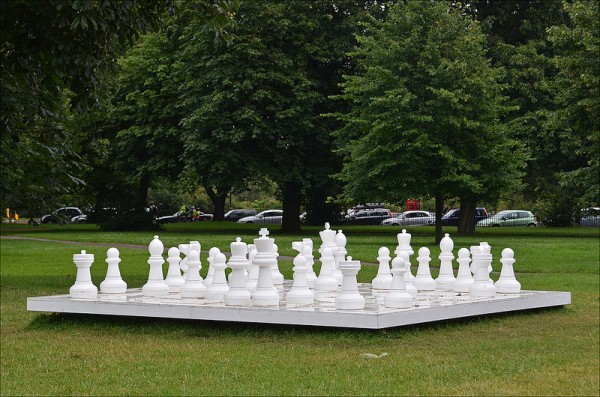
Also set outside, a massive unplayable chess set draws more park wanderers’ attention, toddlers mostly, who climb on the all-white checkered platform like a jungle-gym, embracing the similarly-sized all-white pieces like teddy bears. The concept of Ono’s monochrome chessboard with no division, no groups, and no opposition is certainly a simple and poignant gesture for the advocate of world peace. Yet, regardless of its conceptual roots, there is something exactly right about these bumbling children jumping about and arbitrarily moving pieces around, incorporating collected clumps of green grass and seemingly precious pebble piles. I smile in hopes that the invigilators let them play on, thinking of the impossible, child-like dream of total peace and what that really means in our world, where there is not only black and white, but also infinite grays.

Yoko Ono, Play It By Trust (White Chess Set) 2012.

Additionally drawing in crowds at the back entrance to the exhibition, is the stage for another ongoing participatory artwork, ‘#smilesfilm.’  A large screen displays snapshots of startlingly familiar smiles – the most recent smiles displayed belong to the faces of my surrounding exhibition goers, snapped about five minutes beforehand. Two photo booths are set up to capture the smiles of anyone willing to pose for Ono – who explains on a monitor that she plans to make an entire feature length film with smiles as her raw material. Each amassed photo will be a single frame of the film. Her far from humble long-term goal? To capture the entire world’s population smiling. Yoko says smile, so I submit my smile willingly. I feel a bit like I’m in an amusement park as the Yoko on the monitor walks me through the process; (especially considering I am not ‘tall enough for this ride’ and must sit on a pile of books to get my smile in the frame.) And, apparently there’s an app for that: if you can’t be bothered or cannot make it to the Serpentine you can submit online to be part of the film. I leave feeling slightly over the smiley, feel-goodness and a bit afraid someone might try and sell me a commemorative mug with my photo as I exit. Happily, no one does. Read More »

Share