We are thrilled to bring you a review of MadeIn Company’s recent exhibition in Shanghai from our brand new partner ArtSpy, a website based in Beijing, P.R.China that is committed to establish a global artistic information platform. This article was originally written for ArtSpy and has been translated exclusively for DailyServing.
At the Shanghai Taopu Art District in May 2012, MadeIn Company presented a series of action-related paintings. In their “Action of Consciousness” exhibition at the end of 2011, they showcased a group of paintings in the classical painting style, a result of re-creation through performance upon the aesthetic experience of local realism. In their own words, they initiated a new phase in local realism. A few months later, this type of operation shifted into “Turbulent”.
Black abstract patterns resembling cages, in various sizes and shapes, dominated the wall surfaces as the major part of this exhibition. These patterns were produced by placing the heads of spray paint cans on white canvases and allowing the paint to spray onto the surrounding surfaces. This process created different patterns and the nozzle of the spray paint cans were also left on the canvas surfaces. Through an extremely simple operation and the combination of method and presentation, MadeIn Company created paintings with an abstract aesthetic appeal. Yet it is the integration of all elements that generated an experience outside of the typical appreciation for abstract paintings.
'Dapple', screenprint, Poem by Edwin Morgan (1968), printed by John Taylor at Glasgow Print Studio (1978). (c) The Edwin Morgan Trust (SCIO)
Dapple, by Edwin Morgan (1920 – 2010), the late Scottish poet who became involved in the concrete poetry movement of the 1960s, is one of five poems titled Colour Poems that play with the relationship between meaning, rhythm, colour and sound. The Colour Poems were the inspiration for the development of The Medium is the Message: words in printmaking since the 1960s, an exhibition exploring how artists have used words in printmaking. Running till 9 September 2012 at the Glasgow Print Studio and coinciding with its 40th anniversary, the prints are drawn largely from its archive and features works by artists and writers, many of whom are based in Scotland, including Helen de Main, Alasdair Gray, Scott Myles, and Bruce McLean.
Kevin Hutcheson, 'Architectural Review', 2012, screenprint in an edition of 30, commissioned specially for The Medium is The Message: words in printmaking since the 1960s, copyright the artist and Glasgow Print Studio
Specially commissioned for this exhibition, Kevin Hutcheson’s (b. 1971) Architectural Review uses cut-outs and arrangements from headlines of printed media with the words “NEW TOWN” and “blues” to create a collage, where the slight tilt of the cut-outs that appear as housing blocks express an atmosphere of dolefulness, like the tunes of blues. The work seems to respond to the optimism of urban development conveyed by the mass media, with a personal encounter communicated through the ability of language to possess a kind of feeling-tone.
Martin Boyce, Disappear Here, 1999, screenprint in an edition of 50 plus 1 artist's proofs, 75 x 52 cms, 29.55 x 20.49 inches. Published by Glasgow Print Studio. Copyright the artist and Glasgow Print Studio
The felt experience of an urban life seems to also emerge in Martin Boyce’s (b. 1967) Disappear Here. Produced also as a wall painting in 1999, the work’s grid structure reminds one of a phenomenological encounter in a city, where one can navigate around with the assurance of an order that gradually encloses and contains before eventually disappearing within.
"Girls Jumping In Tilted House" (1970), gouache on paper, 19.5 x 24 inches. Courtesy of Corbett vs. Dempsey.
Sometimes when I am out looking at art I ask myself the question “What does it mean to experience this artwork in this moment?” I found myself asking that question at the exhibition of Seymour Rosofsky’s drawings at Corbett vs. Dempsey titled “Xylophone Solo.”
Rosofsky died the year I was born, 1981. He was part of the Chicago Imagists’ Monster Roster, a loosely affiliated movement of post-war Chicago artists including Leon Golub, Nancy Spero, and Jim Nutt who defiantly insisted on making representational figurative paintings during the height of Modernism. Rosofsky’s work wasn’t typically as political as Golub and Spero, or as weird and colorful as Jim Nutt, though like those artists, he employed a grotesque sensibility in order to define experience.
"Couple Dancing In The Living Room" (1970), gouache and watercolor on paper, 24 x 35.75 inches. Courtesy of Corbett vs. Dempsey.
Often this sensibility was like Norman Rockwell through the delirium of a fever dream, aimed at the existential horrors of middle American domestic life. In Couple Dancing In A Living Room (1970), we see two figures, perhaps children, swinging hand in hand around a piss-yellow, chandelier-lit interior. A tiny Pagliacci figure floats between the dancing couple, seemingly kicking the male in the crotch. The room itself appears to be an open cube surrounded by an inky black void. This surreal scene of creepy domestic merriment is at once spacious and claustrophobic, like a private universe that has nowhere to expand.
The theme of figures trapped within the conditions of their own existence is repeated throughout the show. In Seated Man, Blue Background (no date) a solitary man in a funny hat hunches awkwardly in a chair too tall for his tiny legs. The man in Figure in Chairs With Ball and Two Polls (1969) also sits uncomfortably at rest near what appears to be a seaside view. Hardly a scene of leisure, the man’s slumped posture coupled with Rosofsky’s frenetic rendering suggests an itchy boredom that’s both gnawing and deflating. These scenes also harken back to the lonely human beasts in Francis Bacon’s paintings or George Grosz’s miserable portrait The Poet Max Herrmann-Neisse (1927), images that featured European figures psychologically ravaged by the horrors of global conflict and the failed promise of the Modern era. In Rofosky’s world, the misery stems from themes more uniquely American.
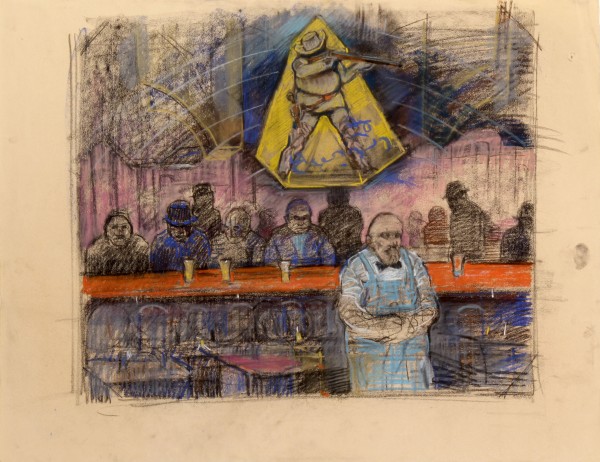
"Rifleman And Bar" (1965), pastel on paper, 20 x 25.75 inches. Courtesy of Corbett vs. Dempsey
In a picture titled Rifleman and Bar (1965), the restlessness and violence of America’s pioneer history, the obscenity of popular culture, and the neon haze of capitalism’s excesses coagulate into a dingy barroom scene. Above a frieze of glum barflies, a gilded mountain man in buckskins takes aim at an unseen target. In the foreground is the bartender, turned away from his customers in a moment of reflection. Is the mountain man the bar man’s fantasy or a giant kitschy advertisement, just part of the décor? Oddly enough it’s the bartender, whose features are highlighted by an unknown light source, who looks like a neon sign. These two figures represent two poles of American identity: the untethered adventurer and the stable working-class hero who can reliably found in the same place night after night. Unfortunately, these archetypes are hardly served by the surrounding tableau. Much of the background feels visually inert, plagued by a horizontality created by the red stripe of the bar that cuts through the center of the picture and leads the eye nowhere. The bar man and mountain man represent two intriguing dynamics that the rest of the picture can’t quite support. Read More »
Help Desk is an arts-advice column that demystifies practices for artists, writers, curators, collectors, patrons, and the general public. Submit your questions anonymously here. All submissions become the property of Daily Serving.
I am currently attending art school (RISD) on the east coast to receive a BFA in painting. I will be a junior this coming year and feel that things have really started to pick up. The first half of my undergraduate education has gone fairly well. Foundation year was rigorous and last year I explored a lot within my own work. I have multiple on campus jobs and am beginning to feel good about my contact and personal relationships with the faculty. Besides my own personal goals to read a lot and really hit the ground running in the studio, I was wondering if you had any advice on what I can do to make the most out of my remaining two years in undergrad? Specific class topics? Outside experiences? Maybe taking advantage of the close vicinity to Boston and New York? Any advice would be great.
Barry McGee, Untitled #29, 2002. Paint (mixed media) on wood panels, 96 x 144 inches
I’m glad to hear that you feel good about how things are going in general. Art school can be tough and competitive, but it sounds like you’re on an even keel and ready to work on your next steps. It’s been a long time now since I was an undergrad, but in order to answer your question I spent some time thinking about the beneficial things I did—and the things I wish I had done—when I was in school. Below are some ideas for you to consider, divided into the three categories of career, artwork, and personal development.
Career: I like that you have on-campus jobs and are cultivating good relationships with faculty. When you graduate, you’re going to run into a lot of people who will say, “Oh, you went to RISD? Do you know Professor X?” and it may be helpful if you’re able to say, “Yes.” Make sure that you get at least a little face time with all of the people in your own department.
Also, spend some time talking to teachers in other departments, because it’s easy to become conceptually isolated in the echo chamber of a particular department. You can figure out which people you want to contact by listening carefully when your friends discuss their classes and instructors. Who is a good teacher? Who gives good feedback? Who is friendly and generous? You want these people in your life, if for no other reason than they will create good energy and positive vibes for your practice (and I can say that with a straight face, because I live in California). If you hear of someone really phenomenal, ask for a studio visit. Inviting people from other departments to your studio will expand your understanding and your practice, which will serve you well after graduation. After all, there are no media-specific departments in real life. When you’re done with school you’re going to have to contend with the entirety of contemporary art, not just contemporary painting.
One would think that reality would remain constant, but as we learn and develop, reality and our experiences of it changes with us. Now on view at Site Santa Fe, More Real? Art in the Age of Truthiness, bring together more than 25 international artists who question the stability of reality. For our look back into the DS Archives, we bring you the 2008 exhibition at the Hirshorn Museum, The Cinema Effect: Illusion, Reality, and the Moving Image.
The following article was originally published on August 19, 2008 by Catherine Wagley:
Washington DC’s Hirshhorn Museum has embraced the history and technology of cinema, launching a large scale video exhibition that explores the perpetually shady filmic relationship between fiction and reality. Called The Cinema Effect: Illusion, Reality, and the Moving Image, the exhibition is divided into two parts. The first, Dreams, ran through May 11th and focused on the imaginative capabilities of film. The second part, Realisms, is on view now. Realisms itself is divided into to sections, one of which emphasizes fictive realism – including pop culture references and Hollywood-inspired ventures – while the other emphasizes documentary-style film work.
As the above video discusses, Realism highlights the cultural, historical savvy of today’s most innovative film artists, while also probing the unique technological capacity film has to question what’s “real.” The exhibition continues through September.
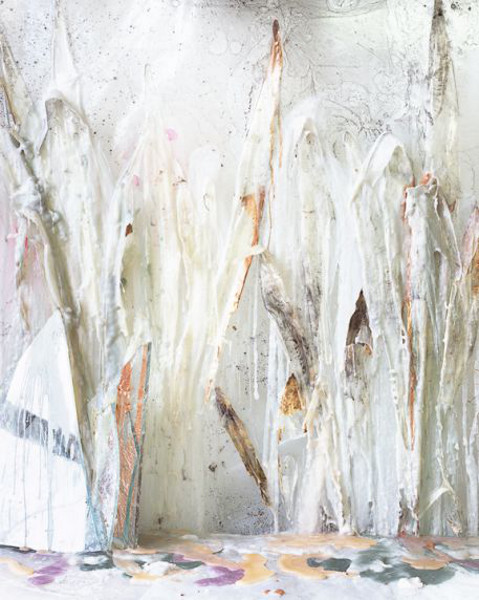
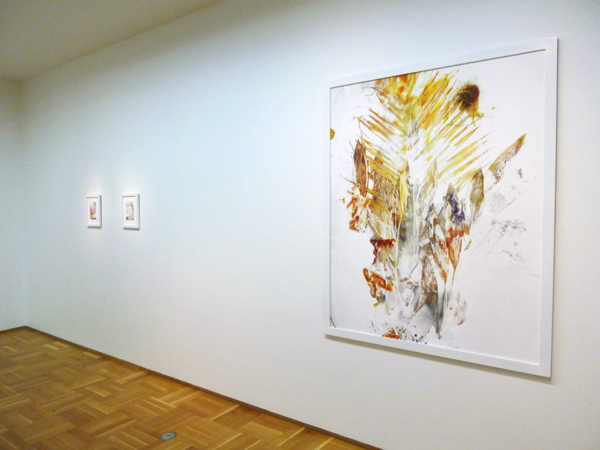
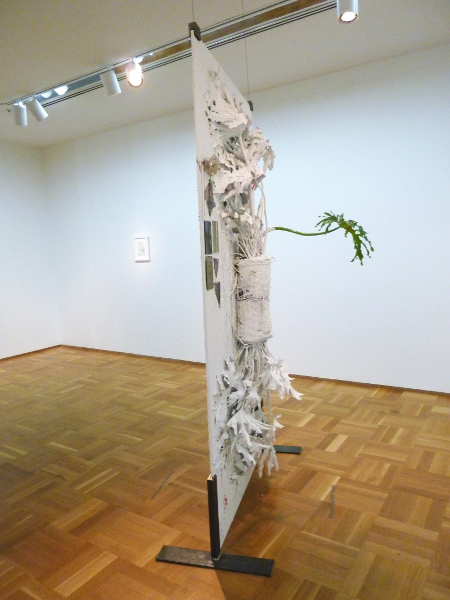
The sculptures are most commonly associated to a herbarium, incorporating houseplants encased in wax, paint, glass and resin. They are also reminiscent to a tomb, where the previously living objects become ornamental, being uprooted and left to decay in order to quench our thirst for visual pleasure. Each sculpture almost tricks the viewer on first sight, presenting us with a mounted glass panel with compositions made up of mirror shards, melted wax, spray paint, faded books, magic lantern slides, and (most dominantly) green houseplants. The works appear 2 dimensional at first, reminiscent of a Man Ray or Fox Talbot photogram, yet once you are truly in the space and invest time exploring each work, you begin to see the compositions boldly jump out at you. Protruding leaves, stems, soil and roots, offer the chance to see the under belly of the work, the process, and fragments lively with their own purpose. The belly, painted white in parts, leads you back to the photographs on the walls, which are so dominated with white space that they almost become vapor, with a spectrum of colored dust left hanging in the void. Her high contrast photographs transform textural physical arrangements into encased two dimensional representations that play with the viewer’s sense of color, dimensionality, light, and transparency. “This interplay of these two media suggests ways of organizing perceptions of space and registering impressions of time.” (Karsten Lund, Curatorial Assistant at the Museum of Contemporary Art Chicago).Where does the work begin and where does it end? Perhaps the question is left unanswered as the compositions are constantly in flux, with life, death, and rebirth being present in each piece.
With such a vast array of visual themes in her sculptures and photography: from decay and growth, encasement and release, to sterile and dilapidated, Norton has perfected the act of obliteration. Her sculptures are layered, combined, manipulated until no square is left bare, each element merges into the next, all becoming one. In contrast, her photography is so over exposed that it is no more than a whisper, or a detailed close-up that could easily be mistaken for an abstract expressionist painting. Without doubt, Norton has a remarkable feeling for texture and form. She both freely executes her works in the chaotic spender of physical forms and the clean sterile practice of creating an exceptional photographic print. Norton has pushed against conventional notions of studio practice and achieved a tactile exhibition where contrasting expressions have been carefully sewn along the seams, embracing both life and death, and always looking for ways to rejuvenate. Read More »
#Hashtags provides a platform for longer reconsiderations of artworks and art practices outside of the review format and in new contexts. Please send queries and/or ideas for future columns to hashtags@dailyserving.com.
"Three young women are being detained by Russian authorities for allegedly performing a protest song in a cathedral as part of feminist punk group "Pussy Riot"," 2012. Amnesty International/Flickr/Creative Commons.
The arrest and trial of three members of Pussy Riot, the Russian riot grrrl band and art collective, has captured worldwide attention. Imprisoned after their impromptu February 21, 2012, performance at the Cathedral of Christ the Savior in Moscow, the case has shined a light on Russia’s struggling democracy and conservative gender politics. But what about the piece itself? We risk ignoring an important lesson if we gloss over Mother of God, Drive Putin Out as work of art.
A YouTube video of the blasphemous performance begins with three members of Pussy Riot—Maria Alehina, Ekaterina Samutsevich, and Nadezhda Tolokonnikova—dressed in colorful tunics, tights, and balaclavas. Commandeering the altar and resembling petite luchadores, the trio kneels, crosses themselves, and mock prays while the soundtrack recites a slew of epithets:
“Shit, shit, the Lord’s shit!” / “Virgin Mary, Mother of God, become a feminist” / “Patriarch Gundyaev believes in Putin/Bitch, better believe in God instead” / “Virgin Mary, Mother of God, put Putin away/Рut Putin away, put Putin away”
The 1:53 long video ends with the group being pushed out of the cathedral. The performance was brief and silly, but ignited an international controversy. The timing was pivotal, capitalizing on discontent and political frustration in advance of Vladimir Putin’s inevitable comeback; the performance took place less than two weeks before Putin’s well-orchestrated presidential election, which saw him rise to power again after a four-year hibernation as Prime Minister.
Days later, the trio was arrested and they have been in jail ever since, with a verdict due today, at 3 pm Moscow time. UPDATE: Days later, the trio was arrested. They have been in jail ever since, and were sentenced to two years of prison on August 16, 2012.
Alehina, Samutsevich, and Tolokonnikova do not fit the usual profile of national security threats. They are not former KGB agents; they are not Mohawk toting anarchists; they are not Chechen terrorists. They are young women wearing pink, green, and baby blue; two are mothers of small children. From Potemkin to Beslan, this is not what security threats have looked like.
It is not simply that these are women—Russia has had plenty of female activists. Pussy Riot directly confronts the austere nature of politics. Most disobediently, these particular women appear to be having fun, offering an alternative to bureaucracies, NGOs, legal briefs, ad hoc committees, and pedagogical lectures. Like the punks from whom they draw inspiration, Pussy Riot opts to play the political game with their own rules. This defiance may be more offensive to the state than uttering a few sacrileges.
In her autobiography, anarchist and fellow Russian feminist Emma Goldman provides insight into the importance of this approach to politics. As a youth, a boy told Goldman that dancing was not appropriate for an agitator. Goldman recalls in Living My Life that she did not believe that a cause that stood for beauty and freedom should deny her life and joy. Furious, she told the boy that their cause could not expect her “to become a nun and that the movement should not be turned into a cloister.” “If it meant that,” she continued, “I did not want it.” Eighty years since Goldman wrote this passage, it has been condensed into the apocryphal yet pithy quote, “If I can’t dance, I don’t want to be part of your revolution.”
Pussy Riot has created a revolution that embraces joy. Pyotr Verzilov, Tolokonnikova’s husband and a spokesperson for the group, explained the rationale behind Pussy Riot’s tactics: “These actions provide visual language for public protest in Russia. So people see that political issues can be raised in a variety of very different ways… Everyone has to do politics. This is the main issue. And everyone has to do politics in the way that is closest to you.” Pussy Riot’s approach acknowledges that politics (and protest) should be as dynamic and multifaceted as life itself. Their struggle would be immediately compromised if their tactics required self-denial.
Pussy Riot at Lobnoye Mesto on Red Square in Moscow, 2012. Photo by Denis Bochkarev/Creative Commons.
Just prior to her fellow band members’ arrests, “Garadzha” explained the name Pussy Riot: “A female sex organ, which is supposed to be receiving and shapeless, suddenly starts a radical rebellion against the cultural order, which tries to constantly define it and show its appropriate place.” This name takes two things women are often forced to sacrifice—their biology and their agency—and foregrounds their importance to the group’s political existence, and it does so with a playful smirk.
The flipside of this mirthful embrace of femininity might be Cyndi Lauper’s pronouncement that “girls just want to have fun.” With all due respect, girls want a lot more than that. Many of them also seem to want careers, education, control of their bodies, political power, economic equity, and the ability to express themselves, among other desires that are less conducive to chart topping lyricism. Pussy Riot, like young Goldman, has found a way tap into their humanity and femininity without foreclosing on the possibility of a deep, political life. Somewhere between puritan radicalism and Cyndi Lauper, Pussy Riot has staked its claim.
Watching Mother of God, Drive Putin Out, it is as if Pussy Riot says, “You oppress me, and yet I smile.” An amazing thing about all governments and regimes is that they are, in some ways, illusions. They are very complex illusions, with guns and bombs, but they only exist and hold power so long as enough people think they do. Putin, like all emperors, is naked. Pussy Riot bypasses the system that gives him legitimacy and demonstrates its frailty. They do not do this by cordially disagreeing with his politics; they do it by living an alternative. It is unlikely that Alehina, Samutsevich, and Tolokonnikova are smiling in their jail cells, but like the illusions of democracy or autocracy, reality can be less important than impression. The Russian people have seen them smile. They have seen it millions of times, and they have read about it and talked about it. The entire nation is now aware of an alternative form of politics. Some people despise it, but others are learning from it and participating. Pussy Riot’s gesture is small, but it is necessary. It is the amalgam of these small gestures that can, should enough of them arise, change policy and culture.
The complexities of realpolitik can make it difficult to believe that a bunch of punks in pink can challenge a nuclear superpower. But the Russian government offers all the evidence needed: states do not make political prisoners of those whom they do not see as threats. Prime Minister and former President Dmitry Medvedev recently doubled down on the case against Pussy Riot: “In some countries the responsibility for such actions would have been much more strict.” The subtext: We’d kill them if we could get away with it.
This may seem outlandish and bombastic to those who live free of punk rock persecution. As Jessica Bruder of the New York Times recently wrote, “the idea that music can help change things, rather than just sell expensive coats, isn’t very popular here right now.” The lack of American prison cells filled with famous punks is a testament to this. Over the last three decades, punk, like other subcultures, has been integrated into mainstream society. Bad Religion’s Greg Graffin teaches evolutionary biology at UCLA and Cornell, Patti Smith recently appeared in an episode of Law & Order, and even Chumbawamba put out a record with a multinational conglomerate. But as Bruder reminds her readers, this is not the case everywhere. In Indonesia, sixty punks were recently sent to reeducation camps; emo kids in Iraq are being murdered, following an interior ministry statement equating emo to devil worship; and in Iran, playing rock music is punishable by flogging. These subcultures are threats not just because they offer alternatives, but because they live them. The hard work and ostracization of punks past in the United States allows the current generation to inhabit whatever claim to society’s mainstream they have. Still, in the United States there are those that are murdered, arrested, or driven to suicide for asserting alternative ways of living, especially in insecure realm of gender and sexual politics.
Pussy Riot’s message to the oligarchs is simple: no matter how much democracy is eroded, they will always have their humanity, femininity, and agency. Recent events in the Arab world illustrate what happens when malcontents decide to stop accepting the illusions they are presented with. As messy and violent as the Arab Spring has been, breakdowns of illusions have been very real for Ben Ali, Gaddafi, Mubarak, and Saleh. For Pussy Riot, regardless of today’s verdict, their political embrace of play attacks these illusions in their own country. For Putin, play is realpolitik.
Matthew Harrison Tedford is a senior editor and a contributing writer for Art Practical. His work also appears in the Huffington Post, the Oakland Standard, and Poor Taste Magazine, among other publications.