New Orleans

Post-Fordlândia: A Critical Look at a Failed Development

Megs Morley & Tom Flanagan, “Interior American Village Fordlândia”, Lamda print, 20×31, 2011

Post-Fordlândia, the new exhibit at Good Children Gallery, is a palimpsest for modern times: it calls from faded pasts to warn us of an ill-advised future. A series of high-def videos and large format photographs, taken by Irish artists Tom Flanagan and Megs Morley, depict the now defunct and abandoned town of Fordlândia, the mad brainchild of Henry Ford. This experiment in urban and cultural planning for the benefit of Capitalism was built in 1928 in the Amazon jungle of Brazil in order to supply rubber to the Ford production plants in the United States. Flanagan and Morley’s photographs document the disaster of this town as riots and unrest left Fordlândia now a barren, post-apocalyptic wasteland.

Megs Morley & Tom Flanagan, “Plantation Factory, Fordlândia” Lamda print, 20×29”, 2011

Post Fordlândia is a small exhibit, made up of five photographs and two videos. The rich, lushness of the high-def shots make the videos the tours de force of this show. Morley cites French philosopher Jacques Rancière ideas on documentary film as a form of fiction as an influence in the structure of the films.  In the video Fordlândia, twenty minutes of ephemeral spaces lulls the viewer into a hypnotized fascination. Imagined stories of the place and its inhabitants grow in the mind as the film progresses. Morley and Flanagan layer present day images and experiences over each other to reveal lost moments in time. Abandoned cities give the viewer the uncomfortable feeling of watching huge chunks of time happening at warp speed. As Peter Schedjahl pointed out recently, “Nothing spoils faster than the future.”[1] In this case, the past and the future seem to intermingle with uncomfortable ease.

Megs Morley & Tom Flanagan, “House, American Village, Fordlândia”, Lamda print, 20×29”, 2011

What is so interesting about this exhibit is that, when placed in the context of New Orleans, the images of an abandoned Americana are imbued with an ominous significance. Flanagan and Morley are collaborative artists working with Gallery 126, an artist-run coop based in Galway, Ireland. Malcolm McClay, a founding member of Good Children, is a native of Ireland and worked with Gallery 126 to bring these artists to New Orleans. He pointed out, “When I saw this exhibition in Galway I assumed Post-Fordlândia was Central or South America, yet when it opened at Good Children almost everyone asked me if it was New Orleans. It is a great reminder of how context profoundly affects the audience’s interpretation.”[2]

As New Orleans enters a new phase in its history, one of redevelopment rather than recovery, Post-Fordlândia reminds audiences that top-down cultural and urban planning are sincerely defunct practices. As large swaths of New Orleans are being knocked down to build hospitals and housing developments, one can clearly see the inherent instability of large-scale redevelopment. What happens to the culture lost during rebuilding? Will institutionally developed neighborhoods be adopted and provide cultural continuity or will Cabrini-Greenesque futures ensue? Owners of the 265 homes in Lower Mid-City razed through the Eminent Domain of the State to build a private hospital are unfortunate experiments in this test tube time.

By deciphering the lost history of Fordlandia, Morley and Flanagan present an alternative strategy, one of new criticism and skepticism regarding urban development. Long, poetic shots of Fordlândia’s empty factories and residences underscore not only the economic loss suffered by Ford (over twenty million dollars were lost by the Ford family when Fordlândia was sold in 1945) but also the loss of a physical space for those native to the region. These long shots are painful reminders of not just a recently empty city, but also a impending changes in the fabric of New Orleans as it becomes a bigger, brighter, slightly more sterile version of itself.


[1] Schjeldahl, Peter, The Art World, “Machine Dreams” The New Yorker, August 6, 2012. Pg. 74.

[2] Malcolm McClay. Personal Interview. September 25, 2012.

Share

San Francisco

Stage Presence: Theatricality in Art and Media

As part of our ongoing partnership with Art Practical, Daily Serving is sharing an article on SFMOMA‘s Stage Presence exhibition by Patricia Maloney.

Charles Atlas. Hail the New Puritan, 1985–86 still; single-channel video with sound. Courtesy of Electronic Arts Intermix, Inc., New York. © Charles Atlas.

The exhibition Stage Presence, curated by Rudolf Frielingfor the San Francisco Museum of Modern Art (SFMOMA), provides an outstanding exploration of theatrical modes of representation in contemporary visual art. The exhibition posits that visual art possesses the same aim of self-reflective awareness on the part of its audience as epic theater does. The Brechtian concept of epic theater necessitates that an audience is always cognizant of its own being; the illusionary veil of immersion is lifted and the mechanics of watching a performance are revealed. The works included in Stage Presence—which range from film screenings and live performances to multichannel videos, photography, and installations—affect this self-awareness by depicting performances in suspended states of staging and rehearsal rather than fully-realized productions. Moving throughout the exhibition, a viewer becomes acclimated to the disruptions, fragmentations, and repetitions that recur, and one’s attention shifts back to one’s role in these productions and one’s agency in inscribing meaning to them.

It is not accidental that Stage Presence occupies the same floor as the Cindy Sherman retrospective, which functions as a prelude. In appropriating the guises of various female typologies—the ingénue, the aging sexpot, or the society matron—Sherman pushes everything to the surface. A viewer’s translation of these characters relies upon one’s recognition of the mimetic gestures, expressions, and styling that Sherman applies over her inherent traits. Even though garish costuming dominates the photographs, the images become blank slates: we craft histories and psyches for these characters-as-subjects that are untethered from the lived experience of the artist.

Sherman’s engineered blankness finds its counterpart in Geoffrey Farmer’s installation, The Surgeon and the Photographer (2011–12) shown in Stage Presence. Farmer collaged photographic reproductions from books into 365 puppet-like sculptures, each approximately the size of a hand, thirty of which are included in this exhibition. The puppets bristle with multiple identities; each angle presents a new figuration as disproportionate and layered appendages cohere into forms. They are totemic but not possessed of any spirit. Rather, they are waiting for occupation and activation.

read more…

Share

Interviews

An Interview with Chief Curator Kathryn Kanjo

Kathryn Kanjo returned to the Museum of Contemporary Art San Diego in 2010 as Chief Curator and Head of Curatorial after nearly two decades across the country as curator and director in museums including Portland Art Museum and University Art Museum at the University of California Santa Barbara, as well as the artist residency program Artpace in San Antonio where she helped turn the formerly private foundation into a public charity that went on to feature over 70 on-site specific works by artists.

This August, I met with Kanjo to discuss the San Diego art scene, her advice for emerging artists, and the Museum of Contemporary Art San Diego.

Kathryn Kanjo

Robin Tung: You’ve been a curator at Portland Art Museum, Artpace San Antonio, and I read that your first curatorial appointment was here at Museum of Contemporary Art San Diego.

Kathryn Kanjo: I had been a curator at this museum in the early 1990s. With curatorial work you move to places to have a different size institution, collection, or a different place in the ranking. So I went to Portland, which was a general museum, but I was their contemporary art curator. Then I went to Artpace, which is a residency program in San Antonio, Texas, and that’s where I had the most experiences working with both emerging and established artists to create new projects.

RT: How would you describe the art scene in San Diego having seen art culture in so many different cities, states, and coasts?

KK: Art scenes are bolstered by both individuals and institutions. Obviously it’s about the individual artist living in a place but that place might be more or less accommodating to them [depending] on if it has a contemporary art museum, commercial gallery scene, or if it’s bolstered by universities. I think here in San Diego, the many universities from Point Loma to UCSD matter to the artist and I think why I’m happy to be here is because this institution matters. This institution’s been commissioning art since the early 1970s. We can be a primary patron to living artists and we’re also a repository of the tried and true. We’re the keepers of the art historical flame. I think San Diego is rich for that, for having particularly the graduate program at UCSD. It keeps seasoned artists here, it brings younger artists through.

The San Diego community is interesting with how many artist-run organizations there are, including Double Break and Space 4 Art. That’s when a community is interesting, I think, when you have that kind of artistic energy from the very grassroots level to the very established and academic levels. You need a healthy ecosystem.  San Diego also benefits from its proximity to L.A., and of course, there’s energy from Tijuana, too.

Doug Wheeler, DW 68 VEN MCASD 11, 2011. White UV neon light. Museum purchase, Elizabeth W. Russell Foundation and Louise R. and Robert S. Harper Funds. Photo by Doug Gates.

RT: What are some of your favorite pieces that have come through the Museum?

KK: The Phenomenal exhibition, which was fantastic for two things: it was a historical exhibition, and we were able to feature so many environments from artists like James Turrell and Doug Wheeler, but we also used that as an excuse to commission new work. And I was really pleased to be a part of commissioning Spencer Finch to create his overhead installation in the Axline Court. It was this minimal yellow disc that hovered overhead and filtered the bright white La Jolla sun that would come through the skylight and yellow sculpture, and it would create the warm quality of light that one finds in Rome. It’s scientific and poetic. We were able to bring Spencer Finch in and give him the opportunity to react to our space and to the history of light and space, so that was very satisfying.

I was very happy to come to this institution with its many types of architecture and do this kind of matchmaking again. I did it with Spencer Finch in La Jolla. And with Isaac Julien’s massive installtion to this beautiful baggage building—there was a bit of architecture for him to react to, but also just enough space to accommodate him.

Spencer Finch, Rome Pantheon, Noon, June 14, 2011. Scrim, aluminum, color effect filter. Courtesy of the artist. Photo by Pablo Mason.

RT: You’ve curated work by Claes Oldenberg, James Turrell, and Robert Irwin among many other great artists. You’ve seen a vast number of artwork at this point. What attracts you? Is there a definitive thing that tends to be exciting?

Read More »

Share

Help Desk

Help Desk: The Social Disease

Help Desk is an arts-advice column that demystifies practices for artists, writers, curators, collectors, patrons, and the general public. Submit your questions anonymously here. All submissions become the property of Daily Serving. Help Desk is cosponsored by KQED.org.

This week’s column features the smart, funny work of artist Justin Kemp (in particular, I love his adding to the internet project, which was too big to be included here). I found his work on the Rhizome ArtBase,”an online home for works that employ materials such as software, code, websites, moving images, games and browsers towards aesthetic and critical ends.” Check it out!

I have never approached a gallery or reached out to the art world beyond maintaining a basic website because I haven’t had a body of work I felt the least bit thrilled with–until now. Meanwhile, my best friend–a successful radio morning-show guy–spent the wee hours of his recent 40th birthday accusing me of being an ivory-tower artist and insisting that I was insane not to be promoting myself on Facebook and other social media. Any defense I could mount sounded elitist and snobby despite my best intentions. It’s been a few days and I’m still having a hard time articulating my reservations. On the one hand, of course I want vast numbers of people to see my work for its own sake and make of it what they will. On the other hand, I am repulsed by the idea of jumping into the public pool just because all the other lemmings did, naively unconcerned with the ramifications of having their lives irreversibly put on public display, just to play trite ego-games in an environment controlled by big business, monitored by government, and all of it propped up by nuclear-energy-guzzling machines made in places with questionable labor and environmental practices, whence they ultimately return on toxic waste barges.

Leaving my paranoia aside, I also feel that an artist today would do well to cultivate a little mystique. Despite my friend’s imploring to the contrary, I feel that yes, I will indeed be somehow rewarded someday for not succumbing to social media, because I feel that a gallerist wants to be the discoverer of the artist as a diamond in the rough, and how can you “discover” someone who already has 3,000 “likes” or “friends?” Am I an e-prude?

Golly. I can’t tell if you’ve come to the absolute right place or the wrongest of wrong places for an answer. Like you, I’ve eschewed most forms of social networking, and while I’m maybe not quite as paranoid (at least on the good days), I do share some of your concerns about privacy and what you winningly call “ego games.” So my answer might be a little bit preaching-to-the-choir, but I’ll do my best to help you puzzle through your current situation.

Justin Kemp, proclaiming my love at a scenic overlook on top of a mountain, 2010. Tree carving; video on website 1’30”

First, let’s deal with practical matters. If you really want to attempt a defense that doesn’t sound elitist, you could cite the studies on Facebook and anxiety and what it does to your self-esteem. Or you could try a more pragmatic tack by talking about how fast technology turns over (remember MySpace and Friendster?), something that the techno-pundits are already discussing. You could mention that Facebook’s IPO was miserable compared to financial projections, the site is losing users, and co-founder Dustin Moskovitz and board member Peter Thiel are dumping millions of shares of stock from their portfolios—not a good sign. And in case you thought FB was the only villain, Twitter is now going to be spamming everyone’s feed with “promoted tweets” based on their interests. Because nothing in this world is truly free, all social media moves in the direction of targeted advertising, which they accomplish by tracking your data.

But really what you need to do, instead of mounting an airtight defense, is to stop comparing yourself to your friend—and stop letting him compare his situation to yours, because they’re completely different. He has a vested interest in being a part of social media: as a radio-show host, he’s a public figure with a specific message. Radio stations are supported by advertising, which the radio station sells to businesses by telling them how many people will hear their ads. They can increase that number of listeners, and then sell ads for more money, by using social media to market the show. By tweeting his political views or NOM NOM sushi lunch, your friend could be ultimately ensuring that he has a job next month. (Just as I’m sure that my editors are reading this right now and thinking, Yes, darling, get a damned Twitter account already and help us sell some advertising so we can keep on cutting checks for this column. But I digress.)

Justin Kemp, surfing with the sand between my toes (after brian wilson), 2010. Sandbox, Mac Pro, desk and chair in living room

Of course, you are an e-prude, at least by today’s standards. If that makes you feel insufferably bad, you’re either going to have to give it up and get publicly naked on the internet or else cultivate a sense of pride and learn to wear your smug, elitist, aloof moral superiority (because that’s certainly what you’ll be accused of) as a badge of honor. If you opt for the latter, recognize now that you may never get to have a normal conversation about the Internet again. No matter how neutrally you frame it, some people will look upon your lack of social media presence as a negative assessment of their own habits and get defensive and preachy. I spent ten years without a television, and learning that fact never stopped anyone from first heartily vowing that they never really watched TV either, and then following that up by recounting the plot of some idiotic sitcom that they were convinced I would just adore. I expect it’ll be the same with social media—your obvious expression of disinterest won’t make the proselytizers go away, so if you hold your ground just resign yourself to having that chat. But you’re a creative person, right? So surely you can figure out a creative way to get people looking at your work without compromising what you believe in.

Read More »

Share

From the Archives

Brave Neue Welt

Wolfgang Tillmans’s career is one of innovation and creativity. Combining tender and intimate portraits, abstract compositions and stark still lifes, Tillmans creates a world to get quietly lost in. Tillmans’s newest series, Neue Welt (“New World”) will be on view at Kunsthalle Zurich from 1 September–4 November 2012. Today from the DS Archives we look back on Catherine Wagley’s review of Tillman’s 2011 exhibition at Regen Projects.

The following article was originally published on March 18, 2011 by :


Wolfgang Tillmans, Installation view, March 12 - April 9, 2011. Photography by Brian Forrest. Courtesy Regen Projects, Los Angeles.

There’s a video—one of many—that’s been circulating the web since last Friday. It’s called “Tsunami Hitting City of Kamaishi” and it lasts for a grueling four minutes and thirty-eight seconds. The first thirty seconds show a view of the Pacific coast that’s relatively calm, though overcast. Ships float by distantly and you can hear the inquisitive voice of a child in the background. No one sounds too disturbed. Then, by second thirty-nine, you see sudsy water foam up and pull boats from where they’ve been docked into the city. The becomes violent but slowly—it takes a few more drawn out seconds to register that something really, really bad is happening. By minute number two, the water’s roof high. By minute four, the city’s barely there, and that kid who sounded inquisitive and chipper a few minutes ago has started whimpering. Devastation, literally. Yet the weirdest part is that the video feels rhythmic, as if what’s happening makes intuitive sense. Read More »

Share

Fan Mail

Fan Mail: Adam Void

For this edition of Fan Mail, Adam Void of North Carolina has been selected from our worthy reader submissions. Two artists are featured each month—the next one could be you! If you would like to be considered, please submit your website link to info@dailyserving.com with ‘Fan Mail’ in the subject line.

The tape fourtrack brought multi-tracking into the bedroom studio and accessing the tools for making okay-sounding songs is not hard. If you have bad equipment to begin with, then tape sounds pretty good. Fresh clean chrome tape sounds great. Hi-fi VHS sounds really great. Mastering to tape from fourtrack is the natural choice and the avenue of distribution is tape if you’re into all that duping and labeling. Then you can bring your recordings to computer and alter digitally—maybe pipeline it further through that eighth-inch jack then try to resuscitate some lost mid-range with garage-band filters. Tape labels are rampant today and most of my friends seem to still have tape decks, but also CD players in their cars, MacBook Pros, and smart phones. This time of technological transition is forefront in art making too—some push for the latest new-media and others prefer to examine the vestiges of innovation.

Physical reality has a mystique to it, a sentimentality of the lives of others—outside of the data-driven world, touching objects, having objects, smells, covers, texts, papers, pens. Not having a lot of fancy stuff, you learn to lag technology. Then you get a taste for the retro, and the underappreciated articles of culture. An obsession with increasingly-obsolete tape equipment is, perhaps, a love of the imperfect—hiss, fuzz, and piercing treble. And maybe it’s a critique of perceived perfection almost achieved by digital. And the analog vs. digital debates goes on. “By any means necessary,” says Adam Void quoting Sartre or Malcom X.

A deep archive of video, paintings, photographs, zines, etc. is what interested me in Adam’s website—a collection that reveals a persona. Our e-mail exchange is about as follows:

CD: Living in Charleston, SC and having explored the south, it’s fun to see videos like Santee River Mythic Christmas South Carolina. Your rejection of crisp imagery is also appealing to me like in Babel Code. What is your sound setup and what methods of recording do you use?

AV: I create my sounds from vintage toy keyboards, a circuit-bent 80’s era drum machine, a police scanner and walkie-talkies. I record to cassette tape through a four-channel Tascam fourtrack recorder. My video is edited in camera, by recording over previously recorded segments until they visually match the soundtrack’s rhythms. I film onto VHS-C tape and transfer them to digital by placing the camera’s display screen in front of a computer’s webcam. All shots are live and not taken from a television. Past Present Future NOW is a name I used for my performances from 2009 until late 2011. I have recorded a full-length tape and multiple videos under that name.

CD: Some people might ask why you would release music on tape or be captivated with old technologies.

AV: Analog technologies such as film, audio and video tape produce a warmth of tone which aren’t possible when using digital technologies. Digital technology involves capturing small samples of sound or image, and recombining them to produce the final product. Despite current high sample rates, digital technology cannot completely recreate natural waveforms in the way of analog technology. My use of analog recording methods is both an aesthetic and a technical decision.

Adam Void

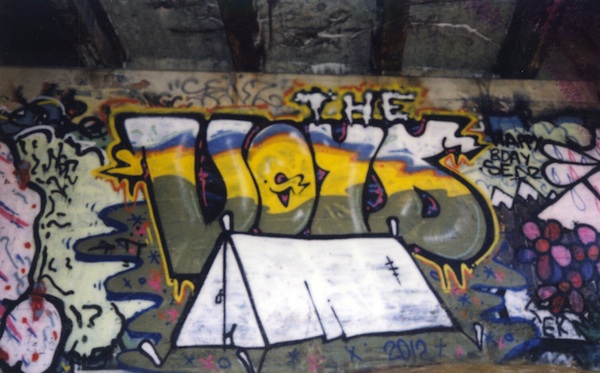
CD: Most graffiti has a secret source but you are connecting your identity to the art—or maybe you’ve built an identity for creating art. Using the name “void” has a certain meaning, but maybe it’s just an embellished lack of meaning. The tent symbol seems meaningful (a tentative space to fill, an efficient traveler) but also reminds me of the shape of a capital A or in it’s extended version AVOID.

AV: The truth is definitely closer to “I have built an identity for creating art.” Adam = Man, Void = Nothing. Over the last few years, I have carefully worked to communicate the meanings behind my art instead of pushing them into the void. The tents are loaded with meaning. From refugees and the homeless to environmentalists and protesters, each tent represents someone who has removed themselves from an understood comfort.

CD: Your photographs have a color and style of cheap 35mm cameras or polaroid, adding flatness and contrast, sometimes a bit overblown and flashed. Chattanooga to Occupy and now living in Asheville but lived in Brooklyn, South Carolina, Baltimore—what have you collected about your locations?

AV: The first images come from a multi-state tour through the American South, shot with a Fuji Instax 210 Instant Camera. The second group of images come from early November in Zuccotti Park during Occupy Wall Street, shot with disposable cameras containing various speeds and brands of film. While I did stay at the camp on and off for over two weeks, the pictures remain tourist photography. They were shot haphazardly and are a represented few from a much larger archive.

South Carolina was a great place to grow up. In the 90’s, Columbia had a unique and intense hardcore and experimental music scene. I participated in Charleston’s graffiti boom during the early 2000’s and decided to move to New York in order to progress my understanding of the art form. While in Brooklyn during the last half of the 2000’s, I got to witness what happens to an over-inflated art scene when the economic bottom falls out. DIY galleries appeared in tiny apartments; Street Art embraced non-saleability; and I had the freedom to experiment with different mediums and controversial content. I moved to Baltimore in 2010 to attend graduate school. There, I was engulfed in the local noise scene and had the physical space to expand my work into installations and large-scale roller-based graffiti. I am just getting my feet on the ground here in Asheville, but I hope to reconnect with how my work exists in relation to physical space, architecture and nature environments.

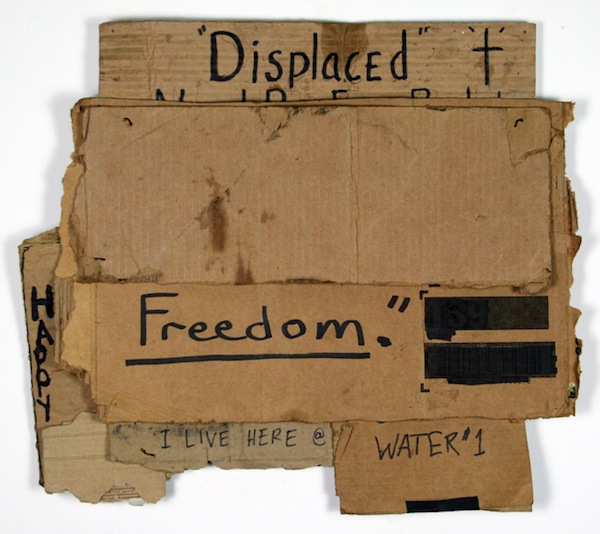
Adam Void, Another Way 1

The found object college pieces titled Another Way, began as hitchhiking signs collected from my travels hopping freight trains in California, Oregon and Washington. Once back in Baltimore, I began noticing the signage on local bodegas as well as the cardboard signs of the local homeless. The final artwork didn’t take shape until the Occupation of Zuccotti Park. Once in the park, I collected protest signs from my fellow Occupiers. At that point I began mixing those worlds, small business, travelers, activists, and the homeless. The resulting works took the shape of the common struggles experienced between those groups.

Read More »

Share

New York

Musing on Street Art vis-à-vis Icy and Sot

Icy and Sot, "Duel" (Tabriz, Iran)

The other day, in a somewhat drowsy effort to shake my late-summer torpor, I decided to poke around online in search of some intriguing, under-the-radar gallery shows.  Rather quickly, and despite (or perhaps because of) the aimless, unfocused nature of my ramblings, I happened upon the just-concluded show Icy and Sot: Made in Iran, which ran August 23-25 at New York’s Openhouse Gallery.

As I viewed the artists’ work, I felt my mental haze dissipating and giving way to the thrill of visual engagement that accompanies the best street art.  The artists, two brothers from the Iranian city of Tabriz known as “Icy” and “Sot” (pseudonyms, they have said, that help them to elude detection by the Iranian government), have been garnering attention for their bold, stencil-based images. Oscillating between playful irreverence and pointed political critique, their work is increasingly ubiquitous both on streets and in galleries around the world.

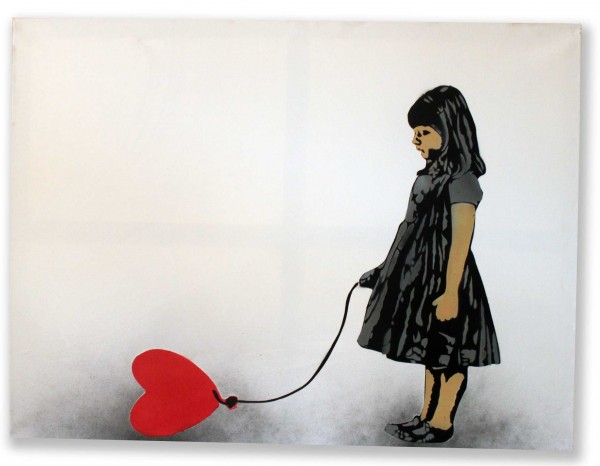
Employing a striking palette composed primarily of black, gray, white, and red, Icy and Sot convey a visceral sense of human vitality and an instinctive attunement to the raw, contrasting textures of social existence.  Many of their works appeared initially on the streets of Tabriz of Tehran and were subsequently replicated for gallery display, one notable example being Broken Heart, a vivid re-imagining of Bansky’s Balloon Girl.

Icy and Sot, "Broken Heart"

Radiating an ambiguous aura of both sadness and whimsy, Broken Heart implicitly acknowledges the artists’ status as inheritors of a long vibrant yet frequently suppressed strain of creative activity.  Arising from social fractures and political cracks, street art has often been characterized equally by audacious vision and material ephemerality; indeed, much graffiti-related debate now centers on whether and to what degree institutional acceptance robs street art of some essential “authenticity” or social force.  Such debate, however, seems to assume that “authenticity” can be clearly defined and, further, that street art’s significance is contingent on its means of production and dissemination—i.e., on its realization in the streets.

Read More »

Share