Hashtags

#Hashtags: Rejecting a Binary Argument with Toyin Odutola

Back in early March 2012, I reviewed Mark Bradford’s solo show at SFMOMA and learned shortly thereafter that the oft-repeated narrative about the circumstances of his early work—that he grew up in poverty in a depressed African-American neighborhood of Los Angeles—was simply not true (he was raised in Santa Monica, an affluent suburb). Given that I’ve heard this myth repeated even by knowledgeable curators, I shared my concerns with artist Toyin Odutola and was surprised to learn that even though she is in the early stages of her career, she is already encountering similar circumstances. Creating the narrative around art, framing its situation and contingencies, is always a tricky endeavor, but perhaps more so when the artist is of color and the myth-makers are white. I set out to talk with Odutola in more depth about her own work and process, and the way in which an artist—especially a successful artist of color—may or may not be able to control the story of her own work. In addition to being talented and modest (always a winning combination), Odutola is an articulate and energetic speaker. What follows is part of our conversation from mid-July.

Toyin Odutola, Black Surfaces. Black Grounds. I (Dotun. Abuja, Nigeria.), detail, 2012. Pen ink on black board, 20 x 15 inches

Bean Gilsdorf: Let’s begin with the question that’s usually asked last in interviews: what are you doing next? You’re going to Japan?

Toyin Odutola: Yes. Japan is a graduation present to myself, I really want to be in the place where it all started for me. I come from a comic-book background, from manga. In Japan I’m going to visit museums, get some Japanese papers and pens… Then when I get back, I’m going to a printmaking residency at the Tamarind Institute in August, which is really exciting. And I’m going to have a solo show at my gallery in April next year. Now the pressure’s on, because the first show was a tester and this is the real thing.

BG: Do you think Japan is going to have an influence on your work? Will it change what you’re working on for the show?

TO: I find myself returning to manga a lot lately and just noticing more aesthetic cues. I’m planning to go to cartoon museums in Tokyo, I really just want to be exposed to as much as possible. And I also really want to look at surface. One of the issues I’ve been having—and I think this would help with my show—is finding a really nice paper.

BG: I’m intrigued by the thought of you working at a printmaking residency, because the new pieces, the black-on-black drawings, look at lot like etching plates…

TO: Yeah, those are my way of saying, Toyin, I think it’s time to make some prints, and at Tamarind I can work with master printers who can show me how to do that properly. But the black-on-black pieces are still…tentative, just kind of not there yet. And a lot of that has to do with the ink and the paper, issues that can be resolved in making a print.

Toyin Odutola, Adeola in Abuja (Study), 2012. Acrylic ink and pen ink on black board, 15 x 10 inches

BG: It’s funny, you were working in black and white, then a jump into color for a little while, and then there was a dramatic shift into the black-on-black works.

TO: The reason I moved away from color is that I don’t have any concept of color whatsoever; it’s just lost on me. When I use color it’s not like painting where it’s part of the process, but it’s more like I lay it on, let it dry, and then the pen does all the work. That’s not really a proper way to go about making an artwork. There’s been a lot of interest in the color drawings, but I don’t feel like I have a handle on it. Now that I have time to think about it, I can see there there’s work that needs to be done.

BG: Now that you’re done with the MFA you can step away from it for a while.

TO: Yes, and I am going to go back to it eventually. But for this show, I know I’d like to do something similar to the black-on-black work. I’m taking my camera with me to Japan to take photos of Japanese people and draw them…and of course I’m thinking about what that means.

BG: That’s going to be a big shift, too.

TO: Completely. There have been a lot of write-ups of my work—I’ve been really fortunate—but it’s like black artist, black, black, but really, what is a black portrait? It can be anything. People allocate me to this “African-American Woman Artist” category, which is fine, that’s what I am, whatever—but it doesn’t mean that my subjects are that. So to do something with Japanese people would be fun, to play with the idea of the black portrait. What makes a black portrait? Are they black portraits because I’m black and I’m making these, or because they are the color black? I’m playing with the concept of blackness and what that means.

Toyin Odutola, Black Surfaces. Black Grounds. III (Adeola. Abuja, Nigeria.), 2012. Pen ink on black board, 20 x 15 inches

BG: I love the idea of exploring blackness culturally and conceptually. When the Mark Bradford show was at SFMOMA you and I talked about cultural expectations and the biographical narrative of an artist of color, and of course I’ve been thinking a lot about your work and the narrative that’s becoming linked to your work. I know you’ve questioned some of the interactions you’ve had…

Read More »

Share

Elsewhere

Macho Boogie-Woogie in Mexico

It’s a rainy summer night in Guadalajara. Zooming through the dark, the jeep I’m riding in feels more like a powerboat as it leaves a black wake in the flooded streets. This ain’t no British rain – and thank God for that. (I’ve had enough drizzle for two lifetimes.) Palm fronds shake and the heavy rain suddenly turns to hail. The frothy water in the street is peppered, and ice pounds the roof. ‘What do you call this?’ I ask, shouting from the backseat in my remedial Spanish. ‘Granizo,’ my friend replies. ‘Graaneeezooo’ I repeat, wondering if a silk shirt and a mini skirt was a good idea. I ask for perhaps the forth time during the car ride where we are going and what exactly we are doing. My friend merely replies something along the lines of, he can’t really explain – but there will be drinks – and it’s ‘an art thing.’ After a week in an unknown city where I don’t speak the language – I’ve learned to go with the flow.

We must be in downtown Guadalajara, but all I can see is the glisten on the streets as I bail out.  I run through the torrential rain across the pavement, dodging granizo and landing on the dry doorstep of an airy, modern restaurant called Café Benito. Having just escaped the rain and hailstones, I am now immediately bombarded by something else. Blasts of an unexpected kind of music: vintage, improvisational jazz pulsates from the DJ booth with astonishing force. Music you usually imagine softly breathing from a record player booms against the cement walls like a dubstep concert. Shaking out my hair, I quickly realize this isn’t just a restaurant – but a uniquely hybridized and multi-disciplinary space. The back of the bar is connected to a theatre of sorts and I can catch a clean white glimmer of an adjoining gallery space. Naturally we head for the bar and order a round of cervezas. My friend advises that, despite being 2 hours late, we are right on time for the performance, a thing I’m liking more and more about Mexico.

Cafe Benito in Guadalajara

Meandering through the modern décor scattered throughout the hard-edged cement space towards the gallery, I meet a number of Guadalajara’s tight knit crew of contemporary artists, who, in addition to all being good friends, seem to have matching mustaches and tattoos. (I discover that these ‘homemade’ tattoos were the handiwork of visiting artist Thomas Jeppe’s recent residence and assumingly, a night full of escalating dares and mezcal.) Guadalajara’s art scene is personal and friendly – after a few days, these guys all know my name. Thankfully, I missed tattoo night. The curator, Antoine Thelamon, shouts his hellos over the music, reluctant to clarify what I am about to see, except for teasing about a little surprise in store. The artist on show is a locally based artist, Adrian S. Bara, who walks me towards the installation.

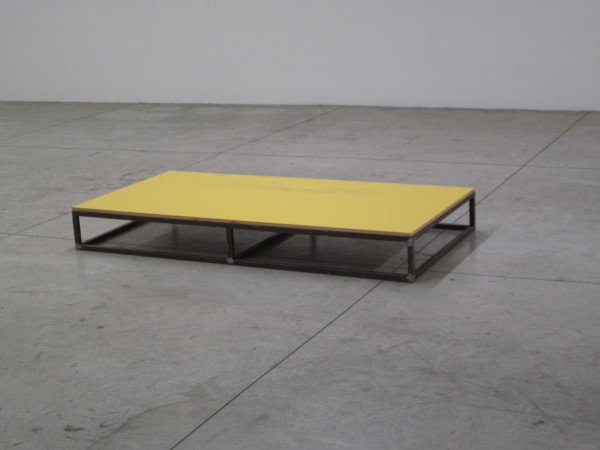
Adrian S. Bara sculpture installation, Cafe Benito, 2012

Beyond the bar, and still reverberating with loud jazz, is a pristine gallery space scattered with minimal sculpture objects. A low steel platform with a golden yellow top humbly blushes in the centre of the floor, a hint of colour in the cool space. Roughly polished with hints of iridescent circular marks, a grey steel bar juts from a high corner, sloping 45 degrees and before being mechanically bolted directly to the concrete floor. Across the cavernous space is a curious scene: a blank section of wall seems taped off, as if to signify an invisible, white painting that once was there. Below either side of the black perimeter, two spotless concave wooden objects hug the lower corner of the wall. In the typical fashion, since Minimalist sculpture encourages the viewer to walk around the space, I pace around and under, along and through….but soon Bara curiously encourages me to stay close to the walls as the a hip crowd gathers to watch the performance.

Adrian S. Bara sculpture installation and performance, Cafe Benito, 2012

I am slowly piecing together the work when two teenagers roll in on skateboards battering through the space. Uh, is that allowed? It takes the sound of a skateboard deck smashing and scraping along the yellow sculpture at the centre of the gallery for me to realize exactly what’s happening here. The steel bar becomes a rail and the two wooden sculptures across the space now so obviously become ramps. Artworks turn into obstacles, as gallery becomes skate park – and all the usual rules of either arena go right out the ventana. The world where artwork is precious, jealously guarded and forbidden to touch is shattered with the loud slap of wood, metal and wheels.

Read More »

Share

Sydney

A Double Take at White Rabbit

Ai Weiwei, Sunflower Seeds, Hand Painted Porcelain, image reproduced courtesy of White Rabbit Gallery

Things are not quite what they seem in ‘Double Take’ at the White Rabbit Gallery in Sydney. The exhibition presents some new works and others which have been seen before but deserve re-examination. A heap of porcelain sunflower seeds, a shiny Harley Davidson which turns out, on closer inspection, to be a bicycle, and the doorway of a Beijing apartment which reveals itself to be padded cloth, stitched and embroidered in a simulacrum of downmarket real estate:  these and many other works repay a careful second glance – the ‘double take’ – in order to reveal hidden meanings.

Ai Weiweis Sunflower Seeds, piled on the floor in more modest numbers than the overpowering 100 million exhibited in 2010 at Tate Modern, seem far more domestic. We remember that sunflower seeds were the snack item shared by ordinary Chinese in times of great poverty and hardship. A close examination reveals their individual beauty. The seeds, at first glimpse so real, possess many complex, even contradictory, meanings. They allude to imperial porcelain production, and to modern-day China as the world’s factory. They also allude to the conformity expected of the masses, reminding us of the price paid by individuals for China’s breakneck modernisation. In propaganda posters Mao was often represented as the sun, with the faces of the proletariat turned towards him. More audaciously, they can be seen as a direct critique of the commodification of contemporary Chinese art, and the way it has been voraciously consumed by western curators, critics and audiences – almost a new ‘Chinoiserie’.  Ai Weiwei connects the current western fascination for contemporary art from China with the trade in willow pattern and porcelain ware in the past.  Shown in a space which also includes Zhou Xiaohu’s fake press conference and a satirical Pisan video work, ‘Cracking Sunflower Seeds’, the connections between the works allude to the artist as political dissident and artworld iconoclast.

Ai Weiwei, Sunflower Seeds, hand-painted porcelain, image reproduced courtesy of White Rabbit Gallery

A replica by young artist Gao Rong of the entryway to her Beijing basement apartment delights and surprises audiences new to her work. The artist, who made a full size version of her grandparents’ house in Inner Mongolia for the recent Biennale of Sydney, has created a simulacrum so real that many viewers walk straight past thinking it must be a service door for the gallery.  In fact every detail is stitched, sewn, embroidered, appliqued – including rust stains and electricity fuse box. Continuing this theme of simulated reality is Tu Wei-Chengs ‘Happy Valentine’s Day!!’, an installation in which the sense of smell is first tantalised and then repelled by the aroma of chocolate wafting out of an apparent confectionery shop. Shelves and counters display heart-shaped boxes with pink satin bows, and an array of enticingly packaged chocolates.  On closer inspection the ‘chocolates’ turn out to be weapons, hand grenades, tanks – the machinery of war. And they are not made of chocolate, but of plastic. The artist explores how menace and aggression can lie beneath love and romance, in a veiled message about the fraught relationship between his birthplace of Taiwan and the People’s Republic of China.

Liu Zhuoquan’s intricately painted installation of glass bottles painted in the ancient tradition of ‘neihua’, or ‘inside painting’, contains beautifully painted body parts rather than the traditional misty mountains or blossoms seen on snuff bottles. “My work is like a scientific laboratory”, says the artist. His bottles often contain a coded meaning, and this installation, despite its beauty, may be read as a comment about the way in which organs for transplant are reputedly obtained from executed prisoners. Lu Xinjian’s ‘City DNA Beijing’ at first appears to be a formalist abstraction, but in fact his works are representations of cities seen via Google Earth. Satellite views reduce any metropolis to a complex geometry of interlocking lines and shapes.

Lu Xinjian, City DNA Beijing, 2010, acrylic on canvas, 200 x 400 cm, image reproduced courtesy of White Rabbit Gallery

A very different approach to painting is seen in Shen Liang’s painterly impasto replicas of Cultural Revolution comic book covers from his early childhood. Reproducing every tear and stain on covers depicting Young Pioneers marching into a bright socialist future, he also added schoolboy graffiti and obscene doodles. He is mocking his own seriousness as an academically trained painter, as well as puncturing the propaganda of his past. “I give old things new meanings through my work”, says the artist.

Read More »

Share

Interviews

“the edge between structure and intuition” – An Interview with Anne Lindberg

On a visit to the Nevada Museum of Art this summer, I first encountered the work of Kansas City based Anne Lindberg. Tucked in a small, irregularly shaped gallery, Lindberg’s luminous installation immediately caught the eye, where individual threads created volume and marked space in a way that belied its virtually imperceptible constituent parts. Her large-scale graphite drawings also on view in the gallery invited close inspection, the subtle shift in hand drawn lines creating a palpable sense of movement within the confines of two-dimensions. I had the opportunity to speak with Lindberg on the occasion of her exhibition, sustaining pedal, at Carrie Secrist Gallery in Chicago.

I understand that after receiving your B.F.A., you served as a curatorial assistant at the Smithsonian Institute in the Department of Ethnology. How did your close work with textiles influence your approach to materials, pattern and color?

As a curatorial assistant, I had the rare opportunity to help unpack and notate objects from the Lamb Collection of West African Textiles that was being given to the museum. I was charged with making a drawing of a section of the objects, counting threads, identify if the threads were Z or S spun (which determined the likely gender of the spinner), make notes on provenance and repack the item for storage. That work at the Smithsonian, first of all, helped me to decide that I wanted to be an artist rather than an anthropologist or museum professional. I feel that this work honed my tendency to work with very fine delicate elements in accumulation and as a method to build intensity and meaning. I entered a graduate program at Cranbrook Academy of Art immediately after leaving the Smithsonian, and began an investigation of concepts to visualize and materialize space, spatial qualities of architecture and light.

Anne Lindberg, "parallel 34," 2012. Graphite and colored pencil on cotton mat board. 104 x 58 inches. Courtesy the artist and Carrie Secrist Gallery, Chicago.

Your work has been compared to Minimalists like Sol LeWitt and Richard Serra, for whom, it has been argued, concealing the artist’s hand in the resulting piece was paramount. In contrast, mark-making and physical involvement in the work seems key to your practice. How do you feel your process relates to these Minimalists? And what value do you place on the artist’s hand in the execution of your works?

Works by both of the artists you mention here have an incredible presence of the maker and the material. The graphite wall drawings by LeWitt are done painstakingly by hand, the index of the mark-making becomes the work. And with Serra, there is a compelling, riveting sense of body, weight, sound, materiality in his Cor-ten steel sculptures as well as the oil stick drawings. Minimalism has become a very broad term that is perhaps over-used, maybe even ill-used. In my work, the fact of my body and its actions to make the work are quite central, particularly in the graphic drawings. Each line corresponds to a body movement in time. Also, I intentionally show the beginning and ending of each graphite line so that one feels it as a physical line, an action with a beginning and a resolution before the next line begins. And the staples in the installations are quite visible as they mark the point of turnaround for the taut thread; they create another layer of drawing in the work and an honest acknowledgement of how the work is made.

What issues do you consider when deciding how to produce a thread installation in a particular location?

Each installation is different, yet the body of work is a process of building one work from another through knowledge gained, and so I see these works as a series of drawings. They just happen to live in different spaces at different times. It’s important to consider that I can’t actually make the work until I begin the installation at the venue. My studio is a place for study, research, engineering and model making for each project. With each project, I consider the architectural circumstances, i.e. height of the ceiling, vantage points within the space, materiality and proportion. The personality and character of the space is also important in terms of the age of building, current and former uses, cultural indicators, the overall energy of the place. For each project thus far, I have made numerous (upwards of 6-10) small 1/4 inch scale models of differing paths, forms, colorations and densities in order to arrive at what feels right.

Anne Lindberg, "zip drawing," 2012. Egyptian cotton thread and staples. 8 h x 10 x 35 feet. Installation view at Carrie Secrist Gallery, Chicago. Courtesy the artist and Carrie Secrist Gallery, Chicago.

Your work in two-dimensions with both your graphite and colored pencil drawings and your thread drawings, which can aesthetically look quite similar. What differences do you see in how these works operate?   

Read More »

Share

Help Desk

Help Desk: Mind the Gap

Help Desk is an arts-advice column that demystifies practices for artists, writers, curators, collectors, patrons, and the general public. Submit your questions anonymously here. All submissions become the property of Daily Serving. Help Desk is cosponsored by KQED.org.

Is a gap in your artist résumé detrimental to your current job, exhibition and other prospects? I haven’t exhibited art in a year for various circumstantial reasons. Now I am looking for a job as an art teacher and in a few months, I will be applying for exhibitions here in my new home of New York City. What if 2013 rolls around and I have no exhibitions or work to show for 2012? Am I in a hole that just gets deeper and deeper with each month?

The short answer is that a hiatus from exhibiting is not a disaster. The longer answer depends on how lengthy your pause is and how you deal with it. Let’s go through the finer points.

I contacted a number of art-school human resources departments, but no one was willing to go on record and pony up a definitive answer. However, Stephen Slappe, who serves as the Chair of Video & Sound at Pacific Northwest College of Art (he’s sat on a number of hiring and grant committees), came through with some reassuring advice for the job seeker: “A one-year gap wouldn’t even be a blip on the radar from my point of view. A person could have been working on a big solo show, relocating to a new city, or even suffering from an illness. I think most hiring committees understand the ups and downs of careers and lives. If your CV had a multi-year gap then it might draw more attention from a committee.” So you really don’t need to worry at this point.

Chiharu Shiota’s installation at Art Basel Miami Beach 2010

Bear in mind that you’ll use different informational formats to apply for teaching gigs than you would for an exhibition proposal or grant application. A teaching résumé will emphasize your instructional experience, media-specific expertise, and other specialties like working with age/language populations. There are lots of sample art-teaching résumés out there, and you can check out a few here (but leave off the little painter’s palette icon, please), here, here, and here. Also, a job résumé is often limited by length (usually one or two pages), so you’ll want to use the space to highlight your pedagogical experience and accomplishments instead of your exhibition record. When you’re applying for a job, do pay particular attention to the requested page limit. Having sat on a few hiring committees myself, I can tell you that when you’re faced with a giant stack of applications, you start to look for ways to sort the wheat from the chaff; applications that don’t adhere to the stated guidelines are often relegated to the circular file.

The terms of engagement are different for teaching jobs than for exhibition proposals/grants/residency applications, and you’ll want to tailor your document to suit. Often these submissions ask for a CV with no set page length, and they are meant to be a complete list of all of your art-related achievements, which means that your gap might be more apparent here. Even so, a one-year lacuna is still not a big deal for the same reasons pointed out by Professor Slappe, above. For further information on formatting a standard CV, you can review the College Art Association’s handy guidelines here.

Read More »

Share

From the Archives

The current exhibition at the California College of the Arts Wattis Institute, When Attitude Became Form Becomes Attitudes, is a sequel to, and a reevaluation of, the legendary 1969 exhibition When Attitudes Become Form, which was curated by Harald Szeemann at Kunsthalle Bern in Switzerland. It brings together 82 international contemporary artists who follow, in various ways, the legacy of Szeemann’s iconic exhibition. Today from the DS Archives we take a look back at two past exhibitions at the Wattis Institute, The Wizard of Oz, and Moby Dick (below).

The following article was originally published on November 16, 2009 by :

MobyDick_upstairs-45

The Great American Novel, Moby Dick, takes on new life at the exhibition of the same name currently showing at California College of the Arts’s Wattis Institute. The exhibition loosely traces the narrative of the epic (and episodic) tale with each of the three galleries dedicated to the story’s protagonists, Ishmeal, Ahab, and of course, the White Whale, Moby Dick. Thirty-three artists ranging from the established to emerging are exhibited, and a large number consist of specially commissioned works that reflect the artist’s own interpretation of the Herman Melville classic. Among the highlights are Marcel Broodthaers, Felix Gonzalez-Torres, Buster Keaton, Richard Serra, Hiroshi Sugimoto, and even Orson Welles. A room-sized replica of the sperm whale has been executed by artist Andreas Slominski, and though a commissioned work (size, scale, and the dried, crumbling, clay material reveal this) Slominski’s interpretation of the harpoons which brought down the White Whale demonstrates his imaginative personal iteration of the novel’s denouement. Also of considerable interest is an eight-foot salt tower by Mexican artist Damian Ortega. Thick, crystal-white salt was rammed into a narrow, rectangular tower made of plywood. The wood was removed, leaving the salt tower to crumble to the gallery floor, an unplanned but satisfyingly rich effect. Read More »

Share

Los Angeles

Conversion and Inversion Stories

L.A. Expanded: Notes from the West Coast
A column by Catherine Wagley

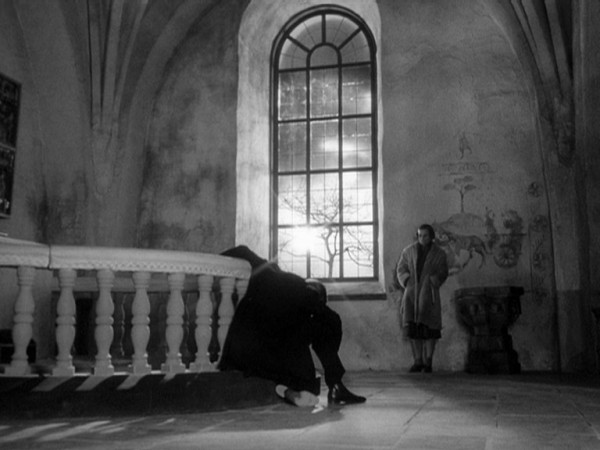
Still from Ingmar Bergman's Winter Light.

Tobias Wolff and a friend went to a free showing of Ingmar Bergman’s Winter Light one evening in 1970. Shown in the sanctuary of an Oxford church, the severe narrative about spiritual malaise seemed hauntingly appropriate and, in a 2008 essay, Wolff describes his experience with it as “harrowing”—he felt himself drowning in the characters’ uncertainty. When a self-assured preacher stood up to proselytize after the film, Wolff listened earnestly and might have committed his life to Christ that night had not the preacher projected William Holman Hunt’s Light of the World on the film screen.

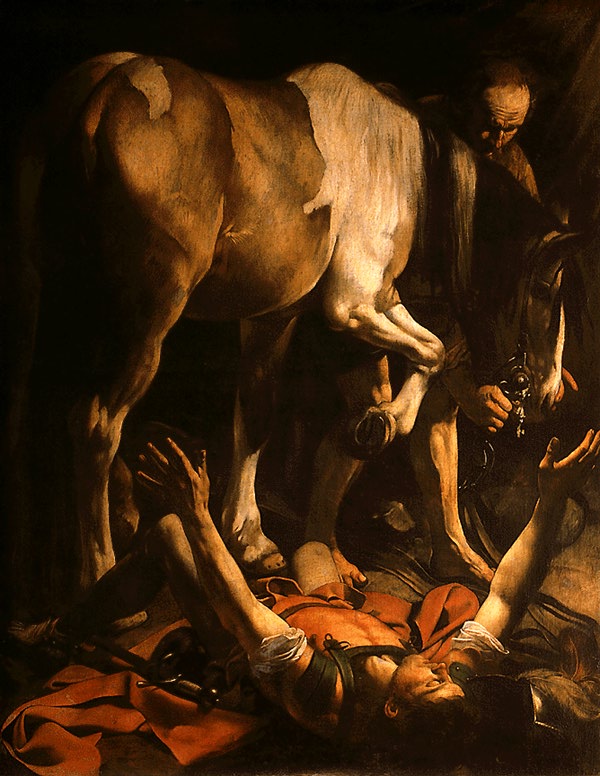
The way the image turned salvation into a protected stroll through Neverland stifled Wolff’s interest. But what if the image had been Caravaggio’s Conversion of St. Paul, Wolff wonders now, in which Paul lies beneath his horse as if frozen in an epileptic spasm, momentarily experiencing the supernatural in order to become better equipped to live in the present? Maybe then he would have become a missionary instead of a novelist.

Michelangelo Merisi da Caravaggio, The Conversion of Saint Paul, 1600-1601, Oil on canvas.

In Hunt’s pre-Raphaelite world,  you can wander into a secret garden and find yourself walking side-by-side with a radiant Christ. Caravaggio positions Paul’s conversion amidst life’s complexities, not secluding him but equipping him to face the snarls of early Christianity. Yet both paintings ultimately gesture toward the same distilled narrative: life is complicated and finding a divine answer helps.

When I visualize the place where these opposing narratives meet, I imagine two vertical scaffolds standing next to each other. And what if they somehow leveled out on a horizontal plane? What if Hunt’s tall and narrow garden flipped over and opened up so that some of the brush fell out onto the sterile ground of Caravaggio’s painting while Caravaggio’s horse wandered into Hunt’s wooded background?

JP Munro, Dionysus In India, 2012, Oil on Linen. Courtesy International Art Objects.

At International Art Objects — formerly China Art Objects — on Saturday, JP Munro leveled out the verticals. His oil on linen paintings, intricate and painted so that they look like tapestries, spill different iconic or historical narratives into each other. In Dionysus in India, you see Hindu gods and goddesses amidst characters from Greek myth. In Woman Playing the Piano,  you see a lady who could’ve popped out of a Jane Austen novel playing the piano, while seaside L.A. buildings and a palm tree can be seen out the window in the distance. Naked bodies that again look like they’re from Dionysian myth lounge in the foreground. There’s no distilled narrative — actually there’s a mess of narrative — but somehow, Munro’s paintings feel more  comfortable with themselves than either Hunt’s or Caravaggio’s.

Share