Citizenship, the Body, and the Ethics of Exposure

From our sister publication, Art Practical, today we bring you Michelle Weidman’s piece from “Issue 8.1: Art + Citizenship.” Weidman excavates the ethics of exposure, and the violation and consumption of black bodies, brown bodies, women’s bodies. She asserts, “We live in a society that relishes exposure—see nude photo leaks; the Kardashians; interest in diaries and private correspondence cloaked with the pretense of literary or political interest—and that does not value privacy equally for all.” This article was originally published November 10, 2016.

Felix Gonzalez-Torres. "Untitled" (Portrait of Ross in L.A.), 1991; Candies individually wrapped in multicolored cellophane, endless supply; Overall dimensions vary; Installation view: More Love: Art, Politics and Sharing Since the 1990s. Ackland Art Museum, University of North Carolina, Chapel Hill. 1 Feb. - 31 Mar. 2013. Courtesy of Andrea Rosen Gallery, New York. © The Felix Gonzalez-Torres Foundation

Felix Gonzalez-Torres. “Untitled” (Portrait of Ross in L.A.), 1991; candies individually wrapped in multicolored cellophane, endless supply; overall dimensions vary; installation view: More Love: Art, Politics and Sharing Since the 1990s. Ackland Art Museum, University of North Carolina, Chapel Hill, Feb. 1 – March 31, 2013. Courtesy of Andrea Rosen Gallery, New York. © The Felix Gonzalez-Torres Foundation.

I. The ethics of exposure: our virgins and our whores

In May 2016, Chloe Sevigny shared an Instagram post of herself at the Met Breuer picking out a piece of cellophane-wrapped candy from Felix Gonzalez-Torres’ “Untitled” (Portrait of Ross in L.A.) (1991), which is often understood as a representation of his lover’s body weight before his eventual death from AIDS-related illness. In all installments of this work, audience members are allowed to take a piece of candy diminishing the weight in the process. The post has 11,600 likes.

Sevigny occupies a unique place both on the fringe and at the center of American fame, and is for that reason an interesting representation of societal (double) standards of beauty, exposure, and self-possession. The story of her rise to stardom is the quintessential virginal origin story: She was merely walking down the street when she was discovered and thrust into the limelight. She never searched for fame; it found her, uncontaminated by aspiration. She was first labeled an “it girl” in a 1994 article in the New Yorker by Jay Mclnerney. The piece spends a lengthy paragraph breaking down her physical imperfections, ending with astonishment that people still can’t get enough of her.

Read the full article here.

Share

Shotgun Reviews

Ludovic Duchâteau: In Dreamland at A Stark Project

Shotgun Reviews are an open forum where we invite the international art community to contribute timely, short-format responses to an exhibition or event. If you are interested in submitting a Shotgun Review, please click this link for more information. In this Shotgun Review, Noah Sudarsky reviews Ludovic Duchâteau: In Dreamland at A Stark Project in Berkeley.

lduchateau-indreamland-4

Ludovic Duchateau. In Dreamland, 2016; installation view, A Stark Project, Berkeley. Courtesy of the Artist and A Stark Project. Photo: Hillary Goidell.

French sculptor Ludovic Duchâteau’s first solo show in the U.S., In Dreamland at Berkeley’s A Stark Project, is a polished articulation of his dystopian obsessions, which previously found homes in miniature scenes of domestic life cleverly ensconced inside otherwise ordinary-seeming briefcases and among tentacular silicon sculptures engineered with e-waste. Originally a game programmer, Duchâteau abandoned digital media at the height of the first internet bubble in favor of working with a broader variety of materials [1]. The result is particularly striking, evidenced by the ominous installation, In Dreamland.

In the life-size installation featuring epoxy resin and aluminum wire (among other materials), a boy inside a black tarp has fallen asleep reading a famous graphic novel, Akira (set in “Neo-Tokyo” in the aftermath of World War III). The science-fiction titles that are scattered around his makeshift campsite complete the post-apocalyptic literary symbolism. Next to the boy, a cryptic life form emerges from the tent, its gigantic tendrils scouting the empty terrain; this massive, encroaching root system may be a projection of the sleeping boy’s imagination, or perhaps it is all too real—a slithering alien creature seeking to occupy an already ravaged world and replace the frail remnants of a depleted humanity. Either way, viewers are confronted with a heart-stopping scene that belies the pacifying title of the work.

Read More »

Share

New York Shotgun Reviews

Manifesto at the Park Avenue Armory

Shotgun Reviews are an open forum where we invite the international art community to contribute timely, short-format responses to an exhibition or event. If you are interested in submitting a Shotgun Review, please click this link for more information. In this Shotgun Review, Bai Yuting reviews Julian Rosefeldt: Manifesto the Park Avenue Armory.

Julian Rosefeldt. Manifesto, 2015; installation view, Park Avenue Armory, New York. Courtesy of Park Avenue Armory. Photo: James Ewing.

Julian Rosefeldt. Manifesto, 2015; installation view, Park Avenue Armory, New York. Courtesy of Park Avenue Armory. Photo: James Ewing.

This winter, the Park Avenue Armory presents the German cinematographer Julian Rosefeldt’s thirteen-channel video installation, Manifesto (2015). Drawing from more than fifty early writings of artistic legends like Claes Oldenburg, Kazimir Malevich, André Breton, and Sol LeWitt, the work weaves some of the most poignant thoughts of the 20th century into thirteen powerful monologues. Superbly performed by Cate Blanchett, each soliloquy corresponds to an aesthetic movement in the history of modern art, including Fluxus, Dadaism, Futurism, and Constructivism. Detached from their historical backgrounds and reimagined as contemporary realities, the dated manifestos are invigorated through the characters’ refreshing feminine voices.

The Armory’s artistic director, Pierre Audi, known for breathing new life into classic works, presents Manifesto as a cutting-edge, immersive art experience. The towering, 55,000-square-foot Wade Thompson Drill Hall delivers an impressively theatrical aura. As I enter the cavernous space, I encounter a massive screen that displays images of flickering flames. In a soft voice, Blanchett recites excerpts from Karl Marx’s Manifesto of the Communist Party. Following the map included in the playlist-like press release, I turn to the left. On another screen, unrecognizably impersonated by Blanchett, a homeless vagabond staggers along apocalyptic industrial ruins, debunking capitalism with words from Guy Debord’s Situationist manifesto; the press release provides all sources of Blanchett’s script and an introduction of Situationism in lay terms.

Read More »

Share

Paris

Soulèvements (Uprisings) at the Jeu de Paume

What if the imagination made mountains rise up? Georges Didi-Huberman poses this question in Soulèvements (Uprisings), a new exhibition at the Jeu de Paume National Gallery in Paris. Throughout the museum’s galleries, contemporary artworks, books, historical documents, and photographs present a potent survey on the theme of social rebellions in the West, ranging from Victor Hugo’s call for the abolition of the death penalty (in the preface to his 1829 novel, The Last Day of a Condemned Man) to Maria Kourkouta’s 2016 video, Idomeni, March 14, 2016, Greco–Macedonian Border. In the latter, the artist documents the silent passage of groups of burdened refugees across the landscape—the kind of image that, through repetition in the worldwide media, has acquired a disturbing normalcy.

Dennis Adams. Patriot, 2002; C-print mounted on aluminum; 40.5 x 54 in. Courtesy of Centre National des Arts Plastiques, Paris. Photo: Galerie Gabrielle Maubrie.

Dennis Adams. Patriot, 2002; C-print mounted on aluminum; 40.5 x 54 in. Courtesy of Centre National des Arts Plastiques, Paris. Photo: Galerie Gabrielle Maubrie.

Based on Didi-Huberman’s extensive research, the exhibition guides the viewer into an iconographic exploration of what makes humans revolt. Apparently the answers are in the uninspired organizing themes—“Elements (Unleashed),” “Gestures (Intense),” “Words (Exclaimed),” “Conflicts (Flared Up),” and “Desires (Indestructibles).” The exhibition opens with Dennis Adams’s Patriot (2002), a large-format photograph of a red plastic bag floating against a white and blue background—a partly cloudy sky. Striking in its literal nature relative to the exhibition’s ethos, Adams’s work also exemplifies what the show achieves by requiring the spectator to imagine the possible curatorial narratives (which were previously and lengthily developed in a text that is absent from the show and only invoked in the aforementioned categories).

Read More »

Share

Los Angeles

Radio Imagination: Artists in the Archive of Octavia E. Butler

Radio Imagination: Artists in the Archive of Octavia E. Butler is an exhibition curated by the Los Angeles–based arts organization Clockshop, and is part of Clockshop’s yearlong program to commemorate the ten-year anniversary of the celebrated science-fiction writer’s death. In addition to this exhibition, the program has also included collaborations with local platforms such as ALOUD at the Los Angeles Public Library and REDCAT. On view at Pasadena’s Armory Center for the Arts, Radio Imagination comprises newly commissioned artworks by several artists who explored and responded to contents of the author’s archives, which are housed at the Huntington Library in nearby San Marino.

Installation view of slideshow of materials from the Octavia E. Butler Papers. Courtesy of Clockshop. Photo: Gina Clyne.

Installation view of slideshow of materials from the Octavia E. Butler Papers. Courtesy of Clockshop. Photo: Gina Clyne.

A room near the exhibition’s entrance features a slideshow of images of notebooks, photographs, and ephemera from Butler’s papers at the Huntington. It is not hard to imagine how artists—who must persist through impossible cycles of success and failure—must understand the motivation and frustration ever-present in Butler’s notes. “Focus on Action!” is written again and again on a particular scrap, undoubtedly reminding the author to continue pushing forward, no matter how grueling the project. While the slideshow provides an evocative glimpse of the archive’s source material, it would be even stronger if objects from the collection were actually on display at the Armory, and were allowed to intermingle with the new work generated by the invited artists.

Read More »

Share

Montreal

La Biennale de Montréal: Le Grand Balcon at the Musée d’Art Contemporain de Montréal

There is admittedly a little bit of confusion when one arrives at La Biennale de Montréal’s main venue, the Musée d’Art Contemporain (MAC), for a great part of the biennale does not in fact take place at the MAC. With eighteen satellite venues beyond walking distance and inaccurate information from its front-line stewards, trekking through extreme winter conditions in the land of the tragic 19th-century poet Émile Nelligan becomes a daunting mission. What emerges are the growing pains and logistical issues of propelling this baby biennale into one that is world-class.

David Gheron Tretiakoff. A God Passing, 2008; video with sound; 20 minutes. Courtesy of the Artist.

David Gheron Tretiakoff. A God Passing, 2008; video with sound; 20:00. Courtesy of the Artist.

The challenge continues with curator Philippe Pirotte’s verbose yet perspicacious statement. Titled Le Grand Balcon [The Grand Balcony], the biennale is drawn loosely from Jean Genet’s play Le Balcon [The Balcony]. Part of a luxury brothel, the balcony of Genet’s play is “a space of contestation between revolution and counter-revolution, reality and illusion,”[1] where the power elite and other seemly characters engage in role-playing. Pirotte remarks, “Le Grand Balcon invites us to rethink both the (im)possibility of an emancipation through pleasure—and its urgency. Asserting a hedonist politics far from the easy rewards of consumption, in an environment of potentially economic or political instrumentalization, the exhibition opposes a via negativa of alienation, skepticism, discomfort, and loss.”[2]

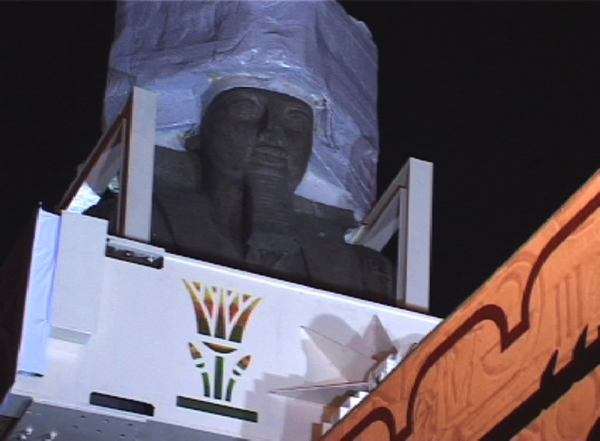
A tiny, dark room, which feels like an abandoned space in a near sci-fi future with the last surviving single-channel video, houses David Gheron Tretiakoff’s A God Passing (2008). The video opens with various shots of men waiting and staring. An intense suspense gradually builds up, with the weight of gazes matched by careful shots of worn city scaffoldings and slow, seeping water. The crowds of men are awestruck—many on each other’s shoulders, dancing and chanting “Long live Egypt.” With particular cinematic cutting style, the video finally reveals that they are witnessing the historical 2007 move of the 11-meter statue of pharaoh Ramses II from a Cairo train station to the Grand Egyptian Museum on the Giza Plateau. Meanwhile, a man screams that Egyptians are not deserving of this regal inheritance—that they need to clean their nation first. A God Passing shows Pirotte’s interest in spaces of “revolution and counterrevolution, reality and illusion” and is framed by our present foreboding knowledge of the imminent and similarly fanatic cheering of the unfulfilled Arab Spring. Spectral, ominous, and morbid, A God Passing exposes a phantom limb and offers a cool balcony from which to ruminate on this surly hedonism and its malformed smile guided by the eternal cycle of political instrumentalization.

Read More »

Share

Odd Jobs

Odd Jobs: Danielle Dean

Welcome back to Odd Jobs, where artists talk about their varied and nontraditional career arcs. For this installment, I spoke to Danielle Dean—born to a Nigerian father and an English mother in Alabama—whose interdisciplinary practice draws from this multinational background. Her work explores the interpellation of thoughts, feelings, and social relations by power structures working through news, advertising, political speech, and digital media. She has shown her work in solo exhibitions at Commonwealth and Council in Los Angeles and Bindery Projects in Minnesota, and in group shows at the Hammer Museum and the Guggenheim Gallery at Chapman University. She has received grants from the Foundation for Contemporary Arts, Rema Hort Foundation, and Creative Capital. This month, Dean has a solo show opening at Commonwealth & Council, and will also have work in a group show at the Sculpture Center in New York. 

Danielle Dean. Hexafluorosilicic, 2015; installation view at Commonwealth & Council, Los Angeles. Courtesy of the artist.

Danielle Dean. Trainers, 2014; installation view at the Hammer Museum, Los Angeles. Courtesy of the Artist.

Calder Yates: You were born in the U.S. but you grew up in England, is that right?

Danielle Dean: Yeah, so I have American and English citizenship, but in a lot of ways I’m more English than American.

CY: Did you work while getting your BFA?

DD: Yeah, I’ve always worked. I lived in a suburb of London and I worked in bars, a couple of pubs in Hemel Hempstead, one in particular called The Patch.

CY: Were you a barback or a bartender?

DD: Yeah, um, a bar person? I was like a bar lady. It was a proper old man’s British pub. It smelled really bad. I did a fundraiser there. I got the owner to do a sponsored bar dance where we had to dance the whole night behind the bar. It was really successful, I got loads of money because he was a real good sport but he wasn’t very fit, you know? We had to move and dance the whole time. I also worked in a pub in London, it wasn’t a very nice pub. It was in Holborn. It had a lot of businessmen who would drink a lot of shots made out of sweets. And the men were really sleazy. I hated it.

Read More »

Share