Hashtags

#museumpractices: The Museum On My Mind, Part II

Wall labels. Curatorial text. Provenance. Titles (or un-titles, as the case may be). At what point do the words surrounding an artwork serve the work, and at what point do they disrupt it? In terms of the museum, specifically, when do explanatory labels benefit museum-goers, and when do they detract from an individual’s experience? This week, #Hashtags features Part II of The Museum On My Mind, a meditation on the role of museum commentary and what it means to “know” a piece of art. Click here for a refresher on Part I.

Part II: Writing on Water

Famous for using chance operations to compose both musical scores and visual art, John Cage’s goal was not to manifest a “gratuitous” randomness,[1] but to put “the intention of the mind . . . out of operation.”[2] For Cage, non-intention was not unintentional: “If you work with chance operations, you’re basically shifting—from the responsibility to choose . . . to the responsibility to ask.”[3] Cage was influenced by the “whispered truths,” three principle tenets from one school of Zen Buddhism, including, “[Y]our action should be as though you were writing on water. . . . In other words, not to make an impression.”[4] Simple as the principles are, they signal the fundamental endlessness, evanescence, and wholeness that we camouflage with our attempts to limit, preserve, and distinguish experience.

Left: John Cage, Eninka 28, 1986; one in a series of 50 smoked and branded prints on gampi paper chine colle; 25 x 19 inches. Right: John Cage, Without Horizon 33, 1992; one in a series of 57 unique aquatints with etching and drypoint on smoked paper, 7-1/2 x 8-1/2 inches. Both published by Crown Point Press, San Francisco; courtesy of Crown Point Press.

“Writing on water,” whose activity is visible but whose product is not, suggests a method of commentary that acts as a medium rather a mediation—present but silent—and that almost invisibly carries the visitor through the exhibit. If afterward, the personal revelations of a visitor’s experience have obscured the visitor’s memory of the commentary, “commentary on water” will have achieved its goal of making no impression.

The Spirits That Lend Strength Are Invisible

I come upon The Spirits That Lend Strength Are Invisible III (Nickel/Neusilber), Sigmar Polke’s 1988 painting at the San Francisco Museum of Modern Art. In my mind I see an image, but it’s really a feeling and it’s really in my gut: the expansion of the painting beyond its boundaries. Standing outside of it, I feel suddenly upon it, inside it, traveling through it. All of this happens before I come to the painting’s label.

Sigmar Polke, The Spirits That Lend Strength Are Invisible III (Nickel/Neusilber) (1988), painting, nickel and artificial resin on canvas, 157-1/2 in. x 118-1/8 in. Photos: Saul Rosenfield, ©2012, with permission of the San Francisco Museum of Modern Art.

Labels tell me what I might expect to “discover” in the artwork: Polke’s painting is a homage to American Indian culture, evoking both the sense of support, of strength, and the invisibility, the unknowableness, honored in its source proverb; and the image is changeable, its chemical process evolving, thus, time-altering. The language is clear and gentle,[5] but would I have felt as transported had I first read the label, whose words risk displacing—or, worse, standing in for—my experience? This is how the modern art museum has taught visitors to engage art—to frame experience with interpretation—but is the experience of art truly about the words that prepare the visitor for it? If a large part of what a person knows derives from the gifts of knowledgeable others, the part most likely to stick comes from—to paraphrase Cage—the questions that each of us asks during an entirely personal quest, and the answers each discovers during that quest.[6]

Read More »

Share

Glasgow

Tales of the City

'Roni Horn, 'This is me, this is you' (1998/2000) detail from installation of 12 photographs. ©Roni Horn, courtesy Hauser & Wirth, Zürich & London. Presented by the Art Fund under Art Fund International

Across a two-year period beginning from 1998, Roni Horn took photographs of her niece Georgia, that are on show in an installation at the Gallery of Modern Art (GoMA) in Glasgow. A set of prints are placed on one side of a wall, seeming to trace a path of growth as Georgia adopts a different hairstyle, posture, and way of expressing herself to the camera. Another set of prints hanging on the facing wall seems to present duplicate images, with almost imperceptible differences that are revealed on closer look. At each occasion that Horn recorded Georgia’s actions, two consecutive photographs at intervals of a few moments would be taken, giving rise to a series of seemingly double prints. While This is me, this is you documents a specific point of a young girl’s development in a spontaneous and personal manner, the series of prints provoke thought on the way our identities shift not just within the passage of two years, but also within seconds, as expressions we try on and grow into.

These fluctuations and representations that revolve around individuals and spaces in history, seem to be one of the themes emerging from Tales of the City, an exhibition now on view at GoMA that seeks to bring together artworks interpreted as responses to man-made urban spaces, from documenting changes in the city to re-imagining them, and features artworks by artists including Martin Boyce, Boyle Family, Emily Jacir, Toby Paterson and Corin Sworn.

Fiona Tan, 'Disorient' (still) (2009). Copyright the artist. Courtesy the artist and Frith Street Gallery, London

Fiona Tan’s Disorient occupies the ground floor gallery, the same space where another video work she made, Tomorrow (2005) was presented two years ago.  A two-screen installation, one screen pans slowly across a recreated depot, with the camera moving to reveal a curious assortment of objects from Asia, and a voiceover reading from the tales of Marco Polo. The facing screen pieces together commentary and footages extracted from modern-day documentaries of countries in Asia. Commissioned for the Dutch Pavilion at the 53rd Venice Biennale in 2009, Disorient draws on the cultural history of Venice and questions the nature and reception of text and visual representations of Asia across centuries to the present.

Read More »

Share

New York

“Who Cares?” / We Do:
Eric Yahnker’s VIRGIN BIRTH N’ TURF at The Hole

center: From Here To Eternity, 10 sunset beach towels, 15ft. coat rack, replica of Hawaiian shirt Montgomery Clift wore in 'From Here To Eternity,' dimensions variable, 2012 installation image from Virgin Birth n' Turf, The Hole, NYC, 2012

Eric Yahnker’s current solo show VIRGIN BIRTH N’ TURF, at The Hole through October 6, is a meticulous chronicle of canonical American cultural mediocrity.

Walking into the vaulted white squareness of The Hole, I’m slammed from all sides by Yahnker’s enormous images — meticulously hand-drawn, magnified portraits of kitsch. Yahnker takes aesthetically unexalted elements of popular media, elevating the mediocre cultural staple and outfitting it with a subtle weirdness. Amidst his drawings are constructed a series of relational installations that inform the work: bottles of “skin milk” lotion are strung up by a thick coarse rope across the front of the gallery; Hawaiian beach towels surround an impossibly tall coat rack, at the top of which a single Hawaiian shirt becomes an exalted totem to leisure. In another room, an enormous portrait of James Dean’s back (featuring, on the panel of his leather jacket, an embedded portrait of Osama Bin Laden with an X through it) is framed by a series of minuscule g-string thongs strung up by similar coarse twine (String Theory). Yahnker elevates basic staples of cultural significance to a meticulous grandeur.

Yahnker deals in puns and tongue-in-cheek associations that become revelatory codes to unlock how America thinks about politics, objects — and how objects become political. Yahnker’s work has been described as “stand-up comedy for drawing”– and this element makes it a kind of unthreatening, even good-natured criticism. Because it’s a joke, there’s a sweet sting. The cultural slams become appealing, and he can get away with it.

Circle of Life (In Square), hand-cut felt lettering on felt sheet, ceramic dog, dimensions variable, 2012 installation image from Virgin Birth n' Turf, The Hole, NYC, 2012

“Drawing is truth,” Yahnker is quoted in the show’s press release. But I would say that more specifically the kind of drawing Yahnker does is associated with a search for truth. It’s this kind of instinct to point things out – especially about “what we are doing” as cultural participants — but the search for truth is not truth itself, and Yahnker seems well aware of that. Yahnker toys with us as he excellently copies elements from our everyday lives and embellishes them with the absurd: things that would never happen, things that are not possible. Chili Fries Without a Face is, as the title implies, a massive portrait of a head of Shirley-Temple-esque red ringlets whose face becomes a plate for a glistening pile of chili fries. By tacking on parallel cultural elements, he splashes the “Real Thing” with a slight distortion that diverts the otherwise straightforward path of its subject.

There’s a definite allusion in Yahnker’s grotesque chronicle to the stylistic legacy of hyper-realistic American artists such as Norman Rockwell, and this reference is not far below the surface of Yahnker’s work. One of the sculptural works surrounding the dad-totem of Hawaiian beachwear is a mug rack which actually features four collector’s edition Norman Rockwell sailing mugs, above which presides an old box of Dramamine.


Poem #3 (Rockwell n' Roll), 4 Norman Rockwell collector's mugs on hooks, and Dramamine on wood, dimensions variable, 2012

Yahnker references Rockwell overtly both in style and medium — his photographically accurate, brightly colored drawings are like vomitously enormous reconstructions of the same sanitized Americana that Rockwell mass-produced. As Yahnker chronicles sexuality and consumerism in US culture, he covers tropes we know so well that they themselves have become kitsch. Yahnker produces a self-aware imitation, a kitsching of kitsch — extending Rockwell down a new trashy, psychic hole.

Read More »

Share

Elsewhere

Film vs. Digital: Why the “vs.”?

Malcolm Le Grice, "Berlin Horse" (1970), still from a multi-projection film

A lively, critic-to-critic dialogue published recently in The New York Times[i] left me pondering over the persistently blinkered nature of so much “digital age” discourse on film.  Moving imagery has long been implicated and explored in and across myriad cultural and creative contexts, yet the breadth, depth, and diversity of filmic practice has been, and continues to be, belied by a narrow focus on commercial trends and big-budget studio tendencies.  The result is a (mis)conception of film and digital media—two distinct yet deeply intertwined creative conduits—as somehow mutually exclusive, and of film itself as a technologically primitive and increasingly obsolete medium.

Clearly, if one measures film’s vitality by its presence at (or absence from) the multiplex, the medium appears to be rushing toward an imminent and inevitable demise.  Major studios have already indicated that they plan to phase out 35mm film, and movie theaters are now scrambling to acquire the equipment necessary for digital projection.  Yet prognostications of film’s death are predicated on an assumption that the relevance and viability of film as a medium is entirely contingent on its embrace (or rejection) by commercial movie producers and distributors.  In fact, though film may be vanishing from theaters large and small (an issue that bears its own, complex set of implications), film has since its inception been a fluid, porous medium, one whose life extends far beyond the bounds of traditional narrative moviemaking.

Absent from much popular discussion is an attunement to issues of artistic imperative and intent and, further, an acknowledgment of film’s dynamic, very-much-alive presence in the larger realm of contemporary art.  Commenting in The New York Times[ii], film critic A.O. Scott observes:

Throughout history artists have used whatever tools served their purposes and have adapted new technologies to their own creative ends [….] Long before digital seemed like a viable delivery system for theatrical exhibition, it was an alluring paintbox for adventurous and impecunious cinéastes.

This is certainly true, as from the 1960s onward, artists as diverse as Nam June Paik, Vito Acconci, and Joan Jonas deliberately explored and exploited the raw visual quality of early video, doing so in the context and service of wide-ranging aesthetic, conceptual, and political endeavors and ends.  Conversely, today, as Hollywood studios and multiplexes rapidly adopt digital-exclusive processes of production and delivery, “cinéastes” and other artists continue to excavate, manipulate, and—often unconsciously—reaffirm film’s unique aesthetic properties.

Vito Acconci, "Claim Excerpts" (1971), still from a black and white video

In a 2001 interview[iii], avant-garde luminary Nathaniel Dorsky mused:

I don’t know what it would be like to be 20-years-old now–would I buy a Bolex and start shooting film, or would I buy Final Cut Pro and a DV camera?  I don’t know.  I know that I like the alchemy of this thing that you have to load in the dark, expose to light, and process.  [With video] you can just tape and erase. With a roll of film, you know, it’s so expensive, that when you’re going push the button, it’s an existential decision.

Predictions of film’s demise–and compelling evidence to the contrary–are hardly new, and current arguments over film and digital media echo, particularly in their “either/or” tone, many earlier debates regarding film and video.  However, as A.L. Rees maintains in his book A History of Experimental Film and Video[iv], the “1970s disputes between experimental film-makers and the then new video-art movement have long abated for most artists,” and he notes that many early filmmakers of the “first underground,” among them Malcolm Le Grice and David Larcher, now actively incorporate video into their creative practice.

Read More »

Share

Help Desk

Help Desk: Writing/Practice

Help Desk is an arts-advice column that demystifies practices for artists, writers, curators, collectors, patrons, and the general public. Submit your questions anonymously here. All submissions become the property of Daily Serving. Help Desk is cosponsored by KQED.org.

I am a recent graduate from a somewhat less than prestigious MFA program. I chose the program because, A. they gave me a good scholarship, and B., because I believe that one’s long-term career is based on the quality of one’s work, not the contacts they made in grad school. However, my program focused very little on writing and I am struggling to figure out how much of a handicap this will be in the future. I consider myself a reasonably competent writer but I really don’t like doing it, especially about my own work. How important is writing to an art practice? Can I expect to be able to get by without writing anything beyond a simple artist’s statement (which is hard enough!)?

I get the sense that many MFA programs don’t put much emphasis on writing, and that’s a shame. In the short term it may make the coursework easier to navigate—after all, many artists find the writing process difficult and justifiably prefer to concentrate on their artwork—but in the end it does these students a disservice because they will mostly likely need some writing skills after graduation. Proficiency can be quickly developed with regular feedback from a professor or mentor, but now that you’re already out of school there are plenty of other resources to help you along the way.

Maarit Suomi-Väänänen, Up And About Again (Jalkeilla Taas), 2009. Still from film (photographer: Jarkko Liikanen)

In truth, the relative importance of writing to your practice depends on what you want to do and whether or not you have money for it. Do you need to find a funder for a large project or a body of work? Do you want to travel to a conference or a workshop that will aid your professional development? Have you considered attending a residency? If you are independently wealthy with no interest in residencies, then you can probably skip the rest of this column and go about your merry way.

However, if you’re like the rest of us and need to find sources of funding for projects, travel, research, and time for intense studio work, then you’ll want to sharpen your writing ability so that you can craft applications that will allow you to buy the materials, tools, and time needed to push your practice to a new level. While I agree that an art career is based mostly on the quality of the work, you also need to be able to explain very clearly why it’s important to fund your artistic development. Remember that there are many talented artists out there, and they will be your competition; when choosing among several worthy candidates, a granting agency will consider many factors, and the ability to express your ideas clearly and persuasively is chief among them. An artist I know who recently sat on a grant panel told me, “In reviewing applications, we quickly narrowed it down to a few shining candidates based on the quality of their images. In the end, however, it was the clarity of the writing that made the final selections possible; and we went with the applicant that was best able to present her project in a way that we could easily understand and visualize.”

Maarit Suomi-Väänänen, In a Musty, Misty Thicket (Pöheikön Hönkä), 2012. Still from film (photographer: Jarkko Liikanen)

I recommend you check out The Artist’s Guide to Grant Writing by Gigi Rosenberg; although the book’s focus is specifically on grants, I think a lot of the information translates to other kinds of applications as well. I had the opportunity to meet Ms. Rosenberg in Portland, Oregon many years ago, and I can attest to her enthusiasm and encouragement in addition to her wealth of knowledge about the grant application process. If you want to get a sense for what she covers in the book, there’s a free PDF on her website that lays out her own path to successful grant writing and includes a few basic tips on navigating the grant application process. Some of her helpful advice includes: “Use the grant-writing process to clarify where you want to go, so that even if one grant application doesn’t succeed, you gain something very valuable—your action plan… Ask for help. Don’t write your applications and assemble work samples in isolation… Research the funder so you match what you want with the needs and interests of the people who sign the checks… Write and rewrite, have conversations, let the application sit, edit, and edit again until you wring out the words that describe the who, what, when, where, why, and how of your project.” All good advice, no matter what kind of application you’re working on. You can also find similar advice here, and some regional arts funders will hold information sessions and application prep workshops in advance of their deadlines, so review funders’ websites carefully to see what assistance they might offer.

Many artists use applications for grants and residencies to keep them on track in their practice. Having to meet multiple deadlines over the course of each year means you’ll be constantly writing about what you’re doing, which has three main benefits: first, a regular writing practice means that you’ll be continuously strengthening your writing skills; second, writing about your work will clarify your ideas and direction; and third, you can often recycle the same language for multiple or successive applications (including for exhibition proposals), meaning that you can refine your words instead of starting from scratch with each new application. Maarit Suomi-Väänänen, a Finnish artist and filmmaker, says, “I don’t have gallery representation, I produce all of my films independently. I’m an application machine; I do them all the time. My work depends on that, so I have to take it seriously. Grant application deadlines keep me writing constantly. I write maybe fifteen or twenty applications a year—grants, distribution, residencies. From post-its and my journal and other notes, I make a mind-map and use that writing to begin a grant application.”

Maarit Suomi-Väänänen, Up And About Again (Jalkeilla Taas), 2009 /Minispectacle Douche (Korpee) 2010. Still from film, (photographer: Jarkko Liikanen)

For any application, you have to do your research and consider the reader. London-based sculptor Briony Clarke says, “I’ve applied for over a hundred grants and had about twenty-five funded. The money has been used for everything from creating a piece of artwork (so, small amounts) all the way to creating large-scale events that have enabled me to bring in other artists. The most important part of writing a grant is being clear about your aims and really finding a way of making it accessible and relevant to the granting institution. For example, for the Arts Council England, you have to have a project that has participatory involvement or engagement, so I would only apply if the work included that. You have to find the right grant to apply for. You also have to be careful that the terminology you use doesn’t alienate the reader. Don’t shoot yourself in the foot by using language that the grant funder can’t relate to.”

There are quite a few compelling reasons to write regularly about your work, but the most important are to define and resolve some of the ideas that drive your practice, and to have a body of writing to draw on when you need to apply for time, space, and materials or equipment that will allow you to develop your work further. Good luck!

Share

From the Archives

From the DS Archives: Cool and Collected

Today from the DS Archives we bring you coverage of Kavi Gupta Gallery’s 2011 summer group exhibition including Nathaniel Donnett, Curtis Mann, Antonia Gurkovska and Theaster Gates. Gates’s work is currently on view at White Cube Gallery until November 11.

The following article was originally published on August 9, 2011 by :

Theaster Gates, Love Seat, cement, wood, fabric and glass, 2011, courtesy of Kavi Gupta Chicago | Berlin

Outmoded by street festivals, public music events, movies in the parks, and trips to the beach, Chicago’s summertime visual art scene is a desert of options. Dominated by loosely-themed group shows and limited gallery hours, art spaces choose to focus on scheduling studio visits and re-strategizing programming, all but closing their doors to the public.

Kavi Gupta is arguably no exception, but the lure of the gallery artists in their simply and straightforwardly-titled group show, Summer, up through September 3, was enough to draw my interest. Stepping out of the 104 degree, 100% humid exuberance of a Chicago August, into the stark, air-conditioned quiet of the gallery space, the works in this show reflect a shared, and for me mutual, sense of wildness contained.

Theaster Gates‘s sculptural pieces, uniform stacks of plates entombed in box-shaped cement, yearn to be unpacked, freed from their confinement. While Loveseat, the tattered, decripit, side-view of a sofa also encased in cement speaks more to times past, loss, decay, and eventual interment, but with a nod toward the savage process of decomposition controlled.

Antonia Gurkovska Untitled (AG12) oil, acrylic, enamel paint, staples on canvas, 2011, courtesy of Kavi Gupta Chicago | Berlin

A large painting, Untitled, by Antonia Gurkovska unexpectedly reveals itself. Upon approach, pastel pours give way to vague art historically familiar figures undulating on a background of meticulous rows of staples. Something about it is both primitive and prim in a juxtaposition that evokes a feeling of being let in on a secret–whispers devious yet restrained.

Curtis Mann, Night Sky, chemically altered chromogenic development print, 2011, courtesy of Kavi Gupta Chicago | Berlin

Curtis Mann reliably delivers with his Night Sky, a mural grid of chemically treated photos, as, moving up off the horizon line, stars become tiny explosions, become splatters of light. It is spectacular and disturbing in its dazzling and subsequent collapsing of the image.

Nathaniel Donnett, Treason in the Land of Melanosites, mixed media, 2011, courtesy of Kavi Gupta Chicago | Berlin

And finally, Nathaniel Donnett‘s collage-drawing, a boy, his head enigmatically composed of a black trash bag, carrying a giant, obviously burdensome chess piece. I don’t quite have it all figured out, but the title, Treason in the Land of Melanosites, makes a nod to skin pigmentation somehow gone awry, the child’s t-shirt references Tutenkhamen and (Michael?) Jackson, among others, with a prominent gold necklace stating “King” hanging around the chess piece’s de-facto neck. I struggle to put together pieces of a puzzle that isn’t yet complete, but one thing’s sure: wherever this kid is going with the strain of his gamepiece, it feels strangely hopeful. Donnett’s work will be featured in a solo show at Kavi Gupta in September, an opportunity to pick up more clues from this sphinx.

And with that, I head back out into the heat.

Share

Fan Mail

Fan Mail: Mathew Zefeldt

For this edition of Fan Mail, Mathew Zefeldt of Vallejo, California has been selected from our worthy reader submissions. Two artists are featured each month—the next one could be you! If you would like to be considered, please submit your website link to info@dailyserving.com with ‘Fan Mail’ in the subject line.

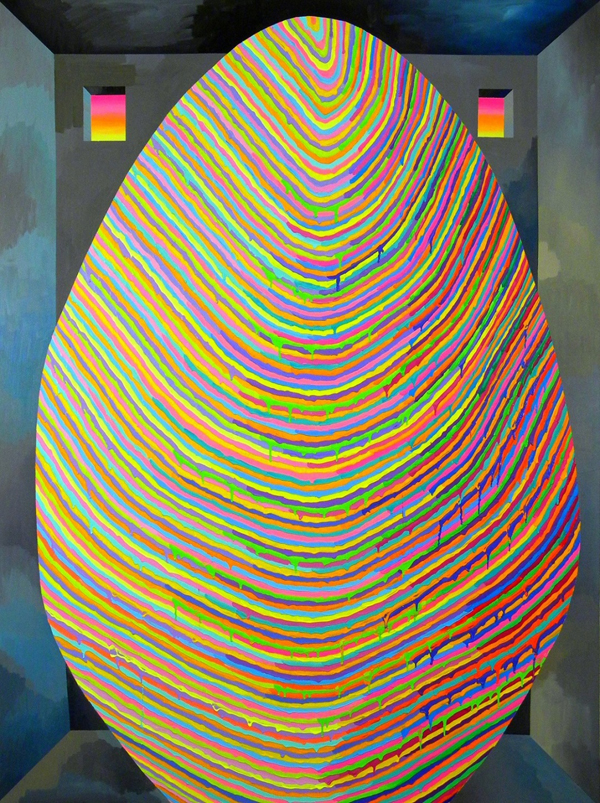
Mathew Zefeldt, Before It's Too Late 2.

Dripping paint shows us that paint is there. Love of paint often draws in the painter to deliver impasto effects like icing on a cake. Decorating a cake is not far from Mathew Zelfeldt’s paintings; they contain a vocabulary of elements that are repeated and varied, and he’s created a bunch of delicious things for our consumption. Elements of a painting displayed on a pink background show disparate items in “Things and Stuff”, looking like a ready-to-assemble sculpture. Zefeldt’s images are large, often about his own height, so that the planes are worlds (or windows to another world), filling up the viewer’s space.

Mathew Zefeldt, Things and Stuff.

As a group, the works build a repetoire of characters and events, providing a kind of alternative history like the kind of place found in Flatland, a Victorian-era primer on dimensional perception. Flatland develops the social structure and environment of a universe kind of like ours, but populated by 2-D geometric shapes. Used as a tool to examine its own times through obvious metaphor, the text is still living today as it playfully examines our limited capacity for imagining increasing dimensions of reality.

What are the available dimensions of mind? In remembering a dream, there is a sense that time is layered on itself and people, events, places take on multiple identities. Multiplicity adds meaning that singular identity cannot. Sometimes characters are generalized forms and take on an idealized nature, a simplification that allows for multiple readings. “Small mutliples reveal, all at once, a scope of alternatives, a range of options,” design visionary Edward Tufte says in his book Envisioning Information. Possible worlds are compressed into one; the spectrum is broken apart.

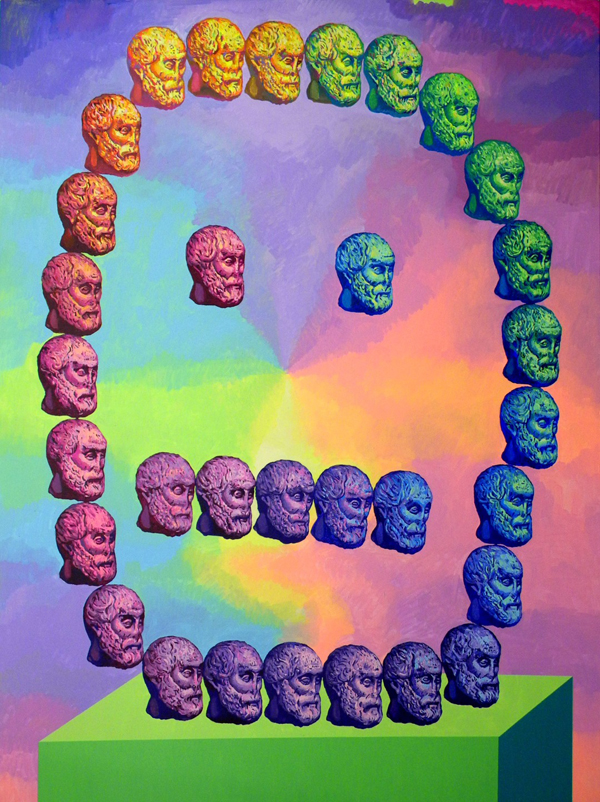
Mathew Zefeldt, Head Face.

There is some repulsion to all these rainbowed compositions. Form is rendered somewhat formless, to disturb the viewer’s preference for perfect gradation in comprehending space. But the effect of light on planes is illustrated eccentrically and this new kind of light is fun to understand. Tufte says “Pure, bright or very strong colors have loud, unbearable effects when they stand unrelieved overlarge areas adjacent to each other…” and that “…signal enhancement through noise reduction can reduce viewer fatigue…” in Envisioning Information. Zefeldt’s tactics seem to run contrary to Tufte’s theories of good design, at least in limiting the palette, but I wonder how Tufte would respond to this work (though design is not visual art, there is essential overlap as they operate on the same sense). Painting that is undulating and disturbing to elegance is part of the content conveyed. There is some bombardment of color in “Head Face” and other paintings that is relieved by the clean edges of form.

Read More »

Share