LA Expanded

High Performance

L.A. Expanded: Notes from the West Coast
A weekly column by Catherine Wagley

This following L.A. Expanded column was originally published on March 9th, 2012.

Gail Devers in Athens

Do you remember track star Gail Devers, with her absurdly long nails? I noticed her for the first time in Atlanta, on television during the 1996 Olympics, where she one her third gold. Then, her nails were painted gold to match the medal she had yet to win. Eight years later, in Athens, her nails were blue. That she had those nails at all made her seem smarter than her competitors, like she alone had figured out how to bend norms and regulations to make her body entirely her own. “I run with my feet,” she once said, meaning it didn’t matter what flourishes she had on her hands.

I thought of Devers when I read that Caster Semenya, the 2009 World Champion in the 800 meters race who was hindered from competing in 2010 when huge improvement in her time and her butch appearance made officials and others question her gender, has a new coach, a woman from Mozambique. She will no longer be working with the men who managed her as her career began, when she was often going off with other racers to prove to them her femaleness: ‘”They are doubting me,’ she would explain to her coaches, as she headed off the field toward the lavatory.”

Semenya has long nails, too, or at least she did when writer Ariel Levy tracked her down for a brief moment in 2009, not long after she had been subjected to a series of uncomfortable, publicly debated gender tests. “She wore sandals and track pants and kept her hood up,” said Levy. “She didn’t look like an eighteen-year-old girl, or an eighteen-year-old boy. She looked like something else, something magnificent.”

Read More »

Share

San Francisco

Profile: ISHKY

Pi in the Sky from Instagram: Savanéh - approximately 29 days ago #today #numbers in the #sky #clouds #code #interesting #skyline #bayarea #test #forwhat

As a part of our ongoing partnership with Art Practical, today we bring you a profile of ISHKY by Alex Bigman.

On the afternoon of Wednesday, September 12, 2012, a string of digits appeared across the Bay Area sky. Produced by five skywriting planes equipped with dot-matrix software, the gaseous markings looped around the bay, beginning over San Jose, then circling up to the East Bay, curving over San Francisco, and continuing down the peninsula back to their point of origin.

While only those who caught the initial digits, 3.1415, were likely to recognize it, the seemingly random string of numbers was in fact the decimal expression of pi—the ratio of a circle’s circumference to its diameter—to the first thousand of its (debatably) endless, non-repeating places. It is the longest continuous message that the skywriting team, which typically deals in brief personal messages or simply brand names, had ever undertaken. And with each digit spanning about a quarter mile in length, it may also be the largest ephemeral art installation to date.

I had the opportunity to view the installation from the at once privileged and impoverished vantage point of a sixth plane, flying on the tails of the skywriters for the purpose of documenting the event. Beside me sat ISHKY, the artist responsible for it all. From where we were sitting, the bursts of swirling white exhaust seemed to dissolve as soon as they emerged, forming nothing resembling numbers. However, ISHKY’s phone was abuzz with Instagram-ed proof of pi’s legibility from the ground. A few meddlesome fog banks notwithstanding, his first-ever public art installation was turning out as planned.

ISHKY, otherwise known as Ben Davis, is not an artist in the traditional sense; at least, he has not presented himself as such until now. His pseudonym ISHKY sets Pi in the Sky—Davis’s debut artistic endeavor—apart from his broader professional background, which is in communications and design. His San Francisco–based creative agency, Words Pictures Ideas, crafts visual identities for public works projects such as the Central Market Revitalization Effort and the construction of the Bay Bridge’s new East Span—the largest public works project in California’s history, as measured in sheer dollars.

Read More –

Share

Fan Mail

Fan Mail: Dennis Neuschaefer-Rube

For this edition of Fan Mail, Dennis Neuschaefer-Rube of Bielefeld, Germany has been selected from our worthy reader submissions. Two artists are featured each month—the next one could be you! If you would like to be considered, please submit your website link to info@dailyserving.com with ‘Fan Mail’ in the subject line.

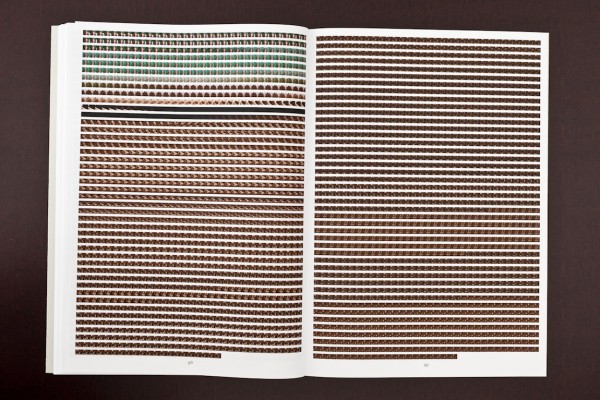
Dennis’s “stilled film” projects are exercises in visualizing the art of filmmaking—-charting changes in time, compressing linear space, and stripping away character and narrative. Beyond appropriating imagery or quoting an influence, Dennis’s works are an analysis of great films, specifically ones by auteurs such as Hitchcock and Kubrick, and Hollywood gems such as The Wizard of Oz which have permeated culture globally. Knowledge of the content of these films is widespread and their influence is far-reaching. To examine their structure and form, Dennis reconfigures film; because these films are so well-known, the public can compare their memory of the film with the new viewing.

His analysis of The Wizard of Oz takes two forms—as a book and video installation. In the book, each page corresponds to exactly one minute of film time, so flipping through it puts the film in fast motion. When reading text on the page, you move linearly from left to right, then down to the next line, but looking at the film laid out on the page in this same style, the need to scroll linearly to understand the content is broken. When watching a film on the screen, the viewer is taken on a prescribed journey and time is dictated by the filmmaker. When The Wizard of Oz takes on Dennis’s book form, the viewer is free to let his own formal questions about the film guide him, such as—how much green is there in this film?

In Dennis’s video installation of The Wizard of Oz, characters are merged using one voice. The image grid maintains a sense of linear progression but allow for a fuller context of past and future events. The viewer is still watching a film in time, but the installation format allows him to come and go at will. The 35 mm film stills are shrunken down, appearing like pixels when shown on youtube, to appears as pixelated images taking 35mm cinema film, rendering down the high quality still into a dot of color, a pixel, abstracting the high definition reality.
Music has an ability to control emotion and make a motion picture more captivating, but Dennis has removed this element for the viewer. Dennis method is systematic, like running an equation on a piece of art and stripping it of all emotional qualities. But what is the advantage of seeing a film’s form only, with the impact of character and sequence removed?

The Wizard of Oz was the book I carried around with me all the time as a kid, a gift from my uncle, a fantasy landscape, the idea of being swept away, swept out of the challenges of the world on a new journey with new friends. I read it often and I would skip around to my favorite parts—imagining the mice carrying the passed out friends through the poppy fields, for example. Both book and movie allowed me to enter the journey at will with multiple re-readings and re-watchings; the book produced an even greater fantasy experience—allowing me to enter the motion picture of my mind in isolation. Knowing the outcome, it was not about finding any deeper meaning—it was pure enjoyment of language and story. I was often that little girl walking down the yellow brick road, not knowing what to make of it, wishing a good witch would leave an indelible kiss on my forehead.

How a viewer understands a film or story transforms through multiple rounds of navigating it. But a good narrative often has the ability to bring the viewer to a meditative state, where reflection and analysis are challenged by the beauty and enjoyment of the art. Television has this effect too—but often through trickery rather than artistic vision, pulling in the viewer through fast editing and layered sound, producing a bombardment on the senses that is mesmerizing. A competent viewer can reflect on these qualities of film as many a film-school student does but Dennis aims to pull us out of the picture in a new way. Creating a document of art, Dennis gets us out of the fantasy. To see the end and know the progression, to know how it all works out, allows us to study structure.

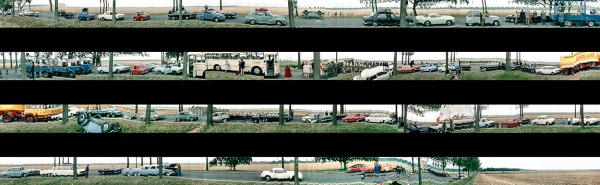
The long shot and long exposure are two other areas of study for Dennis. He shows us the real length of a scene in Godard’s Weekend by showing the strips laid out. The shot is some 8 minutes long—the camera pans across a crowded route, moving faster than traffic, showing stalled out vehicles and upset motorists. This is the kind of scene that isolates many viewers from “art house” films which, though beautiful, often have some boring or confusing quality that makes them somewhat unwatchable. Dennis’s depiction of the scene allows any viewer immediate access to the length of the shot without having to experience that length in time.

Read More »

Share

Interviews

An Interview with Susan Graham

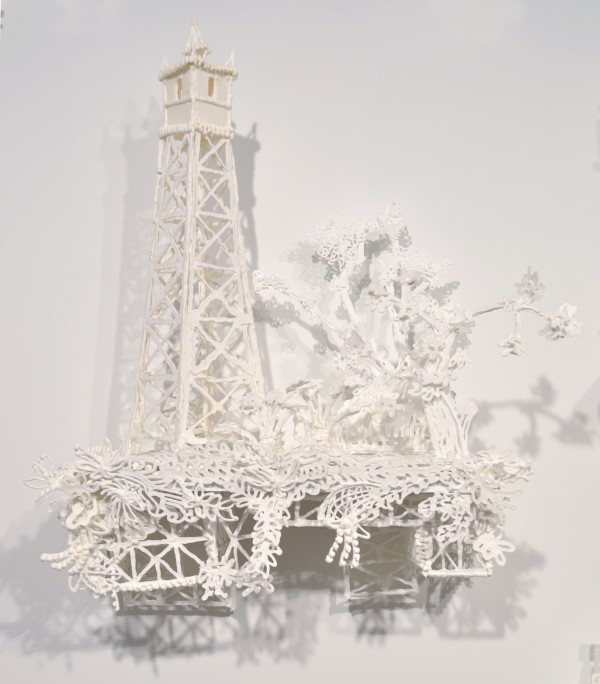
On a Tuesday morning in September, I met with sculptor and photographer Susan Graham at Lux Art Institute in Encinitas, California. Graham was more than halfway through her five-week artist residency and opened her studio to me, allowing an up-close view of her sugar and porcelain sculptures in the process of assembly. Graham shared stories from her childhood in Ohio, articulated her thoughts about working, and touched on how September 11 has altered the view of some of her earlier art.

Susan Graham, Toile Landscape, 2010-2011

Robin Tung: Thank you for opening your studio. What are you working on while you’re here?

Susan Graham: I made a sugar toile piece previously, and I proposed making one here and expanding it with porcelain. I’ve been doing temporary sugar pieces that are large-scale. I have five weeks here and estimated that by making some pieces out of porcelain, I could come back in and expand the piece by adding sugar [while here] because sugar doesn’t really ship well.

RT: So the materials aren’t mixed—it’s either a piece of sugar or a piece of porcelain.

SG: Yes, it’s not sugar and porcelain mixed together. It’s sugar or porcelain. In the piece, it’s mixed, which is new to me. I’ve never put them side by side. So it’s different whites, a different way of doing an on-site piece.

RT: What do you mix the sugar with?

SG: It’s sugar and egg whites, an icing mixture. It’s something I started using a long time ago because I was in New York and didn’t have any money. I had gotten a studio though, but didn’t have tools and just wanted to start making things. I was looking for a material that would mean something to me.

There was nobody artistic in my family, really, but my grandmother had a craft club and she lived next door. They made bouquets of tiny flowers out of salt dough. And I thought they were amazing. For myself, I was thinking of something that seemed feminine, sweet and domestic, and also I wanted to work off material that was white.

Susan-Graham, 22 Deputy Single Action Revolver, 2002

RT: Themes of escapism or imagination with wide-open spaces, natural phenomena, and vessels like cars and planes, are often visible in your work. And it seems like there’s this binary to the pieces, like the gun made out of sugar.

Read More »

Share

Help Desk

Help Desk: “Recreativity”

Help Desk is an arts-advice column that demystifies practices for artists, writers, curators, collectors, patrons, and the general public. Submit your questions anonymously here. All submissions become the property of Daily Serving. Help Desk is cosponsored by KQED.org.

Note: if you’ve been following the conversation on writing negative reviews, Will Brand has an interesting take over at the L Magazine.

Pardon the interruption of our regular programming. Instead of running a regular Q&A column this week, I’d like to take a moment to address an essay published last Friday on Slate.com. Simon Reynolds’ “You Are Not a Switch: Recreativity and the modern dismissal of genius,” manages to get a number of notions about creativity and appropriation wrong, and over the past nine months of writing this column I’ve received a number of questions about this subject, so continuing the dialogue seems both relevant and timely.

Here’s how Reynolds begins his essay:

“Some years ago I visited the Tate Modern in London with my young son. Then aged 5, he had lately been drawing pictures of a fantastical nature, so as we approached the threshold of a Surrealism retrospective, I suggested that he might want to check these paintings out. ‘It’s really weird, this stuff,’ I said, giving it the hard sell. ‘And you might get some good ideas.’ He just flashed me a disapproving look: ‘That would be copying.’”

“This incident sprang to mind recently when making my way through a spate of recent books, articles, and blog posts celebrating the practice of artistic theft. In stark contrast to my 5-year-old’s seemingly instinctive aversion to mimesis, an emerging movement of critics, theorists, writers, and artists argue that techniques of appropriation and quotation are inherent to the creative process. Not only are the concepts of originality and innovation obsolete, they’ve always been myths. Let’s call this movement recreativity.”

Candice Breitz, Becoming, 2003. Stills from video installation

There’s a problem with this approach: leaving aside the idea that anything intellectually germane on this topic could come out of the mouth of a small human only recently cognizant, the field isn’t really emergent; it’s just coming now to the fore of cultural consciousness as it has done so many times before. “Recreativity” was first addressed in the Bible (written around 1000 BC), to wit, “The thing that hath been, it is that which shall be; and that which is done is that which shall be done: and there is no new thing under the sun,” (Ecclesiastes 1:9, KJV, italics mine). Nearly three millennia later, in 1609, Shakespeare’s Sonnet 59 was built on that biblical verse: “If there be nothing new, but that which is/Hath been before, how are our brains beguiled,/Which, labouring for invention, bear amiss/The second burden of a former child.” For those of you not familiar with the conventions of the Bard’s phrasing, here’s the Cliff’s Notes translation: “Sonnet 59 dwells on the paradox that what is new is always expressed in terms of what is already known. The elements of any invention or creative composition must be common knowledge, or old news. The phrase ‘laboring for invention’ indicates not only the poet’s determination to create something entirely new in his verse but also his frustration in trying to do so.” Given these well-known antecedents, it seems in many ways quite silly that in 2012 we’re still questioning the role of prior works in the production of new ones, or even wondering if some kind of pure originality—what Reynolds calls “genius”— exists.

One notable absence in Reynolds’ essay is an acknowledgement of the differences between the various kinds of artistic theft and their distinctive aims and intentions. Instead of teasing apart the characteristics of separate practices, he misses the mark entirely by gathering all mimetic usage under one dank umbrella of failure, citing “…the genius, who takes something and makes it his or her own, effectively erasing its origin and turning it into another facet of his or her glittering originality. This contrasts with the timid craftsman—the merely talented—who never quite makes you forget the source and ultimately achieves glitter only by association.” One might forgive Reynolds, a music critic, for not understanding the aims of the appropriation movement in visual art that began in the 1970s and 80s with artists such as Richard Prince and Sherrie Levine. The whole point was to take images that already existed and, by re-photographing and recontextualizing them, examine the influence of culture by putting it at a one-step remove or critical distance. It’s not that Prince and Levine hoped to make the viewer “forget the source”—truly, the work relied on the viewer’s knowledge of the source material and would have been culturally irrelevant without it. In fact, Barbara Kruger, another Pictures Generation artist, suggested that someone from the gallery’s staff should, “nudge visitors conspiratorially in front of each picture and whisper, ‘Get it?’”*
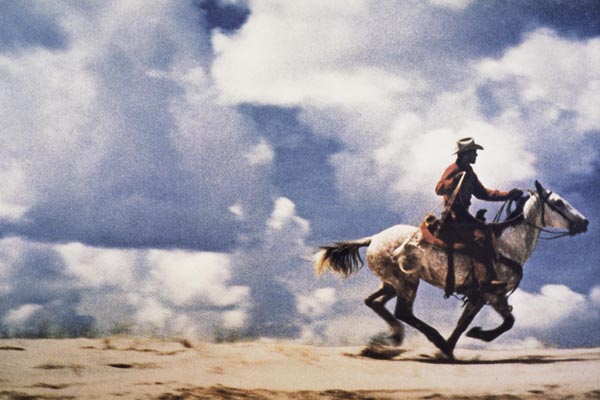
Richard Prince, Untitled (cowboy), 1989.

Nevertheless, and ignoring more contemporary contributions of accomplished artists like Sturtevant, who re-created Warhol prints using the artist’s own original screens to challenge the notion of the famous artist’s aura; or Glenn Ligon, who has adopted historical frameworks such as runaway slave posters and quotes from Richard Pryor jokes to confront the legacy of racism, Reynolds continues: “Whereas the ideology of recreativity, as it spreads, not only legitimizes lazy, parasitic work, it actively encourages it by making it seem cool, ‘timely,’ somehow more advanced than that quaint middlebrow belief in the shock of the new.” Yet there has always been sloppy, lazy, simply bad art in all forms and genres. Reynolds’ error is in lumping the chaff with the wheat as though we can’t tell the difference. Some art transcends, and some doesn’t. The human race has never been able to agree on what makes a good work of art, but to suggest that there isn’t a hierarchy of value, and that any remix is legitimized based on the very nature of its form, is absurd. The sophomore artist that exhibits a re-photographed Levine—itself a re-photographed Walker Evans—and attempts to make a claim for its relevance fools no one. If there is an ideology of mimesis it exists in a plurality or spectrum of ideas, and its mere existence ordains nothing. No art has been made extraordinary simply by being the product of an appropriative practice, just as no art that is “original” or “new” is legitimized on that basis. The social valuation of art has less to do with its supposed ideology than with what it brings—visually, aurally, etc.—to its audience. While the current popularity of mimesis and the remix might encourage budding creatives to try their hand at mash-up videos, found poetry, and bedroom-set rap songs, it does not make those concoctions more advanced or more inherently interesting. By tarring all mimetic art, good and bad, with the same broad brush, Reynolds undermines his own argument.

Read More »

Share

From the Archives

The Simple Life/Jobs Suck and Art Rules

Don’t you wish sometimes that you could just leave all your worldly possessions behind and live as one with nature? Yes? No? Maybe? Well, if you do, you will probably be interested in the upcoming exhibition at Kunstverein & Stiftung Springhornhof, The Simple Life, which “presents works that from various perspectives address the yearning for modes of lifestyles considering sustainability and naturalness as well as their aporias, and in which the role of “art” itself is reflected.” And in the spirit of breaking away from the daily grind, today from the DS Archives we bring you the Michael Tomeo’s article Jobs Suck and Art Rules about the 2010 exhibition at Elizabeth Dee Gallery, Today I Made Nothing.

The following article was originally published on August 23, 2010 by :


Today I Made Nothing, Organized by Tim Saltarelli, Elizabeth Dee, New York, NY, July 27 – September 18, 2010, Installation view Courtesy Elizabeth Dee, New York

I’m so over jobs right now. Sure, we need them, we’re thankful for the paycheck and it’s fun to hang out with coworkers (sometimes), but let’s face it, jobs blow.  While the total freedom associated with making art seems antithetical to the 9 to 5 slog, there are definite correlations between art and work and they are given form in the impeccably timed Today I Made Nothing at Elizabeth Dee Gallery.

Virginia Overton, Untitled (chairs with lights), 2009, chairs, light fixture, ratchet strap, Dimensions variable, Courtesy the artist and Elizabeth Dee, New York

There are two types of workplace rebellion on view here. In one, the artist is an outsider, fighting for equal rights and clashing against the system. Works like Alejandro Cesarco’s Why Work?, Duncan Campbell’s Factories Act 1961, and Jonathan Monk’s The Sound of Music (A Record With the Sound Of Its Own Making), each use techniques and ideas from the 1960s and ‘70s such as appropriation and institutional critique. Vaguely recalling the efforts of the late-60s collectives such as the Art Workers Coalition, these works feel a bit dated, but they lend the show a historic scope.

Joseph Strau, title forthcoming, 2010, mixed media installation with floor lamp and two paintings, dimensions variable, Courtesy the artist and Elizabeth Dee, New York

Another group of artists is more successfully subversive. Mika Tajima, Renée Green, Joseph Strau and Virginia Overton each use the visual vocabulary of today’s corporate world as if they are involved in a diabolical inside job. Overton’s Untitled (chairs with lights) reconfigures mordant institutional design to create what is ostensibly a badass floor lamp/sculpture.  Joseph Strau’s title forthcoming, presents two dainty abstractions with a lamp in front of them, as if Franz West were the display manager at IKEA. Mika Tajima’s A Facility Based on Change, an impenetrable work cubicle, updates the underlying claustrophobia in minimal sculpture for the middle management set. Renée Green’s banners take on the look of corporate brainstorming lists in what she calls Space Poems. They’re funny, off-putting and deceptively smart. In a room full of works attempting to challenge the boundaries of what art is, these might take the cake.

Read More »

Share

San Francisco

What else can I be but what I am?: Mutables at Eli Ridgway Gallery

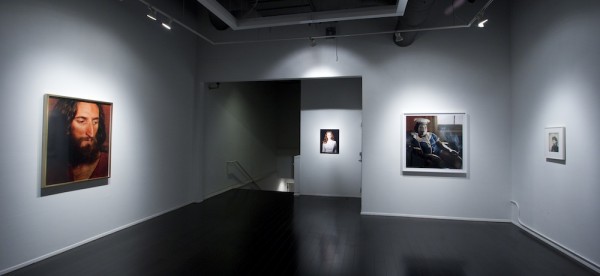
Imagine if we never had to define ourselves. Imagine if we could exist suspended in a sort of identity probability cloud in which we were only more or less likely to be one thing than another. Or better yet if we could be in two conflicting states at once. We may never know the luxury of being both particle and wave, but we can certainly challenge preconceived notions of self and other. In the current exhibition at Eli Ridgway Gallery, Mutables, curated by director Ashley Stull, the artists take various archetypes of identity, joyously smash them to bits, and build their own specific narratives.

Adi Nes, Christ, 2009. Image courtesy of Jack Shainman Gallery, NY.

There is a long tradition of photographs representing the world as it is—a history of “truth”. Photographs continue to carry assumption of veracity, making it an ideal medium of deception. From late 19th century images of ghosts and fairies, to the digitally manipulated images today, our culture wants to believe that what a photograph depicts is true. This concept is uncovered dramatically through Adi Nes’s Christ. The simple titling of Adi Nes’s large-scale portrait imbues the image with so much power and history that I found myself wondering things I know aren’t true. Still, I couldn’t help but give into the illusion. The photograph instills deep familiarity—the scale and shallow depth of field brings you intimately close to a man who embodies many of our culture’s preconceived notions of what Jesus Christ looked like. Drawing on the model’s physical characteristics and dramatic body language, Nes calls on 2000 years of Christ’s likeness in art history  to deeply question the truth and intent of our historical heritage embedded in image.

Gillian Wearing, Lily Cole, 2009.

Unlike Nes’s deeply deceptive image, Gillian Wearing’s portrait of Lily Cole shines a dark and psychological light on the act of portraying oneself. Lily Cole, a particularly doll-faced model, with wide-set eyes, porcelain skin and a small, delicate mouth is already unique and compelling. Despite this, or maybe because of this, Wearing chose to photograph her in a mask of herself. The sophistication of the mask successfully complicates the image—as your eyes wander over the mask, you are confronted with dramatically alternating moments of believability and fiction. The nose, the lips, and the redness of the cheeks all seem like they could be real, except that one cheek is cracked like a broken shell, violently seaming together two archetypes: the model and the doll. In her portrait of Lily Cole, Wearing emphasizes the artificiality and fragility of such an identity, one in which the person may very well be hiding behind his or her own face.

Read More »

Share