Help Desk is an arts-advice column that demystifies practices for artists, writers, curators, collectors, patrons, and the general public. Submit your questions anonymously here. All submissions become the property of Daily Serving. Help Desk is cosponsored by KQED.org.

Note: if you’ve been following the conversation on writing negative reviews, Will Brand has an interesting take over at the L Magazine.
Pardon the interruption of our regular programming. Instead of running a regular Q&A column this week, I’d like to take a moment to address an essay published last Friday on Slate.com. Simon Reynolds’ “You Are Not a Switch: Recreativity and the modern dismissal of genius,” manages to get a number of notions about creativity and appropriation wrong, and over the past nine months of writing this column I’ve received a number of questions about this subject, so continuing the dialogue seems both relevant and timely.
Here’s how Reynolds begins his essay:
“Some years ago I visited the Tate Modern in London with my young son. Then aged 5, he had lately been drawing pictures of a fantastical nature, so as we approached the threshold of a Surrealism retrospective, I suggested that he might want to check these paintings out. ‘It’s really weird, this stuff,’ I said, giving it the hard sell. ‘And you might get some good ideas.’ He just flashed me a disapproving look: ‘That would be copying.’”
“This incident sprang to mind recently when making my way through a spate of recent books, articles, and blog posts celebrating the practice of artistic theft. In stark contrast to my 5-year-old’s seemingly instinctive aversion to mimesis, an emerging movement of critics, theorists, writers, and artists argue that techniques of appropriation and quotation are inherent to the creative process. Not only are the concepts of originality and innovation obsolete, they’ve always been myths. Let’s call this movement recreativity.”

Candice Breitz, Becoming, 2003. Stills from video installation
There’s a problem with this approach: leaving aside the idea that anything intellectually germane on this topic could come out of the mouth of a small human only recently cognizant, the field isn’t really emergent; it’s just coming now to the fore of cultural consciousness as it has done so many times before. “Recreativity” was first addressed in the Bible (written around 1000 BC), to wit, “The thing that hath been, it is that which shall be; and that which is done is that which shall be done: and there is no new thing under the sun,” (Ecclesiastes 1:9, KJV, italics mine). Nearly three millennia later, in 1609, Shakespeare’s Sonnet 59 was built on that biblical verse: “If there be nothing new, but that which is/Hath been before, how are our brains beguiled,/Which, labouring for invention, bear amiss/The second burden of a former child.” For those of you not familiar with the conventions of the Bard’s phrasing, here’s the Cliff’s Notes translation: “Sonnet 59 dwells on the paradox that what is new is always expressed in terms of what is already known. The elements of any invention or creative composition must be common knowledge, or old news. The phrase ‘laboring for invention’ indicates not only the poet’s determination to create something entirely new in his verse but also his frustration in trying to do so.” Given these well-known antecedents, it seems in many ways quite silly that in 2012 we’re still questioning the role of prior works in the production of new ones, or even wondering if some kind of pure originality—what Reynolds calls “genius”— exists.
One notable absence in Reynolds’ essay is an acknowledgement of the differences between the various kinds of artistic theft and their distinctive aims and intentions. Instead of teasing apart the characteristics of separate practices, he misses the mark entirely by gathering all mimetic usage under one dank umbrella of failure, citing “…the genius, who takes something and makes it his or her own, effectively erasing its origin and turning it into another facet of his or her glittering originality. This contrasts with the timid craftsman—the merely talented—who never quite makes you forget the source and ultimately achieves glitter only by association.” One might forgive Reynolds, a music critic, for not understanding the aims of the appropriation movement in visual art that began in the 1970s and 80s with artists such as Richard Prince and Sherrie Levine. The whole point was to take images that already existed and, by re-photographing and recontextualizing them, examine the influence of culture by putting it at a one-step remove or critical distance. It’s not that Prince and Levine hoped to make the viewer “forget the source”—truly, the work relied on the viewer’s knowledge of the source material and would have been culturally irrelevant without it. In fact, Barbara Kruger, another Pictures Generation artist, suggested that someone from the gallery’s staff should, “nudge visitors conspiratorially in front of each picture and whisper, ‘Get it?’”*
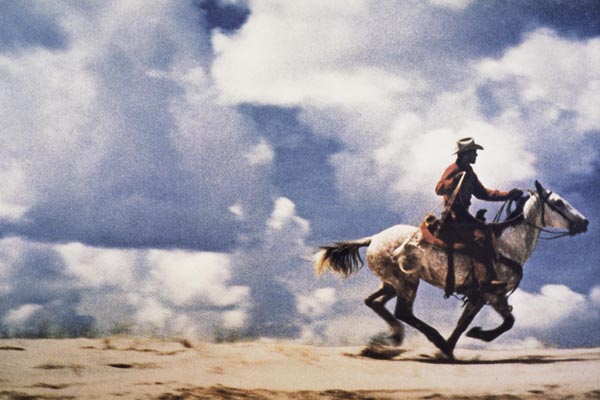
Richard Prince, Untitled (cowboy), 1989.
Nevertheless, and ignoring more contemporary contributions of accomplished artists like Sturtevant, who re-created Warhol prints using the artist’s own original screens to challenge the notion of the famous artist’s aura; or Glenn Ligon, who has adopted historical frameworks such as runaway slave posters and quotes from Richard Pryor jokes to confront the legacy of racism, Reynolds continues: “Whereas the ideology of recreativity, as it spreads, not only legitimizes lazy, parasitic work, it actively encourages it by making it seem cool, ‘timely,’ somehow more advanced than that quaint middlebrow belief in the shock of the new.” Yet there has always been sloppy, lazy, simply bad art in all forms and genres. Reynolds’ error is in lumping the chaff with the wheat as though we can’t tell the difference. Some art transcends, and some doesn’t. The human race has never been able to agree on what makes a good work of art, but to suggest that there isn’t a hierarchy of value, and that any remix is legitimized based on the very nature of its form, is absurd. The sophomore artist that exhibits a re-photographed Levine—itself a re-photographed Walker Evans—and attempts to make a claim for its relevance fools no one. If there is an ideology of mimesis it exists in a plurality or spectrum of ideas, and its mere existence ordains nothing. No art has been made extraordinary simply by being the product of an appropriative practice, just as no art that is “original” or “new” is legitimized on that basis. The social valuation of art has less to do with its supposed ideology than with what it brings—visually, aurally, etc.—to its audience. While the current popularity of mimesis and the remix might encourage budding creatives to try their hand at mash-up videos, found poetry, and bedroom-set rap songs, it does not make those concoctions more advanced or more inherently interesting. By tarring all mimetic art, good and bad, with the same broad brush, Reynolds undermines his own argument.
Read More »