#bindersfullofwomen: The Art of Being Female

Mitt Romney had binders full of women, #Hashtags has “The Art of Being Female.” Originally published March 13, 2012. Please send queries and/or ideas for future columns to hashtags@dailyserving.com. #Hashtags provides a platform for longer reconsiderations of artworks and art practices outside of the review format and in new contexts.

Screenshot taken from an attack ad against Congresswoman Janice Hahn, 2011.

If you’re young and female, I hope you’re introduced to a positive mentor early enough to build a strong sense of self-worth, because in 2012, American society still refuses to make it easy for you to maintain one. Looking at the last few months, women’s rights seem to be in retrograde, with the obvious example being the tone of the Republican campaign. But if you need more proof: so far this decade we have seen Hillary Clinton and a female aide photoshopped out of situation room documentation of the moment Osama Bin Laden’s death was announced, Fox News’ Greta van Susteren’s decision to ask Sarah Palin on-air whether she’d gotten breast implants, and an attack ad against Los Angeles City Councilwoman Jan Hahn comparing – even conflating – Hahn with a pole dancer.

And then last week there was that little Rush Limbaugh thing. You know, where he repeatedly attacked, on air, a woman that he first identified as “Susan Fluke.” Sandra Fluke, a Georgetown law student, had argued in front of Congress that private health insurers such as her own should be required to make birth control available at affordable rates. Fluke collected the stories of friends and fellow students, ultimately testifying that women rely on birth control not just for contraception, but in their treatment of other health issues, like ovarian cysts. For her trouble, Limbaugh called Fluke a slut and a prostitute, demanded that she put her sex videos online, and even suggested that by forcing insurers to provide this option, the taxpayer would take on the role of pimp.

Screenshot of Sandra Fluke speaking on "The View," March 5, 2012.

Unfortunately for Limbaugh, Fluke turned out to be nothing like his stereotypes – he had her pegged as a ditzy undergraduate, not the articulate and thoughtful speaker that she is. Fluke met Limbaugh’s comments with a press tour of her own, putting her remarks (and his) into context and reshaping the narrative that Limbaugh had twisted, so much so that Limbaugh eventually offered a limp apology.

Read More »

Share

Perth

The Elusive Yonder

installation view. Photograph courtesy of Bewley Shaylor

There is much talk in Perth of the city’s isolation, of the role that global mobility might play in local contemporary art practice. ‘Mobility’ here is a necessity, inevitable in some form, although its direction is another question as the city remains attached to a European history that is far from the reality of the continent and region. These concerns are visible undercurrents in Yonder, curated by Jasmin Stephens at the Perth Institute of Contemporary Arts, in which mobility is explored as subject and method. In scope, however, the exhibition is more ambitious: ‘yonder’ is a complex place.

The term suggests an elsewhere that could be metaphysical or political and the 14 artists included in Yonder run the gamut of interpretation. Australian Andy Best’s photographs search for Merlin and mythology in the Black Forest, whilst Singaporean Charles Lim Yi Yong’s elegantly simple video of rope slowly lolling in the ocean evokes the mutability of borders with significant political resonance. There is also a diversity of material approach: Clare Peake’s rudimentary vessels, sculpted from the earth of her regional home-town of Geraldton share the floor with Benjamin Forster’s Short Message Service, an electronic ‘sculpture’ delivering geometric patterns by request and satellite to pockets and handbags.

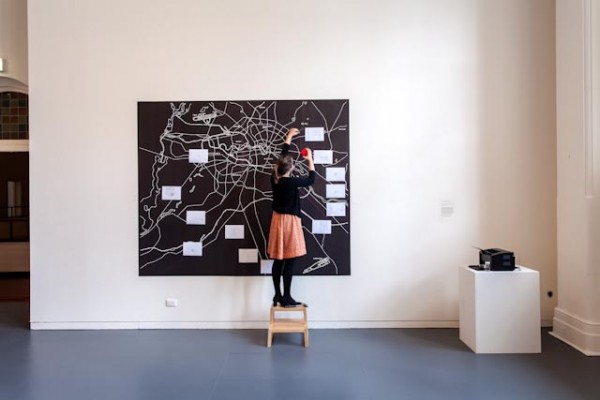
Simon Faithfull, Limbo: An Expanding Atlas of Subjectivity, 2012, live digital drawing

Yonder is, due to this inclusiveness, a busy exhibition but the heft of its engagement is relieved by a series of clever and surprising formal echoes. A reductive approach in many of the works, which frequently refer to 1960s and 70s strategies of distribution or dematerialisation, creates a negative space both physically and conceptually important. A shared art-historical irreverence means that traditions jostle and merge like meals at an international food court. Simon Faithfull’s observational drawings, made on a tablet, are transmitted to a printer in the gallery space and used to create a fragmented map of his daily experience in Berlin, applying the ethos of Lucy Lippard’s suitcase curation to naturalistic representation with digital immediacy. Heman Chong’s work, positioned on an exterior wall, provides a pertinent closing statement. Using Richard Long’s font and format, Chong presents a series of odes to international cities as though experienced on foot. Each sparse poem is heavy with a weight of emotion and imagery that is, importantly, fictional. Great journeys, as artworks have often suggested, can occur whilst stationary.

Read More »

Share

Fan Mail

Fan Mail: Kevin Frances

For this edition of Fan Mail, Kevin Frances of Providence, Rhode Island has been selected from our worthy reader submissions. Two artists are featured each month—the next one could be you! If you would like to be considered, please submit your website link to info@dailyserving.com with ‘Fan Mail’ in the subject line.

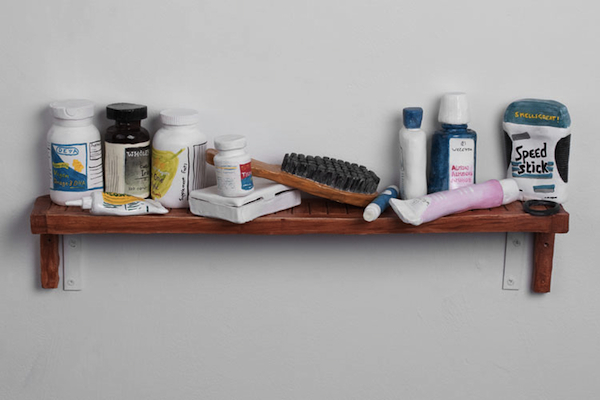
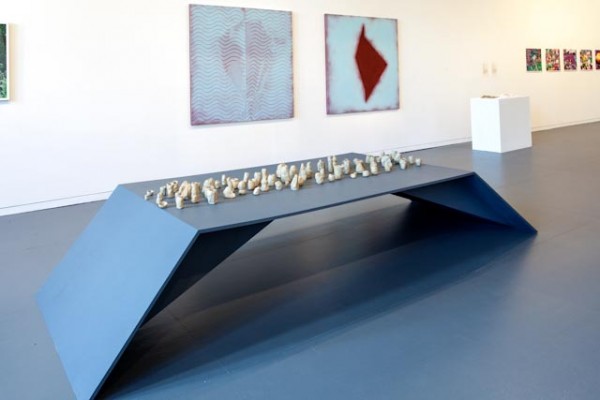
Kevin has made several renditions of rooms filled with ceramic objects, using screen printing and acrylic paint to label his imperfect things. He is currently pursuing an MFA in printmaking at Rhode Island School of Design (RISD) after graduating from University of California, Davis in 2010. In February he’ll be participating in a printmaking group show at the Sol Koffler Graduate Student Gallery at RISD and in May, he’ll be a part of the RISD Graduate Thesis Exhibition at the Rhode Island Convention Center. Kevin was enthusiastic to reflect upon his art to me via email, so here follows our conversation.

Kevin Frances, Our Bathroom Shelf.

Why so much love for the commercial object world?

I’m endlessly fascinated by people’s objects. I will probably go through your medicine cabinet. I’m really interested in the idea that the objects people own, they way they organize their environment can give us a window into their personality, their state of mind. They form a kind of portrait, however incomplete.

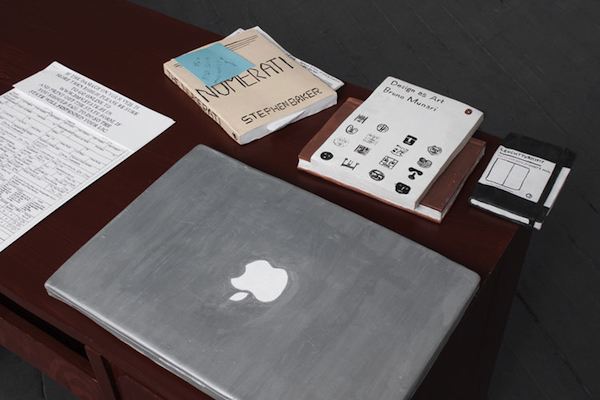
Kevin Frances, Our Desktops: A Love Story.

How do you see your role as an artist who is remaking non-art?

In the piece Our Desktops: A Love Story, I remade three desks, mine, my girlfriend’s, and our coffee table, and all the objects on them; books (loved books and those we aspire to love), notes, bills, coffee cups, computers. The importance to remaking them was to prompt the viewer to evaluate each object as a potential carrier of significance. Every object is rather intentionally clumsy, I don’t want to be Richard Shaw, it’s not about fooling the viewer, it’s about telling a story, or maybe more accurately: asking the viewer to tell a story.

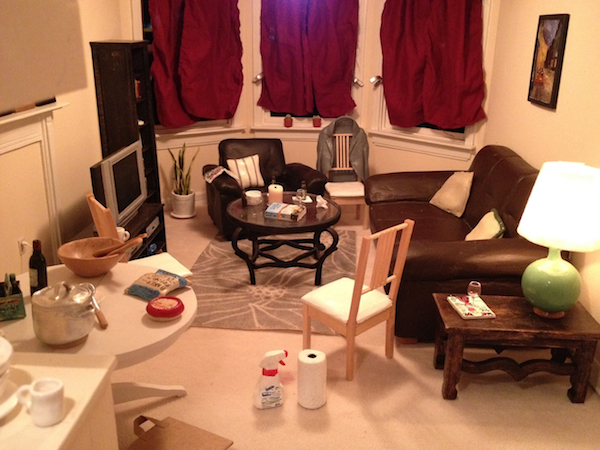
Kevin Frances, That Melancholy (the aftermath of a party).

That Melancholy was a nice piece because the objects seem to speak to each other. Is this a remake of a real scene?

The photo That Melancholy continues along a similar train of thought–except the space is fiction. I created a scale model of an apartment, something of a mashup of apartments I’ve lived in, and my memories of friends’ houses. It tells the story of three months of the life of a young woman moving into an apartment: she moves in, buys furniture, decorates, cooks dinner, does exercise videos, has a party, a romantic encounter. And this is all told through still photos of her objects. That Melancholy (the aftermath of a party) comes near the end of the series. It stems from a comment someone said to me recently that the moment right after everyone leaves a party is one of the saddest moments imaginable. That’s kind of an exaggeration obviously, but part of what this story is about is the tragedies and triumphs of everyday life–until something earth shattering happens to you to really put things into perspective, we live our lives totally zoomed in, and the little peaks and valleys are all we see.

Read More »

Share

Singapore

We Like STATIC

Static, Luxury Vandals MMXI, 2011. Five color screen print , 220 gsm Mirriboard, 46 x 46 cm. Edition: 35 per color variant.

Long entrenched in British literary tradition, parody, pastiche and caricature have, more recently, been revived in contemporary British urban art. Street artist Banksy’s foray into social criticism of war, art world commercialism and totalitarianism (just to name a few) or Mau Mau’s sprawling colourful murals, elaborately scrawled on public surfaces are such notable instances of irreverent commentaries that satirise and caricaturise. A more domestic, less public iteration of the extent to which parody, pastiche and caricature have become hallmarks of contemporary culture is found in the Internet. The emerging culture of open imitation, reconfiguration and deconstruction – helped generously along by readily available digital technologies – in many online communities exists for a variety of reasons: to pay homage, to ridicule, to praise.

Static, Thalia, Paper Edition, 2012. 19 layer screen print with iridescent silver background with hand sprayed spot varnish, 300 gsm fabriano paper, 56 x 56 cm, Edition of 50.

An East London-based collaborative duo, We Like STATIC’s first solo show at Collectors Contemporary follows the standard bearers of the emerging wave of urban and digital art. The show is a deliberately pastiched-response to contemporary events, comprising works that situate themselves in the middle of a key postmodern rhetoric that juxtaposes, layers, subverts, appropriates, deconstructs and parodies the boundaries between ‘high’ art and ‘low’ art through various artist media. Static is primarily concerned with artistic processes that flaunt the deconstruction, reconfiguration and the juxtaposition of disparate elements. Handcrafting, screen-printing, spray painting and the use of hand-cut stencils layered with glass and aluminium characterise their practice; the result is a three-dimensional graphic style of bright colours overlaid multiple times, consequently enacting an interplay between shape, colour and perspective that changes according to the position of the viewer.

Static, Queen Vandal, 2012. 3 layered glass, diamond dust, stencil, spray paint, screen print and aluminium, 63 x 63 cm.

But if Static’s works seem to recall graffiti art – a medium often associated with alienation, marginality and rebellion – it becomes clear that the only common ground here is the techniques of production when juxtaposed alongside those who use the spraycans for the purpose of tagging or delineating territory. Their works tell a different and a less angsty story, evidently operating within the boundaries of light-hearted satire and irony, encapsulating and caricaturising contemporary consumerist obsessions. Against a backdrop of sketched diamonds, a masked Elizabeth II holds a pink spray can in a hand as she sits on her throne, having, presumably, just sprayed a caricature of her own crown on the wall next to her in Queen Vandal (2012). Static’s ironic take on graffiti artists’ tendency to rebel against authority positions the head of state as a perpetrator of graffiti tagging, barely disguised by a handkerchief covering that deliberately reveals more than it conceals. In a parody of the British Monarch’s Diamond Jubilee celebrations, Lovely Jubilee’s (2012) places a literal emphasis on actual diamonds, while Luxury Vandals’s (2011) mash-up of motifs explores the commodification of art and fashion.

Read More »

Share

Help Desk

Help Desk: You Broke It!

Help Desk is an arts-advice column that demystifies practices for artists, writers, curators, collectors, patrons, and the general public. Submit your questions anonymously here. All submissions become the property of Daily Serving. Help Desk is cosponsored by KQED.org.

What is the most professional way to handle a guest breaking a piece of artwork at an opening? This has happened to me a couple of times this year, and I’m at a loss for a.) how to prevent it from happening (short of posting signs that say “please no running in the gallery”); and b.) how to handle it once it does happen (is it better to calmly tuck the work away and inform the artist, or yell at the person who has broken the piece, etc., etc.)? There are also insurance implications here…

It remains to be seen if accidental harm can be prevented. Obviously, parents of rambunctious children should be reminded of their duties with a discreet request to take them in hand. The Museum of Contemporary Craft in Portland, Oregon—which often hosts shows of invitingly tactile work—has small signs scattered throughout the space advising patrons: “Touching harms the art.” If you’re working in a place where you think someone might be inspired to run, by all means, put out a sign that says, “Please no running in the gallery.” Your job is to protect the art, so do what it takes to guard fragile or potentially fragile work from abuse, whether that means a polite whisper to a particularly animated guest or putting “keep-back” tape lines on the floor to remind patrons to maintain a safe distance.

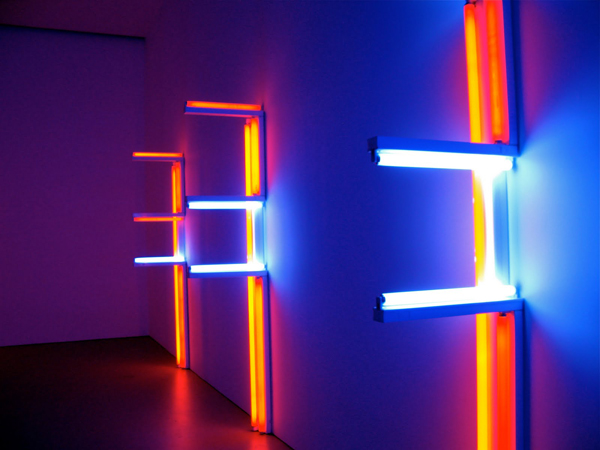
Dan Flavin, Untitled (for John Heartfield) 3a, 1990.

But oh, I feel your pain!—not every “accident” is accidental. Years and years ago, at an opening reception for my husband’s work, I spied a young man about to touch one of the wall-hung motorized sculptures. Clear across the gallery, the director was deep in conversation with a group of patrons; the gallery assistants were nowhere to be seen. Rather than wait for someone else to notice, I walked over to find the man cranking on an immobile part of the work. “Please don’t touch the artwork,” I said. With his hand still on the work, he replied drunkenly, “It’s not working. It’s broken.” So I reached out and took his hand away from the piece, saying, “It’s not broken, it’s on a timer.” Rather than back off, he slurred insistently that the work was not functioning. I reiterated that it was timed to go on and off at intervals, and if he wanted to see it move he would have to wait. Continuing to argue with me, he reached up to touch it again and I had to physically place myself between him and the piece. As you can imagine, it ended badly with me asking him (as politely as I could) to leave the gallery. He did, but I heard later from friends that he lurked out front for a bit with his inebriated pals, apparently waiting to “kick my ass.”

Dan Flavin, Untitled (to Helga and Carlo, with Respect and Affection), 1974.

I dredge up this unpleasant memory in order to emphasize the difference between an accident and a case of bad intent. However, in either situation I think the most professional response is to speak to the breaker in careful, measured tones. Try to get a handle on what’s going on. Was it a mishap or was the person doing something obviously wrong (like running in the gallery or fondling the artwork)? This may give you a sense for what to say and how to proceed. If you begin with the idea that it was truly unintentional (someone might have tripped over a cord or slipped on a dropped wedge of opening-night brie), you’ll give this hapless individual the opportunity to apologize and maybe even offer to buy the work. If, in your conversation, you discover that the breaker had some sort of malicious desire to hurt the work, then by all means you’re free to call in the authorities and press charges. But remember that raising your voice is only going to make more of a scene; the artist whose piece is broken and who has to witness a shouting match is never going to work with you again, and the gallery patrons will only remember a fight instead of the art you’re seeking to promote. Keep your cool no matter what happens.

Read More »

Share

From the Archives

From the DS Archives: The List Visual Arts Center at MIT

Today from the DS Archives we highlight past exhibitions at the List Visual Arts Center at MIT, and feature the upcoming exhibit, In the Holocene, which “explores art as a speculative science, how artists investigate principles more commonly associated with scientific or mathematical thought. The exhibition proposes that art is an investigative and experimental activity, addressing what is explained through traditional scientific means: time, matter, energy, topology, perception, consciousness, etc. In this sense, both art and science share an interest in knowledge and disruptive insights, yet are subject to different logics, principles of reasoning, and conclusions.” You can find other DS articles on exhibits at the List Visual Arts Center here.

The following article, Otto Piene and Hans Haacke at MIT, was originally published on December 7, 2011 by :

You walk in to a darkish room where ever-changing shapes move like a school of fish across the walls. After your eyes adjust, you find that the there are two benches sitting among six sculptures that are producing the schools of fish and that the fish are made out of nothing but light beams. These sculptures are metal. Simple geometry (sphere, cube, etc). The room is quiet and calming. Everyone who has been here talks about the unexpected smiles that slip onto their cynical faces, and it happens to you too.

Installation view Otto Piene: Lichtballett. Photo: Gunter Thorn. All photos courtesy MIT List Visual Arts Center

Read More »

Share

San Francisco

Ooga Booga at Kadist Foundation

San Francisco/Paris- based Kadist Art Foundation is launching a new and exciting project featuring a series of video books. The Kadist foundation, in San Francisco, is currently hosting Ooga Booga, a Los Angeles mixed media “bookstore” as a pop-up project. Ooga Booga was founded in 2004 by Wendy Yao as a broadly defined bookstore. “Bookstore” does not adequately describe the space as it not only carries artist publications and books, but also publishes, records music, hosts events, and exhibits artwork. 

Ooga Booga’s video book is narrated by the bookstore’s founder, and features a visual page-turner filmed in a simple deadpan format. For this project, Ooga Booga and the Kadist Art Foundation have come together in their support for arts publishing and cultural collaboration. This specific book project functions in tandem with various Kadist programs such as its artist/writer residencies, and the Reading Shop and Reading Room, which features various international publications. Look out for more video books by Kadist Art Foundation in their new and ongoing project.

Ooga Booga / Temporary Satellite at Kadist SF from Kadist San Francisco on Vimeo.

Share