From the DS Archives: First-Person Reality: I Am Not Free Because I Can be Exploded Anytime

Today, From the DS Archives takes another look at Sterling Ruby‘s 2011 solo exhibition at Sprueth Magers in Berlin. Early next month Ruby’s work will be in a group exhibition titled Cellblock I & Cellblock II, curated by Robert Hobbs at Andrea Rosen Gallery in Los Angeles. Cellblock I & Cellblock II will also feature works by Peter Halley, Robert Motherwell, and Kelley Walker.

The following article was originally posted on April 20th, 2011 by Heather Van Winckle.

Installation view, 'Sterling Ruby. I AM NOT FREE BECAUSE I CAN BE EXPLODED ANYTIME', Sprueth Magers Berlin, 2011, © Sterling Ruby Courtesy Sprueth Magers Berlin London

The year is 1999. Television has adapted to the more violent nature of man.

Sterling Ruby‘s solo show at Sprueth Magers drops you into a space reminiscent of the real world, but reflected through an alternate lens. The main room feels overwhelming in scale, full of over-sized and crudely modeled ceramic sculptures, towering red dripping sculptures that look like some sort of giant animal’s tendons freshly ripped from its body,  and spray-painted canvases hanging on the walls. As well, there are hanging fabric pieces in the shape of drops that both mock and confirm violence with their suggestion as blood drips in such a comically literal fashion.

Sterling Ruby SP151, 2010 Spray paint on canvas 125 x 185 x 2 inches 317.5 x 469.9 x 5.1 cm, © Sterling Ruby Courtesy Sprueth Magers Berlin London

The most popular form of television remains the game show.

The video game Wolfenstein 3-D (1992) introduced gamers to a three-dimensional environment where the camera is your eyes, a now popular point of view with the proliferation of first-person shooter games. Ruby’s spray painted blocks and wall hangings seem to reference the aesthetic of these 90’s video game graphics that place the viewer in this familiar world where you’re still a normal human, but, due to technological limitations, non-essential information, such as concrete walls, aren’t highly rendered. This room is quiet, and the suspended animation of the fabric sculptures puts the situation on pause. It’s calm, but horrific, as if your character has just faced an incredibly dangerous situation and through violent acts, defeated the level. Instead of moving to the next environment however, you’re suspended in this room to examine all of the carnage that has been created. While Wolfenstein and its ilk were often criticized for their violence, there was at least a noble purpose for the bloodshed. The player, the narrative’s clear protagonist, was forced to deal with the situation placed upon him. That sense of urgency is not apparent here, as if the violence has no purpose.

One show in particular has dominated the ratings. That show is Smash T.V. The most violent game show of all time.

Two lucky contestants compete for cash and prizes. Each contestant is armed with an assortment of powerful weapons and sent into a closed arena.

In a first-person game, instead of pressing buttons to make an avatar respond from a distance, the line between reality and the game’s universe is blurred as the player is sharing a pair of eyes with the avatar. When a trigger is pulled, the bullet blasts out from in front of you, and in some cases, due to technological advancements made to heighten the game experience, you can feel a rumble or a recoil as the shot is fired. Your character didn’t shoot as you watched from the god perspective, you made the kill. Ruby argues that we don’t need these alternate worlds to tell us to be violent. By presenting this aesthetic in our real space, the over-the-topness of video games is used to highlight far worse atrocities of man that we regular people may ever have to encounter. In a world where wars are sold with technologies that are meant to separate us from the violence we cause, the hyper-violence suggested in Ruby’s shows drags back the more personal connection linking the offenders and the victims.

Installation view, 'Sterling Ruby. I AM NOT FREE BECAUSE I CAN BE EXPLODED ANYTIME', Sprueth Magers Berlin, 2011, © Sterling Ruby Courtesy Sprueth Magers Berlin London

Nowadays, simulated experiences are, if not completely believable, able to pique and maintain our interest while allowing us to play out fantasy scenarios that we may not want to carry out in reality. The problem comes when these simulations are based on reality and these traumatic and horrific scenarios do exist in our world. In Ruby’s show, it is as if our fused eyes have been pulled from this structure where our sole mission is to defeat the bad guys, into the complex ‘real world’ full of grey areas and complicated matters. This environment within the confines of the gallery, has all of the gore, but none of the background information or context. The entertainment value of gameplay has been stripped away, forcing us to acknowledge the reality we exist in.

The action takes place in front of a studio audience and is broadcast live via satellite around the world.

Video games are violent and make the players of them violent. While the validity of this statement is highly contested, that’s a common argument anytime a kid decides to bring a gun to school and take out his aggressions on the student body. The assertion is that once we find out how fun it is to see something die at our hands in a simulated situation, we are going to get a taste for blood that we need to quench in the real world.

Be prepared.

The future is now.

Sterling Ruby Monument Stalagmite/Survival Horror, 2011 PVC pipe, foam, urethane, wood, spray paint and formica 216 x 63 x 36 inches 548.6 x 160 x 91.4 cm, © Sterling Ruby Courtesy Sprueth Magers Berlin London

Ruby’s show seems to be the antithesis of the much discussed videogamafication of military operations in the media since the first gulf war. He takes the look of the hyper-violence that is all but commonplace in our media and makes one ‘level’ out of the gallery space. When your reality is like the virtual world, and you a video game character,  a sudden shift in what is deemed an acceptable violence level tends to occur.

You are the next lucky contestant.

Italicized and bolded headings are quotes from the opening cutscene of the videogame Smash T.V. (1990)

Share

Los Angeles

You Go Crazy

L.A. Expanded: Notes from the West Coast
A column by Catherine Wagley

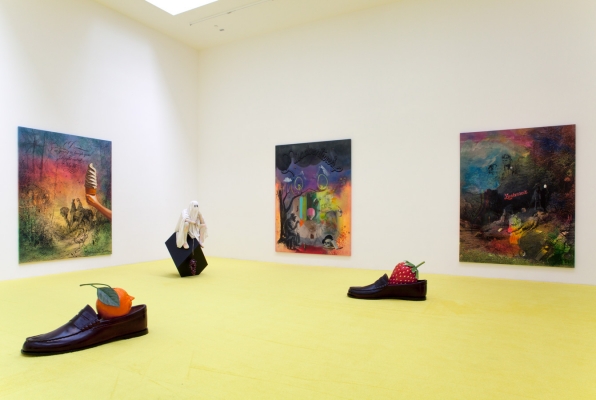
Installation view of Friedrich Kunath's show at Blume & Poe. Courtesy the artist and Blum & Poe.

I was slapped by a child named Sam who must have been 4 years old the last time I visited Friederich Kunath’s show Lacan’s Haircut at Blum & Poe. Sam was playing with his sister on the bright yellow carpet in the first gallery — each subsequent gallery has bright carpet too, orange then red. He had been fondling one of the oversize oranges with squinty eyes and pointy nose when we locked eyes. Then, after a pause, he sort of sashayed over and slapped me on the hand. It didn’t hurt, but it wasn’t gentle either.

A woman who wasn’t his mother called him over in that too sweet I-have-something-serious-to-say-but-don’t-know-how-to-talk-to-children voice. So I thought she had seen what just went down, but, probably, she hadn’t because what she said was, “I just want to congratulate you, Sam. I saw you looking at that painting over there and most children wouldn’t be able to do that for that long without touching it. I was impressed by how cultured you are.” I thought, better to touch a painting than randomly hit people, and since when does repressing tactile urges make you “cultured”?

Friedrich Kunath, "You Go Your Way and I'll Go Crazy," 2012, Digital video. Courtesy the artist and Blum and Poe.

The Kunath show, oversaturated in the best way, has sculptures of big enamel and resin loafers as well as the oversized fruit, and old-fashioned rendering of bearded men sleeping under trees or explorers on horseback sharing canvas space with cartoon characters and psychedelically colored polygons. In the back video gallery, You Go Your Way, and I’ll Go Crazy plays. It’s a video in which a tall guy who looks like a slightly glamorized version of South African writer J.M. Coetzee works in his studio, fondling the oranges just like Sam did, talking on a rotary phone that’s not plugged in to anything, wading into a pool fully clothed, standing nude over the San Gabriel Mountains, hitting tennis balls against some of the paintings that are in the exhibition. It’s insane, but in a smooth and subdued way, which is why being slapped by a preschooler while perusing this show felt kind of like par for the course.

I left at the exact same moment Sam, strapped into a car-seat, was pulling away, riding in a station wagon. We locked eyes again — I swear– and he waved.

Lucio Fontana, Concetto spaziale, Attese 58 T 2 (Spatial Concept, Expectation 58 T 2), 1958.

A few days later, at the opening of MOCA’s Destroy the Picture, I was backing away to get a better view of  a painting by Lucio Fontana, when I backed right into a regal older woman with soft hands. I know about her hands, because when I apologized, she grabbed my hand and squeezed, and said, “No, I’m sorry.” I like this, actually, the random physical contact while art-looking trend. It intensifies the whole experience, and an occasional slap might be worth it.


Share

Elsewhere

Revelations in Paint

Prior to this exhibition, I associated Jules Olitski with his stained color field canvases from the early 1960s. But like my experience of most solo exhibitions, I was pleasantly surprised to discover the dramatic range of paintings he produced throughout his nearly fifty-year career. Revelation: Major Paintings by Jules Olitski at American University Museum walks the viewer through Olitski’s creative evolution as an abstract artist, demonstrating the breadth of his experiments in light, color, texture, application and technique. Olitski’s career serves as a paradigm for modern painting in the second half of the twentieth century, as he continually challenged the medium through experimentation, pushing each element to the boundaries of abstraction.

Jules Olitski, "Patutsky in Paradise," 1966. Acrylic on canvas. Collection of the Art Gallery of Ontario, Toronto.

Laid out across three lofty gallery spaces in the curvilinear Katzen Art Center, Olitski’s career unfolds through five distinct stylistic chapters – Stain Paintings (1960-1964), Spray Paintings (1965-1970), Baroque Paintings (1973-1981), High Baroque Paintings (1983-1989), and Late Paintings (2000-2006). The space’s shape initially made for a confusing layout; it was only through a very helpful printed gallery guide that I became aware of the intentional chronological flow of the exhibition. Despite my difficulties with the layout, the tall ceilings and bright galleries were optimal for viewing each colossal densely colored and textured canvas.

Installation of "Revelation: Major Paintings by Jules Olitski," at the American Museum at the Katzen, Washington D.C., September 15 - December 16, 2012.

Olitski’s stain paintings welcome you into the exhibition, where geometric shapes of acrylic color appear to float on raw canvas, creating harmonious, whimsical compositions much like those of fellow color field painters Helen Frankenthaler and Morris Louis. Across the room, lofty clouds of electric colors fill the canvas and vibrate off his spray paintings. These paintings are stunning in person, bringing the artist great praise at the 1966 Venice Biennale. And yet, in 1973, he moved on to his so-called “baroque paintings,” which upon first glance have a hard time standing out next to the punchy stain paintings and compelling spray paintings, but are equally compelling upon closer inspection. Olitski used a combination of rollers, sprayers and squeegees to create the rough built-up surfaces in these muted monochromatic canvases that beg to be touched. Moving into the exhibition’s second gallery, the textures get increasingly richer and the tone of the exhibition becomes more serious and contemplative. The high baroque paintings are complex canvases formed from thick globs of metallic impasto reminiscent of Jackson Pollock, echoing his allover compositions, gestural brushwork and brooding melancholic effect. The rich texture and metallic pigments produce a shimmering effect of movement and shadows. The final gallery presents Olitski’s late paintings, which truly represent the culmination of his many years of experimentation. The canvases combine the bright colors and circular shapes of his early work with the dense textures of his later work, resulting in a dynamic, cosmic aesthetic.

Jules Olitski, "With Love and Disregard: Splendor," 2002. Acrylic on canvas. Private Collection. © Estate of Jules Olitski/Licensed by VAGA, New York, NY.

Painting was a spiritual experience for Olitski. He describes, “I’ve come to believe that this power I can surrender to in my studio is indeed a higher power.” Beyond the playful colors and pleasing compositions, the artist reveals a serious and emotional side through his works. Through the exhibition, it becomes clear how the word ‘revelation’ is tied to Olitski. It may refer to the revelation that Olitski had each time he sat in his in studio and was struck with an idea, or the revelation of each new stylistic chapter of painting, or the revelation of a new means of applying paint whether it be via spray gun, roller, leaf blower or using his own hands. Through experimentation in paint, Olitski continued to challenge his own aesthetic and push the limits of abstraction.

Revelation: Major Paintings by Jules Olitski is on view at the American University Art Museum through December 16.

Share

London

The Art Fair Boyfriend or How I Survived Frieze Week and Learned to Love the Fair

It’s autumn in London – the sun-dappled days at Hyde Park become distant memories as my brief trip back to California enters my rear view. The temperature drops, the leopard-print bikini begins its hibernation, and I stock up on Wolford tights again. The droves of art world professionals have returned from their envy-inducing Facebook check-ins in Saint-Tropez and Positano to the sudden realisation that Frieze week is fast approaching.

Noemie Goudal viewers at Edel Assanti. Photo courtesy of Edel Assanti.

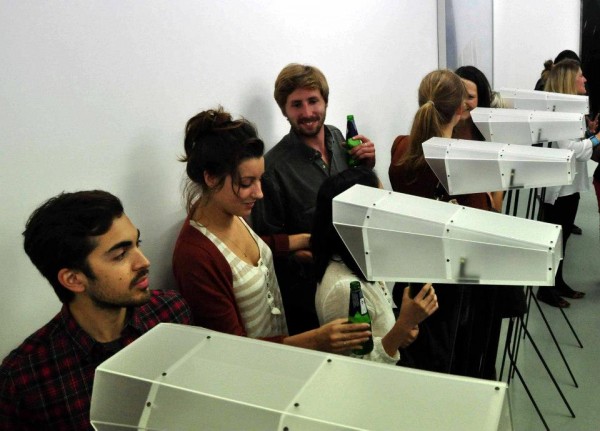
The first post-summer reunion is at Edel Assanti: the Private View is filled with my much missed gang of art cognoscenti; we all dodge the rain and dive into an ice bin filled with beer and admire the haunting Noémie Goudal photos. Looking up from the tiny world inside the artist’s stereo viewers, I see an almost familiar face. Hmmm…don’t I know that guy? He’s tall and slim with a sort of clean-cut charm extracted from a Ralph Lauren ad. My trusty wing woman and I edge towards the make-shift bar to meet up with some nearby Gagosiennettes. As our little groups converge, he gives me a blue-eyed look and says ‘Hi.’

Of course, I fake it for a while, studying his face before giving in and begging the question as to where we have met. He flashes a devilish grin, explaining we met at the infamous Courtauld party last year at the Notting Hill Arts Club – a party from which I barely escaped with my life. Lovely, he thinks I’m a drunken maniac. After sharing a few laughs about the mess of last year’s party, the two of us, my best girl and my best gay all head out of the gallery towards Soho for tapas – a night which ends in a whirlwind of Prosecco, trannie bartenders and 80’s dance tunes.

He does a mean Footloose impression.

He asks me out to a more civilized date at a trendy restaurant soon after – I’m thoroughly impressed after living in a city where ‘lets meet at the pub at eight’ and I buy my own Guinness qualifies as a date. He helps me with my coat, pays the bill and even walks me home.

Keith Coventry, Looted Shop Front, 1995 Bronze. Installation at the NewArtCentre. Photo Courtesy of NewArtCentre.

It’s now late September, I can feel the art fair panic set in slowly and then accelerate, amplifying at the same rate as the plethora of heady art events. Clearly, there are not enough cocktail dresses to go around. Frieze week approaches like a foreboding cloud. With pulses on the rise, my fellow art professionals become sleep-deprived – we all know it’s not really Frieze until somebody cries. (It’s Saturday before Frieze when my exhausted best girlfriend cries into her Lalani tea and scones at the Burlington Social Club tea party over a missing price list.) I manage to escape the city for one last day of relaxation to catch the opening of Keith Coventry’s show at the NewArtCentre in Rochecourt, appreciating the irony of a show celebrating urban blight in such a gorgeous and exquisite estate nestled in rolling, green English countryside.

I wonder what he is up to.

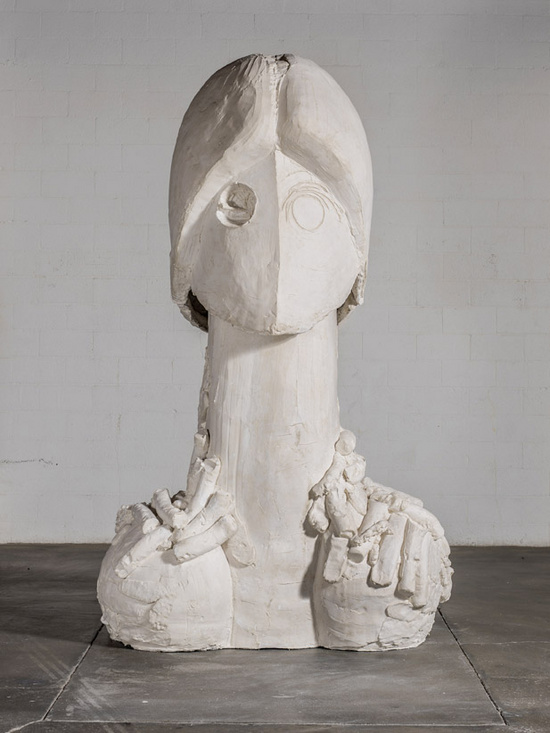
Thomas Houseago, Portrait Column I, 2012 Tuf-Cal, hemp, iron rebar. Photo: Fredrik Nilsen.

A number of big, blue-chip exhibition openings mark the official beginning of an orgy of private views leading up to Frieze, like the impressive Thomas Houseago sculpture show at Hauser & Wirth, a scattering of monumental, and of course, phallic, sculpture in the glass case of the Saville Row space. The Pace Gallery and David Zwirner both inaugurate their competing flagship spaces in Mayfair with highly attended champagne parties: pristine exhibition spaces sprinkled with the who’s who of the international art world. Luc Tuyman’s at Zwirner’s were pleasantly luminous and interesting, one still life with cabbages bringing to mind perhaps a bigger, more electrified Morandi (or was that the blindingly lit space?) Pace’s highly anticipated Sugimoto and Rothko mash-up of colorless horizon lines was disappointing – Milly Glimcher’s green sequined gown certainly the most dazzling thing in the gallery space. All agreed that Pace served better champagne in larger quantities – which the swarmsters and I still managed to gulp down in less than two hours.

Since it is my old stomping ground, I spend the evening at Pace flirting with old tech crushes and avoiding rival gallerinas, swirling about the crowd in a black leather mini skirt. Halfway through my third glass of Veuve, I see that familiar face enter with his auction house entourage. He is all smiles in his slim black suit, skinny tie and… a motorcycle helmet. Vroom. He introduces me to a few friends, falling in and out of German to English as we both spot and chat with out a few art celebs. I tuck myself into a corner as he slowly leans in to speak over the crowd… My old tech crushes sigh, lower their eyes and empty their glasses. We exit hand-in-hand out of the scrum to find a burger at Mayfair’s Automat. By the end of the night I realize two things: Automat fries are about as close as one can get to In n’ Out fries in London and… I might like this guy touching my knee under the table.

Hugh Mendes, Obama Lama at The Future Can Wait

I ring in Frieze on Monday with a spicy Vesuvius martini at The Sanderson with old friends, swirling the red chili in my martini glass while we all exchange gallery gossip. We crash Gavin Turk’s colorful print exhibition at Paul Stolper Gallery and the over-subscribed Future Can Wait Saatchi Show. The works at The Future Can Wait are about as random as the hipster outfits, and fighting for a drink is hardly worth the effort. A brief blissful moment with Hugh Mendes saves us from the crowd as he shows us his small, careful works featuring news clippings of the Dali Lama. We arrive at our next stop, wobbling in heels over cobblestones and feeling like well-dresssed vampires as tuxedoed bouncers and lines of flaming torches lead us down into a dimly lit church crypt. Lusciously grotesque, the fabulous Metamorphosis show by All Visual Arts includes slimy octopus bodily bouquets by Polly Morgan and surreal, feathered snakes by Kate MccGuire arranged throughout the worn brick archways. Standing out, one painting by Jonathan Wateridge shows a woman, facing away from the viewer. She wears a lush white fur and a blonde bob and walks towards the uncertainty of heavy velvet curtains. There is a Mulholland Drive, LA Noir tone to the work, we cannot see her face, which is perhaps a painfully beautiful one, or a grotesquely disfigured one. And, somehow, I am certain the blonde bob is a wig. As the crowd swells and babbles underground, the bubbles go to my head, I get lost in her world – wondering if she is alone, in danger, or in a some desperate kind of love.

Read More »

Share

Chicago

ALLEYS AND PARKING LOTS Joel Ross in collaboration with Jason Creps at moniquemeloche

"In The Future (Installed and Abandoned, Bradley, IL)" 2012. Archival pigment print; 42.5 x 55 inches. Courtesy of the artists and moniquemeloche.

In the foreground of one of Joel Ross and Jason Creps’ photographs, the artists installed a sign that reads “At the beginning of the story I will say to you ‘This is how it happened’ and then we will proceed, okay?” This statement could be the thesis for the artists’ exhibition of cinematic photographs titled “Alleys and Parking Lots” at moniquemeloche, a show in which text-based interventions re-characterize the peripheral spaces of the urban environment.

The artists install signs and placards near dark alleyways, outside of abandoned shopping malls, and in empty parking lots. They then photograph these places – often at night – setting up a dialectic between the pictures as documentation of the artists’ interventions, and the theatrical context produced by the addition of the signs and the framing of the photographs. The artists’ work with existing lighting conditions and do not manipulate the alleyways and parking lots they photograph beyond the addition of the signs, yet the images are highly stylized, like story-boards or pages from a noir graphic novel. Rich blacks amplify a sense of mystery and menace, particularly in nighttime images. Image-making and narrative construction take clear precedence over documentation and intervention within the artists’ practice as the photographs demonstrate unmistakable evidence of craftsmanship and finish, while the installation of the signs appears to be more like a step in the process rather than an end in itself. After that first shutter click, we are never shown what happens to the signs or how the people who utilize these spaces interact with them.

"Do Don't (Installed and Abandoned, Chicago, IL)" 2012. Archival pigment print; 55 x 80 inches. Courtesy of the artists and moniquemeloche.

Like great cinematographers, Ross and Creps find locations pregnant with mood and dramatic potential, often focusing their attention on urban industrial locations devoid of people, though never lacking character. In a piece titled Do Don’t (Installed and Abandoned, Chicago, IL) (2012), an alleyway beside an anonymous brick building is buttressed by a security barrier and chain-link fence. Leaning against the barrier is a sign that says, “Whatever you do don’t arouse suspicion.” Yet the stillness of the tableau, the long shadow of the building, and the unseen pathway just around the corner all arouse plenty of suspicion. The addition of the sign amplifies an already palpable sense of peril and suspense, feeding off not only the seedy darkness and seclusion of the street corner, but also popular mythologies about urban danger from movies and sensational “if-it-bleeds-it-leads” journalism.

"Quiet Voices (Installed and Abandoned, Champaign, IL)" 2012. Archival pigment print; 56.25 x 80 inches. Courtesy of the artists and moniquemeloche.

In a number of the photographs, the places depicted become both character and setting for the larger noir stories implied by the signs. In a piece titled Quiet Voices (Installed and Abandoned, Champaign, IL) (2012), an empty parking lot in front of a shuttered shopping mall is flooded with light from a single lamppost. On the lamppost is a sign that reads “When strange quiet voices are telling you something is wrong you should listen.” The strange quiet voice could be coming from the lot itself, again warning of the dangers in the dark cement jungle. Or, the sign could also be read as an epitaph for the businesses and bank accounts that were washed away since the start of the financial crisis in 2008. Next to the corpse that is the failed shopping center, the sign becomes like a banner across a memento mori and a hard-earned lesson about hindsight and intuition.

Read More »

Share

Help Desk

Help Desk: Missed Opportunity

Help Desk is an arts-advice column that demystifies practices for artists, writers, curators, collectors, patrons, and the general public. Submit your questions anonymously here. All submissions become the property of Daily Serving. Help Desk is cosponsored by KQED.org.

Dear Help Desk,

I have a nagging suspicion a prominent curator in my town feels slighted by my inaction to follow up on a studio visit he solicited. I know opportunities like this don’t happen often, and I deeply regret not following up, but I was in my thesis year of graduate school and could do little more than eat, sleep and work in the studio. We’ve bumped into each other at art openings and other events and he does his best to overlook me but greets my husband. Building an art career is difficult enough, I worry that his feelings toward me might make it even harder. I’m so embarrassed by the situation I don’t know how to proceed.

So you missed an opportunity to present your work, and now you believe that the curator is taking it personally and showing you his feelings by snubbing you at openings. There’s really only one way to find out if that’s true: by writing to him and asking for a studio visit.

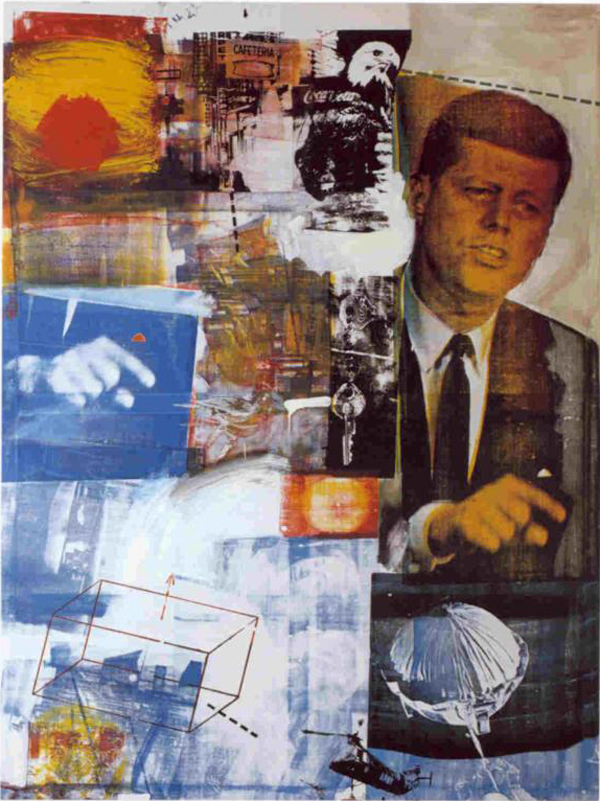
Robert Rauschenberg, Minutiae, 1954. 

You could play this a few different ways. You could, in the email, apologize for not following up, explain how overwhelmed you felt during school, and ask if the opportunity is still open; or you could just send a very short note requesting a time for a visit (with no mention of your prior interactions); or you could try for the middle ground, requesting an appointment “now that I’m out of school and not swamped by coursework.” Personally, I’d choose the last option, acknowledging your former position but without making it into a big deal. You owe it to yourself to investigate this situation and see if it’s possible find out what’s really going on—otherwise, you’ll just torture yourself every time you run into him. By getting in touch, it’s likely that you’ll be able to determine (either by the curator’s response, or by his non-response) how he feels about your interactions; and whether it’s good news or bad news, it will allow you to discern his estimation of your (albeit limited) interactions. Additionally, if this curator’s feelings were indeed hurt, your continued interest in a studio visit might mend the rift. Communicating your previous situation will let him know that it was nothing personal and that you take the opportunity seriously. Don’t put this off any longer, just write a nice email and send it off today.

Robert Rauschenberg, Retroactive I, 1963.

Now, aside from the issue of if/when/what you hear back from this person, you’ll want to think about your broader goals. This person is important in your community, but make sure you’re not putting put all your eggs in his basket. Building an art career is laborious, and you can’t control what other people do; but you can take steps to carve out your own future regardless of how things end up with Mr. Prominent Curator. While he may be a big deal in your town, he can’t be the only one, so sit down and make a list of all the other people that you’d like to ask for a studio visit. Start the list with curators and gallerists in your town, then make another list of people you’d like to work with in the closest big city (this process may require research, which you can read about here). When selecting the people you’d like to contact, try to strike a balance between the VIPs and the relatively obscure. On the one hand, I encourage you to shoot high. Even if the blue-chippers aren’t scurrying over to your studio in droves, you’ll get your work in front of them, which is never a bad thing. On the other hand, be sure to include curators, writers, and other artists who share your ambition but are also still on their way. By creating a balanced list, you’re more likely to actually make some appointments, and you never know who will be enthusiastic and give you some useful feedback. Low-pressure studio visits are great practice for when the heavy hitters do start sniffing around, and today’s upstart arts blogger might be tomorrow’s Artforum staff writer. Of course, just like grant applications and project proposals, studio visits are a great tool to help you see your work through another person’s eyes, to analyze your studio practice in novel ways, and clarify your thinking about your artistic motives and strategies.

Read More »

Share

From the Archives

From the DS Archives: He disappeared into complete silence

Today from the DS Archives we take another look at the exhibition of Louise Bourgeois’s work at  De Hallen in Haarlem, The Netherlands. The Faurschou Foundation’s current exhibition, Alone and Together, presents and overview of Bourgeois’s seven-decade career.

The following article was originally posted on November 24, 2011 by :

Machine Torture, 1975. After the narration of 'In the Penal Colony' (1914) by Franz Kafka, realized for the exhibition 'Machines Celibataires' (1975-1977). Photo: Gert Jan van Rooij.

Read More »

Share