Hong Kong

Joel Morrison at Gagosian Hong Kong

Joel Morrison, Untitled (Meat Tenderizers), 2012. Stainless steel, 30 1/2 x 16 1/2 x 16 inches (77.5 x 41.9 x 40.6 cm), Version 3 of 3. Photo by Erich Koyama.

In his first solo exhibition in Asia at the Gagosian gallery in Hong Kong, Joel Morrison presents a reasonably entertaining series of recent works that challenges formalist sculpture while engaging in a constant critique of art historical directions. Drawing on readily-available objects utilised in daily life, Morrison’s composite sculptures begin as disparate Duchampian readymades: weather balloons, bullets, mannequin busts and shopping carts, just to list a few. Through a process that begins with casting, these found objects are moulded into forms that look oddly familiar and yet not, then cast in stainless steel, and finally subjected to intense polishing. Forced together, these objects don’t sit too well in their new skins, poking and swelling out of their casts with deliberate stubbornness, creating a rolling landscape on shiny surfaces. Consequently, the physical sum of the parts of these flimsy, ephemeral readymades is a permanent, unrecognisable blanketed structure intended to provoke and outrage. If traditional sculpture concentrates on the materialisation of an intangible idea in three-dimensional space, Morrison’s eccentric, amorphous surfaces seem to reverse the process, becoming figurative the moment his readymades take their final forms.

Joel Morrison, The Reaganomic Youth (version 2), 2012. Stainless steel, 28 1/2 x 18 x 22 1/2 inches (72.4 x 45.7 x 57.2 cm), Ed. of 3. Photo by Erich Koyama.

The polished and glitzy Untitled (2012) piece forged frommeat tenderisersis part Greek sculpture, Medusa-myth and part punk-metal (pun not quite intended), exhibiting both the stateliness of Ancient Greek busts and the flamboyance of pop culture. If Greek busts were commissioned to commemorate the heroics of war, or to serve as propaganda, Morrison’s silver work is an amusingly brilliant commemoration of postmodern’s obsession with consumerist excess and pastiche. No less quirky and alluring are the ironic and arresting steel jaws of a crocodile-like predator used to represent the seductive male lover in Romeo (2010) and bulbous The Reaganomic Youth (2011) that features an overturned bottom half of a shopping cart supported by a fused number of round-ish protrusions.

Joel Morrison, Tomb, 2012, Nickel plated aluminum. 58 x 54 x 2 1/2 inches (147.3 x 137.2 x 6.4 cm), Ed. of 3. Photo by Erich Koyama.

By appropriating forms and ideas in the history of western sculpture, Morrison’s oeuvre recalls the naturalism of the classical era,  the futurist emphasis on energy, movement and the dynamic flows in space, and the conceptual Duchampian readymade. Above all, his forms pay tribute to the works of other modernist sculptures, echoing the organic and abstracted shapes of Barbara Hepworth’s, or the deliberately disproportional, undulating and imperfect reclining forms of Henry Moore. In a playful homage to Frank Stella’s Getty Tomb (1959) for instance, Morrison’s large namesake resembles at first glance, a striped T-shirt made with a reflective surface. If Stella’s famed black, unmodulated series of canvas works were intended to contain no meaning other than existing painted objects, Morrison’s peculiarly shaped Tomb (2012) seems to revoke that formalist abstraction through its rippling drapes and stripes, implying a more complex relationship sculpture has to contemporary attitudes and responses.

 **********

Joel Morrison was born in Seattle, Washington in 1976. He received a BA in English Literature at Central Washington University, and an MFA in sculpture at the Claremont Graduate University in Claremont, CA. Morrison lives and works in Los Angeles. This exhibition will be on show at the Gagosian Hong Kong until 17 November 2012.

Share

Help Desk

Help Desk: Insults & Insecurities

Help Desk is an arts-advice column that demystifies practices for artists, writers, curators, collectors, patrons, and the general public. Submit your questions anonymously here. All submissions become the property of Daily Serving. Help Desk is cosponsored by KQED.org.

Is your practice hot or not? Frieze Magazine is ready to assist you with your latest statement.

This week’s column features the artwork of Dimitri Kozyrev. His solo exhibition “ЗЕРКАЛО (Mirror)” just closed at Mark Moore Gallery in Los Angeles, but you can find more images here.

I am having a rather embarrassing problem with some of my local colleagues in the visual arts. That problem is a general enmity and competitiveness when it comes to grants and exhibitions. I have always taken a ‘win some lose some’ approach to my own art career and have always applied this sentiment to the failures and successes of my peers. Lately however, I have noticed that as I move up the food chain, as it were, many of the people I have known for a long time are now taking a much nastier tack with me, making underhanded digs at my decision making or being sure to insert a subtle insult along with their congratulations. I also notice that new artists that I meet at this same level act the same toward me, being generally snotty and backstabbing. Is this just a necessary evil of being an up-and-coming artist? Is there an end to it? Do blue chip artists have to deal with the petty insecurities of their peers or does everyone just get along past a certain point?

I wonder why you’re embarrassed by this problem when the poor behavior is coming from your colleagues and not from you. It seems that if anyone should be embarrassed, it’s them—after all, who hasn’t felt a little green-eyed when faced with the news of a competitor’s good fortune, even if that competitor is a friend—but they should have the good sense to offer their best wishes and leave it at that. Sulking is best done at home where no one can see your frowny little face.

Dimitri Kozyrev, Last one 16, 2012. Acrylic on canvas, 84 x 72 inches

It’s true that the competition model breeds insecurity. When 300 artists apply for one $10,000 grant, that leaves 299 disappointed; and everyone expresses disappointment in their own way. A few can shrug it off, as you seem to do, and others grow embittered and let it poison their relationships. Limited resources can sometimes turn friends into frenemies and complete strangers into adversaries. Yes, some people live their lives like this, but that doesn’t mean you have to follow suit, and no matter what else you decide to do, please don’t adopt their paradigm.

So what can you do with your current situation? First, I hope you will take a moment to review all those underhanded digs and subtle insults and make sure you’re not just being hypersensitive. Sometimes we imagine the responses of others in advance (“Gosh, this new award is going to make everyone jealous!”) and then project those imaginings onto reality. Before you go any further, make sure you read the situation correctly and keep your own insecurities out of the driver’s seat. Got it? Okay, just checking.

Then, assuming you are really being insulted, you have a few options. You could ignore it and hope to find some nicer, more generous colleagues soon, or you can respond when your current pals start misbehaving. If they don’t know enough to say, “Congratulations!” and then bite their tongues, you are free to acknowledge their unkindness.

Dimitri Kozyrev, Last one 14, 2012. Acrylic on canvas, 60 x 48 inches

There are probably some people with whom you’d like to remain on friendly terms. You might consider speaking to these people in private, letting them know that they’ve hurt your feelings and that you’re uncomfortable with your current interactions. Tread carefully here, using “I feel” and “I think” assertions, instead of “you” statements, which tend to make people defensive and combative. If your goal is to preserve and even enhance former good feelings between the two of you, be ready to listen as well as talk.

Read More »

Share

From the Archives

Let the Bodies Hit the Floor

Today from the DS Archives, we bring you the body: old and new. An unavoidable topic of contemplation, the body has been the subject of art since the very beginning. Needless to say there have been many different interpretations. Bodies and Shadows: Caravaggio and His Legacy at LACMA, chronicles the work of Michelangelo Merisi da Caravaggio (1571–1610). The article below, “Hello, all but forgotten piece of 1970s feminist Earth Art, have you ever seen a transsexual before?” illustrates a contemporary view on bodies.

The following article was originally posted on February 14, 2012 by :

Show card for "Hybrid Narrative" at Mac Arthur B Arthur, in Oakland, CA, 2012.

Sight, acknowledgment, and shared experience all figure prominently in Hybrid Narrative: Video Mediations of Self and the Imagined Self, currently at Mac Arthur B Arthur in Oakland, CA. Artists Liz Rosenfeld, Chris E. Vargas, Sofia Cordova and Shana Moulton make themselves “seen” though video, film transfer, installation and performance.

Read More »

Share

London

Fan Mail: Iavor Lubomirov

For this edition of Fan Mail, Iavor Lubomirov of London has been selected from our worthy reader submissions. Two artists are featured each month—the next one could be you! If you would like to be considered, please submit your website link to info@dailyserving.com with ‘Fan Mail’ in the subject line.

What kind of elation do you get from your study of mathematics? You have taken a journey from studying mathematical systems to producing unique visual analyses of that data. How might you square up the concept of free will with a seemingly deterministic universe?

Mathematics to me is an expression of the inner workings of our animal thought machine. It can do things like laugh and catch a ball and we know why, to some small immediate extent, and with mathematics  we glimpse a little bit of the how. A tiny tiny tip. We humans know so little mathematics, though it’s ever so much. To me, mathematics does not have that deterministic quality which it is standard to associate with it. I see the fuzziness in its structure. At its core it is based on a notion of duality – things are or they are not – and I believe, or rather feel, that reality quite comfortably exists in contradiction, that this is not the exception but the rule. The ancient Platonic conception of the perfect mould in heaven and the imperfect instances of it on Earth to me is entirely the reverse of reality. Perfect objects are intensely complex and human attempts to simplify them produces imperfect shadows in our minds, which we call logic. So for me there is no dichotomy between determinism and free will. They are two faces of a hugely complex shape.
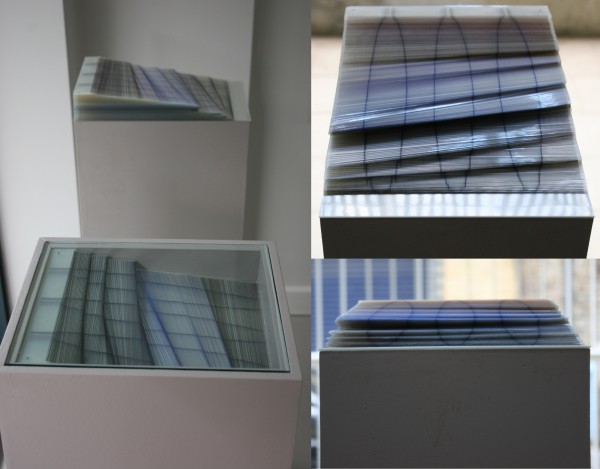
Iavor Lubomirov, Three-Phase Cylinder I & II, 2012, 100 Micron Clear Film 21 x 27.9 x 4.6 cm.

“The origin of conic sections is unknown – the earliest reference we have is in the work of Apollonius of Perga around 200BC. Traditionally, Apollonius and the spate of mathematicians who followed in his footsteps over the centuries, used a cone sliced by a plane to define the circle, ellipse, parabola and hyperbola. Three-Phase Cylinder departs from the reductivist approach used to isolate these regular shapes and instead flirts with the methodology itself, letting a whimsical curling plane (mathematically defined by oscillating trigonometric functions) intersect three regular cylinders to produce a mathematically inutile set of shapes.”

This method of playing with a shape in physical reality as a means to grasping some mathematic complexity before it was written symbolically shows how these generalizations are functional and elegant.  It reminds me of a trip that I took to see Gaudi’s Sagrada Familia church in Barcelona earlier this year where I saw Gaudi’s method of understanding the form and load-bearing capacity of his arches by making upside-down string models hung with weights. It allowed complex mathematics to be used and understood in a simple and direct way.

Iavor Lubomirov, Ersatz Biblical Synaesthesia, The First Book of Moses called Genesis, 2012, Giclée Print on Hahnemühle 21 x 27.9 cm.

“The works are composed by a computer program which processes the numerical ASCII codes of the characters in the English text. The program uses a bespoke logic to convert the resulting numbers into hexadecimal RGB colour codes, with which it colours a square digital image pixel by pixel. A typical Old Testament book will contain around 200,000 characters, resulting in a seemingly random, highly pixelated image, which nonetheless is a faithful rendering of the King James text. The fact that a human will not be equipped to ‘read’ this visual text is an important comment on the nature of translation and the long history of a text which has so often been inaccessible to people whose lives were nonetheless deeply affected by its substance, interpretation and political appropriation.”

I imagine that you must enjoy the detail and tedium of your works–some artists might say it brings them to a meditative state–do you have that kind of spiritual component of your life?  In light of your ‘Ersatz Biblical Synaesthesia’, I’m curious to know what kind of beliefs you hold about religion, Christianity, spirituality, and/or the mind/body problem. The content of ‘Ersatz’ seems to be the mutability and evolution of these texts through translation.

Going on to religion, spirituality and existence, I find myself a bit overwhelmed as to how to begin to answer such a complex and rich matter. I have read a lot of historical and scientific texts on Christianity – both about the small Jewish sect founded by Jesus under Roman occupation of Jerusalem and about its later transformation into a European spiritual religion, primarily through the early writings of St. Paul, who brought us the myth of the resurrection. I have also made some researches into Islam and to a very small extent Hinduism and Buddhism. What interests me in the major religions is their influence on the overwhelming majority of contemporary world society, which can remain enmired in these early and simple forms of human philosophy even while living in an age of radically evolved understanding. Reality is of course immeasurably grand, inhuman and terrifying – much more so than a vision of a universe ruled by a compassionate and essentially human maker. I don’t deny god – that would be arrogant indeed. But nor can I seriously allow myself to believe in medieval and ancient conceptions of what god is and which have been shaped for centuries by the political and philosophical conveniences of their day.
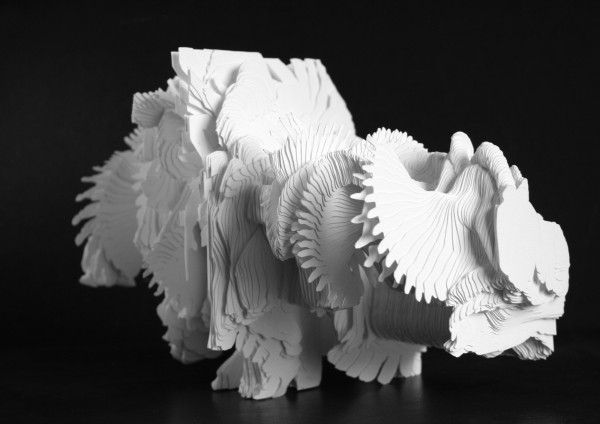
Iavor Lubomirov, In Hind Sight, Fabriano Watercolour Paper, 2006-2009.

“‘In Hind Sight’ considers objects in 4-D space (3-D space with time) and tries to show them from a new visual perspective. Its starting point is a video of a 34 second movement performed by two artists in an empty space and filmed at 25fps. The video was decomposed into 850 individual stills, each was cut out of paper and the whole was then assembled.”

A work such as ‘In Hind Sight’ seems like it would take quite a lot of work to cut by hand and the edges are so perfect.

It took me over a year to cut and assemble ‘In Hind Sight’, with some more and some less intense periods of work. The hardest part is finding the time to indulge such an inexplicable activity. One might expect that it would be the tedium of cutting – which you perceptively see as a source of joy rather than pain – but this in fact is largely mitigated by the observation of the slow evolution of the work and its many beautiful hidden moments, which are revealed and then obscured by the process.

Upon first viewing ‘In Hind Sight’, I saw what immediately resembled a Chinese lion dance costume to me. The analysis of two bodies in motion is not something I would have guessed from looking at the work, but that content was there in an intuitive way. How did you deal with the negative space between the figures—did you need to smooth out the lines to make it work?

The negative space in the piece is accepted honestly and there is no trickery designed to evade it. Some of it is hidden inside the work. Other negative spaces simply make it quite fragile in totality. The two dancers worked very close to each other in a confined room, so they did not create very large gaps between their bodies for this short piece.

Your ‘Prototype for a Romance’ brings back an architecture space from a 2-D rendition into real space. The collaborative process and the meeting of two minds is like a romance. We can never unify or see through another’s mind but we insatiably try.

Iavor Lubomirov, Prototype for a Romance in Many Dimensions, 2012, Multiple Giclée Prints on Card Four pieces, each 21 x 27 cm.

“This series of four architectural works is a prototype for a planned collaboration with painter and printmaker Bella Easton. It was created by hand, using 359 identical prints of Easton’s ‘Rule 174′….Lubomirov and Easton take calm stock of the visual and compositional purpose of the grid established last century. They accept its validity as an overt presence…” Bella is currently creating 180 finely graded prints which I will shape into a sculpture.

Your website suggests that the grid is a kind of scaffolding for art rather than a constraint. It makes me wonder about your relationship to the landscape in general. A sense of place is often defined by our artifacts, and when considering the grid, I think of the city laid out over the land, and the grid is a structure that makes a vast city comprehendible and navigable. But there are layers of landscape before/below/inside/above the grid. The grid has a capacity to wipe out history or to let a place evolve and learn from itself in a strategic way.
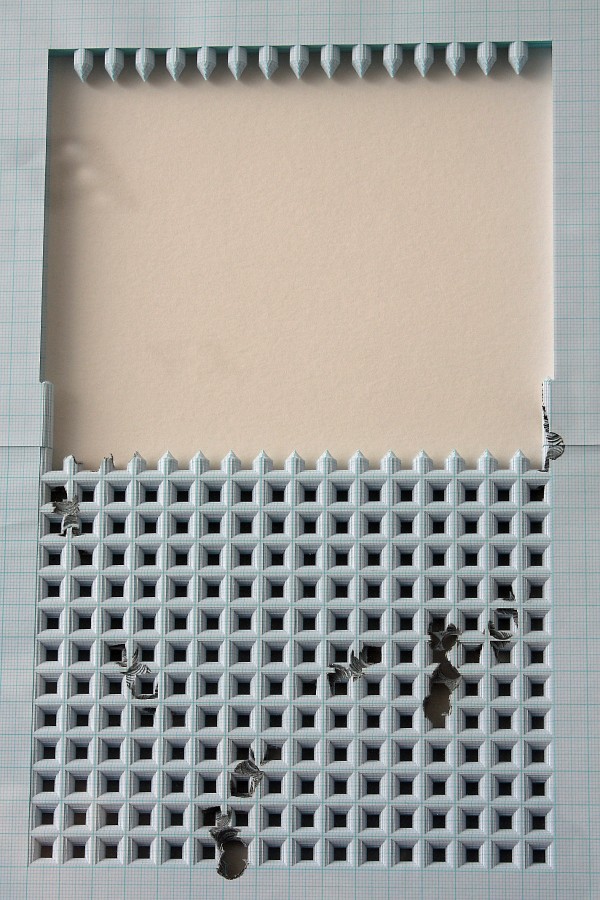
Iavor Lubomirov, Heliothis.zea, 2007-9 graph paper 45x55x3 cm.

“In the gallery, the work was placed on a small white desk, into which a rectangular hole was cut, very slightly larger than the grid in the pad. Thus, when a viewer sat down to examine the graph pad, they were able to see their own legs through it and through the desk.”

Iavor Lubomirov, Schema for a New Grid System (Liverpool), 2008, graph paper 45x55x3 cm (installation view).

I missed your question about my relationship to the landscape. To me it is incidental. Fishes swim in the sea, birds in the air, worms in the earth. Crabs and humans crawl about on the bottom and occasionally look up. Each substance is a sea and a landmass, depending on your own incidental density and the speed of time. If you put a piece of lead on the ground and speed up time so that a thousand years is like a second, you will see it sink down like a rock thrown in the sea. You see these old houses with stone fences that lean after a hundred years and you realize that they have been built on mud and are floating and bobbing on top of it. Everything is fixed and in constant flux too. Time is just a dimension. Nothing ever disappears.

Iavor Lubomirov was born in Bulgaria completed his degree and Masters in Mathematics at Oxford University in England and his BA in Fine Art at University of East London. Part of his ‘Three-phase Cylinder’ will be on show at the all inclusive CGP Gallery Open show opening on Sunday, November 11th. His selected solo and group exhibitions include: Vegas Gallery (2012), Angus-Hughes Gallery (2011), The Magnificent Basement (2010), August Art Gallery (2009), Calvert 22 (2008), Liverpool Independents Biennial (2008), and The Royal Academy Summer Exhibition (2007). Iavor is a co-founder of the art network ALISN, supporting emerging artists in the UK and abroad. In 2012, with painter Isabella Easton, Iavor opened the Lubomirov-Easton Project Space.


Share

When Rock Star Fantasies Go Too Far

This post was originally written for Art21.org and published on October 25, 2012.

Laura London. "Once Upon A Time... Garage Text," 2012. Color photograph on vinyl stretched on aluminum strainers. Copyright Laura London.

When photographer Laura London’s show opened at Coagula Curatorial in Chinatown last month, it was called Once Upon a Time…Axl Rose was my Neighbor. By the time it closed on October 20, its title had been cut down to just Once Upon a Time… and all direct reference to Axl Rose, famous for Guns N’ Roses but more so for being his complicated self, excised from the press release. The release nowapologize[d] for the confusion” the first title may have caused.

From the get-go, the show was supposed to occupy that slippery space between truth and fantasy. But Axl Rose’s lawyer didn’t catch the nuance.

Read More »

Share

Elsewhere

Surveying the Terrain at the RISD Museum’s “American View: Landscape Photography 1865 to Now”

A visually compelling, conceptually provocative consideration of the photographic medium, American View:  Landscape Photography 1865 to Now is anything but the kind of straightforward overview such a title suggests.  Showcasing works drawn primarily from the Rhode Island School of Design’s rich photography collection, American View shifts deftly between and among periods and styles and, in so doing, illuminates the ever-evolving relationship between landscape and photographic image.

Joe Deal, Kite, Chino Hills, California, 1984, from the portfolio Subdividing the Inland Basin. Gift of the artist. © The Estate of Joe Deal, courtesy Robert Mann Gallery. Museum of Art Rhode Island School of Design, Providence.

Upon entering the first gallery, the viewer is immediately enmeshed in a web of contemporary imagery whose formal and conceptual diversity offers a heady, concentrated sense of the exhibit’s open and adventurous ethos.  Just inside the entryway hang Millee Tibbs’ Self-Portrait in the Fog (2009) and Henry Wessel’s Night Walk #28 (1995).  The moody austerity of Tibbs’ image, a serene yet unsettling evocation of air and atmosphere, suggests a kind of minimalist, abstract refraction of Wessel’s image.  The latter, meanwhile, calls to mind the detached, de-peopled style of the New Topographics photographers in its stark image of a suburban house.  Yet this darkened house and its eerily illuminated, square-frame doorway yield a haunting sense of loneliness, even alienation. While the geometric precision and angular composition of Wessel’s photograph contrasts the intangible haze of Tibbs’ Self-Portrait, together, the two images exude a shared existential intensity.

Millee Tibbs, Self-Portrait in the Fog, 2009. Gift of the artist in honor of Joe Deal. © Millee Tibbs. Museum of Art Rhode Island School of Design, Providence.

Moving deeper into the first gallery, one encounters Catherine Opie’s chromogenic print Football Landscape #12 (2008), a vivid, wide-angle view of a Texas high school game in progress and a telling glimpse of regional American culture. Further on, Gregory Crewdson’s alluring, large-scale ink jet Untitled (Cement Canal) (2007) conjures a mysterious world of post-industrial decay and moral isolation, while across the gallery, Doug Rickard’s #82.948842, Detroit, MI, 2009 (2010) appropriates a Google Street View image in an implicit exposé of urban poverty that serves, equally, as an indictment of societal indifference.

Read More »

Share

Art & Vexation: Interview with William Powhida

William Powhida’s text-based drawings* skewer the contemporary art world with relish. From fake Rolling Stone magazine pages to charts explaining economic relationships, or trompe l’oeil pages torn from the notebook of an art-world malcontent, Powhida sticks his finger into the wounds of modern culture. For example, What Do Prices Reflect? pessimistically lists the rationale used to determine an artwork’s financial value: “Whether or not the work will impress your cultured friends…A highly ritualized exercise in shared delusions…The informal collusion of taste in a statistically insignificant % of the population.” By turns sad, true, and laugh-out-loud funny, his schadenfreude-inducing drawings call out the major players, poke fun at the artist as a brand, and divulge the art world’s dirty little secrets. Powhida and I talked this summer at the Headlands Center for the Arts, where he was a resident artist.

William Powhida. Cynical Advice, 2012; Graphite, colored pencil, and watercolor on paper, 15 x 20 in.

Bean Gilsdorf: How does your work start? Where do you begin?

William Powhida: All the drawings are very specific to a theme, often something that is irking me. The hysterical voice that provides the narrative is a way to amplify things that I’m responding to. A lot of the drawings tie into a bigger narrative, and the smaller “list” drawings are more episodic, they start with some aspect of my own practice or my own engagement with the art world. They are a way to think through all of this, it’s like having a character that speaks through the work.

BG: And how much do you script before you draw the final version? Do you have it totally written out or do you play with it as you go?

WP: I do start with a draft, and I also play as I go. I find there’s an arc to the drawings: the drafts are a basic outline, but then as I’m drawing and spending time with each sentence, it morphs and changes from the original draft.

BG: I’m interested in the play that you have with the voices that come out in the lists, where there’s a lot of sarcasm, on the one hand, and then there’s also optimism. The piece called Less is so negative—not that it’s untrue—but then Hope talks about collaboration and engagement…

WP: It’s been changing over the years. The drawings have started to split, like What’s Right with the Art World and What’s Wrong with the Art World. Despite all the ranting and raving, there’s always been this vulnerable part of the voice. I meet people who are terribly optimistic about how the art world works—they’re realistic as well, they don’t deny that a lot of it is crazy—but they still see it as an amazing place to work.

The narrative voice in the list drawings is not objective, because I want the drawings to be the experience of being in somebody’s head and listening to them think about the art world. That also gets articulated in works like the faux magazine covers, as a vehicle to insert myself into this upper echelon of the art world and to critique it. But as the lists have developed, they’ve become a little more rooted in reality. I don’t have to invent as much because it’s actually happening to me. Now it’s a question of trying to find some balance between what I’m actually experiencing in the art world and the things I think are still worth discussing. Whether it’s an effective critique or not I don’t know, but I’m speaking these things out loud so we can talk about them.

Read More »

Share