Help Desk is an arts-advice column that demystifies practices for artists, writers, curators, collectors, patrons, and the general public. Submit your questions anonymously here. All submissions become the property of Daily Serving. Help Desk is cosponsored by KQED.org.

I recently had to pick the edition size of a digital interactive project I made. I just went with a standard ten but it got me thinking. I understand that when you are making prints for example each piece in the edition has to be physically produced by the artist. Thus it makes sense to limit the number of pieces that can be made. But why arbitrarily constrict the number of something that can be copied infinitely at no cost or time to me? Video works would be another example of this. Movies, music, and literature don’t have this type of artificial supply constriction. Can you please explain the function and process of editioning digital art?
In general, edition numbers vary for reasons both pragmatic and market-driven. Traditionally, the edition run of a print on paper is determined partially by its technology; most printmaking media such as etching plates degrade with repeated use. Therefore, if you want the last print to look as good as the first, you have to limit the overall number of prints produced so that every print is of nearly the same quality. It has less to do with being physically produced by the artist—many editions are contracted out to printing houses—and more to do with the inverse relationship between edition size and print quality.
But, of course, there is no limit to the amount of digital copies you can generate from an original file, because unlike prints on paper, the reproduction quality never deteriorates no matter how many CDs or DVDs you burn. So should you limit the number of copies available? It’s a great question, but the answer isn’t arbitrary even though it may be artificial.

Cory Arcangel, Sweet 16, 2006. Projection from a digital source, dimensions variable, edition of 5
One factor to remember in digital editioning is that it’s contingent on the art-historical precedent set by the conventions of more traditional media. Capital-A Art typically has an aura, in part because the art object is singular (a painting) or because the technology that produced it can only last through a limited number of runs (lithography stones, ceramic molds). This has a direct bearing on digital editioning—generally, when a new technology is introduced to the arts it has to fit into the established paradigm.
In addition to its reliance on preexisting standards absorbed from other media, editioning of digital work is also market-driven. In a capitalist society, restricted supply means increased value, so when the medium itself is cheap and infinitely reproducible, value can be contrived by limiting its availability.
In the case of digital editioning, historical precedence and market forces conspire—sometimes to an absurd extent. For instance, some videos are now created in editions that include “artist’s proofs”—a term used in traditional printing for the very first prints, of higher quality resulting from the fresh printing stone. Print-on-paper APs, it can be reasoned, are more valuable because they are generally sharper and more colorful than subsequent prints; but video APs have no such enhanced clarity, making them into something between an embarrassment and an in-joke.
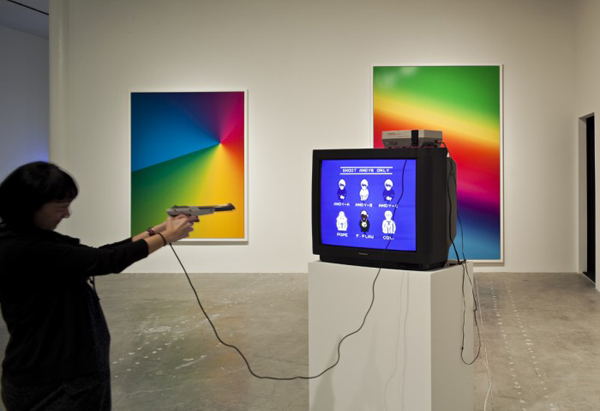
Cory Arcangel, I Shot Andy Warhol, 2002. Interactive video installation
All skepticism aside, creating a limited run of a digital work is a perfectly legitimate practice. Doing so is a promise to collectors that you will not devalue their purchase by making additional copies of the work at a later date. And if you do limit the edition, it is important that you stick to this promise, painful though it may be in the long run if demand for the work increases. The question of whether or not to limit an edition of a digital work hinges on your priorities. If wide distribution is your first priority then it would be more advantageous to produce a larger edition or an open edition. If you desire a high financial value for the work then a limited edition and the scarcity it creates will serve you better.
Read More »












 Gustaf Mantel