Los Angeles
Enrique Martíinez Celaya: “The Hunt’s Will” at L.A. Louver

Installation View
“I didn’t set out to be a 48-year old man painting unicorns,” remarks Cuban-born painter and sculptor, Enrique Martínez Celaya. Featured in six of the sixteen works currently on view at L.A. Louver, the one-horned mythical creature does make an unlikely appearance in Celaya’s work; though it is merely one facet of his calculated exploration of absurdity rooted in reality. The Hunt’s Will is a continuation of the artist’s purposefully divergent narrative: vibrant and whimsical, but also muted and unidealized – a conscientious union that encapsulates Celaya’s preoccupation with disillusionment. In totality, his work appears the uncanny amalgamation between the pragmatic and imaginative – perhaps a residual effect of his Ph.D in Quantum Electronics – yet it maintains the vague familiarity of recollection. Scrutinizing “the promises of childhood,” Celaya extracts vignettes from the ubiquitous farce in which the unknowable meets reality.
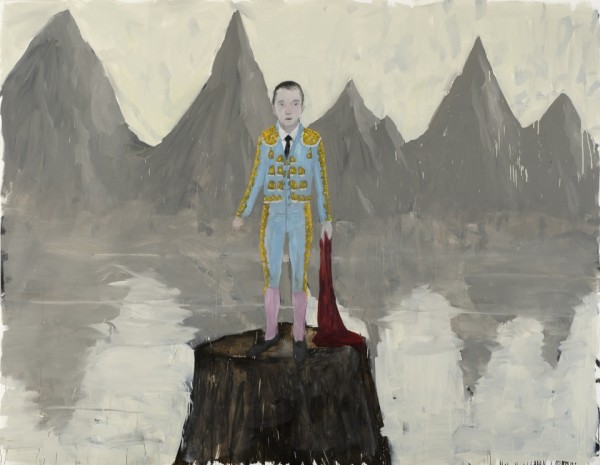
The Guest, 2012, oil and wax on canvas, 92 x 118 inches. Courtesy of L.A. Louver
In The Guest, Celaya exemplifies the isolation that often comes with knowledge. The young bullfighter stands atop a tree stump, and stares pleadingly at the viewer. A charcoal mountain range looms in the background, void of amphitheater or four-legged opponent, and starkly rendered with Celaya’s wax and oils. Wistful in his expression, the matador seems prematurely defeated; his red muleta dangling limply by his side. As if plucked from the drama of his playful daydream and stranded in this melancholic locale, the bullfighter personifies the cognizance of mortality. Not only do the reveries of our youth rarely become manifest, but the exclusive guarantee in life is death – for we are simply guests upon this earth.
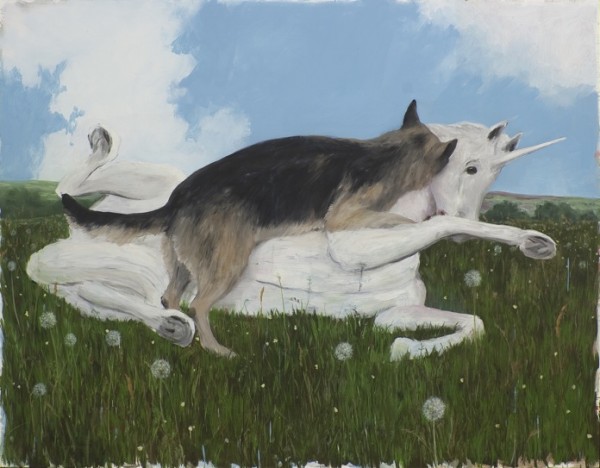
The One Who Has Taken Its Place, 2012, oil and wax on canvas, 78 x 100 inches. Courtesy of L.A. Louver
It is this arrival upon enlightenment that Celaya captures so succinctly, even in its most unassuming incarnations. In “The One Who Has Taken Its Place,” an ivory unicorn tussles with a German Shepard; a picturesque blue sky and grassy meadow setting a seemingly frolicsome scene. However, the ambiguity of this interaction denotes unease, as the encounter is neither determinately benign nor violent. As the adult mind grasps the limitations of a terrestrial actuality, is the fantastic image ultimately annihilated by one of domesticity, or is their coexistence feasible? Such an unreliable milieu accentuates the necessity of choice – both with regard to the immediate viewer, and the external factors that shape our perpetual maturation.