Elsewhere

Art Basel Miami Beach: In Stereo
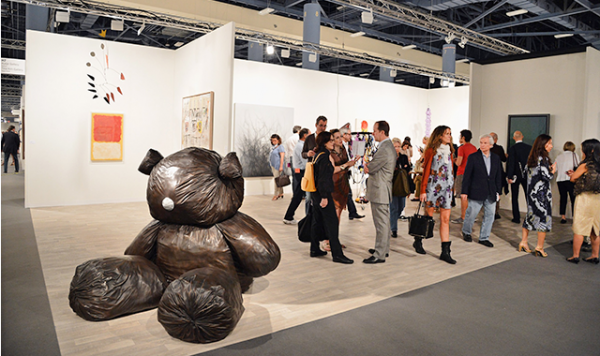
Photo by Mike Coppola/Getty Images for Art Basel Miami 2012

Let’s begin with the facts. This year’s 12th annual installment of Art Basel Miami Beach featured 257 exhibitors (excluding publications, institutions, or bookstores). This means 257 booths spanning the floor of the approximately 500,000 square foot bottom floor of the Miami Beach Convention Center. If you walk all eight north-to-south aisles (one way), you will canvas a little over two miles of carpeted ground. This does not include the shorter east-to-west aisles (of which there are six), or offsite partnering venues (of which there are three). Add to the mix the record attendance numbers (50,000 visitors) over a short period of time (four days) at the pricey cost of participation ($35,000 on average), and you have a bona fide contemporary art circus. At $42 a ticket, the show better be worth the cost of admission.
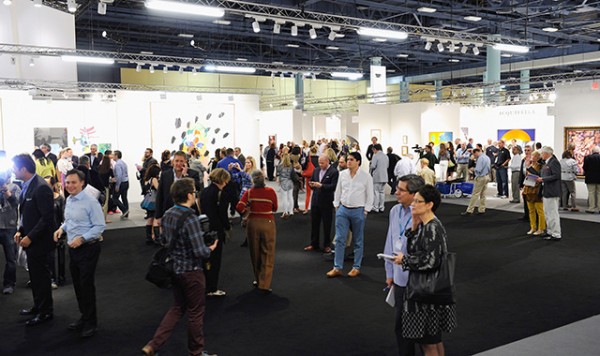
Photo by Andrew H. Walker / Getty Images

Needless to say, the costs associated with exhibiting in one such fair are astronomical. Beyond the cost of the booth itself (which runs $52 per square foot in the fair’s main section), a gallerist must consider packing, shipping, flights, meals, staff hotel accommodations, promotional expenses, possible furniture rental, client entertaining, and the omnipresent “unanticipated expense.” Need an extra light bulb in the booth? That’ll be $150 each. Lunch for the staff of four? $96 a day. Needless to say, the pressure to (at a minimum) break even on the expenses of participating in the headlining mega-fair oftentimes results in high-ticket inventory from high-ticket artists, leaving little room for the mid-career, emerging, or unknown set. So when a gallerist decides to feature the atypical – potentially, unsaleable – artists of his/her program, it can often be considered a bold, magnanimous statement. Moreover, to hold the attention of a collector is challenging enough when sensory overload is a fated plague, but to also attempt to capture their focus through an unorthodox sensory faculty requires certain panache. Enter: sound and video art; the conceptual, disenfranchised cousins of Basel’s long running triple feature, starring Koons, Murakami, and Warhol. This is not to say that presenting sound and video art at a venue like Art Basel Miami Beach is easily done, or even encouraged, by participating dealers. All signs typically point to “easily overlooked,” especially when competing with more commercially digestible works like the colossal Roy Lichtenstein in Gagosian’s booth, or the hustled parade of hip hop moguls weaving through the masses. However, a select few of these ambitious projects managed to cut through the white noise of the fair’s inner murmur, and conduct an alluring opus for the observant few.

Read More »

Share

Elsewhere

Craft is Not Dead

What defines the art of craft? What is the difference between art and craft? 40 Under 40: Craft Futures at Smithsonian’s Renwick Gallery blurred the lines for me, while at the same time helping me to appreciate craft in a new light. There is something about the word “craft” that connotes antiquated techniques that don’t necessarily relate to our contemporary world. This exhibition breathes new life into the art of craft and highlights the contemporary relevance of craftsmanship.

Installation view, 40 Under 40: Craft Futures, Smithsonian American Art Museum and the Renwick Gallery, July 20, 2012 – February 3, 2013.

In celebration of the fortieth anniversary of the Renwick Gallery, the exhibition features the work of 40 artists born since 1972 – the year the Smithsonian Art Museum established its contemporary craft and decorative arts program. All of the works were created since September 11, 2011, drawing particular attention to the state of contemporary craft and the way it relates to our society. Although we often associate craft with functionality or pure aesthetics, the pieces in this exhibition have more profound stories to tell in much the same way as contemporary art.  The show explores issues of technology, technique, relevance, and even the current economic climate as it relates to craft. Christy Oates fuses traditional woodworking techniques with CAD software technology to make furniture, while Joshua DeMonte creates jewelry using digital fabrication, both examples of how new technologies are changing the nature of craft. Several artists highlight the importance of sustainability exemplified by Jeff Garner’s sustainable clothing designs and Uhuru’s furniture made from reclaimed materials.

Read More »

Share

Elsewhere

From Miami: Selections from the Miami Art Fairs

Driving to Miami in a car, through scrub trees, pines and high water along the highway, I feel like I’ve come to the end of America. Here we are for the 2012 Miami Art Fairs, a city-wide, four day long event comprised countless art fairs, exhibitions, and unofficial events. Arriving in a city that I’ve never visited, my first night is spent in orientation. I’ve done little research to line up the best events, preferring to see where the city takes me. However, my intention when coming to the Miami Art Fairs was to find imaginative figurative work, perhaps because some of my favorite art is folk or brut, and often for me, conceptual art often lacks the energy and expression that I sense as vital to the artistic process.

KATSU ISHIDA, BUDDA, mixed media on handmade paper, 2011 72 x 60cm

At Aqua Art Miami, Japanese artist Katsu Ishida‘s primarily black and white drawings on paper were filled with tiny faces, reminding me of writhing souls in hell piled up on each other. Ishida told me that he makes all his paper and brushes himself, and the forms are dictated by the materials; he sees faces in the paper.

Read More »

Share

Elsewhere

Holding Up Half the Sky: An interview with Lin Tianmiao

After seeing Bound Unbound, the major retrospective show of Lin Tianmiao’s work at the Asia Society Museum in New York I was so intrigued by how such work could emerge from the testosterone-fuelled Chinese artworld in the late 90s that I decided to seek her out in Beijing to ask her what it’s like to be pretty much the only female artist in China to wear the ‘feminist’ label.

. Fiberglass, silk threads, mixed media, sound. Dimensions variable. “Non Zero,” Beijing Tokyo Art Project, September 18–October 3, 2004. Collection of the artist.””]On a bitterly cold Beijing day, I drove out to Songzhuang Artist Village to meet the artist. Waiting for her to arrive, I noted the books and DVDs on the shelves and the artworks on the walls. Books are everywhere in tranquil rooms filled with the sounds of finches fluttering in an enormous bamboo birdcage among ficus trees and potted plants.

Lin Tianmiao, December 2012, photograph Luise Guest

Her studio is a white calm space filled with works in progress. Twenty studio assistants work in silence at long tables. Women wind colourful silk thread around the bones which her assistant told me several times are synthetic (perhaps this has been a contentious issue) or stitch the ‘badges’ similar to those currently showing at Galerie Lelong New York. I ask her if, in the years she worked as a textile designer in New York  before her return to China and her emergence as an artist to be reckoned with, she could have imagined all this. She shakes her head. The New York years, were hard, she says. Although she loved the energy of that city, she herself was not left with the energy to think about making art. Returning to China was also hard, but, she says, despite all the social problems of corruption, pollution, food safety and the increasing gap between rich and poor, she thinks China now has the creative energy that New York had back then.

Read More »

Share

Help Desk: What to Give ‘Em

Help Desk is an arts-advice column that demystifies practices for artists, writers, curators, collectors, patrons, and the general public. Submit your questions anonymously here. All submissions become the property of Daily Serving. Help Desk is co-sponsored by KQED.org.

Merry Hanukkwanzmas and Happy New Solstice Apocalypse! ‘Tis the season for gifting, so this week I’ve prepared a list to make your holiday shopping easier. My suggestions are based around the idea of advice—this is an advice column, after all, and who doesn’t need a little wise counsel now and then? For those on a tight budget who still want to share the love, I’ve thrown in a few items at the end that don’t rely on the almighty dollar.

For the Art School Student: I Like Your Work: Art and Etiquette

As the title suggests, this edited collection of essays explains the social mores of the professional art community. From studio etiquette to what to say and do at openings (as well as a fun essay on how to dress!), this sometimes-serious, sometimes-tongue-in-cheek volume will have you nodding in (weary) agreement. There are also a few juicy sections by anonymous authors that supply a bit of keen insight into the workings of our little world. Warning: thumbing through will only make you want to keep it, so order a copy for yourself and a copy to give away.

Draw It with Your Eyes Closed: The Art of the Art Assignment (2012). 128 pages, perfect-bound

For Your Favorite Art Teacher: Draw It with Your Eyes Closed: The Art of the Art Assignment

As with I Like Your Work, this book is also a collection of essays edited by Paper Monument. While the title makes it sound a bit dry, the contents are actually quite touching and amusing. Some articles are written about professors’ own attempts to teach their students, and some are written by former art students about the relative efficacy of the assignments they received. As you might imagine, the pedagogical tasks described herein run the gamut from Zen-koan-like simplicity to arduously complicated, making this a winner for both the seasoned instructor and the neophyte. One personal favorite is Kevin Zucker’s tragically comic essay, “Seemingly Innocuous Assignments that Will Lead to Improbable Calamities: Cautionary Notes for Teachers, Unfortunately Based on Personal Experience”—as far as I’m concerned, this one alone is worth the price.

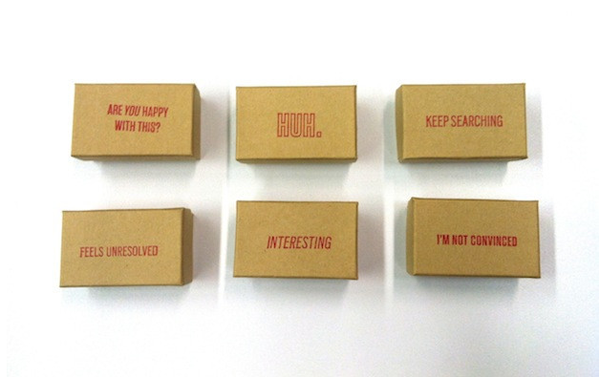
Stamps of Disapproval, by Heather K. Phillips/Schooled

For the Critique Leader/Art School Program Director: Stamps of Disapproval

Okay, it’s not a book (but it is text) and it’s not really advice (unless “I’m not convinced” counts), but this set of six stamps is a great gift for anyone who has anything to do with art—they’re easily presented to everyone from your Art History T.A. to your pal the freelance graphic designer. If you don’t already have someone in mind for these babies, they’re cheap enough to keep on hand in case you are ensnared in one of those last-second gifting situations: Oh, you got me a gift? Well, here’s something for you.

Guillermo Gómez-Peña, co-author (with Roberto Sifuentes) of Exercises for Rebel Artists: Radical Performance Pedagogy

For the Budding Performance Artist or Instructor: Exercises for Rebel Artists: Radical Performance Pedagogy

Here’s another slim volume chock-a-block with fun and exciting things to do. Though it is specifically about performance, I found some of the information adaptable to other kinds of classroom settings where you need to get people moving and thinking—or when you just need to shake things up. Written by long-term practitioners Guillermo Gómez-Peña and Roberto Sifuentes, this book is replete with honest, playful advice for artists and it walks the reader through a series of step-by-step exercises that create public spectacles, circumvent convention, and question all kinds of borders and boundaries.

For the Aspiring Gallerist: How to Start and Run a Commercial Art Gallery

Godblessum, that Edward Winkleman. Not only does he write a blog that offers advice to artists (and contributed to this column), but he’s also penned an in-depth look at what it takes to found and maintain a successful art gallery. From writing a business plan to finding and renovating a space to promoting the gallery and representing artists, Edward has you covered. If you’re thinking about opening a gallery, don’t miss out on his hard-earned wisdom.

Read More »

Share

From the Archives

Shoot ‘em Up

I think it is safe to say that every person will experiece violence in various ways. Some fortunate people only ever encounter it indirectly, through popular culture and media, while others live through it every day. Today from the DS Archives we bring you two interactions with violence. In Shoot! Existential Photography, the current exhibition at The Photographers’ Gallery in London, photographers playfully examine the correlations between shooting a camera and shooting a gun. The following article features an essay by the Mexican-American artist and writer Robert Gomez and was republished in light of the escalation in Mexican cartel violence at the time.

#Hashtags: Narco-Violence and Ritual Sacrifice was originally published on October 11, 2011 by :

 The discovery Sunday of 49 mutilated bodies on a highway near Monterrey, Mexico, brings this month’s total to almost a hundred.  Analysts speculate that the ramp up has to do with turf wars between the Zeta and Sinaloa cartels, and that the victims were probably not affiliated with either gang, but chosen at random, perhaps even from migrant populations. Critics call the violences “irrational” and “mindless,” but we found ourselves convinced by Gomez’s argument that such violent public spectacles have a much longer lineage.

Please be aware that this article contains graphic representations of violence.  The author and the editors of the site would like to make clear that we are not interested in exploiting the sensational qualities of these images, but rather in their complex social roles.

"Two Flayed Men Appear in Tepic," a screen shot from Blog del Narco, 2011. Website and Digital Video. Image Slightly Blurred by Author.

Read More »

Share

Hashtags

#museumpractices: The Museum on My Mind, Part IV

Wall labels. Curatorial text. Titles (or un-titles, as the case may be). At what point do the words surrounding an artwork serve the work, and at what point do they disrupt it? This week #Hashtags wraps up Rob Mark’s “The Museum On My Mind,” a meditation on the role of museum commentary and what it means to “know” a piece of art. For refreshers, see Parts I, II, and III.

Part IV: Play is the thing

Can a museum nurture struggle, channeling it toward expression, rather than relieve struggle, channeling it toward resolution? It can, perhaps, if it acknowledges that the artwork, rather than its commentary, is the most able narrator, producing a text that both incubates and channels struggle. Can the museum tolerate an object naked of its label? It can if it is willing to recognize the visitor’s capacity to guide him or herself, to collaborate with the artwork to devise his or her own narrative. What might draw a person to an artwork stripped of its commentary? A museum that seeks to transform habitual museum behaviors into a playful struggle, and commentary into engaged community.

Installation Image, About Face (May 23 – February 28, 2013), Courtesy Pier 24 Photography. Image credit Tom O’Connor. Pier 24 posts no gallery text or wall labels.

Resonance and Wonder

Cultural historian Stephen Greenblatt identifies two experiences—“resonance” and “wonder”—that can arise in the museum. Resonance—“the power of the displayed object […] to evoke in the viewer the complex dynamic cultural force from which it has emerged”[1]—reflects the meaning of an object in its time and place, the making of the object and its meaning to its maker. No longer does the object fit in my hand or appear on my wall without the sense of how it might have fit in another person’s hand or hung on another person’s wall. It is equally important, however, to conceive the object’s meaning independent of its context, which is, in a sense, the meaning Greenblatt applies to wonder: “the power . . . to stop the viewer in his or her tracks, [and] to evoke exalted attention.”[1] Wonder can tell us something too, but this something often dissolves when the museum seek to reclaims context.

To what extent is wonder a necessary condition for resonance, just as it is the necessary invitation to struggle? To what extent does wonder, itself, achieve its own sort of resonance? The museum acknowledges the social, political and art history of the object, the encrustation of the experiences that molded and patinated it. Yet it arbitrarily—if unintentionally—signals the end of that accumulation with the object’s installation in the exhibition, signing that finale with an explanatory label. Art starts as a connection beyond the artist’s self, but it—and its context—extends not only to the visitor, but to others in the visitor’s life, both in the moment and on into future. Art that inspires wonder also inspires the desire—even the demand—to share that wonder. Wonder, like resonance, also resonates. This experience, marked by the desire to share, is substantial and enduring; the nonresonant one is impermanent, even superficial. What endures is what remains dynamic—not static: insight that comes out of experience, out of a struggle to comprehend.

How to Behave in a Museum

Follow me into a typical exhibition of paintings or photographs. A large wall plaque tells the story of the exhibition, the story that motivates the curator. Hanging at eye level are the artworks, each piece equidistant from its neighbors, each attended by a small label. Some labels continue the narrative of the opening wall plaque.[2]

The momentum of the crowd in front of Paolo Veronese’s “The Wedding at Cana” (1563). Collection of the Musée du Louvre, Paris. Photograph by Sonia Calzà, 2008. Image courtesy of Creative Commons/Flickr.

A line of people hugs the walls of the gallery. Its one-way momentum is relentless, ruled by some culturally determined number of seconds in front of each piece—and each label. This community standard also impels each visitor to surrender the primary viewing space to the next visitor. Even with audio-, smartphone-, or ipod-tours, technological alternatives that might free visitors from the physical label, the experience remains linearly structured and cognitively skewed. This practice of traveling sequentially, as if on a conveyor belt wending around a gallery’s perimeter, label by label, seems to derive from the expectation—concretized over generations into unconscious visitor habit—that every one of the (many) words and every one of the (too) many objects on display is worthy of attention and necessary to the exhibition’s story.

Read More »

Share