Best of 2012 – You Go Crazy

At the end of each year, we ask our group of over 30 international contributors to dig deep into DailyServing’s content and tell us what is on their list of favorites for the year. Over the next 10 days, we are going to publish those selections as DailyServing’s Best of 2012.

We are pleased to begin our Best of 2012 with a piece from the L.A. Expanded column written by long-time DailyServing contributor, Catherine Wagley. Catherine has written for DS since 2006, and contributed weekly with the L.A. Expanded column since January of 2010. As the column reaches its full three year anniversary we are sad to say that 2012 marks the end of L.A. Expanded. However, we are happy to see Catherine continue her writing practice through various national publications, and an occasional contribution to to DailyServing. Catherine has added an immense wealth of content to our site – 223 original articles to be exact – and for that, we are forever grateful.

Today we bring you two articles from the L.A. Expanded column in 2012, You Go Crazy and Seductresses at Family Dinners, selected by Catlin Moore.

“Catherine is just a master at weaving together the topical, sociopolitical, and personal while extrapolating the major themes of her subject with amazing clarity. These two articles are  perfect examples of that skill.” -Catlin Moore

——————————————————–

L.A. Expanded: Notes from the West Coast
A column by Catherine Wagley
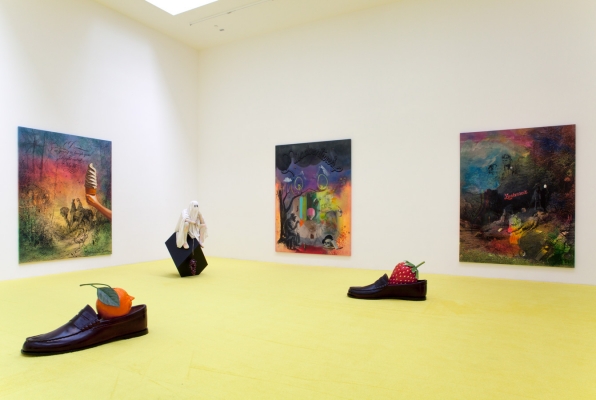
Installation view of Friedrich Kunath's show at Blume & Poe. Courtesy the artist and Blum & Poe.

I was slapped by a child named Sam who must have been 4 years old the last time I visited Friederich Kunath’s show Lacan’s Haircut at Blum & Poe. Sam was playing with his sister on the bright yellow carpet in the first gallery — each subsequent gallery has bright carpet too, orange then red. He had been fondling one of the oversize oranges with squinty eyes and pointy nose when we locked eyes. Then, after a pause, he sort of sashayed over and slapped me on the hand. It didn’t hurt, but it wasn’t gentle either.

A woman who wasn’t his mother called him over in that too sweet I-have-something-serious-to-say-but-don’t-know-how-to-talk-to-children voice. So I thought she had seen what just went down, but, probably, she hadn’t because what she said was, “I just want to congratulate you, Sam. I saw you looking at that painting over there and most children wouldn’t be able to do that for that long without touching it. I was impressed by how cultured you are.” I thought, better to touch a painting than randomly hit people, and since when does repressing tactile urges make you “cultured”?

Friedrich Kunath, "You Go Your Way and I'll Go Crazy," 2012, Digital video. Courtesy the artist and Blum and Poe.

The Kunath show, oversaturated in the best way, has sculptures of big enamel and resin loafers as well as the oversized fruit, and old-fashioned rendering of bearded men sleeping under trees or explorers on horseback sharing canvas space with cartoon characters and psychedelically colored polygons. In the back video gallery, You Go Your Way, and I’ll Go Crazy plays. It’s a video in which a tall guy who looks like a slightly glamorized version of South African writer J.M. Coetzee works in his studio, fondling the oranges just like Sam did, talking on a rotary phone that’s not plugged in to anything, wading into a pool fully clothed, standing nude over the San Gabriel Mountains, hitting tennis balls against some of the paintings that are in the exhibition. It’s insane, but in a smooth and subdued way, which is why being slapped by a preschooler while perusing this show felt kind of like par for the course.

I left at the exact same moment Sam, strapped into a car-seat, was pulling away, riding in a station wagon. We locked eyes again – I swear – and he waved.

Lucio Fontana, Concetto spaziale, Attese 58 T 2 (Spatial Concept, Expectation 58 T 2), 1958.

A few days later, at the opening of MOCA’s Destroy the Picture, I was backing away to get a better view of  a painting by Lucio Fontana, when I backed right into a regal older woman with soft hands. I know about her hands, because when I apologized, she grabbed my hand and squeezed, and said, “No, I’m sorry.” I like this, actually, the random physical contact while art-looking trend. It intensifies the whole experience, and an occasional slap might be worth it.


Share

Best of 2012 – Seductresses at Family Dinners

L.A. Expanded: Notes from the West Coast
A column by Catherine Wagley

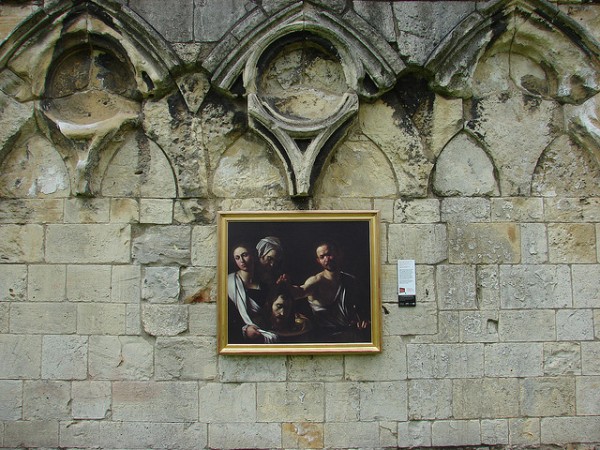
Michelangelo Merisi da Caravaggio, Salome Receives the Head of St. John the Baptist, c. 1609–1610, National Gallery, London, England, photo © 2012 The National Gallery, London

Thanksgiving is not the time of year you realize you disagree with the people you love, but it often is the time you suddenly decide you want to pick the fights you’d usually avoid. My sister called yesterday from Washington, where she was with one branch of the family. She described a dinner conversation in which most people at the table agreed: surrogate motherhood was, essentially, a form of human trafficking.  “I thought, good thing Catherine isn’t here,” Martha told me.

In Atlanta, where I am with another family branch, talk about Petraeus and his “frumpy” wife Holly – thankfully, the friend-of-family who used that word did acknowledge “frumpiness” does not excuse infidelity – led into the conversation I’m sure families the country over were having: was the CIA chief’s affair Paula’s (his mistress’s) fault or the general’s? We were split down the middle: half believed unwaveringly that Paula Broadwell was an ambitious seductress, and the rest of us were just appalled that the other half could really think the way they did. My grandmother, who was not on my side of the argument, said on the drive home, “Well, it will be interesting to see how your opinion changes as you have more experiences with men.” What did that mean? As I got older, I would come to realize that men have no agency in the face of seduction?

Caravaggio's Salome Receives the Head of St John the Baptist hanging at St. Mary's Abbey

I thought about all that – men, agency, war and seduction – when seeing Caravaggio: Bodies and Shadows the week it opened at the Los Angeles County Museum of Art. The show includes work by the ever-dramatic 16th century painter Caravaggio and by artists he either trained or influenced.  There are a few paintings of classic historical seductions in the show, or, rather of the spoils of seduction. One is Caravaggio’s own Salome Receives the Head of St. John the Baptist. In it Salome, the girl who danced so beautifully for King Herod that he promised her anything she wanted and who asked for St. John’s head because her mother told her to, holds John’s head on a platter. She looks uncomfortably, sadly away. The whole image is dark: blackness in the background, dark shadows across the left sides of the faces of Salome and the two men with her. It’s also awkward. The man brandishing a sword hold John’s head out toward the platter Salome is holding, his arm cutting across the frame. Another man lurks in the background. No one makes eye contact with anyone else. Even St. John, though dead, seems to be averting his eyes.

The “Salome” entry in Wikipedia says “Christian traditions depict her as an icon of dangerous female seductiveness,” and in my experience they do, but the politics of that situation would have been awful for everyone. Salome, as far as I know, had nothing personal against John. The girl had just gotten in over her head, and somehow ended up with some power over a man with more power than most people alive  dream of having.  Herod, according to the Gospel of Mark, had no plan to execute John the Baptist, but he hadn’t really considered the stakes when he’d given so much leverage to Salome, and now he had made a promise and how could he backpedal? “And the king was struck sad: yet because of his oath, and for them that sat with him at table, he commanded  [the head]  to be given,” writes Mark.

This, I imagine, is how most tragic seductions have gone down since the beginning of time, Paula’s and Petraeus’ being no exception. They’re unwieldy and everyone’s fault and embarrassing in the aftermath. Caravaggio’s Salome is all that, but I’m not sure bringing it up at dinner would have made an ounce of difference.

Share

Hashtags

Reading the Internet with Joan Jonas: The Task of the Cultural Critic in the Ambient Age

#Hashtags provides a platform for longer reconsiderations of artworks and art practices outside of the review format and in new contexts. This week we’re excited to announce that contributor Kristi McGuire is a Headlands Center for the Arts resident for 2013. Check out her post, “Reading the Internet with Joan Jonas: The Task of the Cultural Critic in the Ambient Age.”

Stock image photograph produced by Google image-search for “stock photography.”

I once thought that I could summon the ambient act of reading on the Internet as part of a singular project of prognostication: using those noisy images (stock photographs, Google image-searches, self-portraits uploaded to social networks) and polyvocal chatter as the agents and conduit of a new kind of meaning-making within language. Cassandra the soothsayer, her ear turned to the imaginary cracklings of Alexander Graham Bell’s phonautograph[1]—and why not? Cassandra is long dead and unreal herself, and now, many epochs after her myth rose to prominence, the metaphorical snakes are no longer licking anyone’s ears clean.

But truth be told, or soothsaid: the ambient isn’t a space that exists in the realm of the falsely prophetic or within other concurrent delays with real time (nostalgia, the future imperfect and conditional tenses). Instead, conveniently in line with its etymological origins (ambient, adj. “turning round, resolving”), the ambient works quite literally with units of time as we’ve come to experience them in the twenty-first century—minutes, seconds, the fraction of a fraction-of-a-moment it takes to follow a plot line on the flickering screen: we’re barely able to enunciate the word “Drake” before we’ve seen Twitter feed Drizzy saturated with the banal and disembodied static of the everyday (what Ben Lerner appropriates from John Ashbery in Leaving the Atocha Station as “life’s white machine”):

Screengrab of Aubrey Drake Graham’s (aka Drake’s) Twitter feed, March 26, 2012.

For writer Tan Lin, boredom is the threshold of the ambient, the place where a work is “born out of our mutual dis-interest”[2] and where “anyone who has ever read a painting will tell you [like Ed Ruscha], paintings, like poems, are most beautiful [and least egotistical] . . . at the exact moment in which they are forgotten, like disco.”[3]

Ed Ruscha, “Pay Nothing Until April,” 2003, acrylic on canvas, 1527 x 1525 x 40 mm. Collection of the Tate, Britain .

Read More »

Share

San Francisco

Fabricators: Blurring the Insider/ Outsider Boundary

Artwork by Creativity Explored Artist Natalie Spring

There have been many times when I have felt uneasy looking at group shows of “Outsider Art”. There can be some crowds, and lots of things for sale, and a lot of people buying them, but mostly what can cause apprehension as a viewer is the wild range in the work. Often there is no thematic or formal thread that could tie all of these art objects together. In fact, often the only reason these objects are in the same room is because they were all made by artists who happened to have a disability. Maybe they all work in the same studio or maybe they have chosen to engage in the “Outsider Art” category and its many variations in some way or another.  What groups their practices together regardless is their societal identity and diagnosis. Of course any art historical category, particularly identity-based ones, will have its baggage: issues, assumptions, or expectations that a viewer needs to navigate in the hopes of seeing the work with some kind of critical autonomy despite the sticky narratives and mythologies of its classification. This issue is amplified in the Outsider category because of its rapid growth, popularity, and mounting commercial pressures to expand. Complex, unresolved questions remain despite the fiscal success: Do the labels insider/outsider mean anything anymore? Is this field permanently tied up with simplified or even dangerous stereotypes of mental illness and genius? Does the work get serious consideration in this context? Can we ever untangle appreciation of the work from our knowledge of the artist’s biography?

Artists in the Creativity Explored Studios in San Francisco

All of these issues have clouded many of my interactions with Outsider Art, yet I have remained hopeful for a strategy that could work to clear away the residue of exploitation and homogenization of artists with disabilities, while also not endangering their careers and livelihoods. The show Fabricators, curated by Glen Helfand and currently on view at The Jack Fischer Gallery in San Francisco, is an example of how a thoughtful curatorial framework can actually help to untangle works of art from their categories’ fraught histories.  The show itself is the culmination of a semester long collaboration between teams of students from California College of the Arts and artists from the studio Creativity Explored, an organization committed to providing artists with disabilities space to make and exhibit their work.

Read More »

Share

Elsewhere

Where Images Fail: Newton, Connecticut

Editors note:
“Where Images Fail: Newton, Connecticut” explores the inability of images to accurately explain the tradgedy and greif afflicted by mass shootings. As a result, we have decided to remove all images from today’s article.

****

In one picture, a teenaged girl holds a phone to her ear. Her free hand clutches her chest. She’s alone in a parking lot on a sunny day. The look on her face is one of immense terror and grief, as though she were screaming into the phone, not speaking. Her eyes are pressed tight and her mouth is open, exposing all her teeth. Her entire face looks wet.

In another image, a fresh-faced but grim firefighter dominates the left half of the picture. Behind him, more firefighters: not the burly action-hero types, but more like the small town volunteers who also have day jobs. On the right, we see a couple, perhaps in their late 20’s. The man has his arm around the woman. He wears a blue t-shirt and a thousand yard stare. She is lost in a moment of intense emotion, her hand covering one eye as she cries. Everyone seems to be stunned, walking toward the camera with little sense of real purpose.

Several other pictures depict faces melting in a wash of sorrow and panic. Or adults clutching small children. Or bands of people clustered in a group embrace. Or concerned police standing around with little to do. Or people of all ages frantically running from right to left.

On Friday morning, a heavily armed 24-year-old man walked into a school in Newton, Connecticut and killed 28 people, including 20 elementary aged children, his own mother, and himself. Reports of yet another mass killing – one more in a year that’s already brought shootings at a movie theater in Aurora, CO, a Sikh temple in Oak Creek, WI, a coffee shop in Seattle, WA, and a sign making company in Minneapolis, MN – renewed America’s sense of collective grief as images and stories of the latest tragedy swept the national news and social media.

Unlike images of burning towers from 9/11 or naked human-pyramids and laughing soldiers from Abu Ghraib prison, these shootings, devastating as they are, rarely leave behind indelible images that sear the national memory. Though the emotional impact of these types of images is acute in the immediate wake of a recent tragedy, they seem to have very little staying power. The fact that guns were turned on an outrageously high number of very young children is particularly horrifying and incomprehensible. Yet, in large part the images from Connecticut are virtually interchangeable with the images of grief from the year’s prior shootings (with the notable exception of the Sikh temple, which didn’t garner nearly the amount of attention and soul searching that shootings in white suburban areas often do).

Maybe that is because these things keep happening and we’ve seen it too many times for there to be any visual difference. Or maybe it is because the impact of these images is overwhelmed by the subsequent media spectacle surrounding the identities of the killers no one seems to understand, even as every detail of their lives becomes a point of fascination. Perhaps it is because the reality of these types of stories is so painful that the country would rather banish these images from our minds until the next catastrophe forces us to look again and wonder “Why?” Perhaps it’s because so little has changed in public policy since April 20th, 1999, when two gunmen went on a killing spree at Columbine High School in Littleton, CO.

As Susan Sontag wrote in her book Regarding the Pain of Others, the majority of us view these images at a distance and feel sympathy for the victims and families pictured. More so, “Even if they are only tokens, and cannot possibly encompass most of the reality to which they refer, they still perform a vital function. The images say: This is what human beings are capable of doing – may volunteer to do, enthusiastically, self-righteously. Don’t forget” (115). Yet, these images can only provide us with so much. They tell us what evil looks like, but “To designate hell is not, of course, to tell us anything about how to extract people from that hell, how to moderate hell’s flames” (Sontag 114).

The images of grief and terror from Newton will not explain the tragedy for us. They cannot think or act in our place. They will not change gun laws to reflect the real needs of contemporary American society. They will not change the culture of violence and humiliation that inspires white men – and the killers are almost always white men – to murder their mothers, classmates, co-workers, and then everyone else within bullet range. And they certainly won’t tame the media spectacle that salivates over the deaths of 28 people, and turns mass murderers into outrageously famous individuals. As more shootings happen, they are hardly even capable of helping us remember. These images can show us a moment in hell, but other than that they are a failure. A failure, that is, unless they challenge us to actively find the answers, with honesty, conviction, and a true sense of urgency, to the questions they inspire us to ask.

Share

Help Desk

Help Desk: Internship Woes

Help Desk is an arts-advice column that demystifies practices for artists, writers, curators, collectors, patrons, and the general public. Submit your questions anonymously here. All submissions become the property of Daily Serving. Help Desk is co-sponsored by KQED.org.

In general, blog writing is a tricky area in terms of authorship. I wrote the blog for a gallery for over six months without having my name attached. The blog did very well and was picked up on by a local magazine that asked the gallery owner to contribute a regular guest column for their publication. Unbeknownst to them, the blog was written by me, the intern. I proceeded to plan and outline the next six months of art-related subject matter with the pretext that I would be getting paid as my internship was completed. After the internship had ended, I wrote three posts for the gallery’s blog before the owner told me it was no longer in his budget.

I was never paid for those entries and my ideas continue to be used thereafter. As interns I realize that we must be willing to work without pay and cannot expect full agency in the work we do without a real job title. Still, I am wondering how you would suggest interns find a balance here? Where do we draw the line on our unpaid time and efforts while aspiring to get recognition for the work that we do?

Yoyoi Kusama, Dots Obsession, 1999. Mixed media, Collection Les Abattoirs,Toulouse

I talked to Jonathan Melber, the co-author of ART/WORK, about your dilemma. He had a few thoughts about your predicament: first, in terms of authorship of a blog, “If you write it, then it’s your intellectual property unless you’ve granted it to someone else in writing, for example in the blog owner’s terms of service or in a gallery’s employment agreement.” Second, “You can still ask to get proper credit for this work. Maybe you can get them to add a byline, or get permission to link to it, or to list it on your resume.” Mr. Melber recommended that you talk with the gallery owner to see if you can get credit for the blog; and, if you manage to obtain that acknowledgement, then talk to the editors at the magazine about retroactive credit there. He also pointed out, “Of course, you could threaten a lawsuit which might result in the gallerist having to take the blog entries down, but the repercussions are probably not worth it,” so think long and hard before you travel that route—lawsuits are ugly and expensive. If you have no luck with the gallery owner (and you didn’t hear it from me), there’s a blog called How’s My Dealing? where artists vent anonymously about how galleries have treated them. At least you’d have your revenge.

Beyond the problem of this particular gallery internship, let’s talk about working without pay and the notions of agency and effort, as you do in the second part of your letter. What is an internship for? Ideally, you receive on-the-job training (essentially, an education) and your employer receives a helping hand (of sorts). As with any educational or business agreement, there should be a contract that outlines responsibilities and expectations—for you both. Now, having said that—and acknowledging the massive imbalance of power in traditional internship situations—let me say that in the cases where no contract is forthcoming you should at least have a conversation about your role and the benefits that your work will have for both the company/gallery and your professional life. Take notes! Ask specific questions about the duties you will be asked to perform. Do interns ever fill in for a sick receptionist? Will you be expected to clean up after openings? And for what, if anything, can you expect to take credit when you leave? Put your cards on the table and expect your internship mentor to do the same. If you want training for the “real world” then this is definitely it, so don’t be shy.

Yayoi Kusama, Infinity Mirrored Room – Filled with the Brilliance of Life, 2011. Installation, Tate Britain

It’s important to point out that the popular idea of an internship—from the employer’s perspective, at least—wherein a bunch of lackeys fetch coffee and write blog posts and clean toilets for free, is actually against the law. For gallerists who want to take on interns, attorney Katy Carrier has some excellent advice at her Law for Creatives blog: “Interns can be a great asset to your business, but it’s important that you understand the restrictions and restraints imposed by the government on the hiring of interns. …[I]t is very hard for a for-profit employer to meet the requirements necessary to engage unpaid interns.” Or, as Jonathan Melber puts it, “If there is no pay, then it needs to be educational. An internship is not an end run around minimum wage.” While I agree that this can be hard on both small business owners and hopeful future interns (and me: I was looking forward to finding some unpaid winged monkeys to do my evil bidding in 2013), the fact remains that the federal government defines unpaid internships in part on the premise that, “The employer that provides the training derives no immediate advantage from the activities of the trainee, and on occasion the employer’s operations may actually be impeded.” In short, if your work as an unpaid intern is of material benefit to the company, then it’s probably not a legal internship. Whoops! That sound you hear is my winged monkeys flying away.

Of course, the legalities of internships mean very little to both the employers who derive major benefits from unpaid labor and to entry-level workers who hope to gain experience and contacts that will help them with their careers. The best you can hope for if you stay on this path, it seems, is to intern with someone who won’t take advantage of you too much, which is perhaps the saddest advice that I have yet typed for this column.

There’s some further reading for both future interns and their potential mentors here:
At the Stanford Fair Use Center: Copyright Ownership: Who Owns What?

At The Law For Creatives blog: Do You Own the Rights to Works Created by Your Workers?

An excerpt from the 2012 book Intern Nation: How to Earn Nothing and Learn Little in the Brave New Economy

At the New York Times: Former Intern Sues Hearst Over Unpaid Work and Hopes to Create a Class Action

At The Atlantic: Unpaid Internships: Bad for Students, Bad for Workers, Bad for Society

Good luck!

Share

From the Archives

From the DS Archives: Christian Marclay

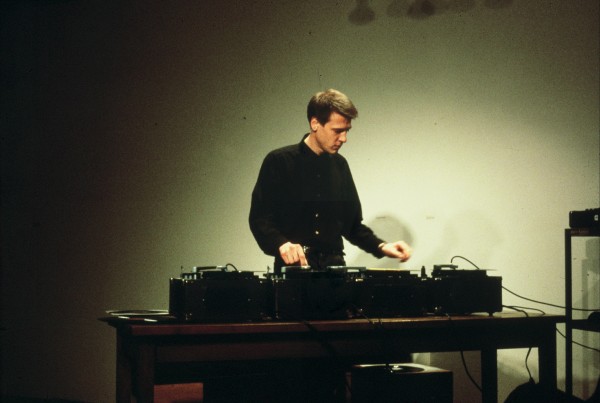
Christian Marclay has been blurring the boundaries between art, video, and sound for decades. His seminal video piece The Clock (2010) begins its tour at The Museum of Modern Art on December 21st. Can’t make it to New York? No problem! The Clock will also be on view at SFMoMA Spring 2013.

The following article was originally posted on June 29, 2010 by :

This week, the Christian Marclay: Festival will open at the Whitney Museum of American Art in New York City. The exhibition celebrates many of the artist’s graphic scores for performance and will take the form of multiple daily performances by individual musicians and vocalists. The Whitney has pulled together some of country’s finest Avant-garde musicians to play more than a dozen of Marclay’s scores dated from 1985 to 2010. Some of the works to be performed include, ChalkBoard (2010), Covers (2007-10) and Screen Play (2005). Many of the pieces take the form of a physical art object produced from videos, photographs, found images, and readymade objects which are intended to elicit a musical response from the performers. Read More »

Share