Hashtags

#loveletter

#Hashtags provides a platform for longer reconsiderations of artworks and art practices outside of the review format and in new contexts. Please send queries and/or ideas for future to hashtags@dailyserving.com.
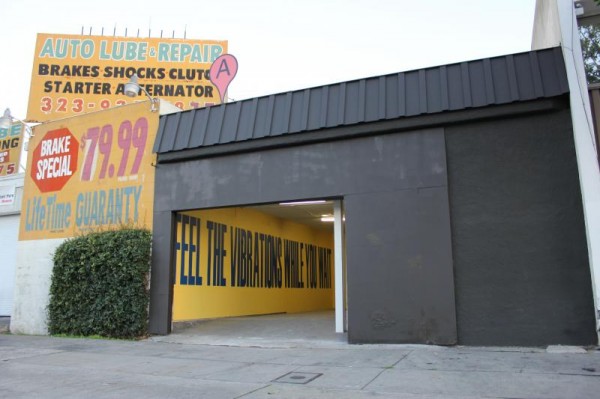
Exterior view of "Fast Service While You Wait" at Venice 6114. Image copyright Venice 6114.

‘From work to event. We are the mould, it’s up to you to breathe substance into it’

I’ll admit it, I’ve been bored when it comes to art lately. Too many shows with too much text (either on the labels, in the press release, or as part of the artist’s statment)—and I’m too aware of the narrative, too aware of climax and dénouement for the opening lines of the first paragraph to do their job and draw me in.

While I’ve seen a few good shows, I’ve seen a greater number of indistinguishable ones. My current viewing routine has calcified to the point that I’m usually in and out of a medium-sized gallery in under five minutes, and sometimes even under one. I’m not bragging. I am full of reticence and pain from past shows that led me on, suspicious as to art’s motives.

Last night, however, the first big night back for Los Angeles after the holidays, the New Year, and the winter blahs, I found new hope. It started with Judith Bernstein, Carolee Schneemann, and Barbara Smith, all speakers on a panel about painting at the Box Gallery in downtown Los Angeles. Each woman told the story of her entrance into the field, and for each woman, the lack of female colleagues and a excessively (if not repressively) masculine mise en scène featured heavily. I know things are far from perfect when it comes to gender equality in the arts circa 2013, but I believe that when female artists from today sit on tomorrow’s panels, issues of gender will not automatically be the first thing to emanate from each and every set of lips.
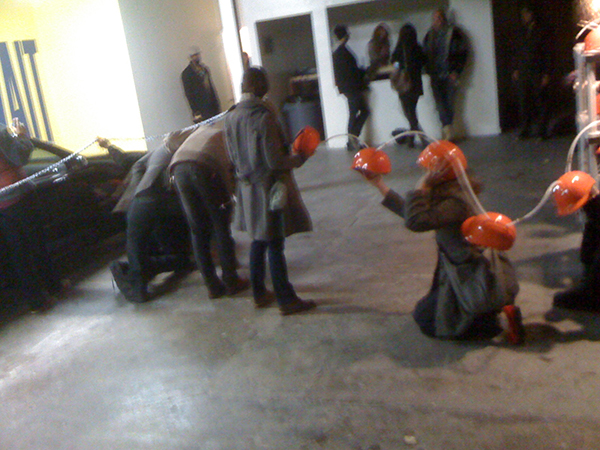
Tyler Calkin, Sarah Petersen, and Adam Peña, "Fast Service While You Wait," 2013.

Mixed in with Bernstein, Schneemann, and Smith were a few of their male counterparts, including Paul McCarthy, who raised my spirits for a different reason. As he describe moving from burning early works to painting with his body, he made it clear that his choices weren’t “from an understanding of historical continuation,” but from the kind of thoughts that come when one is invested in a medium, like “well, what next…should I use my shit to paint?” McCarthy’s candid and humor-laden discussion of the role of instinct and materiality in an artist’s decision process caught me off guard and gave me great satisfaction.

McCarthy’s comments about burning his paintings to find true black also set up my drive west along the 10 freeway, where the bulk of the evening’s openings were. In the sky was the smallest crescent of a silver moon, but the rest of the moon was there, too, a perfect, light black circle against the deeper, velvet black of the rest of the night sky. The moon stayed with me until Culver City, where I lost my ability to stargaze due to the press of bodies demanding my attention on the ground.
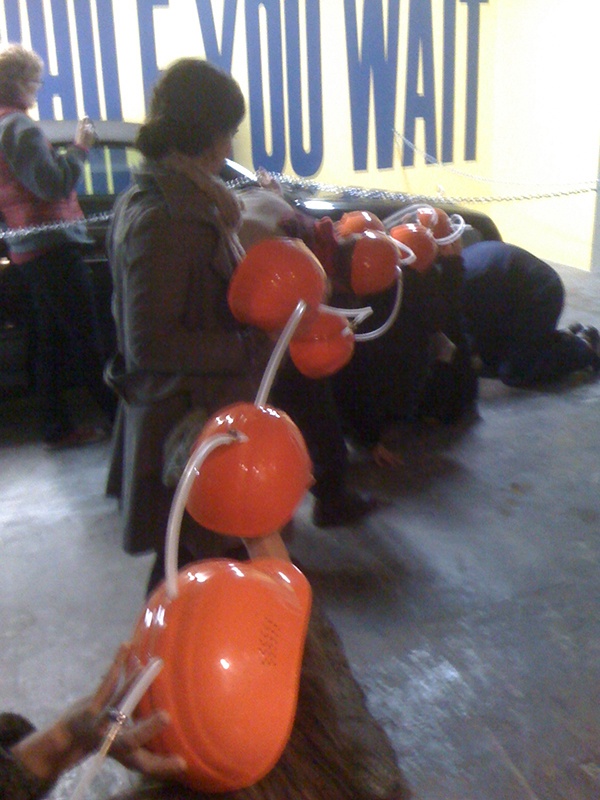
Tyler Calkin, Sarah Petersen, and Adam Peña, "Fast Service While You Wait," 2013.

The shows this month offer a little bit of everything, from painting and sculpture to photography. I stuck to my one- to five-minute routine, for the most part, stopping longer in some spaces, like Kim Fisher’s show at International Art Objects and Bernard Piffaretti at Cherry + Martin, and mentally marking others for return. But instead of feeling let down and disappointed, I was beginning to feel invested again.

The last stop was Venice 6114, a former auto repair shop turned into a gallery/project space, organized by artist Sergio Bromberg. The large door to the main part of the old shop was missing; anyone who walked by could see inside. The phrase “Feel the vibrations while you wait” was painted in huge blue letters against a bright yellow wall. An area was set aside for cars, and artist Tyler Calkin (who co-created the piece with Sarah Petersen and Adam Peña) explained to me that the project’s main point was to offer a very personalized form of tire inflation: Calkin et al had equipped a slew of orange construction hats with plastic tubing, with each hat able to connect to the others. When a car came in, the hats went on, and the person nearest the wall connected the entire chain to the facility’s compressor.

Called “Fast Service While You Wait,” the inflation wasn’t particularly fast, or even one hundred percent effective. Rather, it was a way of grouping strangers, connecting them with what Lygia Clark once called “relational objects,” asking them to investigate the areas where we all overlap and “meet in the world.” It was clunky, but well-intended, and in the end it helped me (in combination with the panel discussion earlier) to re-engage with buried thoughts on art and the arts community. Definitely imperfect, oft times disappointing, but when you know where to look, so earnestly invested in challenging and inspiring that I keep coming back to it.

In 2006, the Musée des Beaux-Arts held a Lygia Clark exhibit entitled “From work to event. We are the mould, it’s up to you to breathe substance into it.” Sometimes things are plotted and reasoned, other times accidental, but regardless, it’s the job of the arts writer, of the artist, of the viewer and participant, to breathe that substance into whatever we identify “it” to be. With passion, people.

Share

From the Archives

Social (Practice) Skills

Have you ever tried explaining Social Practice to someone? It’s basically impossible. It seems I’m always confronted with the response: “wait…so how is that art?” As a relatively new discipline, the study and act of Social Practice is still developing its place in the art world. Still, despite its jeunesse, Social Practice has caused quite a stir and continues to do so in the form of courses, symposia and the investigations of contemporary artists. Today from the DS Archives we look at the Open Engagement Conference at Portland State University as well as Engagement Party: Social Practice at MOCA, 2008–2010, MOCA’s recent publication on the subject.

The following article was originally published on May 19, 2011 by :

Fritz Haeg lecture, photo by John Muse

Last week the Open Engagement Conference gathered artists, critics, curators and one museum director to discuss an emergent field, Art and Social Practice. It was organized by Portland State University’s Art and Social Practice faculty Jen Delos Reyes and Harrell Fletcher along with their MFA students. This is the third iteration of the conference and it featured Julie Ault, Fritz Haeg, and Pablo Helguera – all of whom work across platforms such as art, architecture, education, curatorial practice and publication. Read More »

Share

Interviews

Mark Landis: Father Philanthropy

Today’s feature is brought to you from our friends, the online interview magazine, The Avant/Garde Diaries. The following is a video interview with master art forger, Father Philanthropist, Mark Landis.

Standing next to 57-year-old Mississippi native Mark Landis in the watercolors aisle of a local art store, the words “master art forger” are the least likely to come to mind. Bald, stooped, and slight of voice, Landis looks more the part of a paint-by-the-numbers hobbyist. And yet for the better part of thirty years, this unassuming figure managed to dupe nearly fifty art institutions in over twenty states into accepting forged art works. Many still don’t know they’ve been tricked. Referring to himself strictly as a philanthropist, Landis never profited from this particular compulsion since he always “donated” the works in honor of his deceased parents or a distant relative. His ruse was also abetted by the unassuming appearance of the man himself – which he habitually refined by dressing as a Jesuit priest.

By the mid-2000s, Landis had set up a veritable assembly-line production of forgeries that he created from the comfort of his dim bedroom. In a process that was, no pun intended, deceivingly simple, Landis picked a painting from a museum catalog, made a color copy at an office supply store, affixed it to a small piece of wood, and then drew over it with a mixture of color pencils, paint, and even magic marker. While large institutions usually sniff out such forgeries in seconds, Landis donated to small, regional museums that usually accept such at face value. His works are often copies of little known, nineteenth-century American impressionists, and why on Earth would someone make fakes of such a thing? He is clearly not your average high-stakes forger, which is exactly the kind of cover he thrived upon.

The life and journey of Mark Landis is one of the weirder tales that The Avant/Garde Diaries has profiled, and yet it is also one of the most intriguing. A Rain Man-esque character, Landis might not have the most calibrated moral barometer, but through a singularly bizarre creative will and a notable penchant for theatrics, he will likely be remembered more than the iconic painters he made a career of forging.

Share

San Francisco

Jay DeFeo: Spatial Relations

If you back your way into the Jay DeFeo exhibition at San Francisco Museum of Modern Art, you’ll discover, as I did, a group of five oil paintings in the final gallery. The works are small by today’s standards of monumentality and smaller still by the standards of DeFeo’s most famous work, The Rose. The Rose, occupying its own alcove earlier in the show, is large in every way, even by today’s standards of audacity. Its 2,300 pounds of paint not only expand into three spatial dimensions—its depth measurable in inches and mappable as a topography of hill and valley—but also inflate to a fourth dimension: time, the eight years DeFeo took to create the work.

Left: Burt Glinn, Jay DeFeo working on The Rose, 1960; © 2012; photo: Burt Glinn/Magnum; Right: Jay DeFeo, The Rose, 1958–66; oil with wood and mica on canvas; 128 7/8 x 92 1/4 x 11 in.; Whitney Museum of American Art, New York; gift of The Jay DeFeo Trust, Berkeley, CA, and purchase with funds from the Contemporary Painting and Sculpture Committee and the Judith Rothschild Foundation 95.170; © 2012 The Jay DeFeo Trust / Artists Rights Society, New York, photo: Ben Blackwell

The paintings in the final gallery were all created in 1989—the year of the last big San Francisco earthquake and the year DeFeo died of lung cancer. The earthquake gave no notice of its imminence, but the intimacy of these paintings, their seeming modesty, might be interpreted to represent DeFeo’s attempt to contain the uncertainty of the time, an attempt to ground herself in an ungrounded world.[1] But for me the paintings demonstrate something very different—something that might be said to characterize all of DeFeo’s work.

DeFeo is a master of scale. Her works pack the monumentality we usually associate only with the physically enormous into immense and modest spaces alike. Dove One, which seems to present a dying dove—its eye, its breast, its ruffled wing—is also an immense landscape: a desert void, from which black, white, and gray emerge, first calmly and then with increasing frenzy. If the dove seems to be in repose in one instant, in death in another,[2] the image will not allow these conclusions to rest, for I am overtaken by motion, a roiling river of color that threatens to break into the gallery, and by enormity, as the bird transforms into landscape. All of this happens within the confines of 16 by 20 inches.

Jay DeFeo, Dove One, 1989; oil on linen; 16 x 20 in.; Collection of Dan and Claire Carlevaro; © 2012 The Jay DeFeo Trust / Artists Rights Society, New York, photo: Ben Blackwell. All images in this article are from Jay DeFeo: A Retrospective, San Francisco Museum of Modern Art, November 3, 2012 through February 3, 2013; and Whitney Museum of American Art, New York, February 28 through June, 2013.

This magic is the result not only of what seems to be a patient layering of color—patience is, after all, a hallmark of The Rose, whose construction consumed DeFeo for years—but also her compositional choices. DeFeo contends with space as much as with the objects that fill it. This is an activity of all artists, but rarely do artworks demonstrate this central theme so compellingly. DeFeo demonstrates again and again her capacity to place an “object” in a void as if there were no other place in the field from which the object might emerge. She animates the background, transforming it into an actor itself and the painting into a conversation between two figures.

Read More »

Share

New York

The Last Breath: Xavier Cha at 47 Canal

Xavier Cha‘s Untitled (2012), on view at 47 Canal through January 13th, positions four high definition video screens displaying a series of “screen tests” throughout the small gallery. These close-up video portraits present subjects alternately gazing at and away from the viewer, inviting the audience to scrutinize both the faces and backs of these heads. Jonathan Coward scores the videos with an intensified background noise reminiscent of an interior dizziness, a Tinnitus-like ringing in my ears– and I am hypnotized into a series of staring contests.

Xavier Cha, Untitled (2012). Exhibition Image. Courtesy of the artist and 47 Canal.

As these unwavering gazes reside, impermeable, within video, I am able to indulge in the guilty pleasure of a prolonged stare. The dissociation of looking into a camera lens emboldens the performer to stare directly “at” me, and the distance cultivated by the barrier of the screen allows me to examine the subjects without penalty. We are allowed the illusion of looking deeply at each other as our gazes never meet.

Read More »

Share

Berlin

Artist Interview: Rachel de Joode

As a part of our ongoing partnership with Beautiful Decay, today we bring you an interview with Berlin-based painter Rachel de Joode.

Rachel de Joode is a Dutch artist living in Berlin. Recently, she’s produced a prolific number of sculptural works that break down common perception through the use of unique materials, concepts, and execution. Her work is patently of our time, drawing on themes of technology, isolation, and highly saturated levels of information exchange. But her commentary remains singular, even in the face of some fairly evident influences. De Joode is also the co-founder and art director of  META magazine.

We asked the artist a few questions about what she’s been up to lately and the various processes surrounding her sculpture-making.

Read full interview

Share

Help Desk: Ready for Representation?

Help Desk is an arts-advice column that demystifies practices for artists, writers, curators, collectors, patrons, and the general public. Submit your questions anonymously here. All submissions become the property of Daily Serving.

When is an artist ready to approach galleries?  I’ve been exhibiting my art for about 5 years with a couple decent solo shows and a few big sales.  It’s not an extensive track record but I’m dedicated and need to increase sales if I want to keep making art (I do!).  I keep thinking I’m “almost” ready and don’t want to waste my time or the gallerist’s or risk making a poor first impression with them by jumping the gun.  I’ve read different advice in books but still feel unsure about this important step.

Nice spin on an old favorite! Usually the query is about how to find a gallery, but equally weighty is the question of when. Begin soliciting galleries before you’re ready and you’re likely to receive rejection after rejection as you waste your time on administrative tasks instead of making artwork. You’re right to think about the initial impression you make on a gallerist, too, since you risk being labeled a rank amateur. On the other hand, if you and your work are ready to start seeking representation, there’s no reason to hang back shyly. You’re unlikely to be discovered à la Lana Turner at the soda fountain—you need to get your work out there in front of people.

So how do you know when you’re ready? It’s going to come down to the work’s quality, your determination, and—for some galleries—your resume. Let’s start with the work: you will have a better response from gallerists if you present a body of high quality work that feels cohesive. A body of work doesn’t have to look all the same (perhaps your studio practice has been dedicated to investigating different material forms of a particular concept, for example), but the individual pieces should have some clear commonalities. Quality is subjective and therefore trickier, and different gallerists will have various ideas of what it means. We’ll come back to the idea of quality in a moment.

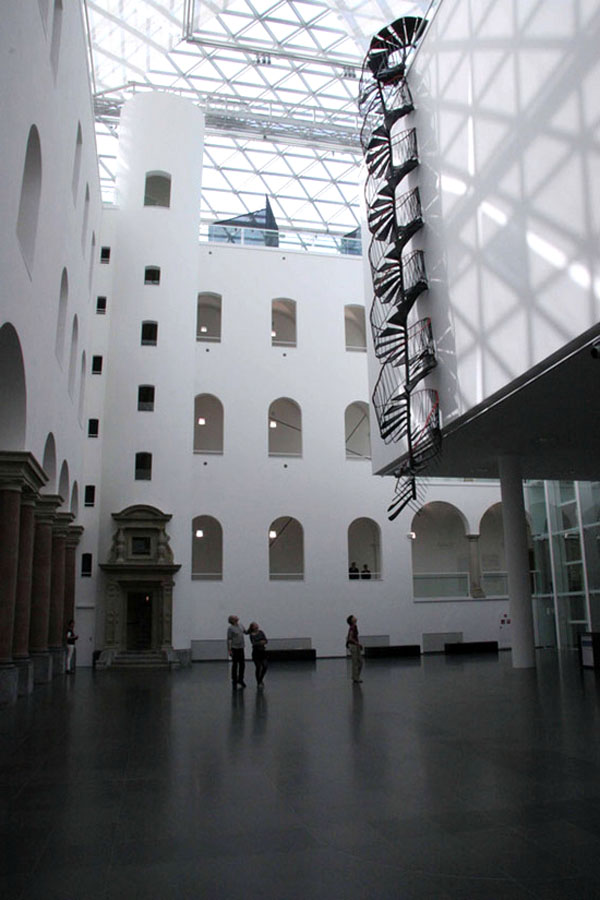
Monika Sosnowska, Stairway, 2010.

The next question is, how’s your stamina? I don’t want to harsh your mellow, but by pursuing gallery representation you’re entering into one of those “prepare for the worst and hope for the best” situations. This will include some tough, time-consuming work: carefully researching galleries that exhibit art in your style/medium/concept, networking at openings and art events, and reaching out via emails, submissions, and in-person meetings. All of this takes major effort, and anticipating the worst means steeling yourself for the inevitable rejections—so that when they come you can brush them off and forge ahead. Conversely, you also have to prepare for success by continuing to make good work and studying legal and logistical protocols so that you’re ready to go when you hear a “yes.” Gallery representation might mean studio visits, dealing with consignment forms and other contracts, and packing and shipping work. Part of being ready to approach a gallery means understanding various conventions of behavior and codes of the art market, and if doing this kind of homework doesn’t sound exhausting then perhaps it’s a sign that you’re ready to move forward.

Monika Sosnowska, Installation view, K21 Ständehaus, Dusseldorf, Germany, 2010

On to your resume and sales: you mention a couple of “decent” solo shows, but since that might mean anything from the lobby of the public library to an exhibition at an art non-profit, it’s on you to make a clear-eyed assessment of how much credibility and cachet you’ve built up. Sales, if they have been made to strangers and not just Aunt Ada, demonstrate that your work is admired and collectible. While I appreciate your mention of how long you’ve been exhibiting—it gives me a general sense for your professionalism—in the end there’s no real correlation between the amount of time spent working and ease with which one attains representation.

Ultimately, before you approach a gallery you must look at what you have already achieved and the work that is yet to come, and you must do it with a realistic and pragmatic eye. Bearing the above in mind, I recommend that you pursue a number of studio visits with curators, gallerists, art consultants, and other artists. This is where the notion of quality comes back into the picture. You can get feedback about your work, gauge its reception, and—if the response is positive—you can ask your visitor if she thinks you are ready to start reaching out to galleries. Make a list of all the art people you know in your area and start sending out invitations. The best resources you have for resolving this issue are probably right there in your address book. Good luck!

Share