Los Angeles

From Los Angeles: The 2000 Sculpture

As a part of our ongoing partnership with Art Practical, today we bring you a feature from writer Matt Stromberg titled From Los Angeles: The 2000 Sculpture. In his piece, Matt examines artist Walter De Maria’s work The 2000 Sculpture, which is on view at the Los Angles County Museum of Art (LACMA) through April 2nd, 2013.

Walter De Maria. The 2000 Sculpture, 1992; two thousand polygonal solid plaster rods, 10m x 50m x 12cm. Collection of Walter A. Bechtler, Siftung, Switzerland. Courtesy of the Los Angeles County Museum of Art. Photo: Museum Associates / LACMA, 2012.

Artist Walter De Maria is perhaps best known for his seminal land art piece The Lightning Field (1977). However, since the early 1960s he has been an important contributor to minimalist, conceptual, and land art movements, steadily making gallery-filling minimalist sculpture alongside his monumental Earthworks. It is into this category of work thatThe 2000 Sculpture (1992) falls. Originally exhibited in Zurich, the sculpture currently occupies Resnick Pavilion at the Los Angeles County Museum of Art (LACMA). This exhibition marks the first time the work has been seen publicly in the United States and is, surprisingly, only De Maria’s second solo museum exhibition in the States.

It is challenging to satisfactorily describe The 2000 Sculpturewith written words. De Maria has posted the piece’s physical characteristics on the wall, highlighting the challenge of verbally and numerically expressing the experience of viewing and moving around the work. The 2000 Sculpture is composed of two thousand polygonal white plaster rods arranged on their sides on the ground. They are placed in rows forming a herringbone pattern of twenty by one hundred units. There are eight hundred five-sided rods, eight hundred seven-sided rods, and four hundred nine-sided rods arranged in a pattern of five-seven-nine-seven-five and five-seven-nine-seven-five. Each rod is fifty centimeters long and approximately twelve centimeters high and weighs twelve pounds. The overall length of the piece is fifty meters (the total length of all the rods laid end to end would be one kilometer), and the total weight is twelve tons. These are the concrete facts of the piece, and yet they give little impression of the sensation of standing before it.


Read Full Review

Share

Help Desk: To Print or Not to Print

Help Desk is an arts-advice column that demystifies practices for artists, writers, curators, collectors, patrons, and the general public. Submit your questions anonymously here. All submissions become the property of Daily Serving.

I am a painter with good gallery representation. There seems to be public interest in the work I make and I am sometimes asked about prints or reproductions. As a printmaker, I don’t like the idea of “limited edition” art prints that blur the line between hand-pulled work and technically limitless reproductions, but I’ve always been a fan of the accessibility of posters and the 9″ x 12″ reproductions you can buy in museum gift shops. I’m not so successful I can afford to print off and give away a big run of such things. Is there a middle ground in publishing reproductions? Something where non-collector fans could spend $10 – 50 on a picture? I’d rather like to send a nice .tif to anyone who asks and suggest they print it out on their own computer. For $5 I could mail them a sticker with my actual signature.

This is the Art Police! Put the mouse down and step away from the computer!

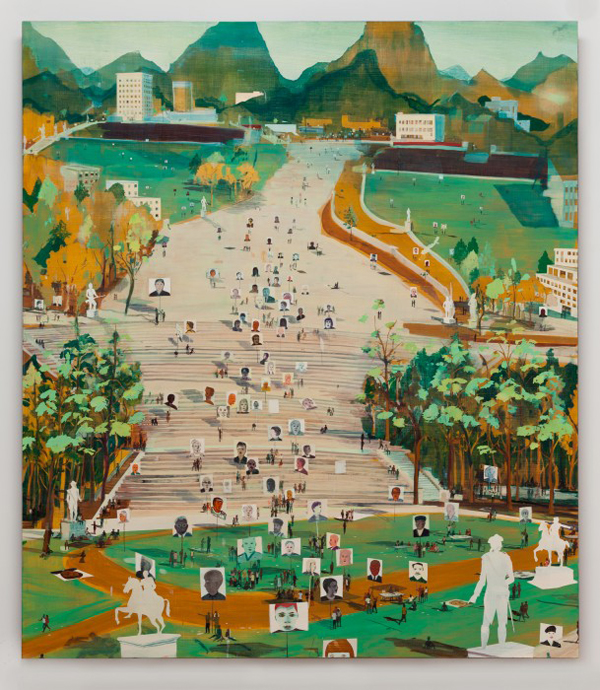
Jules de Balincourt, Idol Hands, 2012. Oil on panel, 76 x 66 inches

While I appreciate the spirit of your generosity, I beg you to abandon the idea of sending .tif files of your work to your admirers. For one thing, you can’t control what the recipient of such a file would do with it once it’s in her possession. She might blow it up or crop it, change the colors, or run it through some ghastly Photoshop filter. There’s also the issue of the subsequent printing, since a home-use HP or Epson isn’t calibrated for color or quality in the same way that a printing house has control of their giclee printers. In the end, who knows what might happen to your image: it could end up re-sized, re-colored, and smudgy—and then it would bear a sticker with your name on the bottom. I won’t arrest you this time, but consider this an Official Warning.

Anyone asking about prints or reproductions either wants a painting that’s already sold or they’re looking for a low-cost way of collecting your work. Notice that I said low cost and not free. There are all sorts of middle-ground options available that make your work more accessible to the entry-level buyer—because a “non-collector fan” is just a collector waiting to happen, right? So let’s review your options.

Jules de Balincourt, Illuminated, 2012. Oil, oil stick, spray paint, and acrylic on panel, 96 x 96 inches

If you have a high-quality digital file made from a completed painting, and if you work with a good printer, there’s nothing wrong with making giclee prints. Since you control both the file and the edition size, the way to get around the “technically limitless” character of giclees is to print all the editions at one time and then destroy the digital file. And if you don’t want to go the full giclee route, you could make a limited edition of prints that you hand color (so, your edition size might be ten, “each unique”). Read More »

Share

From the Archives

The Good, The Bad, and The Real

The concept of the “real” has undergone several interesting changes in the past century, and shows no sign of stopping. With new technologies, reality is now unimaginably more complex. Today from the DS Archives we take a look at More Real?: Art in the Age of Truthiness  and Ed Atkin’s upcoming exhibition at MoMA PS1, on view January 20—April 1, 2013. Atkins, “who considers HD technology deathlike because of its virtualized form,…deploys the bodiless movie format to highlight the conflicting intimacies that contemporary mechanisms of cultural production represent and allow us to achieve.”

The following article was originally published on July 19, 2012 by :

In place of what would have been SITE Santa Fe’s 9th International Biennial, the exhibition More Real?: Art in the Age of Truthiness is mounted as a question. Through cumulative stagings, illusions, virtual worlds, and fictional archives the exhibition creates a circuit of “truthiness”. The term coined by the venerable pop icon Stephen Colbert essentially means truth through gut feeling or desire rather than fact. The survey of works, from the playful to the disturbing, left me with questions like: Is deception in art even possible? Do strategies of subterfuge and ambiguity offer the viewer new possibilities anymore? Aren’t we already swimming in the hum of a falsified reality?

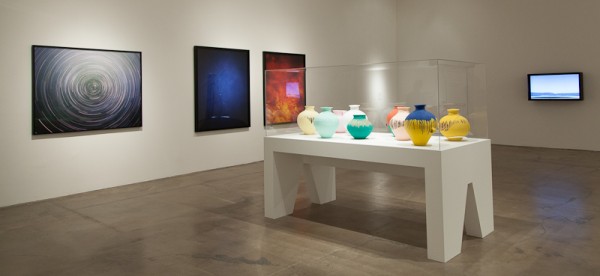
Trevor Paglen, Ai Weiwei, John Gerrard

Read More »

Share

Elsewhere

Registering difference, considering change, mapping regeneration: the 7th Asia Pacific Triennial of Contemporary Art

An-My Le, Vietnam/Usa B. 1960, 'Patient Admission, US Naval Hospital Ship Mercy, Vietnam' (from 'Events Ashore' series) 2010 Archival inkjet pigment print ed. 2/5, 101.6 x 143.5cm, collection Queensland Art Gallery

Twenty years ago in the Asia Pacific Triennial’s first catalogue Caroline Turner wrote, “Euro-Americentric perspectives are no longer valid as a formula for evaluating the art of this region”. Today this seems obvious – but to a significant degree this is due to the previous 6 exhibitions which introduced audiences to the richness of contemporary art practices in the region. It was through the APT that Australian audiences saw the work of Ai Weiwei, Xu Bing, Lee Mingwei, Yayoi Kusama, Cai Guo-Qiang and Gongkar Gyatso. It has facilitated dialogue, debate and scholarship, providing a space for multiple voices and competing ideas. It has exhibited works by over 500 artists from 30 countries, over time expanding its geographical focus, now encompassing works from Micronesia, Melanesia and Polynesia; from South Asia, the Middle East and Turkey; from West Asia and the former Soviet Union.

The biggest surprise (and biggest disappointment) is the inexplicable absence of Chinese artists. With the notable exceptions of Huang Yong Ping’s sinuous snake skeleton, ‘Ressort’, arching its way through the water mall; an installation of tiny paintings from Zhou Tihai (definitely in the ‘too clever by half’ category); some Chinese animations; and ‘MadeIn’ Company’s cartoonish tropical island of plastic shrubbery, there are very few works from the country which has dominated international biennales and art fairs for the last decade.

Made In Company, 'Spread 201009103', nylon, plywood, plaster, acrylic, paint, spray paint, palm fibre, plastic, 500 x 400 x 400 cm (installed, approx) image courtesy the artists

Instead, the lower level of the gallery is dominated by the largest representation to date of work from Papua New Guinea, including masks and structures from the Sepik River. They are intended to represent one of the exhibition’s stated themes: how the built environment influences the way that people engage with their surroundings, with an emphasis on ephemeral structures and collaborative works. Whether powerful ritual objects such as these can easily be made to fit into such a curatorial conceit is debatable. QAGOMA Acting Director Suhanya Raffel says the exhibition is about “registering difference, considering change, mapping regeneration” –  the politics of identity and geography in a rapidly changing world. This latter idea is more easily identified, and many works reflect on colonialism, dispossession and power relationships.

Read More »

Share

Amsterdam

Traveling the universe / inside the human mind.

Imagine: you walk into a white room. One you can only enter wearing some of those sexy, plastic blue shoe protectors. An oversized flatscreen beams bright flickering light at the opposite wall. You sit down in front of the screen. The brightness is of an almost suffocating magnitude – there is so much light your eyes can’t cope. Instead of seeing light you start to see patterns: squares, circles, lines and colours – blues, reds, yellows – and blacks. Within minutes the whole room is filled with geometric shapes. Images flash in front of you and move through the room. They intensify. It feels like you’re on drugs, but you aren’t. You’re definitely still alive, too. It is Monday afternoon and you’re in Amsterdam – for all you know, you’re exploring space.

Matthijs Munnik Citadels: Lightscape V (2012)

Matthijs Munnik‘s installation Citadels: Lightscape V (2012), which can evoke the above reactions, is one of the works included in a new exhibition at NASA, Amsterdam. Contrary to what one may assume with such an abbreviation, the name of the host is not referring to the National Aeronautics team. This NASA refers to the cultural hub: New Art Space Amsterdam.

Titled The Dark Universe, the exhibition is co-organized with Sonic Acts, an organisation occupied with new developments and cross-overs between of music, science and art. The show’s aim is to, artistically as well as scientifically, explore the large part of the universe (roughly 96 percent) that still remains unknown. Made by a selection of visual and sonic artists and scientists, the exhibition includes vision distorting light installations and discombobulating soundscapes – all to help us imagine what it would feel, look or sound like to travel through these dark voids. But the exhibition offers more.

Matthijs Munnik – Citadels: Lightscape II from Matthijs Munnik on Vimeo.

Read More »

Share

BostonFan Mail

Fan Mail: Giordanne Salley

For this edition of Fan Mail, Giordanne Salley of Boston, MA has been selected from our worthy reader submissions. Two artists are featured each month—the next one could be you! If you would like to be considered, please submit your website link to info@dailyserving.com with ‘Fan Mail’ in the subject line.

———–

Years ago, my friend Jessie was talking to me on camera while I lay in a bathtub in Pittsburg. We were there on a high school field trip, and were making a video called “art in the world,” looking at whatever we found along the way, especially bridges, sculpture, trashed tvs, etc. Jessie told me how it made her kinda sad that you can make-out in just about any movie. I said, “I wonder why? Cause some movies are so bad, you just have to make out? That you lose interest in them so much?”

Jessie replied, “Well, it’s not even that the film is bad, cause I think that you can make out in almost any film, but the point is that sex will always beat art, like, it doesn’t matter, sex will always kick art’s butt.”

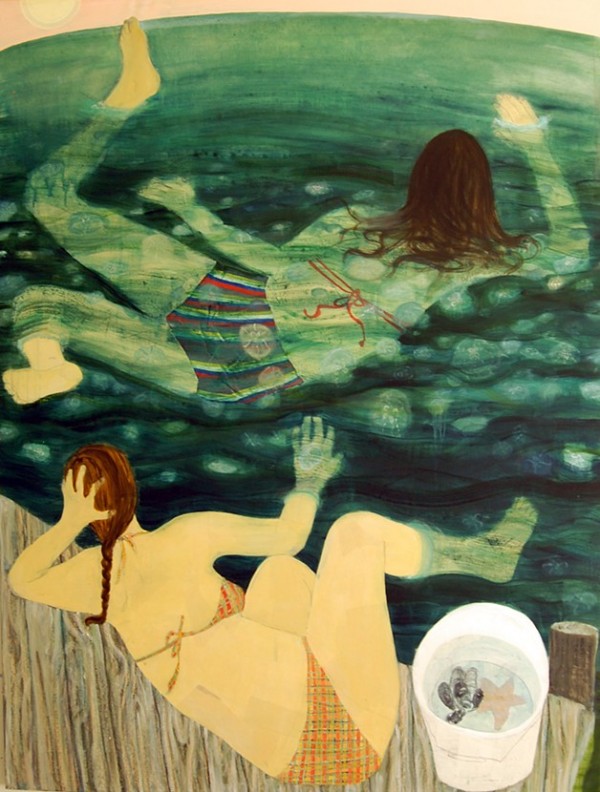
Trina and the Moon Jellies, 2012, oil and mixed paper on canvas, 76in x 50in

Giordanne Salley, Trina and the Moon Jellies, 2012. Oil and mixed paper on canvas. 76in x 50in

Visual art doesn’t usually cause physical excitement in the viewer; no one claps or makes noise at the museum. People gasp in movies and music gets people to move and dance, but visual art is often taken in as a solitary observation with a stillness and gaze.

At gallery openings, I find that most people don’t talk about the art so much. Maybe they point out a few things they like and provide a few remarks to justify or explain why. Sometimes I’ll see a couple walk from piece to piece interpreting meanings and making observations. There is something about their intimacy that allows for this type of walk, a freedom of expression that permits insight to be constructed. People seem to pair off when it is mutually beneficial, and at least for a while, this can be blissful before power dynamics begin to develop. To gain insight in a conversation with a stranger can be euphoria.

Giordanne Salley, Promise? Promise., 2011. Oil on canvas. 18in x 24in

Looking at Giordanne’s paintings this morning, I think about love, being alone in the studio and remembering someone, being pulled toward the other person. It is easy to become obsessed with love, a need for connection, to be present with another. Alone in the studio is a vacuous but elated feeling. We are very social beings, but often art is created in a space isolated from others. We experience loneliness deeply, yearning for the other, but we also seek to be alone in order to find ourself.

Artists often works in solitude, creating from memory as Giordanne does. Making art puts you in a vulnerable state. Love and friendship are fundamental to the human experience, but the art-making experience can be uniquely anti-social. Despite this notion, sociality and human interaction remain at the core of Giordanne’s recent paintings.

Giordanne Salley, untitled (white painting), 2012. Oil on canvas. 16in x 16in

Alone in a gallery (or now viewing a webpage), I seek out the other, the artist’s whose work is before me. If I like the work, the artist has spoken to me, we have engaged in one-way communication. I feel like I know this other person for a moment. I like it when I write to the artist and we begin a conversation about their work that comes from a shared vision—their images somehow succeed to communicate.

Read More »

Share

San Francisco

On Seeing and Nothingness

Barbara Kasten, Construct VI-B, 1981 / Polacolor 10 x 8 inches Edition: 1 AP

A few years ago, I found myself wondering: what is the essence of existence? After some thinking, I came to the conclusion that the simplest evidence of existence is interaction. Even at an infinitesimal level, if something doesn’t interact with something else, there is no way to prove it exists. That being said, there are different ways to measure interactions, both direct and indirect. For more than 30 years, Barbara Kasten has used light, planes, and dimensional layering and flattening to make the invisible visible.

In her current exhibition at Jessica Silverman Gallery, Kasten manipulates the interplay of light and surface, both transparent and opaque, to create abstract tableaus. While the work has a strong connection to the Constructivist aesthetic, the photographs relinquish much of the practicality sought after by artists in the 1920s and reintroduce aspects of the autonomous, nonfunctional art object. This isn’t to say that the work has come full circle; instead Kasten utilizes both historical and contemporary methodologies.

Barbara Kasten, Construct LB/6, 1982 / Polacolor 10 x 8 inches

The works exhibited range from Polaroids made in the 1980s, to pigment prints made in the last five years. The installation is beautifully lit, with only three florescent tubes in one bay window of the gallery, and a light projection in the other. The low lighting, supported by heavy curtains on the windows, completely separates the gallery from the outside world. The projection reflects off a mirror and onto the wall on which the contemporary images hang, transforming the formerly three-dimensional tableaus, now turned into two-dimensional photographs, into a four-dimensional interface between the photographic object and projected film.

Barbara Kasten, Behind the Curtain Installation view, 2013

Read More »

Share