Amsterdam

Peter Feiler: explicit idiosyncrasy

Against the backdrop of industrial chimneys, tidal waves and soaring satellites, satanists play their synthesizers while the world is falling apart. Inside a Corbusian building a middle aged man is hitting a woman with a whip. She’s on hands and knees, tightly leathered up. A third person is standing in the same room, watching them. Discarded pieces of human flesh are scattered around, some are displayed morbidly, on purpose. A five headed monster outside shrieks with desperation. I can’t blame it. If all this was happening and I had five heads, I can guarantee you that I would shriek, too.

Peter Feiler, Dr. Weishaupt muss dem Patienten Goliath Teile des Gehirns entfernen. Der Demokrat kann danach nie mehr wählen, (2009 - 2011)

Peter Feiler’s paintings are not what they appear to be. When you look at them here – downsized and digitally reproduced as png’s or jpegs, it will be hard to discern anything beyond the myriad of colored lines and shapes, let alone distill any of the scenes described above. Dr. Weishaupt muss dem Patienten Goliath Teile des Gehirns entfernen. Der Demokrat kann danach nie mehr wählen, (2009 – 2011) seems here a chaotic mismatch of random, surrealist doodles you’d assume to be produced by someone with vivid, haunting nightmares, or perhaps someone moderately disturbed.

Read More »

Share

New York

A Sense of Noir: Bill Armstrong at ClampArt

Standing before the photographs from Bill Armstrong’s Infinity series, resistance is futile. Intense washes of color and uncertain, alluring forms beckon yet elude one’s grasp, and the encounter between viewer and work becomes a question not of looking but, more powerfully, of experiencing. Critical distance is collapsed, vision becomes a channel for sensation, and image expands into an all-encompassing, alternative reality.

Bill Armstrong, "Untitled (Film Noir #1433)," 2012. Chromogenic print. Courtesy the Artist and ClampArt, New York City.

Such is the effect of Film Noir, Armstrong’s latest exhibition at Chelsea’s ClampArt gallery. A continuation of the artist’s Infinity series, Film Noir represents a further distillation and deepening of the artist’s singular aesthetic. In the manner of his prior series Renaissance and Mandalas, Film Noir is characterized by dense, saturated color and blurred, suggestive form. The series also elucidates the expressive potential of Armstrong’s distinct approach to image making. Appropriating and collaging images from sources high and low, contemporary and historical, Armstrong re-photographs his material in extreme close-up, with his camera lens set at infinity. The effect is heady, surreal, yet paradoxically contingent on the materials’ of-the-world physicality.

Armstrong has written that “the experience of visual confusion, when the psyche is momentarily derailed” enables a kind of spiritual liberation and sensory receptivity that “frees us to respond emotionally” to a given work. His images induce this very confusion even as they envelop the viewer in a visceral realm of the senses; in his photographs, an impenetrable uncertainty dissolves the bonds of reason and leaves the viewer disoriented but thrillingly unfettered.

Read More »

Share

New York

Looking Skyward

Kevin Cooley, Skyward Installation, 2013

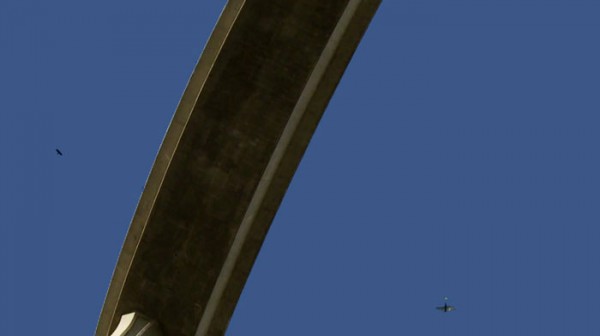
In an unassuming brick building on a gray Willamsburg street, adjacent to a used car lot and several doors down from a polythene bag manufacturer, there is a portal to the West Coast. Kevin Cooley’s Skyward, currently on view at the Boiler—the project space of the Pierogi Gallery—captures the quintessence of Los Angeles life: the car as constant, the looping freeways, the towering palm trees and impossibly blue Southern California sky.

Skyward is projected on a huge screen hung from the 40-foot high ceiling of this former factory boiler room, and viewers lie on the floor on a patch of asphalt scattered with pillows to watch the film. In a radical reversal of birds-eye perspective, it was shot through the open sunroof of a moving car, providing an unusual, exhilarating view of the city.

The juxtaposition of the unheated, industrial New York gallery space with the bright, open images of L.A. is striking, and, according to Cooley, entirely intentional. He is familiar with both cities, having grown up in Los Angeles and spent the last 15 years living in New York; the piece speaks to what he called his “nostalgia for my childhood L.A.”

“I’m fascinated by how much you can see the sky out here compared to New York. In L.A. you’re constantly driving and looking out the window, looking up, whereas in New York you never really look up unless you’re a tourist. … The sky in the film is very ethereal, and I loved the idea of having it pierce through the heaviness of this industrial space,” Cooley said in a phone interview.

Read More »

Share

Hashtags

#Hashtags: Self-portraits in bathtubs

George W. Bush, self-portrait, date unknown.

Four days ago, a hacker named Guccifer broke into former President George W. Bush’s email account, letting loose upon the world three stolen photographs of Bush’s newest hobby, painting. Besides gravitating toward more standard fare, such as landscapes, Bush seems to have surprised art critics with two self-portraits that, in the words of Hrag Vartanian at Hyperallergic, “demonstrate to us a more inward looking Bush, a man who is exploring his emotional life through paint.”

Read More »

Share

From the Archives

Bruce Nauman: Past and Present

Today from the DS Archives we’re going way way back to the long lost time of 2008 to bring you three instances of Bruce Nauman. The two contemporary examples are his current exhibition at Hauser and Wirth in London, and his inclusion in the all-star group exhibition “Silence” at the Berkeley Art Museum (BAM).

The following article was originally published on June 25, 2008 by :

Bruce-Nauman-6-25-08.jpg
Bruce Nauman’s early career neon pieces have reared up again as the focus of a new traveling exhibition, currently installed at San Diego’s Museum of Contemporary Art. Elusive Signs: Bruce Nauman Works with Light includes some of Nauman’s first neon works from the ’70s and ’80s, as well recent figurative neon works. Nauman’s art has always been both lighthearted and confrontational, making him a strange bridge between the serious post-modern conceptualists and the spectacle seekers that populated the ’70s and ’80s art world. He has worked in almost every medium, performance, printmaking, and video included, but neon has been a recurring theme throughout his career. Elusive Signs is at once a history lesson and a sensory experience; Nauman’s neon spans a range of art world hot topics, broaching identity politics, consumerism, illusion, and exhibitionism.

Originally from Fort Wayne, Indiana, Nauman received an MFA from University of California Davis in 1966 and began his career in San Francisco, teaching at the San Francisco Art Institute. Nauman received an NEA grant in 1968 and a Skowhegan Award in 1986. He will represent the United States in the 2009 Venice Biennale.

Share

San Francisco

Too Hard to Keep

Today’s feature is from our  good friends at KQED Arts in San Francisco. Writer Roula Seikaly discusses Too Hard to Keep, a new project by Chicago-based photographer, Jason Lazarus, currently on view at SF Camerawork.

Jason Lazarus, From the series, Too Hard to Keep, 2010 - present

One of the less understood figures in Christian folklore is the sin eater. This person, usually a beggar, was charged with absolving someone of their sins by consuming food and drink that had been touched by the dying person before their passing. Through this ritual, the nearly deceased are eased of their burdens, their mortal infractions kept in check, and the spiritual health of the community at large strengthened.

In a way, Chicago-based photographer Jason Lazarus takes on the role of a sin eater. Through his project, Too Hard to Keep, Lazarus collects the reminders of pain, sorrow, shame, and a universe of other emotions and in doing so, alleviates the suffering of their former owners.

Too Hard to Keep is an archive of objects — photographic prints, books, digital prints received via text message or on discs — that were donated on the premise that the images are too hard to look at, yet too important to discard. Since its inception in 2010, Lazarus has received well over 3,000 objects, and the collection continues to grow with donations from as far away as Europe and South America.

Read full review

Share

San Francisco

Speaking Directly: Interview with Tony Discenza

Tony Discenza’s text-based work is concise yet absurd: the tone is often matter-of-fact while the content is speculative and fanciful. The appropriated formats of a street sign or a book’s teaser page provide an internal logic that holds the tension of this paradox quite neatly. Obviously, I’m a fan, so I asked him to chat with me about his recent projects. Discenza’s solo and collaborative work has been shown at numerous national and international venues, including The New York Video Festival, the Museum of Modern Art (NY), the Whitney Biennial (2000), and the San Francisco Museum of Modern Art. Discenza will be presenting a project on the Kadist Art Foundation‘s Twitter feed (@ Kadist_AF) on February 18, 2013. 

Tony Discenza. TRANSPORTED, 2010; Vinyl on aluminum, 30 x 24 in.

Bean Gilsdorf: Your practice shifted from representational, image-based work to language-and-text based work, was there a particular catalyst for the change?

Tony Discenza: The change was gradual. The whole time I was doing all the video work, which started in the late 90s and continued for about ten years, I had a sort of shadow practice. I was working in law firms, an office environment where there is a lot of down time. I did a lot of art-thinking and art-working while sitting in front of a computer and being in a cubicle. A lot of that work took the form of writing—text, fragments, collecting bits of things—but I never really had a sense of what to do with it. It accumulated, but to a certain extent I had stuck myself with this narrative that I was a video artist. I did reach a point around 2007 or 2008 where I was feeling kind of burnt out on the work that I was doing in video. The things that had fueled it didn’t feel as relevant anymore because of huge shifts in the way that we watch things, and I was burnt on the logistical obstacles, I felt that I rarely got to present the work in the way that I wanted.

BG: How did you want to present it?

TD: Not in very complex ways; for example, in having a darken-able space in an exhibition or having reasonable soundproofing, having a good projector—just things to ensure that the work was presented well. I wasn’t at a point where I was able to say, “You either show it this way or don’t show it at all.” So I started looking at all this other stuff that I was doing, and some of the questions I was exploring overlapped between video and text. I was given the opportunity to do a solo show in my gallery in 2010 and I wanted to show divergent work, something that almost looked like a group show, a range of approaches and tones, to bring the humor out. I wanted more play.

Tony Discenza. Teaser #3, 2010; Lightbox with Duratrans, 30 x 40 in.

BG: Out of curiosity, what were you doing in a law firm?

TD: I was a paralegal. It was a job I fell into after college.

BG: I find that very interesting, considering that the practice of law is to create definitions and strictures with language. Being around that environment for so many years, how could you not be influenced?

TD: Yeah, I worked in offices for eighteen years, and it’s had a huge impact on the way I work with things that are language based: iterative structures, making lists, reports, documents…they all seeped into my thinking.

BG: And how did it feel to present that first body of text-based work?

TD: Up to the point of the show it was very nerve wracking. I second-guess myself a lot, and part of me kept saying, “People are not going to be able to deal with this shift.” Once it was done I felt very satisfied because it looked more like the kind of show that I was interested in at that time. There was video in the show, but also print work, light boxes, an audio installation, a generative text piece, etc. The works were divergent but interconnected.

Tony Discenza. A Report on Recent Developments within the Category of the Ineffable, 2012; Dymo labeling tape, dimensions variable.

Read More »

Share