San Francisco

The Way Beyond Art: Infinite Screens

As a part of our ongoing partnership with Art Practical, today we bring you a feature from writer Genevieve Quick. In her piece, The Way Beyond Art: Infinite Screens, Genevieve explores the 5-channel video installation Hearsay of the Soul, 2012, by acclaimed artist and filmmaker Werner Herzog.

CCA Wattis Institute for Contemporary Arts, The Way Beyond Art: Infinite Screens (Installation View), 2013

As the fourth and final installment of its exhibition series “The Way Beyond Art: Infinite Screens,” the CCA Wattis Institute for Contemporary Arts in San Francisco presents Werner Herzog’s Hearsay of the Soul (2012). Continuing the interdisciplinary curatorial approach of past installments with two exhibitions devoted to graphic design (both subtitled Wider White Space, 2011) and one to industrial design (Sunny Memories, 2010), “The Way Beyond Art: Infinite Screens” presents the filmmaker Herzog’s first, and rather awkward, foray into contemporary art. Originally exhibited as part of the 2012 Whitney Biennial, Hearsay of the Soul combines footage of the paintings and prints of the Dutch Golden Age artist Hercules Segers (c. 1589–c. 1638) with a contemporary classical score composed and performed by Ernst Reijseger. Unfortunately, the piece never fully capitalizes on its five-channel setup to explore the vast potential for juxtapositions of imagery and sound. Instead, Herzog’s choices are predictable, fading between footage of Segers’s ethereal landscapes in a fairly traditional manner, the imagery neither enhanced nor contrasted against Reijseger’s emotive score.

Read the full article here

Share

Fan Mail

Fan Mail: Josh Highter

For this edition of Fan Mail, Josh Highter of Berkeley, California has been selected from our worthy reader submissions. Two artists are featured each month—the next one could be you! If you would like to be considered, please submit your website link to info@dailyserving.com with ‘Fan Mail’ in the subject line.

Josh wrote about his paintings as “inventions shaped by forces of society, economics, technology, and nature, moving in a trajectory of constant re-invention,” and it made me wonder if his paintings were from source material or imagination? It seems like these pieces have some image underneath them that has been totally obliterated, layers of mark-making cover over each other. In Folding, there are shadows behind the caged form. Linear, geometric objects appear in a strange compressed/folded perspective. Some images seem ripe for reading into, for example, ‘Imploding’ appears to me to be a ship at sea. His images seem to reference his physical surroundings, but is formal experimentation more important to the painter?


Josh Highter, Folding, 30" x 40", 2012

“During construction of this work, I often start with fairly nebulous forms, but as I keep layering and taking away, the structures really begin to find themselves…I hope that the viewer sees moments of destruction and creation in them, of spaces coming together or being broken apart. There is something so bound to the earth about these ideas, but I love taking them somewhere else. ‘Folding’ was really a quick piece. I wanted to make a painting completely out of spray paint. I definitely had elements I wanted to incorporate into it, a sense of heaviness at the top, a feeling of lightness at the bottom.

Your question about whether or not the images I paint represent actual spaces is at the heart of my process as a painter. I started painting very traditional landscapes on location in my home state of Vermont. I grew up in what I now recognize as one of the most beautiful parts of the US…I would just take an easle, go for a hike, and go for it. I spent a lot of time painting like that.

I began to realize that what draws me to the landscape is this sense of exploration…but when I am the one creating the space I get to fold into it a lot of elements that just speak to me, like a moment, a line or some color, from another place and time. I moved away from painting on location to painting from models (which kept a lot of the integrity of the original space) to painting from collages or composite drawings that are based in reality but are really created spaces. …I am still in many ways an observational painter.”

Read More »

Share

Singapore

Geng Jianyi: The Artist Researcher

Born in 1962 of parents who were attached to the Chinese People’s Liberation Army, Geng Jianyi grew up in a country shaped by rigid, state-mandated structures that had, by the late 1960s to the early ‘70s, fallen a long way short of the idealistic socialist Chinese state that Mao Zedong had envisioned. Where solidary socialism was intended to create commitment to the system by way of a benevolent bureaucracy, this idea was in reality, frequently afflicted by political and class struggles where individuals were embedded in social groups and contained by an inflexibly orthodox hierarchy. It was within this particular political framework that Geng honed his craft, his fascination with the mechanisms of communication, memory and identity-formation motivated early on by the failures of the bureaucratic state. In light of this, it wouldn’t be too implausible a claim that Geng’s retrospective show at the ShangArt gallery traversing two decades of his artistic practice is as much a chronicle of China’s socio-cultural logic as it is of his oeuvre.

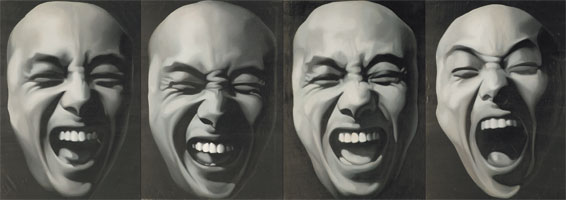
Geng Jianyi, The Second Situation, 1987.

Geng’s early anti-authoritarian projects tended towards stressing the social responsibility of the artist; in this case, they were critiques of the prevailing dynastic legacy of Mao – a brand of socialist realism and repression that still shackled Chinese society well into the years with his successor Deng Xiaoping at the political helm. A seminal work, The Second Situation (1987) is a quadriptic that portrays black and white faces distorted with soundless, cynical laughter. It is a suggestion that laughter, a basic human response to joy has been rendered ambivalent in a society culturally conditioned to prioritise the elements of Confucian teachings emphasising stoic restraint and kinships with the community above individual passions. More importantly, The Second Situation helped pioneer the Cynical Realism movement: a widely shared sentiment of disenchantment among artists such as Fang Lijun and Liu Wei who had, during this period, produced a series of works ridiculing the socio-political malaise that afflicted China.

Read More »

Share

Chicago

Hidden In Plain Sight

Artist Jeremy Bolen brought back a lot of pictures from his trip to Geneva, Switzerland last year, which are currently on view at Andrew Rafacz Gallery in Chicago. Bolen’s one-man show titled CERN, features conceptual photography that is driven by unique processes of exposing film, processes which point toward challenging questions about the veracity of art. The Geneva photos aren’t exactly your standard images of a bucolic European countryside, though there are a handful of those as well. Bolen’s method for documenting an environment is less “point and shoot” and more “bury and wait.”

Untitled (Cern, 7.20.12), 2012, archival pigment print, flora form site. 44.5 in x 36 in. Courtesy of the artist and Andrew Rafacz Gallery.

Below the Swiss landscape, the scientists at CERN – the European Organization for Nuclear Research – are smashing together particles within the Large Hadron Collider near the speed of light. While in Geneva, Bolen conducted his own photographic experiments in an attempt to document and reveal the unseeable forces swirling around the test site. In one such experiment, the artist exposed film using the water of Lake Geneva as a lens, creating a series of pictures titled In Lake Geneva, 2012. The images capture the experience of water in motion as undulating bands of color and sediment.

Read More »

Share

Los Angeles

Llyn Foulkes at the Hammer Museum

Llyn Foulkes, The Corporate Kiss (2001)

For both Walt Disney and Llyn Foulkes, it all started with a mouse. Mickey, to be precise, accompanied both men throughout their respective careers—Disney in a manner of lucrative iconography, and Foulkes in a manner of psychological distress. To most, the cartoon rodent was the paragon of jubilant youth, but through Foulkes’ lens, Mickey was a sanitized, furtive representative of the rats infesting the politics, pop culture, and religion through sly propaganda and commercial gerrymandering. His frustration and agonizing scrutiny of “brainwashing” institutions is not merely palpable, but aggressively sensational throughout the Hammer Museum’s retrospective of the artist’s work to date, on view through May 19, 2013.

Llyn Foulkes, In Memory of St. Vincent School (1960)

Of course, Mickey is not exclusively at fault for Foulkes’ disenchanted apprehension of the commercialized world – and really, the mouse is not quite the genesis of the artist’s unsettling practice as much as he is the crescendo. An absent father and scarring combat experiences from WWII contributed their fair share to Foulkes’ anxious cynicism long before our animated varmint; episodes that forever ingrained a wary sense of distrust in the artist’s perception of how information and rules are disseminated. His early works from the 1960s heavily reference an academic environment; the alphabet, numbers, and childlike scribbles are collaged within charred residue and wood panels – emulating the bombed-out classrooms he witnessed in Germany. In “Memory of St. Vincent School” (1960), a singed blackboard features a hurriedly jotted swastika tucked away in the upper left hand corner. Coupled with an empty child-sized chair, Foulkes’ installation prompts an eerily visceral cue of remorseful mourning for the implied indoctrination once enacted in this setting. Similarly, “Summer School” (1962) consists of a Jasper Johns-esque compartmentalized assemblage, only Foulkes’ target is the muddied, seemingly scorched clothes of a schoolgirl beneath a set of cartoonish ABCs. At the outset, it is obvious that the artist is skeptical of our educators and decision-makers, as they appear to leave a smoldering path of ruination in their wake.

Read More »

Share

Help Desk

Help Desk: Art Consultant

Help Desk is an arts-advice column that demystifies practices for artists, writers, curators, collectors, patrons, and the general public. Submit your questions anonymously here. All submissions become the property of Daily Serving.

I want to know more about standards for art consultant/artist relationships that develop without a gallery being involved. I tried to look it up online and everything, of course, was all over the place and contradictory. I don’t want to be named in a post, but I am interested in knowing more. Specifically I was just approached by an art consultant who asked me ‘how I normally work with art consultants.’ I think what they wanted to know is how I like to divide sales, like a percentage ratio, and I just don’t know what is normal.

For readers who aren’t acquainted with this particular niche of the art market, let’s start with what an art consultant does: she selects, acquires, and helps present artworks for clients. She might collaborate with architects and designers to create spaces congenial to the display and conservation of artworks. If she is working for a client with an extensive art collection, she may additionally curate and design exhibitions.

Just as there are differences in the ways in which various gallerists might work with an artist, art consultants also vary in their methods—that’s why you have come across contradictory information online. For example, most consultants that I know select from the already-completed works made available by artists and galleries; however, in this interview on Artsy Shark, San Diego consultant Barbara Markoff says, “For me the perfect artist partner is an artist that does not mind taking art direction for my projects. Often the art decisions are based on color and size. Knowing that my artist partner will happily create work for me based on my recommendations makes my job much easier.”

R. H. Quaytman, Passing Through The Opposite of What It Approaches, Chapter 25, 2012. Tempera, silver leaf, silkscreen ink, gesso on wood

I contacted a few consultants to find out if there is an industry standard that you could use as a general guide as you move forward. One San Francisco-based consultant said, “Assuming this is an emerging artist, I should say that I never take a percentage of sales from artists who are not represented by a gallery, unless our relationship is such that I’m involved in their PR (more like a gallery would be; but this is typically not done, since art consultants are supposed to be unbiased towards any one artist). That being said, I know other advisors who do take 10-15% of sales from the artist; if working with artists directly this is normally the average rate.”

If you are represented by a gallery, then the percentage is a little different. The consultant continued: “If this artist is working with a gallery then the discount that the gallery gives off retail (10-20%) is passed on to my client, but would not affect the 50% of the sales that the artist would receive from the gallery.” So if the consultant was acquiring a $1000 work of yours from the gallery, then you would still receive $500 and the gallery would get $400 (assuming a 10% discount and a 50-50 division of the retail price). However, it’s important to note that the gallery might want to split the discount with you; this is something you will want to negotiate with your gallerist before you start working with a consultant.

R. H. Quaytman, Passing Through The Opposite of What It Approaches, Chapter 25, 2012. Tempera and silkscreen inks, gesso on wood, 32 3/8 x 32 3/8 inches

Another art consultant that I contacted had a similar idea of standard practice. “When purchasing from a gallery we normally receive a 20% discount off of retail that we split with our clients. When purchasing directly from an artist who does not have gallery representation, we receive a discount in the range of 20% – 40%. We never mark up retail prices knowing the importance of a consistent sales record for the artist.”

Read More »

Share

From the Archives

From the DS Archives: Without Reality There is No Utopia

Today from the DS Archives we bring you the 2011 exhibition, “Vision and Communism”at Smart Museum at the University of Chicago in Chicago, IL and the current exhibition “Without Reality, There is No Utopia” at Yerba Buena Center for the Arts. Both exhibitions address the effects Communism and politics have on culture and art.

The following article was origianally published on November 8, 2011 by :

On the night of October 25th, police officers fired teargas and flash grenades into a crowd of “Occupy Wall Street” protesters in Oakland, CA. The event was a significant escalation of force following weeks of arrests and threats of mandatory dispersal issued by police and local officials in American cities. The morning after the Oakland confrontation, news outlets were awash with chaotic images of police in riot gear and protesters scattering from smoke-filled streets, their hands clutched to their mouths and eyes. It was later revealed that a young war veteran named Scott Olsen was left in critical condition after one of the teargas canisters ricocheted off his head.

The aftermath of the Oakland Police's continued assault on occupiers and demonstrators. #StandWithOakland #OccupyOaklandd

Read More »

Share