San Francisco

Silence at UC Berkeley Art Museum

As a part of our ongoing partnership with Art Practical, today we bring you a feature from writer Bean Gilsdorf on UC Berkeley Art Museum‘s Silence exhibition.

Joseph Beuys. Das Schweigen - The Silence, 1973; 35mm film, varnish, copper, zinc; reels: 7.5 x 15 in.; box: 9 x 17 x 17 in. Collection Walker Art Center, Minneapolis, Alfred and Marie Greisinger Collection, Walker Art Center, T. B. Walker Acquisition Fund, 1992. Copyright 2012 Artists Rights Society, New York, VG Bild-Kunst, Bonn. Photo: Courtesy Walker Art Center.

In Alan Moore’s graphic novel V for Vendetta, the main character tells his young acolyte, “Silence is a fragile thing. One loud noise and it’s gone.” On my way to the UC Berkeley Art Museum’s Silence exhibition, I had a related thought: What would it be like to view an exhibition about silence in galleries full of walking, talking, sniffling, rustling people? Would they break my contemplative experience of the work? As an art patron I admit that I am regularly annoyed by other museum- and gallery-goers; and as Murphy’s Law would have it, the day I visited the museum was the monthly free day, attracting a larger-than-usual crowd. As misguided as it may sound, I wanted to see Silence in silence, and what I got was something different—and far richer.1

Of course, John Cage (whose innovative 1952 work 4’33”inspired the exhibition) declared that there is no such thing as silence: “There is always something to see, something to hear.”2 This was certainly true for the experimental films that were shown at the Pacific Film Archive earlier in February, as part of the exhibition’s related programming. The “silence” in the theater during films such as Maya Deren’s Meshes of the Afternoon (1943) was filled with noise: the hum of the HVAC system, the shifting of patrons in their seats, the occasional stifled cough or sneeze. But more than that, the films made me aware of what I was not hearing, which is to say, a tightly controlled soundtrack meant to direct my attention in a particular direction.

Some of the films’ lack of integral noise created an alternative experience, such as the state of synesthetic sound in Steve Roden’s four words for four hands (apples.mountains.over.frozen) (2006), a film in which handmade dots of colored marker flashed on the screen in ever-changing patterns; in my head I could hear horns and other brass instruments, depending on the bright colors that burst into viewSimilarly, Nam June Paik’s Zen for Film(1962–64)—what the film curator Steve Said called “the most Cageian film in the series” during the press preview—changed my consciousness. The 8-minute projection consisted of ambient dust and debris on the surface of the film; random dark speckles popped and disappeared and linty threads seemed to wiggle their way across the brightly lit screen. As I concentrated on the chance animation of minute fragments, it felt as though time was stretching to accommodate my focus. Instead of being bored and restless, I became relaxed, content to watch this meditative flow, and suddenly aware of my own breath and presence in the space.

Kurt Mueller. Cenotaph, 2011–13; Rock-Ola - Legend - 100-CD jukebox with collected silences; 65 x 37 x 28 in. Courtesy of the Artist. Originally commissioned and produced by Artpace San Antonio. Photo: Todd Johnson.

Viewing the works installed across the street at the museum, I had a more intellectual experience. In the first gallery, Andy Warhol paintings—two Big Electric Chair works from 1967 and Little Electric Chair from 1965—hang amid a suite of canvases by Christian Marclay that isolate part of the original Warhol image and reproduce it in different colors. The silkscreened word silence on a pink canvas is shockingly different than the same word on a silver canvas, exemplifying how much color affects interpretation. I spent most of my time in this space, looking at the long vitrine in the middle of the floor that contains Marclay’s notes and sketches documenting his labor through the ideas on the works in the room. The notes, which include Internet printouts about the death penalty, are chilling.

Read More »

Share

Beijing

SEE/SAW :Collective Practice in China Now

Today, we are excited to bring you coverage of SEE/SAW: Collective Practice in China Now at The Ullens Center for Contemporary Art (UCCA) in Beijing, from our partner ArtSpy, a website based in Beijing, P.R.China that is committed to establishing a platform for global artistic information. This article has been translated from Chinese to English.

SEE/SAW Collective Practice in China Now was an exhibition held at Ullens Center of Contemporary Art between November and December last year, presenting the collective artistic practice of China today. 14 groups were invited to appear in sets of two or three every week and the installations were conducted by the artists themselves. All of the collective practices highlighted the nature of action and sense of judgment. The free play under an open theme, had expressed the code of understanding. Collective practice challenges radical ideas and they were presented here in their entirety. It was more similar to a collective presentation of the groups than an “exhibition”. For over a month, the keynote of this event became the differences between the groups and strong sense of individualism that were shown throughout the exhibtion.

12.11.20-11.25   A Diaodui + Double Fly Art Center 

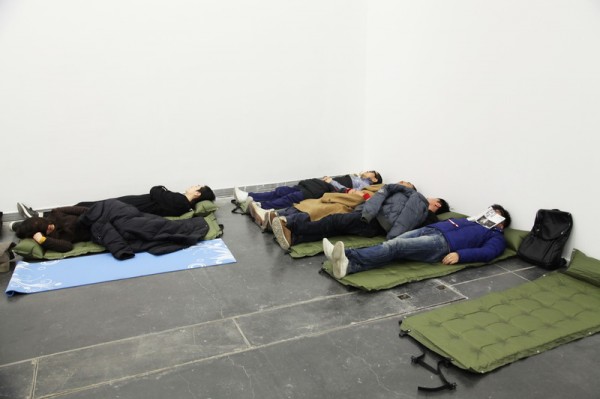
A Diaodui reported at UCCA between 2-4pm everyday and performed different tasks each day i.e. practicing calligraphy, writing couplets, chatting, painting and sleeping.

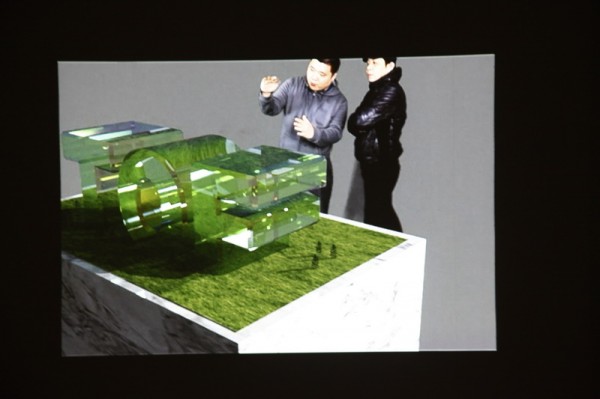
Double Fly Art Center had painted on the walls everyday over the course of a week. The Little Black House in the middle of exhibition hall was like the secret base of Double Fly Art Center, no visitors were allowed in. (Later on it was discovered that this was the prelude to The Double Fly Prequel.)

Read More »

Share

Elsewhere

Camaraderie on canvas

When I think of Jackson Pollock, I picture him working alone in his studio in East Hampton slinging paint across a canvas on the ground, oblivious to the art world around him. It’s easy to forget that the personal lives and relationships of artists deeply influenced their work, a topic brought to the forefront in Angels, Demons and Savages: Pollock, Ossorio, Dubuffet on view now in Washington D.C. at the Phillips Collection. The exhibition traces the relationships between Jackson Pollock, Alfonso Ossorio, and Jean Dubuffet, three artists working simultaneously across continents in similar abstract styles during the period of 1945 to 1958.

"Alfonso Ossorio at the Creeks," 1952. Photograph by Hans Namuth ©1991 Hans Namuth Estate, Courtesy Center for Creative Photography.

The 53 paintings and prints in the exhibition tell the story of how Pollock, Ossorio and Dubuffet influenced each other through not only their close friendships, but also through the sharing of ideas, techniques and even studio spaces. Ossorio, both an artist and collector, bought one of Pollock’s paintings in 1949 and was later introduced to him and Lee Krasner through art dealer Betty Parsons. Pollock then prodded Ossorio to travel to Paris in November of the same year to meet Dubuffet and purchase some of his works. Ossorio’s collection would later be hung in an East Hampton estate purchased in 1951 at the suggestion of Jackson Pollock. Dubuffet wrote a monograph on Ossorio in 1951.

Pollock, Ossorio and Dubuffet were concurrently challenging the canon of painting by forging their own abstract styles. All three grappled with abstraction versus figuration, and each had an interest in process and materials. It seems not a coincidence that Pollock returned to figuration for a period during 1950, as in Number 7, 1952 when he was living in Ossorio’s New York studio.  You can see the influence of Dubuffet in Ossorio’s abstract figural paintings such as Reforming Figure. In the same work, you can see how Ossorio took from Pollock the overall gestural abstraction that fills the rest of the canvas. Dubuffet was highly criticized in his native France, but found solace and praise in New York among Pollock and Ossorio in the burgeoning Abstract Expressionist scene.

Jackson Pollock, "Number 1, (Lavender Mist)," 1950.

Read More »

Share

San Francisco

Through Windows, Through Walls: Driss Ouadahi at Hosfelt Gallery

Driss Ouadahi, Grand ensemble 1, 2012 / Oil on canvas, 78 3/4 x 118 1/8 inches

Painting has long offered codes for interpreting landscape, and from it a perspective on our place in the world. Claude Monet’s series of haystacks, bridges and the Rouen cathedral give us landscape as a clock, an unfolding of the hours of the day and time spent looking, comparing, recording and looking again. Monet had the luck to be surrounded by gardens and fields, but how do we see the hours of our lives from the window of a high rise, or from the street alongside a surging construction site? Driss Ouadahi works through claustrophobic views of anonymous modern cityscapes, mapping the variations, real and imagined, in the landscape of urbanism in Trans-Location, currently on view at Hosfelt Gallery.

Originally trained as an architect, Ouadahi seems keenly aware of the failures of modernist urban planning, while also open to the intoxication of the endless grids and semi-abstract vistas to be found in massive apartment blocks. That ambivalence, as his sterile-feeling plots mutate into lush color and disorienting perspective, lends a human and subjective note to large paintings where traces of the human figure are conspicuously absent.

Driss Ouadahi, Breakthrough, 2012 / Oil on canvas 78 3/4 x 141 3/4 inches (diptych)

Ouadahi’s handling of light and shade is understated but becomes disorienting; light sources on gridded overlays shift in his large street scenes. The grids could indicate scaffolding, construction, ruins or sleek, finished façades. These gridded paintings are more exciting when palette is broader; there’s a joy in complexity and multiplicity that balances the sense of urban overload and numbness in the more muted work.

Read More »

Share

New York

Enrique Metinides: Chronicling Catastrophe

Mexico City, September 19, 1985 © Enrique Metindies, Courtesy 212berlin

The journalistic expression “If it bleeds; it leads” is particularly resonant in Mexico, where an entire subgenre of daily tabloids, devoted to crime and disaster, cover train wrecks and murders in lurid detail. Enrique Metinides made a career as a crime photographer for these nota roja (“bloody news”), earning the sobriquet the “Mexican Weegee” for his obsessive chronicling of accidents and crime scenes throughout Mexico City from the early 1940s through the 1990s.

In “101 Tragedies of Enrique Metinides,” currently on view at Chelsea’s Aperture Gallery, Metinides selects his favorite images from his 50-year career, drawn from an eponymous book made in collaboration with filmmaker Tricia Ziff. The photographs are gruesome and disturbing, but also beautifully composed and compelling in their narrative complexity. In the introduction Metinides remarks, “I would try to capture the whole scene in a single frame—not just the corpse or the weapon, but the entire story.” His self-contained photos, which resemble film stills, make the case that the horrors of daily life are both stranger and darker than fiction.

Mexico City, April 29, 1979 © Enrique Metindies, Courtesy 212berlin

The majority of Metinides’ works feature accidents (plane, train and car crashes, gas explosions, earthquakes), but he also captures more personal disasters such as suicides, crimes of passion and bar brawls that spiraled out of control. The contrast between these images of mass calamity and individual loss is striking. While the shots of flipped buses are grizzly, they don’t carry the same emotional intimacy as the image of a woman weeping over the body of her murdered husband or the grainy photo of a drowned teenager floating face down in a public swimming pool. In January 1971, Metindes photographed an engineer named Jesus Bazaldúsa Barber, who had been torn apart by 60,000 volts of electricity while installing a telephone line. Even as his harness keeps him suspended from the top of the pole, his torso is flung back at an oddly elegant angle, like an image of Jesus in a Deposition scene, asking for some final grace.

Read More »

Share

Hashtags

#Hashtags: What Is Reflected/Where We Meet

Watching “Five Broken Cameras” and “How to Survive a Plague”—two outstanding documentaries nominated for yesterday’s Academy Awards—it’s easy to be reminded of what a gift this kind of attention can be for the community or person being featured. Yet watching Emad Burnat’s young son Gibreel stand center stage with his own camera, filming the Docuday audience during Saturday’s question-and-answer session, it’s also hard to shake the reminder of the power struggle that remains at the heart of many documentary processes. This week, we’re proud to feature an essay by artist Stacy Elaine Dacheux on the confrontational and collaborative capacity of that most old-school of documentary art forms, the portrait.

I.

© Stacy Elaine Dacheux

In the 1980s, Nan Goldin used photography to document her life and empower her own history.

In 2012, I resisted purchasing an iPhone for fear of having too much access to the world at all times. I did not want to think about sharing and likes in relation to worth. I did not want to worry about friends, following and being followed, and I definitely did not want to grow an extra limb in order to show the world I existed.

However, I did not want to be left out of the world either, so, last week, I broke down and bought one, an iPhone, and now I am stuck, specifically, on Instagram.

Read More »

Share

From the Archives

Color, Collage and Cubism

Today from the DS Archives we bring you two artists working during the early to mid 20th century: Kurt Schwitters and Georges Braques. Schwitter’s multi-media collages were recently shown in the US for the first time in 26 years, and Braques’ Cubist still lives are on view at the Kemper Art Museum in St. Louis, MO until April 21, 2013.

For the first time in 26 years, an overview of Kurt Schwitters’ work is touring the US, and the Berkeley Art Museum is the exhibition’s only west-coast venue.  Kurt Schwitters: Color and Collage spans the artist’s output between 1918 and 1947, and includes collages, assemblages, sculpture, and the reconstruction of the architectural/sculptural installation Merzbau, which was destroyed when the Allies bombed Hannover in 1943.  Schwitters had a deep commitment to his practice and personal vision and was a model artist who never stopped experimenting.  His work has had an enormous influence on the generations of artists that came after him.

Mz 601, 1923; paint and paper on cardboard; 17 × 15 in. © 2011 Artists Rights Society (ARS), New York / VG Bild-Kunst, Bonn.

Read More »

Share