From the Archives

From the Archives – #Hashtags: Going Up at SFMOMA

There are so many things to look at in a museum–but that doesn’t mean that art doesn’t exist in unplanned and accidental encounters. Today #Hashtags reprints one of our favorite essays from last year, on the topic of uncurated looking.

It was miraculous to me, only because I had never seen the space behind the doors. Yet, it was shameful, as if I had seen something I ought not to have seen and, worse, had relished the view. As if the question “Should I look?” had been answered by the act of looking before my mind could complete the question with “or not?”

The scene is precisely what a museum is not about: uncurated looking. It is also precisely what a museum is about: serendipitous discovery. The space behind the doors was as mundane as it was miraculous, usually hidden precisely because the space and its goings-on were judged more mundane than miraculous. My inspection of the space was unsuitable, because it was the equivalent of bringing the attention I should bring to the art to a trash can in the museum’s lobby. “Nut,” you might mutter had you seen me gazing, or “Poseur.”

The poster for “Stage Presence: Theatricality in Art and Media at SF MoMA,” July 14 through October 8; Photo: Saul Rosenfield, ©2012, with permission of the San Francisco Museum of Modern Art.

It seems a coincidence that the second time I saw the space, the San Francisco Museum of Modern Art was also staging an exhibit on performance art—Stage Presence: Theatricality in Art and Media. More than a coincidence, a serendipity, because when closed, the doors of the miraculous space supported the enormous welcoming poster for Stage Presence, and when opened, they revealed—what?—a tableau, a stage! And to paraphrase Chekhov’s observation—that a gun introduced into a drama must surely go off—a tableau revealed to the world must surely contain a drama, even if the plot is only in my head, even if the stage-in-waiting masquerades as a freight elevator cab.

Read More »

Share

From the Archives

David Bowie is Peace on Earth

In my opinion, the fact that there hasn’t been a major “retrospective” honoring the artistic career of David Bowie is a crime. Luckily, the Victoria and Albert Museum has prepared an unprecedented look into his archives, opening March 23. Today from the DS Archives, we bring you an edition of LA Expanded that looks at Bowie, Bing Crosby, The Beatles and Christmas.

The following article was originally published on December 24, 2010 by :

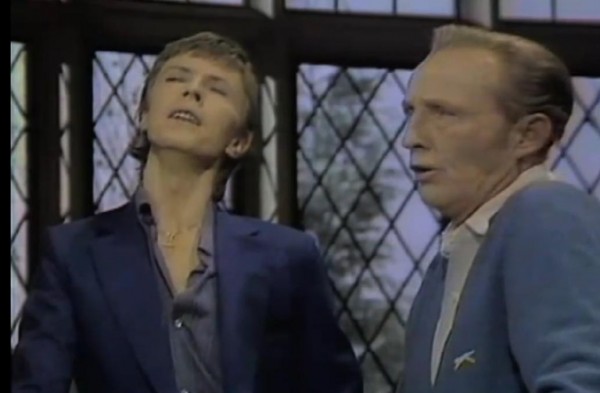
David Bowie and Bing Crosby, Bing Crosby's "Merrie Olde Christmas" TV special, 1977

Bing Crosby died a month before Merrie Olde Christmas aired on national television. The holiday special included one of the most unexpected and fortuitous duets of the crooner’s career: a pairing with David Bowie, then fresh off of Station to Station. Bowie and Bing, over forty years apart in age, performed a combination of The Little Drummer Boy and Peace on Earth, the latter of which didn’t really even exist prior to September 1977. Apparently, the two songs were mixed together in a last ditch effort to keep Bowie on the show. According to the Washington Post’s Paul Farhi, the elfin glam star had agreed to appear with Crosby but refused to sing The Little Drummer Boy as planned, claiming he hated the song (not a huge surprise—it’s hard to imagine the man behind “They were just crass. . . with God-given ass” embracing “Come, they told me”). Writers tried to salvage what producers hoped would be a cross-generational show-stealer, overlaying that dogged “pa-rum-pum-pum-pum” with lines reminiscent of Longfellow’s melancholic I Heard the Bells… The result was spot-on. Read More »

Share

Amsterdam

Loving Memory – Mike Kelley

For the Stedelijk Museum in Amsterdam to choose a retrospective of Mike Kelley‘s work for their first international exhibition since the reopening was, to say the least, symbolic. The Stedelijk opened its newly refurbished and expanded premises in September last year, after years (and years) of highly controversial and heavily debated refurbishments. The enormous white bath tub that is now hovering in front of the institution’s old facade, (brainchild of Benthem Crouwel Architects), the white washed walls and sterile interior, leave little room to reminisce and ponder over what was once a rustic building with creaking floorboards and quaint brick walls. Taking the escalator inside the tub, which is inevitable if you want to see what’s inside, feels as if you’re moving through the architects’ rendering – it’s lifeless, plastic and cold. The visual and physical experience, as well as the €127 million ($170 million) price tag have made the memory of the old building in many ways an uncomfortable one. It’s something rather not mentioned, or thought about for too long. It’s brushed over in conversation because, in all honesty, it hurts.

Stedelijk Museum view of the original building (A.W. Weissman, 1895) and new building designed by Benthem Crouwel Architects, photo John Lewis Marshall.

It’s either complete self-unawareness or ultimate bravery that a museum that has gone through such an awkward moment in time, and which has to deal with the unpleasant consequences of its decisions, chose the current exhibition to start this new era with. The show is, mainly because it was unexpectedly forced into becoming a retrospective after Kelley’s sudden death on the 1st of February last year, the largest exhibition of the artist’s work to date. It takes visitors systematically through the stages of Kelley’s development as an artist and thinker, and displays him, rightly, as one of the most diverse and broadly talented visual artists of our time. Above all, it shows him as a master in dissecting memory and digging up awkward historical moments – themes that reoccur especially throughout the artist’s later work.
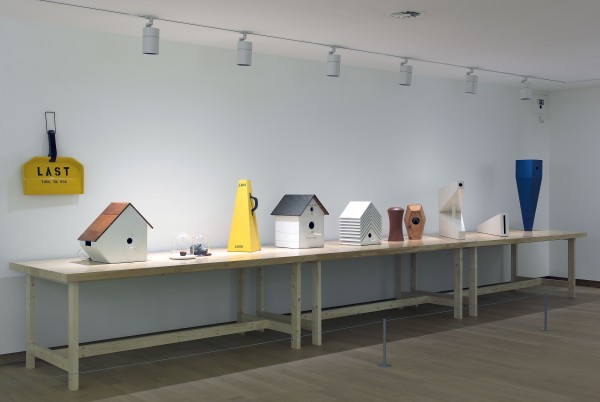
Mike Kelley – Bird Houses. Photo GJ.van Rooij

Starting in the bath tub’s basement, the first couple of rooms exhibit Kelley’s earliest sketches made while still at CalArts. Also on view are instruments that were used for his Early Performative Sculptures and Objects (1977-79), referencing his immersion in performance art and anti-establishment punk. His bird houses reveal influences from his teachers, conceptual leaders John Baldessari, David Askevold and Douglas Huebler. But as with many artists, Kelley’s work only began to mature after he finished art school and was left to his own devices. The works in the next rooms, including Pay For Your Pleasure (1988), testify this.
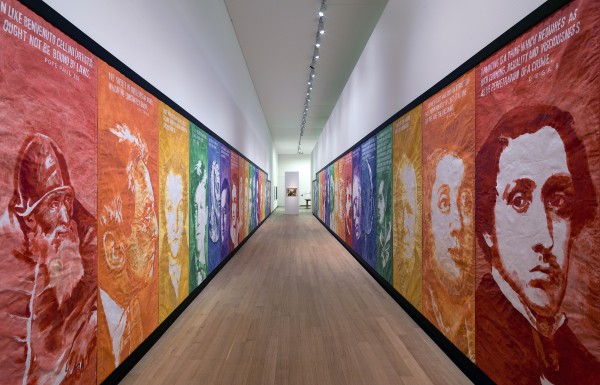
Pay For Your Pleasure (1988) Photo GJ.van Rooij

The starting point of what could later be seen as the artist’s main theme are works like Half a Man (1987-92). This series comprises stuffed animals sewn together in compromising, often sexually provocative positions. For Kelley they were a comment on the commodity discourse and gift culture, on the fact people often end up with pointless and unwanted objects and the herewith related guilt. The fierce reaction these works evoked in American society (it was generally assumed that Kelley had experienced a disturbed, utterly fucked up childhood) is what made him, unafraid and unashamedly, delve into subjects like trauma and memory loss.
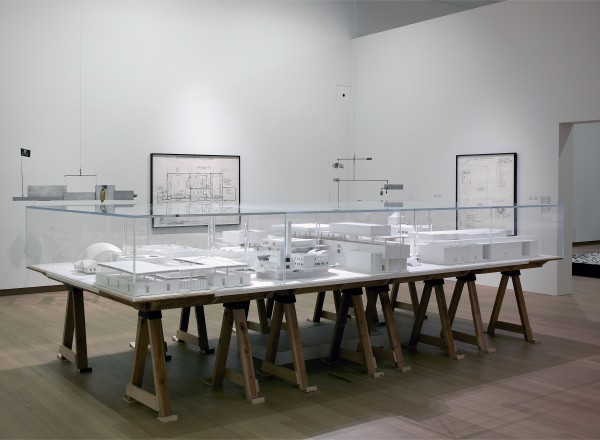
Educational Complex (1995) Photo GJ. van Rooij

What followed are works like Educational Complex (1995), a large-scale model of every institution Kelley ever attended as well as his parent’s house. The buildings are pristine white, and the spaces between them to be interpreted as memory blanks – empty places where trauma could have happened, and which were – eventually – to be filled. Works like the John Glenn Memorial Detroit River Reclamation Project (1968 -1972) touches on a similar, though less personal vein. The giant sculpture covered in mosaics is part of a larger project exploring the history and neglected remnants of Detroit, the city of Kelley’s youth. Things were to get more extreme.
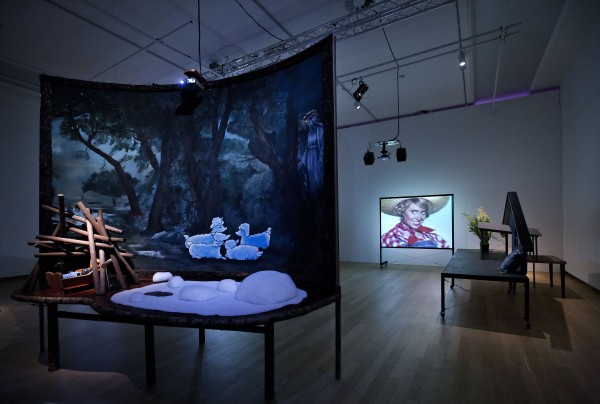
Day is Done (2005) Installation shot Photo GJ. van Rooij

On the first floor of the Stedelijk, where the exhibition continues, the gallery has been made to display Day is Done (2005), which once filled the entire Gagosian Gallery on West 24th Street, New York. The multi-faceted multimedia installation brings together Kelley’s ideas in grotesque installations and moving images, which feature sweating barbers that jerk off behind bathroom doors and singing teenagers with a colgate smiles who perform pop songs in cowboy hats – both equally disturbing. Childhood trauma is here brought to the fore, with no white walls or censorship to hide it. It’s an overwhelming, nightmarish experience, which is tantalising and stomach turing all the same.

Kandors (2007) Photo GJ van Rooij

After this overwhelming visual and sonic encounter it’s a pleasant surprise to then walk into a room filled with Kandors – Kelley’s softest and most  aesthetically pleasing works. Based on the Kryptonian city of Superman’s childhood, which was miniaturised by Braniac and captured in a bottle, Kelley created ten different versions that light up the room with an almost magical illumination and peaceful glow. Heart warming sculptures depicting something inherently sad.

A few video works follow in the museum’s surprisingly great theatre, after which the exhibition – rather abruptly – ends. There’s no ‘the end’ sign and before you know it you’re released into the wild where you’re reminded of the harsh reality that is the museum itself. The cold, white spaces that follow make you realise what a pleasure and privilege it was to be immersed in Kelley’s universe, where there was no hesitation, shame or fear, to show us all that life encompasses.


Share

Denver

Action for the Delaware

Any 20th century art history course worth its salt will have surely shown a slide of Robert Smithson’s Spiral Jetty and prompted students to commit to memory the work’s revolutionary scale and site specificity.  From Smithson to Christo and Jeanne Claude, the history of environmental art is by now long and celebrated.  However, after all these years, it is ripe for reevaluation by artists less concerned with altering the appearance of nature, and more interested in our interaction with the natural world.  It’s exactly this sensibility of ceding control to nature that William Lamson investigates in two concurrent shows in Denver: a solo showing of his video piece Action for the Delaware at the Museum of Contemporary Art and three videos as part of the group show Object | Nature at Robischon Gallery.

William Lamson. Action for the Delaware, 2011. HD video, 14 min 9 sec. Courtesy the artist.

Smithson, Christo and Jeanne Claude executed their work by imposing their aesthetic upon the environment.  Smithson’s Spiral Jetty moved 6650 tons of rubble out into the Great Salt Lake, while Christo and Jeanne Claude wrapped the Australian coastline with one million square feet of fabric.  These grand efforts, intentionally or not, seem to reflect a human desire to bend nature to the creator’s will.  Other celebrated artists such as Andy Goldsworthy and Richard Long have since taken less invasive approaches, but by rearranging leaves or stacking stones, these artists still exhibit a dominion over the will of nature.  Lamson, however, departs from this tradition in a way that reflects a current, more sensitive attitude towards environmental impact by creating art that leaves behind the smallest traces possible, if no traces at all.

Read More »

Share

San Francisco Interviews

An Interview with James Chronister

San Francisco-based painter James Chronister will be the spring artist in residence at Lux Art Insitute in Encinitas, California where five residencies are awarded each year with the goal of connecting the artist with the community and supporting the artist through the completion of a project. This February, I began correspondence with Chronister to discuss his work and process, his Walkman playlist as a kid, and the best advice he has for emerging artists.

Robin Tung: I was awed when I first saw “Devonshire.” Why did you choose to paint in the likeness of photography? And what inspired you to take on pointillist painting, such a time and labor intensive technique?

James Chronister: For years I painted B grade photo realist paintings and was never satisfied with the result. At best they just kind of looked like photographs. The way the paintings are made now, each mark is a separate, one-time incident. It is very hard to go back if I mess up. This gives the painting a feeling of being hand made despite the fact that they are essentially mapped out beforehand by the source material. There’s something poetic in recreating images that already appear in the thousands through the lens of an oil painting.

"Dreaming of Me (Devonshire House)," oil on canvas, 2011, 60"x60" collection of Howard M Steiermann

RT: Your bio says that you “grew up playing Dungeons and Dragons and walking through the forest listening to cassettes on [your] Walkman.” What were you listening to?

JC: When I was a kid growing up in Montana, I used to walk around in the woods listening to my dad’s old cassette tapes. Zeppelin, Stones, The Doors and maybe a little Pink Floyd. Stoner rock. The Led Zeppelin movie The Song Remains the Same was very influential. Especially the scene where Jimmy Page is climbing up the mountain side to meet the Psychedelic Wizard. The music and the landscape had a relationship with one another and the paintings are looking for that connection.

RT: Were you exposed to art as a kid?

JC: My grandmother, on my mother’s side, was into art and had a lot of old art books which my mom inherited. Reproductions of Monet, Manet, Rembrandt, Millet, Van Gogh and Picasso were my first exposure to art. My earliest paintings were basically studies in cubism and copies of Van Gogh.  That’s what I thought modern art was.  The lone genius smoking a cigarette, sequestered in his studio.

I like artists from Santiago Sierra to Aaron Curry to Kaye Donachie. Tons of people are making interesting art, clearly too many to mention. But music is also very influential. The experience created by sound correlates closely with the mental space I want in my paintings, with a lot less need for jargon.

"Wildness," oil on canvas, 60"x60", 2009

RT: What is your process from the inception of an idea to the finished piece?

JC: I like to look through the collection of old books I have when taking a break from the actual painting. An image will strike me as interesting for whatever intuitive reason and I will think about it for up to a year.  I think about how large the canvas should be given the size of the source image, what color the scene “feels like,” whether or not it makes sense with other paintings, and even what the sides should look like. When a painting is next in the queue, I’ll begin by constructing the stretcher, stretching the canvas, gessoing and sanding, painting the surface and sides black, and bringing the whole surface back to a hued white.  The source material and canvas surface have a matching grid and then it’s ready to be painted on.

RT: How long does it take on average to complete a painting?

JC: Not including surface preparation (layers of gesso and oil paint), a 40″x40″ painting typically requires one month of full time work. I like the 9-5 schedule just like a job.

Studio interior


Read More »

Share

Help Desk

Help Desk: Gallery Contract

Help Desk is an arts-advice column that demystifies practices for artists, writers, curators, collectors, patrons, and the general public. Submit your questions anonymously here. All submissions become the property of Daily Serving.

I was invited to be in a group show outside of my home state. I don’t know the owner (who found my work online) and I’d never heard of the gallery before, but it has a nice website and it seems okay. I replied that I was interested and asked the owner for a copy of the contract and he wrote me back and said he never uses one. I’d like to be in this show because my resume is a little thin, but I am wary of just sending my work out. I don’t want to get scammed, but then again maybe I’m just being paranoid. What should I do? Do most galleries work like this?

It seems like you’re in a tough spot. Just at the moment when you could use to get your work out into the world, opportunity knocks at your door—how often does that happen? But is the person doing the knocking a decent guy or a wolf in a pinstriped suit? Should you let him in or should you give him old line about the hair of your chinny chin chin?

You’re right to be wary. Shady galleries do sometimes take advantage of artists, especially young artists early their careers who feel pressured to go with the flow. When you’re starting out it can seem like the gallery has the upper hand and calls all the shots. But there are things that you can do to protect yourself and your work.

Birgit Jürgenssen, “Untitled,” 1978-1979. SX-70 Polaroid. 4 1/8 x 3 3/8 inches © The Estate of Birgit Jürgenssen. Courtesy Alison Jacques Gallery, London

Start by doing some more research. You already looked at the gallery’s website, but check it again to see how long the gallery has been open, how many artists it represents, and if it has a staff of more than one. Try googling the owner’s name, too, and see what you get. Is the gallery a member of an arts organization? An affiliation with other galleries or arts institutions, whether it’s a regional arts-business consortium or NADA, can indicate commitment and/or longevity.

Once you’re confident that the gallery is not a mafia money-laundering enterprise, you could try to work directly with the gallerist to come up with a solution. Personally, I find that it never hurts to put your cards on the table where business is concerned. If you explain that you’re not comfortable working without a written agreement, one of two things might happen: the gallerist might rescind the invitation (an indicator that you probably didn’t want to work with him anyway), or he might work with you to make one. Be diplomatic and polite, not accusatory or suspicious—the point is to try to get to a place where you both are comfortable, which you will not accomplish by saying you don’t want to “get scammed.” For the purposes of writing an email describing your concerns, www.thesaurus.com is your new best friend.

Birgit Jürgenssen, “Untitled,” 1979. SX-70 Polaroid. 4 1/8 x 3 3/8 inches © The Estate of Birgit Jürgenssen. Courtesy Alison Jacques Gallery, London

You can also be proactive and send the gallerist a copy of “your” contract. I highly recommend the standard consignment agreement outlined in the book Art/Work, which is pretty much the bible of All Things Gallery. Chapter 10 goes over the finer points of what should go into an agreement, including the time frame, commission, discounts, payment, shipping, insurance, and more. Save yourself a lot of hassle and check it out.

Now, I’ve said it before and I’ll say it again: a good contract protects each side equally. My first choice—for you and me and all the other artists out there—is to have a written document that outlines the respective rights and responsibilities of both parties. I also think that these gallerists who don’t work with a contract should be reminded that it’s to everyone’s advantage to be on the same signed-sealed-and-delivered page. That said, if a written agreement doesn’t seem like it’s going to work out but you’re not getting a bad vibe off this guy, one possible way around a contract would be to ask for references. A good gallerist will be happy to let you talk with artists that he has worked with before (and he might even offer this option without being asked).

In the end you’re going to have to trust your gut. Much of working in the arts is about relationships, and if someone gives you the willies you should just walk away. The key is to find a balance between your ambition and your integrity. Don’t let someone take advantage of you just because you want a line item on your resume. If you’re lucky enough to have a long life and time to make art, the shows will come. Good luck!

Share

From the Archives

The Light at the End of the Tunnel is an Oncoming Train

Today from the archives we bring you an article by Danielle Sommers titled The Light at the End of the Tunnel is an Oncoming Train. The article was originally published on September 11th, 2011 as part of our biweekly series #Hashtags: Viral Thoughts on Politics, Arts, and Culture.

———————

#Hashtags: Viral Thoughts on Politics, Arts, and Culture

#Hashtags provides a platform for longer reconsiderations of artworks and art practices outside of the review format and in new contexts.  Please send queries and/or ideas for future to hashtags@dailyserving.com.

Ryan McGinley, "Tom (Golden Tunnel)," 2010, C-Print, 72 x 110 inches. Courtesy Team Gallery.

Ten years ago today, on September 11, 2001, at 5:46 am Pacific Standard Time, I was asleep in the semi-darkness of an Oregon dawn.  I was still asleep at 6:03 am.  By 6:37 am, however, I had been jolted awake by the ringing sound of a telephone in another room of the house, and then by the sound of footsteps coming towards my door, andeventuallyby the information that a plane had crashed into the World Trade Center.  For better or worse, I missed the initial confusion, the questions about irregular flight patterns and problems with air traffic control.  By the time I got to the television set, Bush had held his moment of silence, there were reports of a fire at the Pentagon, and it was clear that this was a planned attack.

I watched as President George W. Bush sent our troops into Afghanistan, eventually dragging the rest of the world—in the form of NATO’s International Security Assistance Force —behind him.  In March of 2003, I finally saw the negative space punched out of the Manhattan skyline with my own eyes.  Coincidentally, it was the same week that Bush dropped thinly veiled threats via his press secretary that if the United Nations did not take action against Iraq, other “international bodies” would.  And we did, despite the fact that the motives given were dubious and lacked hard evidence.

Read More »

Share