From the Archives

Photographing Art in the Streets

It is likely that we all have mixed feelings about the seminal film from 1995 titled “Kids,” which was directed by photographer Larry Clark and written by Harmony Korine. At the time of release, the film created considerable controversy for its explicit view of mid-nineties youth culture in New York City. Well, writer Korine is back at it again with a new film titled “Spring Breakers,” an American crime thriller. While Korine has parted ways with Clark in the creation of his new film, we can reconsider Clark’s photographs of youth culture in Catherine Wagley‘s article Photographing Art in the Streets.

This article was originally published on August 5, 2011 as a part of L.A. ExpandedCatherine Wagley’s weekly column for DailyServing.
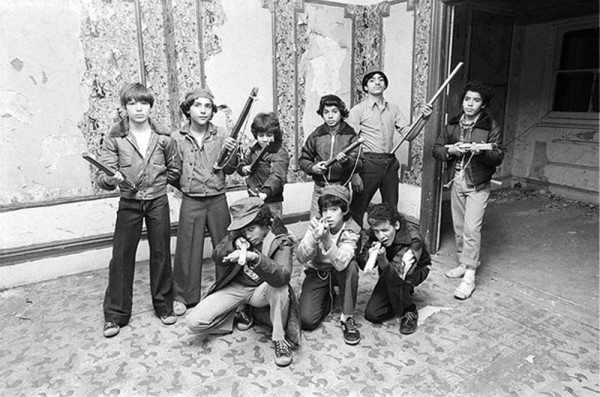
Martha Cooper, "Defiant Youth"

Larry Clark’s mother was an itinerant baby photographer, and she took her son with her on her rounds. This means that Clark, the photographer famous/infamous for his grittily voyeuristic depictions of youth culture, began photographing kids when he still was one. Before he reached 20, he was taking his camera deep into a late 1960s and ‘70s drug culture, documenting the experience in a way that often seemed more persuasively visceral than it probably seemed in real life. Later, he’d shadow skaters and other young creatives, obsessively immersing himself in the worlds of his subjects.

Clark is a lifestyle artist, but not of that holistic, spiritualistic or narcissistically new age “life is art and art is life” vein. He’s the kind who is just interested in doing what he wants to do and doesn’t over-fixate on boundary-crossing—or maybe fixates about boundary-crossing to the exclusion of all else.

This sensibility is what connects Clark with a good number of the street artists who share space with him in MOCA LA’s current controversial street art blockbuster, Art in the Streets. But it’s not what makes his work so well-suited to the exhibition. It’s that Clark, like most of the other photographers who appear, is really good at capturing the vibe of a given community—it’s exclusivity, its urgency, it’s quirks and attitudes.
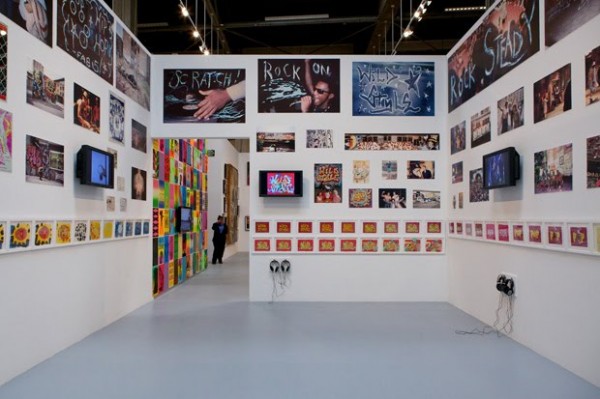
Installation View of Art in the Streets at MOCA

I’m not the first to thrill over the inclusion of such a strong posse of art and journalistic photographers in Art in the Streets. It more or less pulls the exhibition out of the realm of showmanship and into a softer, smarter realm of reflection. While Banksy’s alleyways and dank walls, as dark and melodramatic as a haunted house, and Barry McGee’s  five life-size sculpted taggers standing above in overturned car make it glaringly obvious that you are not in the street, but instead in a weird performance of “streetiness,” the photography pulls you back into the spaces and lifestyles this work emerged out of. Along with Clark, the show features work by photographers (and filmmakers) Martha Cooper, Henry Chalfant, Cheryl Dunn, Ed Templeton, Terry Richardson, Teen Witch and others. Each captures the sense of community and restlessness, and also the thrill of tagging and train-riding and working your way into a subculture that makes sense to you.

Read More »

Share

Fan Mail

Fan Mail: Sandra Erbacher

For this edition of Fan Mail, Sandra Erbacher of Madison, Wisconsin has been selected from our worthy reader submissions. Two artists are featured each month—the next one could be you! If you would like to be considered, please submit your website link to info@dailyserving.com with ‘Fan Mail’ in the subject line.

Sandra Erbacher, #116 (I kept this part away from you), 2013, digital billboard, 14 x 48'. Photograph by Jim Escalante.

At first, Sandra Erbacher’s sculptures and installations seem simple, dealing with space, geometry, and formal concerns in a playful way. After learning that she lived in Germany until age 19, her identity emerges more fully, contextualized in the era of the Berlin wall and her divided country. She says that her imagery “can equally refer to former East Germany, former Soviet Yugoslavia, the Communist Manifesto by Marx, Minimalism or Brutalist architecture-all instances or manifestations of failed Utopian thought.”

On the surface, her work is an antidote to our often overwhelming/overstimulating world. She uses common material, often industrial or commercial products, but renders them anti-monumental. She calls this approach “material failure”, showing the “inadequacy of the object or image to reveal its history and former or indeed current function.” For her digital billboard display, the image first appears as a landscape, especially from a distance. But upon deeper investigation, the viewer is rewarded when the material is detected.

Sandra Erbacher, #116 (I kept this part away from you), view from a distance. Photograph by Jim Escalante.

Erbacher explains this temporal display: “It is a photograph of the opening of a battered, old cardboard box…. Formally, the image vibrates between the illusion of landscape and the representation of an object. …Displaying an image of a discarded object that has outlived its use-value on a billboard, a tool of communication reserved for the marketing of products earmarked for consumption, creates a subtle sense of disruption….”

Sandra Erbacher, #117, wall paper collage, approx 6ft x 20ft.

She describes her #117, wall paper collage as “the ruins of a WW II war memorial are resurrected and translated into the burnt out skeletal structure of a house”, provoking the viewer to consider the state of Germany after WWII, and the past in general as it reverberates through the present. Though there is “no literal translation of a personal narrative,” she tells us, Erbacher describes the connection between mass memory, history, and her identity: “My work is certainly marked by a sense of personal displacement stemming from my departure from Germany almost 15 years ago (at the age of 19) and my move to, first the UK and now the US. This displacement led to a constant search for a sense of belonging and roots, and a curious feeling of nostalgia combined with a sense of detachment towards my country of birth. This personal search for identity and history, which is marked by an acute sense of loss or melancholia and the wish to recover past memories is coupled with an analytical fascination with the history of my country and a more general need to understand and deconstruct a political or social system, its structures and ideologies as well as the mechanisms through which it perpetuates itself. In particular, the works deal with the idea of the breakdown of a system, the obsolescence of monuments and ideologies and the voids these leave behind. They are in essence the result of a process of borrowing and sampling in a continuous rewriting and questioning of history.”

Read More »

Share

Interviews

Talking in Circles: An Interview with Aki Sasamoto

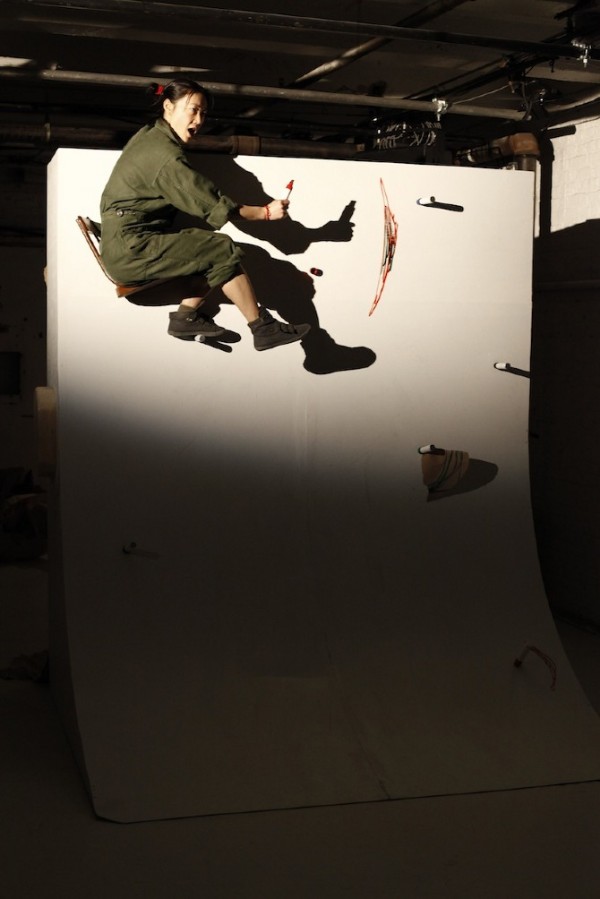
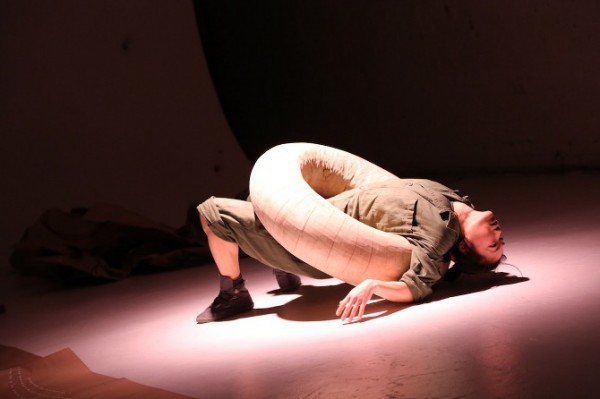
Amongst the many trends floating around the contemporary art world, you may have noticed a resurgence in performance art in galleries and museums.  The old guard of artists from the 60’s and 70’s are being recognized in grand retrospectives, such as Marina Abramovic’s critically acclaimed The Artist is Present at MoMA in 2010, as well as the Guggenheim’s current show, Gutai: Splendid Playground, a retrospective of the often over looked, post war Japanese artists who regularly crossed over into performance. Meanwhile, a groundswell of young performance artists have been showing at venues ranging from theaters to galleries to biennales world-wide.  One of these emerging artists carving out her place in the movement is Aki Sasamoto, who performed at both the Whitney Biennale and MoMa PS1 in 2010.  Her performances involve interactions within installations that are reminiscent of the Fluxus artists of the 60’s, but with a more personal twist.

Aki Sasamoto, "Centripetal Run" (Performance View) 2012, Courtesy of the artist

I first met Aki when she was a visiting artist at the University of Colorado Boulder. We got to know each other over lunch at an oddball Mexican restaurant in Denver that serves frozen dinner quality food while cliff divers leap from the rafters, which was a great meal to share with a performance artist.  Since then, I’ve followed her work as she has shown in India, Korea, Japan and Mexico, published a book, as well as had two New York solo shows – Centripetal Run (2012) and Talking in Circles in Talking (2013) – both favorably reviewed in the New York Times. A year after that first meeting, I was able to catch up with Aki and ask about her renewed interest in performance art and the question of commodity in her work.

Michael Holmes: I recently watched Centripetal Run online.  It was interesting to be able to see your performance in that context.

Aki Sasamoto:  Oh, thanks. I enjoyed doing that but I didn’t have a videographer, so it’s a partial view and bad documentation but that’s ok, it makes people think that you need to see it live.

MH: That’s an important factor, witnessing it in person. I think that is a big part of the renewed interest in performance art. People want to see art live, in the location.

AS:  That has something to do with it. I think people want to witness the body, rather than a static object. They want presence.

MH:  Right. People can more easily access painting or even sculpture online, but performance begs to be witnessed in person. So it’s good for the gallery, good for the museum. It draws people in.

Aki Sasamoto, "Centripetal Run" (Performance View) 2012, Courtesy of the artist

AS:  I was just invited to participate in a panel at The Kitchen, called Language, Art, Bodies or L.A.B.  They invited artists from different mediums to talk about the idea of presence. I find that really interesting. Presence is not limited to performance either. Painters, musicians, writers can all talk about presence.

Read More »

Share

Berlin

Maryna Baranovska and “Madame Oktopus”

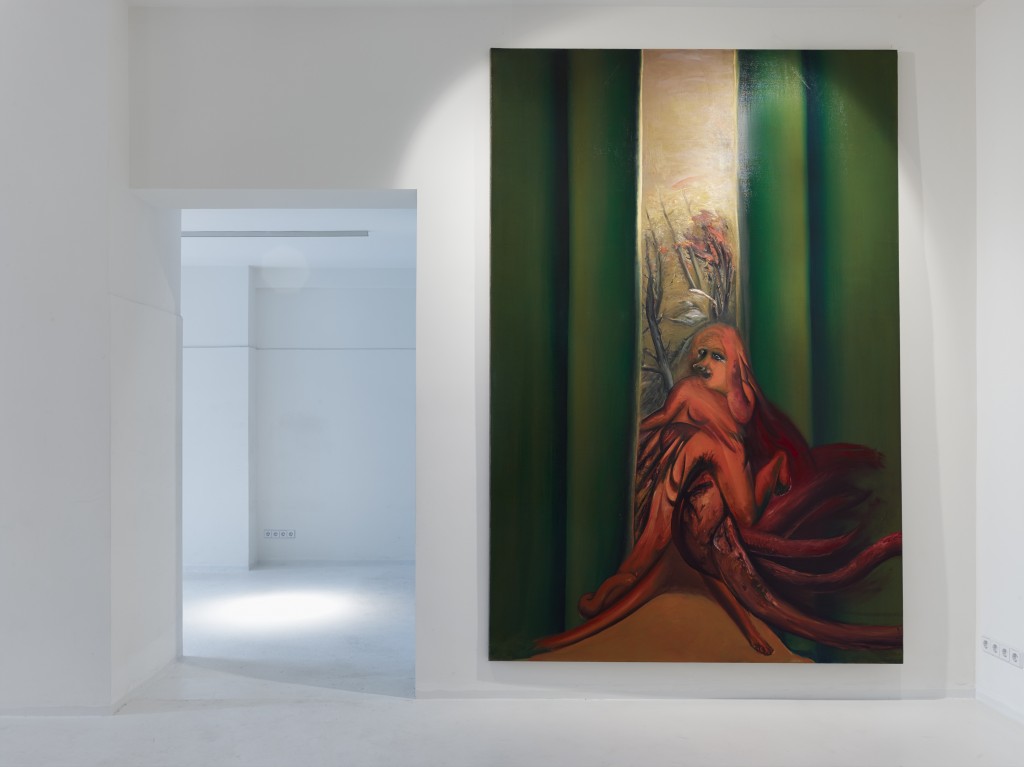
Madame Oktopus is both the name of Maryna Baranovska’s solo exhibition at AJL Art in Berlin and her folk-alter-ego.  The title painting looms large over the exhibition space on Potsdamerstr. and alludes to the entire show’s genesis; a collection of paintings birthed with thick impasto confidence.  Like a lot of Baranovska’s works, Madame Oktopus, occupies the strange and cool split between narrative construction and painterly process.  This character, both mother and artist, looks like a sensual witch, tripping out of the picture plane, and exposing a fourth wall from behind a curtain-cum-painterly-construct.

Installation view, "Madame Oktopus," Maryna Baranovska, image courtesy of Simon Vogel and AJL Art

Baranovska’s larger paintings operate on a modernist plane of ambition and graphics, aspiring to German Expressionist grandeur; a fever-pitch of scale and gusto achieved by Anselm Kiefer among others.  Her more modest endeavors, in contrast, are awkwardly haunting and idiosyncratic, like bright, frothy companions to the drawings of Alfred Kubin.

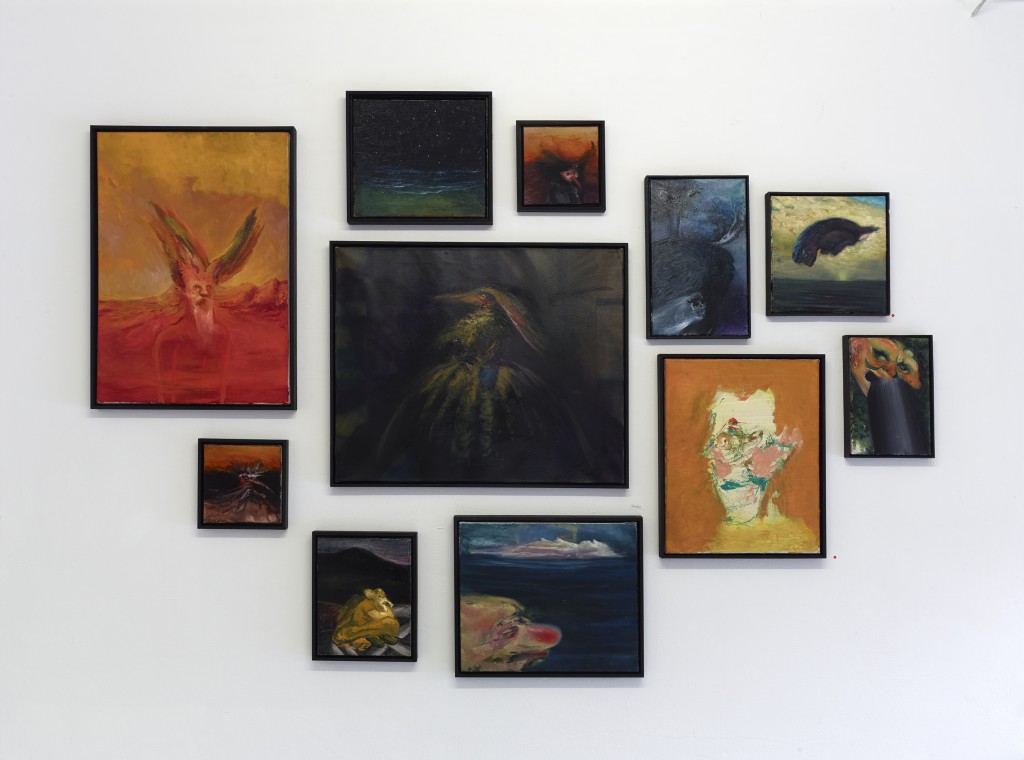
The smaller paintings have a folkloric quality that is strong and clear.  The characters, in contrast, are often less defined.  They are engorged in tufts of painted smoke, or air, creatures with variable dimensions.  There are allusions to mice, peacocks and Eastern tigers, but these remain enigmatic and obscured, allowing viewers to fully engage in a prognostication of form.

"Daemon," 2011, Maryna Baranovska, image courtesy Simon Vogel and AJL Art

To compare someone to Chagall these days is an affront to more refined aesthetic sensibilities.  Chagall is the default sophomore-dorm-room poster; more Russian regionalist than avant-garde.  This Chagall-backlash derives in part from a certain earnest sentimentality, imbued with a childish spirit.  Like Chagall, Baranovska is invested in Eastern European Jewish folklore, and attempts the difficult, if not impossible, task of documenting mysticism through painting.  

Her paintings celebrate supernatural ambiguity, and call to mind a central figure in Slavic folklore: Baba Yaga.  Baba Yaga is an old woman who lives in a hut built on chicken bones and is able to shift and morph into a number of forms and elements (wind, for instance).  An animal called the “Firebird,” features prominently in the Baba Yaga stories, and one can imagine Baranovska’s grandmother (who lives in the forested regions around Kiev) cultivating her interest in otherworldliness.

Installation view, "Madame Oktopus," Maryna Baranovska, 2013


Although this bit of biography is not irrelevant, Baranovska is an artist equally invested in painterly innovation.  In the strongest works her two impulses exist together, leaving the viewer to sort through form, myth and authorship.

Share

New York

The Scattered Geometries of Matt Phillips

This, and then. It’s the title of Matt Phillips’ latest exhibition and a useful shorthand for the mental quick march a viewer undergoes when observing his work. Through his abstract oil and acrylic paintings, Phillips plays with color, form, and volume—the building blocks of our artistic experience—to create dynamic, shifting spatial relationships. His canvases evoke, simultaneously, the calm beauty of the natural world, the randomness of a handmade quilt, and the vivid prisms of Alfred Jensen’s paintings.

Matt Phillips, House of Hands,  mixed media on canvas, 54” x 66”, 2013 / Courtesy of the artist

Phillips is a visiting artist at Mount Holyoke College in western Massachusetts and a founding member of the nonprofit TSA gallery in Bushwick, where he remains a vital presence on the pop up scene. His current show at Steven Harvey Fine Arts Projects—Phillips’ first solo exhibition in New York—features a selection of his most recent works.

Installation, 2013 / Courtesy of the artist

“The show kind of ended up sorting itself out based on the space and the kind of internal relationships between the paintings,” Phillips said in a phone interview. “I didn’t know exactly what works were going to be included until I got into the space.”

The interaction between the art and the space is particularly affecting in this show. While many galleries have frosted windows or restrict exhibitions to inner rooms, isolating them from the street, Steven Harvey has a floor-to-ceiling window in front, which generates a dialogue between the world outside and the paintings on display. The play of shadows across the surface of Revolverator, a large-scale work done in vibrant pinks, greens, and blues, created new lines on the triangles of the canvas that shifted with the moving sun. Somehow, even the teenagers playing basketball across the street in Sara D. Roosevelt Park, and the woman walking by in a seafoam fur coat, seemed to be reflections of Phillips’ vacillating, playful paintings.

Read More »

Share

Help Desk

Help Desk: Juried Shows

Help Desk is an arts-advice column that demystifies practices for artists, writers, curators, collectors, patrons, and the general public. Submit your questions anonymously here. All submissions become the property of Daily Serving.

I am a painter who recently graduated from art school but haven’t had much gallery experience and I was interested in submitting work to some juried shows as a way of gaining some experience and making some new connections. I was wondering if you could offer some advice on finding reputable juried shows to apply to. I have googled around but haven’t found much.

Juried shows can indeed be a great way to gain experience and build your resume, but “reputable” is a relative term. Here are a few questions to keep in mind as you go about sorting through the listings on websites such as College Art Association, Re-title and WOOLOO:

1.) Is there a fee? How much does it cost to apply? Most juried shows charge a fee to review your work and this often goes toward administrative costs such as paying the juror. It’s usually around $30 for 3 images, but you’ll find some that ask for excessive fees (I know of one that charges 65 euro!) and some that charge no fee at all (usually at community colleges or other small regional venues). Set a budget for this career expense and decide what your upper limit is. If you’re independently wealthy you can toss your money around with abandon, but if you are on a limited post-graduation budget you might want to target your applications very carefully.

Bear in mind that a high entry fee does not guarantee a high-quality exhibition. Follow the call-for-entry’s link back to the home website and take a look. Does it appear professional? If it’s an annual show, how was the work from previous years? Have prior exhibitions received attention from the press? The information on the website should help you decide if the institution provides quality programming. If there’s no website, don’t apply!

Henry Taylor, Another Wrong, 2013. Acrylic on canvas, 116 x 75 1/2 x 2 1/2 inches

2.) Where is the exhibition? In other words, who will see the show? If it’s at a small town community college gallery, the audience might largely consist of the students and professors (and I’m not saying that’s a bad thing), whereas a commercial gallery in a medium-sized city might draw a more diverse group of art patrons. Think about what audience you’d like to have. Since you’re early in your career, getting work in front of audiences is the first priority. Sales are great, but exposure to an engaged audience is a critical investment in your future.

3.) Who will jury the show? Often times gallerists or curators from museums/other arts institutions will jury exhibitions outside of their normal habitat. If you see that a curator who has shown interest in the type of work you make is the guest juror for a show, by all means apply. You should always google the juror to see what comes up. Read More »

Share

From the Archives

The Glam That Fell to Earth

Sometimes scholarship on punk can feels a bit blasphemous, but if Billy Idol shows up to a panel, he gives it some cred. Today from the DS Archives we bring you punks, hippies, and glam with two exhibitions examining the cultures, fashion and lifestyles. Glam! The Performance of Style is on view at the Tate Liverpool until May 12 and features the the work of David HockneyAndy WarholCindy ShermanAllen JonesRichard Hamilton, Peter Hujar and many more.

The following article was originally published July 22, 2011 by :

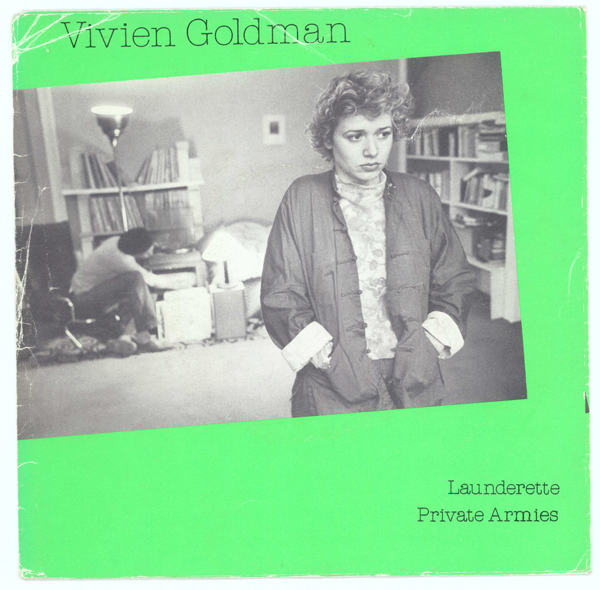
Album cover by Vivien Goldman, moderator of last weekend's Punk Panel at Honor Fraser Gallery.

On Saturday, July 16, Honor Fraser Gallery in Culver City hosted a panel on Punk. The panel preceded the openings of two shows, one an earnest exploration into punk’s visual precedents and antecedents, and the other an extravaganza of posters, bills, and graphics from the Punk movement of 1970s Britain. The Punk panel, chaired by Vivien Goldman, who has been a writer, performer, scholar and manager—she’s recently written a book on reggae—included a surprise guest who came in and put his motorcycle helmet on his chair about ten minutes after the panel’s scheduled start time. Read More »

Share