From the Archives

VERSUS

In this week’s “From the DS Archives”, we link two photographers’ projects which discuss the relationship between a son and his parent, and coping with the effects of age on the brain and the renewed relationships between aging parents and their aging children. Joshua Lutz’s new show “Hesitating Beauty”, which opened April 11th at Clampart, with a new monograph of the same title, creates an intensely intimate portrait of the artist’s mother, whose mental illness dissipated with the onset of dementia. In a similar vein, today we revisit the work of Phil Toledano, whose work has been covered in Daily Serving here and below. A piece from his project “Days with my Father” is pictured below.

The following article was originally published on January 28, 2010 by Allison Gibson
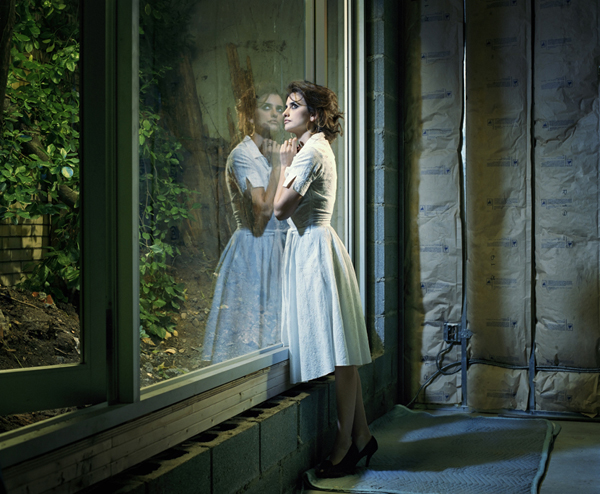
Eric Ogden, untitled (penelope cruz), 2009

Currently on view at Hous Projects in New York is the exhibition Versus—a unique sort of survey featuring 18 seminal photographers of our time. Curated by Ruben Natal-San Miguel, whose work is also exhibited in the show, Versus pairs these emerging and established contemporary photographers with one another according to similarities—and striking contrasts—in subject matter, theme and aesthetics. The photographers explore ideas of ideal beauty, subjects of idolatry in America, relationship dynamics, juxtaposing stages of life and architectural and environmental moods. Some of the comparisons and contrasts between the paired photographs are more subtle, while other times the images seem to mirror one another. The visual motifs presented by the photographs on view are equally striking. Deep shadows conceal some scenes while others employ repetitive pattern to contrast with meek looking portrait sitters.
Jen Davis, untitled (2005)

Jen Davis, untitled, 2005

Read More »

Share

San Francisco

The Modern Monster

As a part of our ongoing partnership with Art Practical, today we bring you a review by Matt Sussman of the exhibition The Modern Monster at Queens Nail’s Gallery in San Francisco.

Valerie Hegarty. George Washington Melted 4, 2011; canvas, stretcher, paper, acrylic paint, and gel medium; 40 x 30 in. Courtesy of the Artist and Nicelle Beauchene Gallery, New York.

“What kind of monster are you?” is the chorus from a single by the ’90s pop-punk group Slant 6.1 The question accuses the listener of being something other than human. However, the singer-guitarist Christina Billotte’s flat delivery also invites the listener to self-identify as non-human: what kind of monster are you? Monstrousness, then, is a condition from which we recoil even as we uneasily recognize its latent potential within us. High points of terror in horror movies often coalesce around scenes in which characters are confronted with the realization that the monster is like them or is in fact one of them—a recurring moment of recognition frequently accompanied by graphic representations of bodily disintegration or somatic disorder.

The artists in The Modern Monster, a whip-smart yet wonderfully unpretentious group show at Queen’s Nails curated by Jeanne Gerrity, consider with both seriousness and humor the hovering existential threat posed by the monstrous. (Disclosure: Gerrity is a contributor to Art Practical.) Gerrity borrows her exhibition’s title from an essay by Lars Bang Larsen that offers a post-Marxist reading of the zombie—the monster with perhaps the most current pop-cultural cachet—as an ambiguous figure for capitalism’s perfected condition, in which subjects are alienated beyond death itself.2 Larsen’s zombie is the last gasp of monster-as-metaphor and the final turn of the screw that collapses both external and self-ascribed alienation onto one chaotic non-being. Although the works in The Modern Monster aren’t nearly as polemical as Larsen’s thesis, many of them opt for methods and materials that formalize the messy business of unbecoming that he traces over the course of his essay.

Read More

Share

San Francisco

Nature is Not Human Hearted

In Art, I am generally not a fan of beautiful landscapes. That is not to say that I do not appreciate the inherent splendor of nature, it just always seems too picturesque and subsequently too easy.  The source of my aversion is popular visual culture’s inundation of images showing over-saturated suns rising or setting, paths and docks receding into the distance, and natural monuments impressing their grandeur. It is a manipulation of the majority’s wide-ranging attraction to the unchallenging and aesthetically pleasing. In Water & Polaroid, Matthew Brandt’s current solo-exhibition at Highlight Gallery, he appropriates and subverts the archetypes of landscape and commercial photography to create works that are both visually striking and challenge the expectations of a “good” landscape photograph.

Mystic Falls K2Y3M3C4 (2013) Multi layered Duraclear and Duratrans prints processed with Mystic Falls water, in LED lightbox frame 65¼ x 46¼ x 2 inches. Courtesy of Highlight Gallery

If imitation is the highest form of flattery, then Matthew Brandt’s reference to contemporary and historical landscapes is a backhanded compliment. He utilizes the pop beauty of nature photography in combination with advertising devices, then breaks them down into a mash up of scenic disintegration. On one side of the gallery hang three bright light boxes, facing them is a mammoth color photograph and on the middle wall two small, monochromatic Polaroids contrast the surrounding vibrancy. While each photograph is undoubtedly of a beautiful vista, none of them gives viewers the cheap pleasures of mainstream landscape photography.

Nymph Lake WY 4 (2013) C-print soaked in Nymph Lake water 72 x 105 inches. Courtesy of Highlight Gallery

Read More »

Share

New York

Historicizing Fantasy: iona ROZEAL brown at Salon 94 Freemans and Edward Tyler Nahem

iona ROZEAL brown’s stylized painting emerges from a studied transmutation of African-American and Japanese cultural tradition. Brown has developed a strong narrative lineage essential to reading her coded (albeit straightforward) illustrative paintings of Afro-Japanese courtesans, voguing stars, and fantasy creatures of mythic royalty. Brown’s concurrent exhibitions at Salon 94 Freemans and Edward Tyler Nahem seek to extend and perpetuate this narrative in a new elaboration on her earlier themes.

Live !, 2013. Acrylic, ink, and gold leaf on wooden panel. 72 x 60 in. Image courtesy of the artist and Salon 94 Freemans.

Brown works out of the personal tradition of a repetitive attempt to merge a fetishization of Japanese and African-American culture, thereby cultivating a mixture of projective fantasy and recollective myth. introducing. . . THE HOUSE OF BANDO, on view through April 25 at Salon 94 Freemans, presents a series of portraits of Benny and Javier Ninja and Monstah Black; these legendary voguing performers collaborated on Brown’s critically acclaimed dance epic the battle of yestermore. . . at Performa 11. no one’s ever gonna love you, so don’t wonder, which ran through March 29 at Edward Tyler Nahem, featured Brown’s repurposed examination of shunga, the specifically erotic form of the Japanese woodblock painting tradition of ukiyo-e. These modern shunga feature a series of heterosexual couplings of Japanese courtesans and royalty sporting a variety of signifiers of an African-American aesthetic, along with blackface makeup deliberately painted over bluish skin.

Brown’s work pays great attention to style. The installation at Salon 94 is symmetrically arranged according to the color of the dancers’ outfits, and each line, painted or drawn directly onto wood, is clean and deliberate. The artist’s commitment to a specificity of technique often associated with the deft, graphic movements of graffiti and street art corresponds to the Kabuki sense of deliberate aesthetic gesture in what seems to be a very tactical simile.

As the artist’s gallery page notes, Brown frequently draws parallels between the intercultural juxtaposition of her paintings and her “artistry as a DJ,” and her artistic practice involves a process of “self-sampling and remixing. . . [creating] endless permutations of representations and meanings.” [i] Brown’s work claims to be a subversion of the original traditions that it mines for its stylistic quality. But remixing is not necessarily subversion—and subversion cannot simply be read as a 180-degree flip of the original. The permutations of Brown’s subjects do not seem endless, but rather quite specific and even finite. Remixing is a postmodern construction that requires a new subject to emerge from the constituents of previously present elements. But as this “newness” is, in fact, merely a re-constructed product of the old, such mixing risks translating as didactic and over-produced.

Pod 222: The Reunion (Song of Solomon 5:10-11), 2013. Acrylic, marker, ink, krink, and graphite on wood panel. Diptych 60 x 48 in. each. Image courtesy of the artist and Edward Tyler Nahem.

Read More »

Share

Los Angeles

Trisha Brown in Los Angeles

"Floor of the Forest". Photo: Winarsh-Documenta 2007.

For whatever reason, the Los Angeles art community has dance on the brain. It may or may not have started with artist and choreographer Simone Forti’s inclusion as one of the “Made in L.A.” finalists (the Hammer Museum’s mega-group exhibition-cum-contest from last summer), but the upcoming “Dancing with the Art World” conference (again at the Hammer) clinches the deal—two days of lectures and events with luminaries like Forti and Yvonne Rainier, as well as Douglas Crimp and Andrea Fraser. The conference’s raison d’être is to investigate a so-called “explosion of dance being presented in an art context” over the past five to ten years, although we all know that dance and art have been lovers for longer than that.

Over the past week, UCLA’s Center for the Art of Performance restaged multiple pieces by Trisha Brown, whose work over the last four decades has pushed the definition of dance and encouraged its viewers to reconsider what could be achieved under the rules of gravity. Originally from Washington, Brown found her way to New York, where she helped to found the Judson Dance Company with Twyla Tharp and Steve Paxton, among others. The Trisha Brown retrospective offered samples from all stages of Brown’s career, including three of her earliest works: Floor of the Forest (1970), Man Walking Down the Side of a Building (1970), and Roof Piece (1971).

Dance Troupe Performs On New York City's High Line Park, 2011. Mario Tama/Getty Images North America.

Even if these works hadn’t been separated out from the rest of the line-up by being performed at museums (the Hammer and the Getty), they are different in that, on the surface, they barely appear to be dance: Man Walking Down the Side of a Building was originally performed by Brown’s husband, who walked straight down the side of a New York apartment building, belayed by rope. Roof Piece involved a group of individual dancers on separate New York rooftops who tried to transmit their movements to the other dancers. And Floor of the Forest is based on the movements of several dancers trying on clothing strung on a grid of ropes, meaning that the dancers dangle from the ropes, along with the clothing.

Read More »

Share

Portland

Porn and Patterns: 21st Century Vanitas in Portland

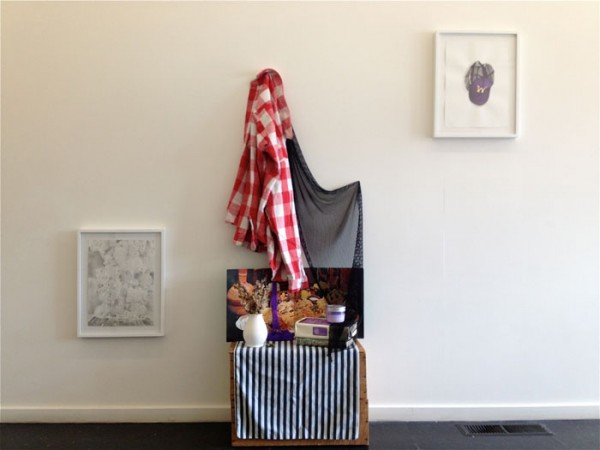
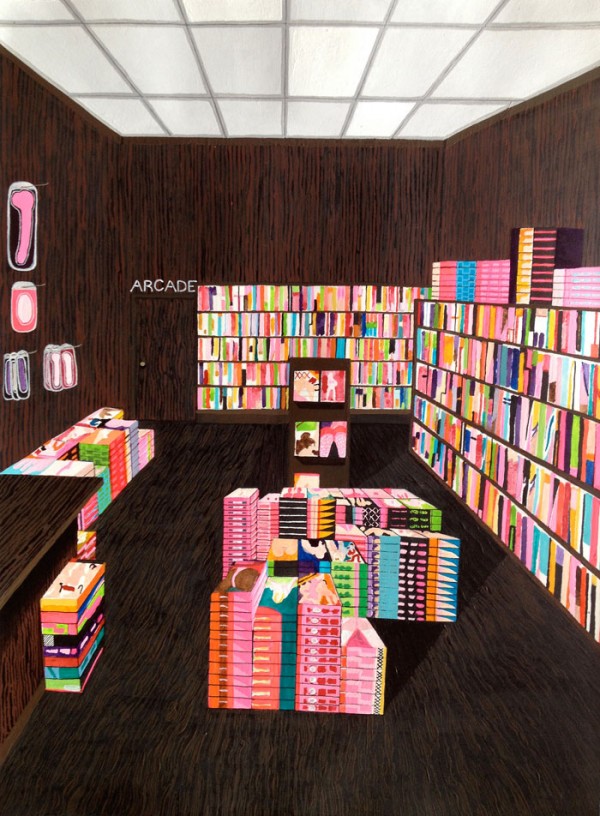
It may take a second to see the sex. Ty Ennis’s show at Nationale this month consists of petite paintings featuring prominent textile patterns, done with the gentlest touch. Look a second longer and you notice the erotic: porn dvds, romance novels, a vaginal oyster.

The paintings are mostly still lifes, and even though there’s sex, they’re not sexy (and not meant to be). They’re softly painted, but the sex imagery is rougher: a DVD case is open to a disc titled “Weapons of Ass Destruction,” with two women flashing.

Ty Ennis, “Still Life with Weapons.” Ink, watercolor, and acrylic on paper. 15x11”. 2012.

Note how the color palette of the disc sticker correlates with the lavender lilacs in the painting: the work is funny. After all the show is called JKJKJK, as if to say “just kidding just kidding just kidding,” (but also JK for Jill Kelly, the porn starlet). The bluntness of the erotic images sidles up to their demure setting. Not surprisingly, the paintings are illustrative. Ennis is Portland-based, and Portland is renowned for its graphic arts scene (comics, illustration, and graphic design alike), with Nationale being fantastic at showcasing some of the best work in the illustration vein, (see: Carson Ellis, Cari Vander Yacht). Like a number of other finely curated shops in Portland—Ampersand Vintage and Monograph Bookwerks—it also features original artwork.

Ty Ennis, “The Knowing You.” Mixed media. Dimensions variable. 2012.

Within the context of a retail space, lines blur between the art and the space. An installation on the right side of the gallery exhibits flannel, the Marquis de Sade, a vase of lavender, a candle, and a record. Although the art camouflages slightly with the merchandise of the retail space, the work is extremely personal. A previous show by Ennis at the (now defunct) New American Art Union also united somber with the personal: You’ll Love It Here: The Lilac City Track Murders ’96-‘98 was based on the female victims of a serial killer in his hometown of Spokane.

In addition to being personal, The work in JKJKJK is not purely humor; as still lifes, they pull from the vanitas tradition, referencing mortality. Ennis’s work is often wrapped up in the past, evidenced by other previous show titles: The Bronze LossWhat it All MeantEverything is great here, maybe.

Ty Ennis, “2nd & Bernard (Spokane, WA).” Ink, watercolor, and acrylic on paper. 15×11.” 2012.

Read More »

Share

Hashtags

#Curating Activism: An Interview with Julio César Morales

Julio César Morales is an artist, curator, and educator who recently left the San Francisco Bay Area to become curator at the Arizona State University Art Museum in Tempe. Morales was an adjunct curator at the Yerba Buena Center for the Arts from 2008-12, where he created PAUSE: Practice and Exchange,” a series of solo exhibitions by artists including Allan de Souza, Euan Macdonald, and Gina Osterloh. He is a co-founder of San Francisco’s Queen’s Nails Projects. Anuradha Vikram spoke to him about his recent transition and his commitment to community-based art and activism.

AV: Do you think that art can influence public opinion and public policy? Is this a legitimate goal for artists to have?

JM: Yes, I do! At the risk of sounding too utopian, there are and have been some amazing projects that have had an impact at various levels of civic engagement. Look at an artist such as Suzanne Lacy, who for the last 30 years has created a wide range of projects that, at their core, are about social change and changing public policy. Her 1977 project, Three Weeks In May,  had a forceful political imperative—to bring hidden experiences of rape to public attention—and her 1999 Oakland-based project, Code 33, was a three year project to reduce police hostility toward youth, provide youth with a set of skills to participate in their communities, and generate a more profound understanding of youth needs. This project led to the development of youth training for the police department. Now anyone entering the police has to take the training created by Lacy and her collaborators, including myself.

Another example is the Tijuana-based Torolab, led by Raúl Cárdenas, which serves as a collective workshop and laboratory, identifying situations or phenomena of interest for research, with a focus on lifestyles and “quality of life.” One recent project, COMA, traced the physiological changes of a Mexican person in their everyday relation to food. The project culminated in creating a type of bread containing all the nutrients absent in a typical Mexican diet, according to the Mexican national health census. This new food product was launched in Puebla, with the support of the city, and is now helping to combat diabetes and malnutrition.

Read More »

Share