Elsewhere

A Clue to The Recovery of Authenticity: Raul Bussot and Kim Hong-Rok in Seoul


Raul Bussot and Kim Hong-Rok "A Clue to the Recovery of Authenticity: Raul Bussot" (Installation View) 2013

Raul Bussot was 5 years old when his family decided to escape Cuba, so he doesn’t remember the details very well.  He remembers his father and two friends assembling a raft in a mangrove forest under the cover of darkness.  He remembers pushing the raft to the beach while keeping an eye out for the Cuban Coast Guard.  He remembers huddling together for warmth out on the ocean.  He also remembers being most excited about watching cartoons without power interruptions.  However, shortly after leaving they got caught in a torrential storm and blown off course into the open ocean.  They drifted for days, not knowing their location, not knowing if they would survive.  On the fifth day, running low on provisions as well as strength, they saw lights in the distance and were eventually rescued by the US Coast Guard.  Now twenty years later, Raul is an artist living in Seoul, South Korea and along fellow artist Kim Hong-Rok sought to recreate that experience in a collaborative piece called A Clue to the Recovery of Authenticity: Bussot, Raul, which ran for five days at Khalifa Gallery in Cheongdam, Seoul.

Raul Bussot and Kim Hong-Rok "A Clue to the Recovery of Authenticity: Raul Bussot" (Performance View) 2013

In preparation of the piece, Bussot and Kim built a replica of the small, aluminum raft that his father had built back in Cuba and installed it in the gallery.  They then “sailed” the raft for five days, living and sleeping on it for the entire duration, eating and drinking only the same provisions that the Bussot family had on their original journey: Spam, chocolate, and water.

On its surface, this work is an endurance piece, reminiscent of Tehching Hsieh’s Cage Piece (1978-79) or Chris Burden’s White Light/White Heat (1974)where the artists lived in isolation with little or no food.  However, this work departs from those others in a significant way.  Russot and Kim actively engaged the audience, sharing both the original experience as well as their current one.  In this way, the interactions of the audience became as much a part of the piece as the performance itself.

Read More »

Share

New York

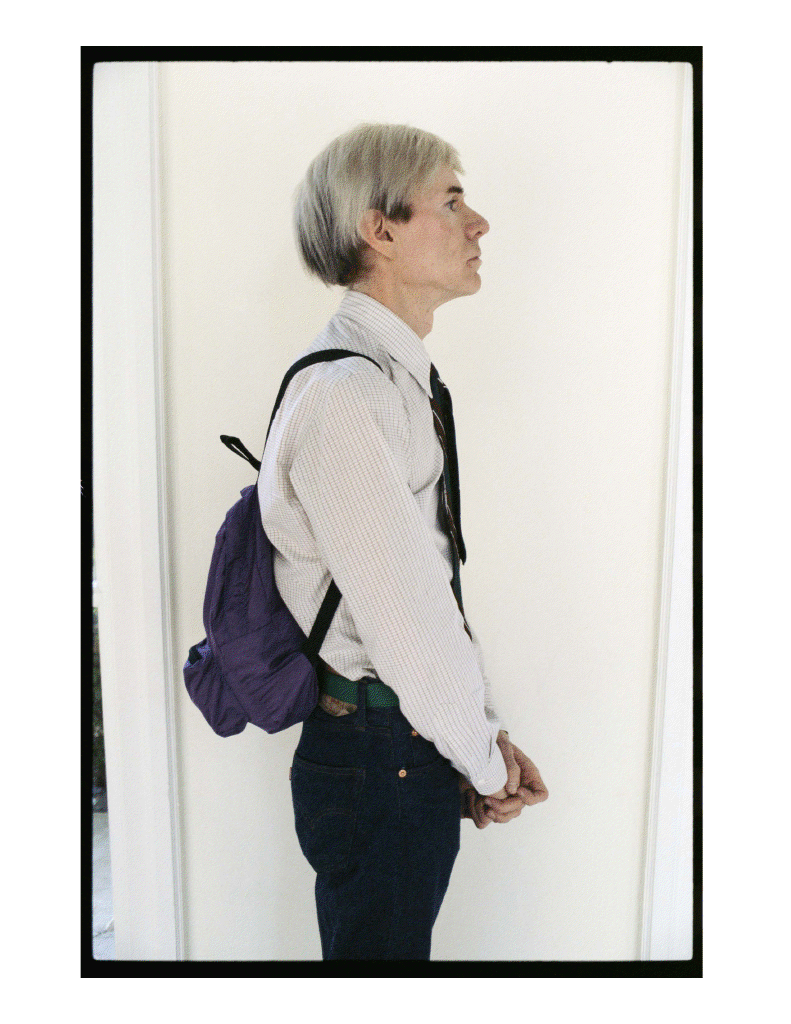
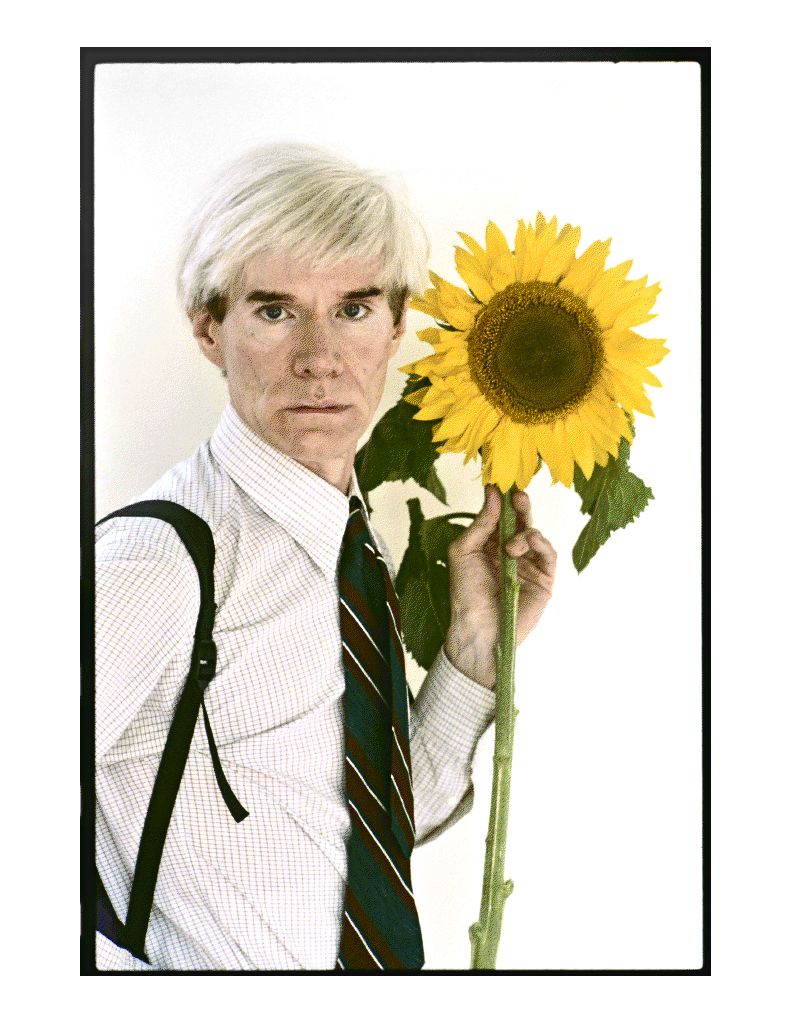
Lost Andy Warhol Photos Pop Up in NYC For First Time

As a part of our partnership with Huff Post Arts, today we bring you a story written by Susan Michals about newly found photographs of Andy Warhol. 

2013-04-22-WarholFlower.jpg
(Image courtesy of Steve Wood)

One of the most iconic faces of the 20th century is about to be rediscovered. On May 3, lost images of pop art icon Andy Warhol will be unveiled in Manhattan for the first time in public in an exhibition sponsored by Interview Magazine, which the artist founded in 1969 . “Lost, then Found”will give viewers a never-before-seen glimpse of Warhol, circa 1981, shot by British photographer Steve Wood.

While the late Mr. Warhol is perennially popular, this week he’d be thrilled to know that he’s getting well beyond his 15 minutes. His New York pad is up for sale for $5.8 million, and his iconic Studio 54 escapades forever immortalized in photographs are on the virtual auction block on April 26 atChristie’s.

2013-04-22-Warhol_Backpack.png
(Image courtesy of Steve Wood)

British photographer Steve Wood had spent his life in the world of photography. As one of the chief photographers of the English national paper, The Daily Express, Wood spent time on the front lines of war, in fashion shows, and found a way to document the Royal family. In the summer of 1981, he traveled to France for the American Film Festival of Deauville, which takes place every August to capitalize on the high celebrity quotient that would be in attendance. By chance he ran into his longtime friend, Elaine Kaufman, her new husband, and their friend Andy Warhol.

Read more >>

Share

Hashtags

#Hashtags: No Wrong Way In, No Wrong Way Out

Left: Barbara Takenaga, "Blue Wheel," 2007. Acrylic on panel, 24 x 20 in. Right: Daniel Zeller, "Filtered Compression," 2008. Ink in colors on paper, 10 1/4 x 8 in. Both from the collection of Richard Green.

In contemporary U.S. culture, abstract art is difficult for many to grasp because it so completely defeats the imposition of language on art that cultural meaning falls away. If abstract art asserts meaning at all, it does so elliptically, circling around, not toward, the identifiable expression of objects, events, people, experiences, emotions, or ideas that representational art depicts. In a sense, then, abstract art is always subversive, always in conflict with mainstream European cultural and historical imperatives to populate the canvas with recognizable objects, traditionally the symbols and tropes that a particular era and place associates with authority and power, history, capital, or god. This dominant way of making and perceiving persists even though U.S. culture has been from the start, and is continually, inflected with culturally multitudinous ways of expressing and seeing. Even when it deploys forms, colors, and compositions that are culturally resonant, abstract art incites the visitor to relinquish this representational predictability and safety.

In the face of unpredictability, however, I, the viewer, am pushed toward agency. I must see in personal terms rather than in the prefabricated terms of literal depiction. Abstraction is cruel in that way. Either I trust the legitimacy of the intuitions this personal journey may inspire or I doubt the work—or, worse, myself.

Read More »

Share

From the Archives

Fan Mail: Tabitha Soren

This week, From the DS Archives revisits an article by  from our Fan Mail series.  Tabitha Soren‘s new exhibition Running recently opened on April 13th at the Kopeikin Gallery and will be on view during Paris Photo Los Angeles, April 26th – 28th, 2013.  No saying what kind of impact our profiles may have on the artists that we feature, but we are always happy to see our Fan Mail artists off doing excellent work!

Tabitha Soren, Installation view of Running at Kopeikin Gallery. Photo courtesy of Kopeikin Gallery.

 Fan Mail: Tabitha Soren was originally published on November 22, 2012.

For this edition of Fan Mail, Tabitha Soren of San Francisco, CA has been selected from our worthy reader submissions. Two artists are featured each month—the next one could be you! If you would like to be considered, please submit your website link to info@dailyserving.com with ‘Fan Mail’ in the subject line.

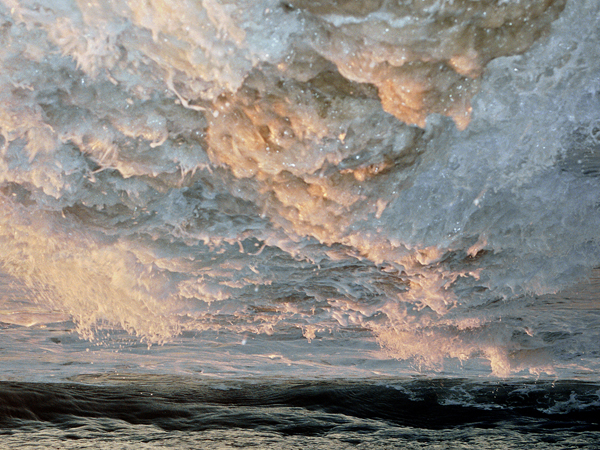
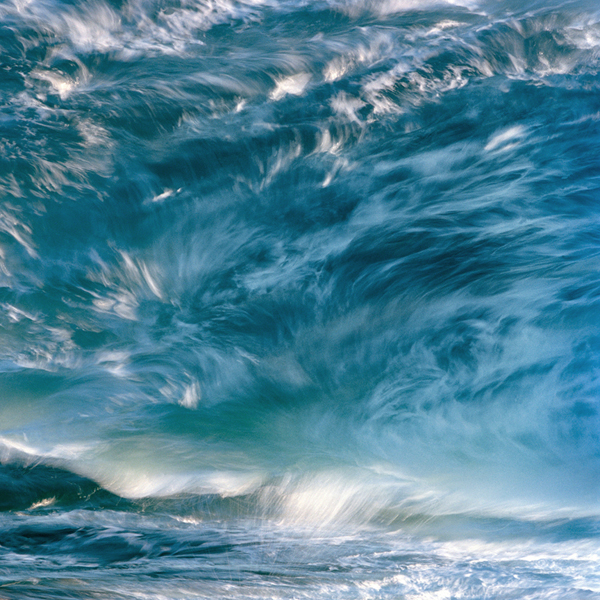
Tabitha Soren’s photographs of turbulent water are steeped in her experience and emotion rather than simply being an homage to the beauty or majesty of nature. Like Alfred Steigliz’s photographs of clouds which he called “equivalents” and other Cloudscape photographers, nature is a catalyst for the phenomenological content of the photographer. The way that forms can be seen in clouds is like looking at an inkblot, and water acts in the same way, producing random formations on the surface.

Tabitha Soren, "Panic Beach" series, Oceanscape 15763-4.

Soren says of these images: “For me, the waterscapes are taken in response to the random tumultuousness of the human experience. In fact, I got knocked down quite a bit by the ocean taking these pictures. This project is an invitation to dive into the complexity of life – and into the unpredictability of it.  (It’s not as if we have any choice about the havoc anyway.) But, then, I remembered how much I respond to the beauty AND meaning in J.W.M. Turner’s paintings and to Hiroshi Sugimoto’s photographs.  My oceanscapes are in wild contrast to Sugimoto’s calming black and white seascapes but nonetheless, inspired by them.”

Tabitha Soren, "Panic Beach" series, Oceanscape 00107-8.

“The compelling colors and patterns of the ocean may draw you in but the ferocity and brutality of the water are lurking too.  Each photo attempts to blur the distinctions between earth and sky, and flat and deep, which is how unbalanced I feel when a crisis hits. Rapidity is brought to a still in the image. Like the flow of information on a television screen or in our urban environment, we are normally washed over by the rapids, and encountering stillness gives a moment of peace and reflection.”

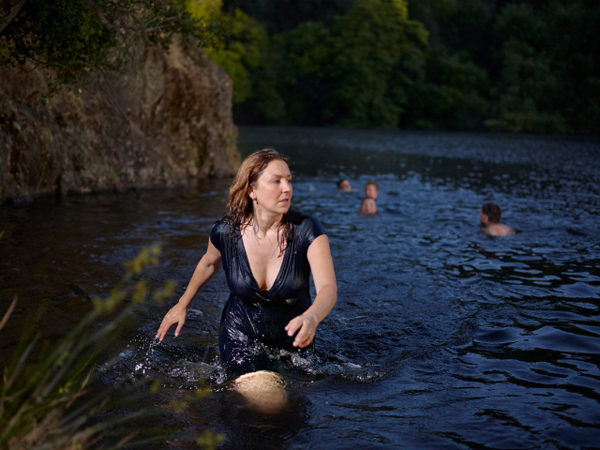
Soren’s subjects are set-up as though part of a narrative, but they are not actors, just acting. The confluence of intent and acceptance of the unknown are essential to her process.

Tabitha Soren, "Running" series, 000516, 2012.

“My Running series attempts to explore panic, mortality, resilience and the role of the accident in life.  The images involve a lot of pre-production, but then once the person starts running, I have no idea how the picture will turn out. The images also rely pretty heavily on a mixture of natural and artificial light.  The combination of light sources, planning and spontaneity serve as comment on contemporary photography.  Is it true? and does that matter? The Running photographs are also as much about what is outside of the frame, as what is inside it.  The viewer has to mine their own secrets to fill in the narrative. Finally, when people run their bodies contort and we get a glimpse at emotions that are normally kept hidden.”

Read More »

Share

Chicago

Painter of History

Painting has been around for a while, haven’t you heard? So it’s no surprise when a new show can set off a flurry of historical associations and still appear to be of its own time. Jon Pestoni’s exhibition of recent abstract paintings at Shane Campbell gallery does just that.

'Condiments' (2013). Oil on canvas 78h x 60w in (198.12h x 152.4w cm). Courtesy of Shane Campbell Gallery.

Pestoni’s paintings bare a superficial resemblance to work by Gehard Richter. The vertical and horizontal movement of nearly canvas-wide brushstrokes in Pestoni’s work is an unmistakable nod to the German painter. These elements destroy and create with their very presence, much in the way Richter’s marks do. In works such as Condiments (2013), wide swaths of paint bury colorful under-paintings, only to get worked over by additional ribbons of bright color. The layering of paint seems to engage more than one palette; orange and magenta peak out of the bottom of the composition, but are obscured by a haze of cool white that occupies the majority of the image. High chroma red, orange, and yellow, and black are applied over the milky white cloud, setting up a tension between 80s-style neons and less saturated hues.

'Sea Legs' (2013). Oil on canvas 78h x 60w in (198.12h x 152.4w cm). Courtesy of Shane Campbell Gallery.

Unlike Richter’s technique – in which intuitive decisions are obscured by the chance results of dragging giant metal scraping tools across the canvas – Pestoni’s approach is calculated to garner a stratified effect without so much deference to luck. Painted layers appear to be built one on top of the other, combining optically by virtue of their translucency, but without violating the integrity of the next closest stratum. Sea Legs (2013) exemplifies this strategy of layering without mixing, acting as a record of the myriad brushstrokes and paint applications used to construct the image.

Richter’s work is an obvious point of departure, which Pestoni uses to move both forward and backward through history. The paintings look as though they could have been produced by an undiscovered Modernist from the 1950s. Drippy paint, autographic gesture, and color field abstraction are slapped together into an over-determined Greenbergian pastiche. Plumbing (2012) engages all of these elements. A large swath of plum purple paint floats Rothko-style over thin gestural bands of lime green and peachy stains of dripping paint, creating a palimpsest of Modernist strategies.

'Plumbing,' 2012. Oil on canvas 45h x 31w in (114.3h x 78.74w cm). Courtesy of Shane Campbell Gallery.

On the other hand, Pestoni’s commitment to form as subject matter is so utterly complete that it achieves a kind of post-Post-Modern energy, the kind of thing painting vomited up after it ate its own tail several times over. The artificiality of colors that sneak out from behind the more dominant layers of paint – like the hint of electric blue in Sea Legs (2013) or the day-glow orange in Buried Target (2012) – suggest a contemporary type of image that seeks to deconstruct painting through more painting. A similar sensibility can be found in the work of Odili Donald Odita, Amy Sillman, Jaya Howey, Alex Hubbard, Keltie Ferris, and other artists trying to piece together whatever vitality abstract painting still has after nearly a century of triumph and failure and more triumph and failure. The longer it stays around, the more nonobjective painting will have to say to everything that came before. I love history, but it would also be nice to see something new.

Share

New York

Laughter in the Dark: Diego Perrone at Casey Kaplan Gallery

The leering white faces watch from the walls. They follow you from room to room, vacant eyes staring out from behind their grotesque masks. Though the lower part of their jaws are missing—unhinged—their slit-like eyes and upturned mouths indicate that the figures are consumed with mirth. We see the same white mask over and over, but from various angles: on its side, in three-quarter profile, straight on. Always, it floats in empty space, highlighted against a field of pure black.

Diego Perrone. Detail view. Idiot’s mask (Adolfo Wildt), 2013. Airbrush on PVC. 77.75 x 248.75″ / 197.5 x 631.8cm. All images courtesy Casey Kaplan.

In his third show at the Casey Kaplan gallery in Chelsea, Italian artist Diego Perrone explores the intersection of sculpture, painting, and photography. The nine airbrush paintings featured in the exhibition are fanatically faithful renderings of photographs taken by the artist of the Maschera dell’Idiota (Idiot’s mask), a sculpture by early twentieth century Italian architect Adolfo Wildt. Scultura che non sia conchiglia non canta currently occupies all three rooms of the small, spare gallery.

Perrone’s work meditates on the traditions and myths of provincial Italy—making frequent reference to the brutality of the natural world and the passage of time—and is influenced by avant-garde movements such as Futurism and Arte Povera. Raised in Asti, a small city in the country’s north, Perrone now divides his time among his birthplace, Milan, and Berlin. His palate is muted, his work minimal. As in this exhibition, Perrone frequently experiments with a variety of media including photography, sculpture, painting, video, and drawing, but he always returns to certain core motifs: ears, bells, darkness.

In this show, his focus is the mask. Though at first the figures appear to be digitally rotated replicas of the same image, they are actually airbrush paintings done on long rolls of black PVC, tacked unceremoniously to the bare white walls. Process is pivotal in Perrone’s art, and here each decision, each layer, each lighting choice and imperfection, is laid bare for the viewer’s scrutiny. The faces are lit from different angles and take on distinct shades: one is the color of milk gone bad; one is tinted with royal blue, another with violet.

Diego Perrone. Scultura che non sia conchiglia non canta, 2013. Exhibition view.

In one of the most memorable works, two swipes of pink paint are added to either side of the figure’s head, giving the impression of pig ears. The ears and the angle of the shot (from below) highlight the porcine, swollen features of the mask. Each pose plays up a particular aspect of the hideous face—the painfully sharp cheekbones, the gaping mouth, the unseeing, deranged eyes.

Read More »

Share

Help Desk

Help Desk: Art Consultant Transformation

Help Desk is an arts-advice column that demystifies practices for artists, writers, curators, collectors, patrons, and the general public. Submit your questions anonymously here. All submissions become the property of Daily Serving.

This week’s column features the artwork of David Byrd, whose solo exhibition Introduction: A Life of Observation is currently on view at Greg Kucera Gallery in Seattle. Mr. Byrd is 87 years old and this is his first gallery show. As Kucera puts it in the press release, “There have been a number of ‘discoveries’ in the art world lately.  This one is the real deal.”

I am an artist and art teacher of 15 years. I am ready to get out of teaching mode and into something new and becoming an art consultant is highly appealing to me. I have a BA in Art History and an MA in Transformative Arts. I simply do not know the first steps I should take to start this new career. I don’t want to own my own business–obviously I am not yet qualified for that. I would like to work in an established art consulting firm. I’ve searched the web and can’t find any. Can you give me some pointers?

If you’ve been reading this column for a little while you already know that I champion pencil-and-paper brainstorming, so get your writing hand warmed up. Make a list of everything you think an art consultant does, and then for each of those tasks, I want you to list the sub-tasks and skills that are necessary to accomplish each item. For example, if one of the duties of an art consultant is to stay abreast of developments in contemporary art, one of the subtasks might be subscribe to gallery mailing lists, the skill for which is research. Take twenty minutes and a couple of pieces of paper, and work out all of the different things that you think you are going to have to do to be successful.

David Byrd, Suicide, 1996. Oil on canvas, 30 x 40 inches

Done? Good job. Now that you have that list, compare it to your current resume or CV. What have you been doing for the last fifteen years that has given you a skill set for becoming an art consultant? No fair being sarcastic and saying, “I’ve been managing petulant students, which has given me the patience and poise necessary for dealing with capricious wealthy collectors.” (Actually, okay, that works—but in general try to be serious). Concentrate on defining the organizational and interpersonal skills that you’ve developed that will help you get started as a consultant. By reframing your abilities, you’ll have a head start on writing a coverletter/introductory email and you’ll also boost your confidence. Check in with some trusted friends, too, or a significant other; these people have critical distance and can tell you what they think about your talents and competencies.

Next, get ready to talk to a whole lot of people. The Art Partnership’s founder Leslie Watkins offers this advice: “Like any new venture, tell everyone you know what you are doing, reach out to your social network to see who can connect you if you don’t want to start out on your own. Network like crazy.” So start talking to your fellow art teachers and administrators, other artists, and art community friends. Ms. Watkins continues: “If you are looking for a job within a firm, contact some of the larger firms (art consulting firms tend to be small by nature – there are a couple of larger ones in CA). Call art consultants in other parts of the country and see how they work and what organizations they attend. Develop relationships with galleries.” Try contacting some consultants in your immediate area and see if you can arrange a brief face-to-face meeting. Tell the consultant that you’d like to talk to her about how she got her start, and offer to buy her a drink or a cup of coffee. Bring your list of skills and ask if there’s any job that an art consultant does that you’ve overlooked. Don’t forget to follow up with a thank you letter.

Read More »

Share