New York

Alone Together: Newsha Tavakolian at Thomas Erben Gallery

“We are all so much together, but we are all dying of loneliness.”

This quote by German theologian Albert Schweitzer captures a universal truth about the human condition, but its poignancy is particularly acute for city dwellers. Feeling lonesome while contemplating the vastness of the ocean or looking at the night sky is one thing; feeling isolated while surrounded by a crush of people on a packed subway platform or navigating a crowded sidewalk is quite another. The presence of all of those unfamiliar bodies—millions of unconnected souls coexisting in such close contact—only intensifies one’s psychic isolation.

Newsha Tavakolian, “Look,” 2012. Inkjet print, 41 x 55 in., courtesy the artist/Thomas Erben Gallery

Look, the most recent series by Iranian photographer Newsha Tavakolian, personalizes this pervasive urban phenomenon. Currently on view at the Thomas Erben Gallery, the exhibit features large format portraits of Tavakolian’s neighbors in the Tehran apartment building where she has lived for the past ten years. Though the residents have spent significant time in close proximity—riding the same elevator, sharing the same view out their wide picture windows—they remain strangers. In its relentless documentation of individual solitude, Look serves as a contemporary, Iran-specific take on a classic modernist subject: the isolation and alienation of urban life.

“I wanted to bring to life the story of a nation of middle-class youths who are constantly battling with themselves, their isolated conformed society, their lack of hope for the future and each of their individual stories,” Tavakolian notes in the exhibition’s press release.

The framing of the photographs emphasizes what is shared among their young middle-class subjects. Shot over a period of six months, the portraits are almost identically composed. Each subject sits alone in the center of the frame before large wall-to-wall windows, which give out on a view of monolithic high-rise apartment buildings. Taken at 8 pm, as evening falls and the sky darkens, the photographs are infused with a cold, bluish light. Almost half of the subjects appear to be crying.

Newsha Tavakolian, “Look,” Installation view, courtesy Thomas Erben Gallery

Tavakolian’s project is driven by her desire to illustrate the difficulties of daily life in modern Iran. In response to President Mahmoud Ahmadinejad’s ongoing nuclear program, the US and the UN have imposed harsh new rounds of economic sanctions over the past three years, many of which specifically target the nation’s highly profitable petroleum industry. As a result, Iran has been plagued by high rates of unemployment and hyperinflation, and soaring prices have limited supplies of basic foodstuffs and medications. Despite unprecedented access to technology—several of Tavakolian’s subjects are shown with smartphones—Iran is increasingly cut off from the rest of the world.

Read More »

Share

Berlin

Envy: Matias Faldbakken at Galerie Neu

I am watching the film Haywire by Soderbergh and the quality of compressed expressions reminds me of the current exhibition Envy, by Matias Faldbakken up now at Galerie Neu in Berlin. On a first viewing of Faldbakken’s work I was put off by the intellectual deference of the nearly empty showroom–the cool distancing which is so often currency for cultural glamour.  Let’s hope I am mistaken about the value of reductive selectivity within the show, that it is more about care than mystique.  Like an effective meme, I am frequently reminded of the power of selection and reduction within exhibition spaces via the Gabriel Orozco exhibition at Marian Goodman Gallery in 1994.  There is a presumed eloquence to the idea of having “choosen” those four, famed yogurt lids to occupy such vast art world real estate (testing the bounds of their ready-made-ness and their fiscal value per square foot), when in fact we know that it could have been any four lids prior to the hanging but that upon presentation, those four would be lionized and brought directly back into the realm of the select.

Regarding Haywire and the specificity of choosing, it is at first the crunching of bodies materially and the sexless yet erotic maneuvering of the main characters’ fighting that is striking and similar to Faldbakken. Haywire is weightless, translucent; the cinematography feels like looking through a dense shower curtain, there’s no nudity and hardly any dialog. I have the impression that Soderburg is reading past me, he knows that I can easily google his brazen protagonist if I really have to see her tits, so of course he needn’t ply me with diversions. I am imaging Faldbekken is thinking the same thing about his novels. He doesn’t have to deliver any of that creamy sauce in the gallery because he’s written it all out elsewhere.

Read More »

Share

Help Desk: Being “Discovered”

Help Desk is an arts-advice column that demystifies practices for artists, writers, curators, collectors, patrons, and the general public. Submit your questions anonymously here. All submissions become the property of Daily Serving.

I’m just about to finish my first really serious series of paintings, and I’m curious about which approach is the best for self-promotion. Is it better to go all out and submit art to blogs, magazines, post cards, business cards, etc., or is it better to play it subtly, try and meet the right people, and become that hidden gem that someone finds and then shows to the world? Is it possible that being over-exposed on blogs can be a turn off to galleries, like they don’t have the pleasure of being able to say, “Look what I found!”? (I’m talking about the galleries that like to showcase new talent rather than blue chips, the kind you get your foot in the door with as an artist.)

Apparently you missed that day in Catholic school when they taught us Matthew 5:15-16: “Neither do men light a candle and put it under a bushel, but on a candlestick; and it giveth light unto all that are in the house. Let your light so shine before men, that they may see your good works.” Notice that this verse doesn’t advise, “get thine light discovered by cunning means” or “have another man lighteth thine candle for thee.”

Philippe Parreno, La Batalla de los Patos, a documentary project with Rirkrit Tiravanija, 2003, 2013. Screenprint, printed in phosphorescent ink, 39.5 x 55.5 inches, edition of 6

Where are all these imaginary people who have ample time and inclination to discover you? I can’t imagine a single gallerist who, after curating, framing, installing, promoting, and selling a show—in addition to managing a staff, courting new collectors and arts patrons, and maybe even having a home life in the odd moment outside of work—who is going to be able to wade through the deep seas of information put out there by artists who are promoting their work, in order to find you. I hope I am making this point clear for artists who sit in their studios hoping to be “discovered”: when you hear the phone not ringing, it will be the galleries not calling.

But you don’t have to take my word for it. I wrote to several arts professionals about being found and they all said the same thing: it doesn’t work like that. One gallerist from Boston said, “I would agree with you on the ‘discovery’ idea. With all the ‘noise’ in our contemporary culture, subtlety when it comes to self-promotion is a losing idea. Years ago, before social media, [another] gallerist told me he had a rule of three: if he heard the same name from three different people he would check out the work. The more ‘buzz’ around the work the more attention it is going to get.” A gallerist in San Francisco told me, “I couldn’t agree more. An emerging artist should be doing as much as he/she can to connect with others and find exhibition opportunities. So much can be learned from showing and working with others. This is how an artist builds his/her community within the art world and an important audience for their work. From a marketing or sales perspective, it’s of course far easier for a gallery to work with an artist who has already established a positive reputation.”

Philippe Parreno, No More Reality, reunion, 2006, 2013. Screenprint, printed in phosphorescent ink, 39.5 x 55.5 inches, edition of 6

As for “playing it subtly” and trying to meet the “right people,” those are strategies likely to disappoint unless you already know influential arts professionals who have previously indicated that they are happy to promote your work. Here’s where you need to be honest about your ability to get within shouting distance of whomever these “right people” might be—I’m guessing that you’re not currently rubbing elbows with a bunch of gallerists and collectors who summer in the Hamptons. In the long run it’s better to rely on the quality of your work and your marketing than to try to strong-arm friendships with the mighty. I’d rather see you take a more sensible route, one that will keep you from dying with a note to David Zwirner clutched in your paint-stained hand.

Since your ultimate goal is to get some attention from galleries, you’re going to have to start elsewhere and build up that “buzz” that our friend in Boston is talking about. Have your work photographed by a professional. Make it easy for people to find you by having a website with a good layout and visible contact info. Email a few images and a short press release to online and print publications likely to be interested in your work. Make a Facebook page, a tumblr, or an instagram account. Contact the local papers. Sometimes you can get other groups interested—for example, if you paint trains you could send an email to the National Model Railroad Society. Don’t laugh! It’s a somewhat-facetious example but I do know artists who have made sales and built a buzz on the basis of their work’s subject matter, so brainstorm people and organizations who might connect to what you’re doing. Don’t discount any avenue you have for creating a dialogue around the work.

Philippe Parreno, From November 5th Until They Fell Down, stop animation film, 2010, 2013. Screenprint, printed in phosphorescent ink, 39.5 x 55.5 inches, edition of 6

While you’re doing all that, line up some studio visits with arts professionals—gallerists, independent curators, even arts writers. Do your homework and figure out who might be interested in your paintings. If you’re not used to doing studio visits, practice by swapping visits with art friends and/or ask a few former professors to come for a short visit so you can “warm up” and be ready for when a gallerist arrives.

In about every third column I find myself flogging the book Art/Work, and the reason is that it’s a tremendously useful resource for artists who want to be on the gallery track. Please buy a copy and read it cover to cover. You will find that it answers many of the questions that are bound to come up after the buzz starts. Get your work out there, and good luck!


Share

From the Archives

Sunday Boys

Today from the archives we bring you an article by Catherine Wagley titled Sunday Boys. The article was originally published on August 13, 2010 as part of her weekly column L.A. Expanded: Notes from the West Coast.

L.A. Expanded: Notes from the West Coast
A weekly column by Catherine Wagley

Andy Warhol, Dennis Hopper, Screen Tests Reel #4, 1964-65.


I spent Sunday looking at boys. It began at LACMA, where I saw Catherine Opie’s quarterbacks, linebackers and surfers  followed by Thomas Eakins’s rowers, wrestlers and athletic but stationary nudes. It continued at the Egyptian Theater, with ten of Andy Warhol’s four-minute screen tests: Buffy Phelps with delicate, defiant eyes and blondish curls; John Giorno of Sleep, darker and rougher than Buffy; Kip “Bima” Stagg, equally dark but not as rough; Dennis Hopper, twenty-eight but looking younger; Hopper again, still near twenty-eight, but suit-clad and looking older; Gregory Battock with Clark Gable jauntiness; Richard Schmidt and Paul Winterbottom; Kenneth King and Richard Markowitz, who, along with Giorno and Hopper, would appear in the compilation The Thirteen Most Beautiful Boys.

Because Warhol’s tests are meditative and slow, I lost myself in their static silence, and didn’t think about gender until the reel played out. “They were all men, weren’t they?” I said to the friend sitting next to me. He’d noticed before I had.

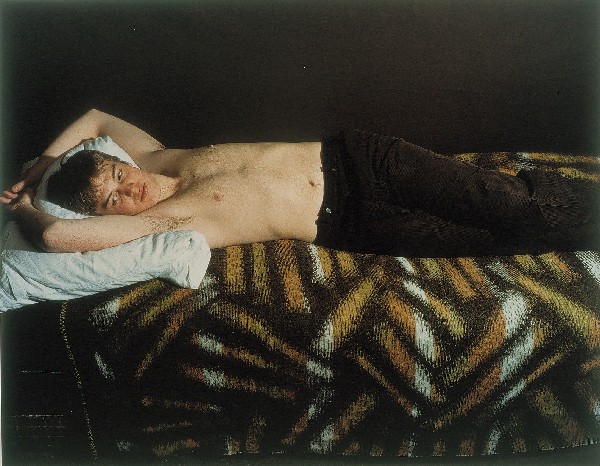
Collier Schorr, "Jens F.," 2005.

Three weeks ago, when Catherine Opie’s unprovocatively titled Figure and Landscape opened, Opie talked about her work in LACMA’s Bing Theater. She mentioned comparisons often made between her sports photographs and the work of Collier Schorr, which depicts, among other things, young male bodies posing and sparring. “Collier wants to be her boys,” said Opie. “I don’t . . . I’m not interested in seeing my butch body through them.” What she’s interested in is bearing witness, and she’s been witnessing a precariously in-between generation, some of which has gone to Iraq, some of which has died.

Being versus bearing is not so simple a distinction, of course–Opie’s boys, as poet-critic Eileen Myles has pointed out, tend to adopt the Opie expression, which resembles a “scary duh.” Even so, it’s possible Schorr wants to be her boys while Opie wants to be aware of her boys; certainly, Eakins wanted to be with his boys while Warhol wanted to collect them.

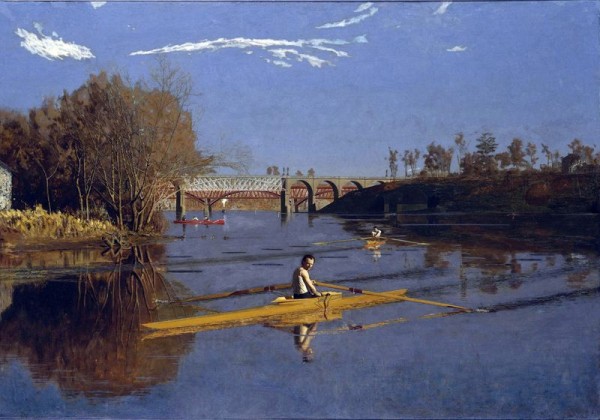
 Thomas Eakins,"The Champion Single Sculls," 1871. Courtesy LACMA.

Thomas Eakins,"The Champion Single Sculls," 1871. Courtesy This week from

LACMA.

It’s Warhol and Schorr who most prominently prefer male subjects. Warhol’s Screen Test Reel #5 includes only two women and, like Reel #4, Reel #6 is an exclusive boy’s club. Schorr, when asked why she doesn’t photograph girls, has said she does; she just uses boys to do it. But the strange, sports-focused mannishness of the paired Opie-Eakins exhibitions is even stranger in light of both artists’ genuine interest in women. Opie’s girl-only Girlfriends series showed at Gladstone Gallery in New York last year, and Eakins consistently included women in his work, and even in his controversies. It was his uninhibited disrobing in front of female students and his insistence on the removal of a male model’s “loin cloth” during a drawing session women attended, not his obsession with his “beloved” (as one wall label reads) young men, that forced him to resign from the Pennsylvania Academy of the Fine Arts in 1886.

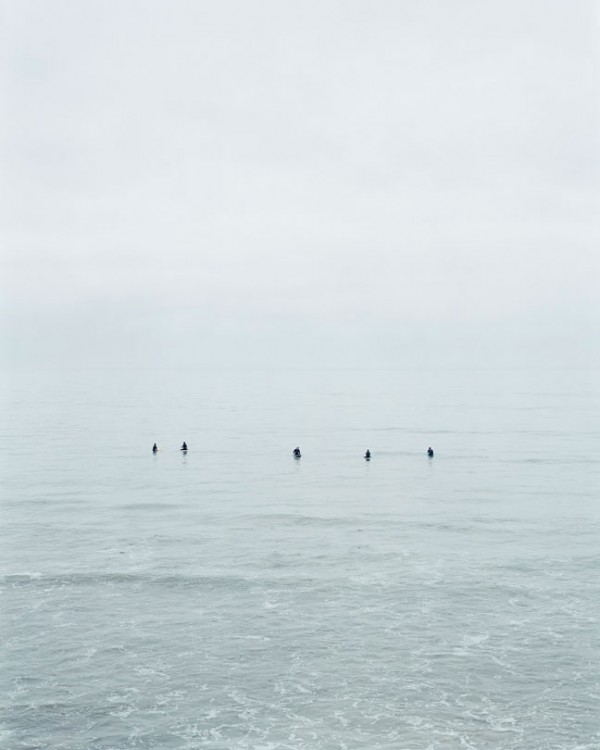
Catherine Opie, "Untitled #10 (Surfers)," 2003. Courtesy Regen Projects.

In Manly Pursuits and Figure and Landscape, Eakins and Opie, both realists, show themselves to be exquisite technicians with a virtuosic, if predictable, eye for poetic composition. In Eakins’s The Champion Single Sculls, a burnt sienna scull cuts smoothly across royal blue water and its inhabitant looks elegantly, if illogically, casual as he turns to look back. In Opie’s portraits, skin, eyes, pose, gaze, the position of the football helmet, have all been carefully considered; royal blue makes frequent appearances in her work as well. But both artists render the trappings of a conventional masculinity and gender-play to which neither quite belong–to which no one quite belongs–and it’s the work that revels in inaction that seems most gaping and honest.

A room at the back of Figure and Landscape features only surfing images, and, though Opie has made striking portraits of surfers she’s shadowed, none of those portraits are included here. Instead, there’s just expansive gray rectangles in which far-off bodies float, largely unmoving, waiting for a chance to resume their sport. They’re certainly skilled surfers; everyone Opie photographs seems to be good at what they do. They’re also like little pawns or bobbing black buoys. They don’t look volitional but they do look comfortable; like the artist who made them, they’re virtuosic and yet awkward precisely because they’re virtuosic.

Share

Los Angeles

Sunshine, Lollipops and Rainbows

The very first thing you see when visiting Stefan Stagmeister’s “The Happy Show” at MOCA’s Pacific Design Center is wall text boldly declaring: “THIS EXHIBITION WILL NOT MAKE YOU HAPPIER.” While the text may seem like a cheeky and sarcastic pre-summarization of the content, Stagmeister sets the stage for his internal conflicts.  The information presented on the walls ranges from dry, yet poignant data, to personal musings and interviews describing different states of and interactions with the phenomenon of happiness.

Installation view of Stefan Sagmeister: The Happy Show, March 20–June 9, 2013 at MOCA Pacific Design Center, photo by Brian Forrest, ©The Museum of Contemporary Art, Los Angeles.

Stagmeister, who made a living as a graphic designer in the music industry and beyond, is an ideal comparison to the PDC’s shiny-floored cubicles filled with things like tasteful, modern lawn furniture. The first room of the exhibit, which explains his motivations to pursue Art as a respite from graphic design, demonstrates the tenuous relationship between commercial and Fine Art. Through his use of typography and installation, Stagmeister creates a platform to express opinions that would otherwise be stifled by the mainstream media to which he reported.

Installation view of Stefan Sagmeister: The Happy Show, March 20–June 9, 2013 at MOCA Pacific Design Center, photo by Brian Forrest, ©The Museum of Contemporary Art, Los Angeles.

Initially the statistical information piqued my interest, for example Sanskrit has 16 words for happiness and German allegedly has none, or the theory that our happiness is based on 50% genetics, 40% activities and 10% life conditions. I was then confronted with an interactive measurement of visitors’ happiness demonstrated through ten clear gumball dispensers. The wall text invites viewers to take a gumball from whichever numbered tube they feel represents their level of happiness on a scale of one to ten. My first reaction was to take a gumball from the five tube, which made me depressed to think that my happiness level was so low, so I took one from the six tube when really at that point I was probably a four.

Installation view of Stefan Sagmeister: The Happy Show, March 20–June 9, 2013 at MOCA Pacific Design Center, photo by Brian Forrest, ©The Museum of Contemporary Art, Los Angeles.

Read More »

Share

San Francisco

Blanking Out: Will Rogan at Altman Siegal Gallery

Jazz great Miles Davis once said, “Music exists in the spaces between the notes.” Language provokes us to name and describe empty spaces—like those that exist at the intersection of thought and memory. In Blanking Out, Will Rogan’s exhibition at Altman Siegel Gallery, a combination of sculptures and two-dimensional works reveals that the negative spaces are as important as the objects that create them.

Will Rogan, Cradle to grave (1), 2013; wood, paint, brass, 12.63 x 12.5 x 1.25 in. Courtesy of Altman Siegel Gallery, San Francisco.

In Rogan’s sculptural works Cradle to the grave (1) (2013) and Cradle to the grave (2) (2013), his deliberate use of geometry creates an illusion bound not by time but by the viewer’s imagination. Perfectly whittled, stained wooden segments, each around the size of a standard wooden ruler, intersect and join in variously angled vertices. A clock face laid across one of the wooden sections bends across it, a clear reference to Salvador Dalí’s painting The Persistence of Memory (1931). While Dalí’s clocks have become almost trite, Rogan’s versions effectively evoke the feeling of losing one’s memory—it slowly slips away, eluding our grasp. These poetic, minimal works give tangible form to the voids in our thought patterns. Though these pieces appear effortlessly put together, a close examination reveals their thoughtful construction. Rogan’s sculptures speak to the silences between words, those quiet segments of life rarely explored in our fast paced, cut-and-paste culture: the moments in between status updates, before the finger swipes against a device.

Will Rogan, Blanking Out, 2013 Installation view. Courtesy of Altman Siegel Gallery, San Francisco.

In direct conversation with the Cradle works are Rogan’s untitled mobile pieces. Suspended from the gallery ceiling, each of their elements—from triangular pieces of wood to painted prisms—hangs from translucent strings. The perspective constantly changes as one walks underneath and through these works. They do not stay still; their movements are barely perceptible but still significant. Rogan painted the top portions of each prism, creating a visual effect that mimics a pair of eyes unfocused in its gaze. Precarious and appearing to float magically above the viewer, these untitled works are constantly in flux. Each figure seems to represent a stanza to some forgotten poem, a word that has yet to be spoken, or a phrase on the cusp of enunciation. Much like poetry, Rogan’s meticulously constructed works are deliberate and require the viewer to ignite meaning between their components. Just as one reads and rereads a poem, it is possible to view these works multiple times and gain a different perspective at each turn. The spaces and lapses of time are emphasized as the viewer’s position and presence shifts.

Read More »

Share

New York

Inner Vistas in Jonathan Ehrenberg’s “The Outskirts”

Jonathan Ehrenberg, still from "The Outskirts," video, 12 min. 43 sec. All images courtesy the artist/Nicelle Beauchene Gallery.

Jonathan Ehrenberg‘s The Outskirts conjures a world of mesmerizing, haunting, and deeply disorienting beauty. Currently on view at Nicelle Beauchene Gallery, the artist’s latest video envisions a world of visual enchantment and visceral disquiet, of existential ambivalence and psychic uncertainty.

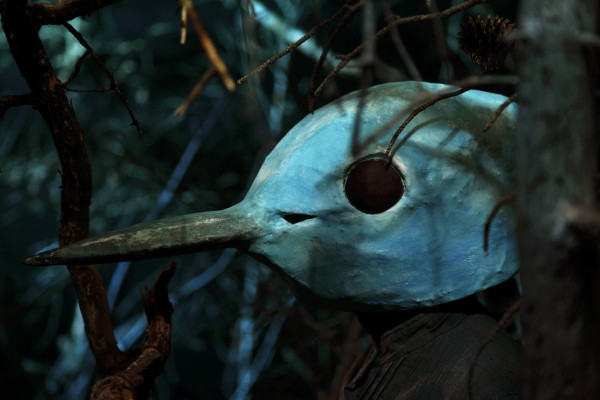
With its opening shot of a shadowed, densely wooded landscape, The Outskirts plunges us into a world that is superficially suggestive of yet atmospherically apart from our own. As the emergent strains of Timothy Andres’ score penetrate the obscurity, the camera shifts to reveal a lone male figure, his face a pallid, dimly lit mask, gazing through the surrounding tangle of tree branches. This image is succeeded by one of yet another, similarly solitary being, a creature of indeterminate nature whose hollowed-out eyes and disembodied, skull-like head are a compelling conflagration of animation and decay, vitality and death.

Jonathan Ehrenberg, still from "The Outskirts," video, 12 min. 43 sec.

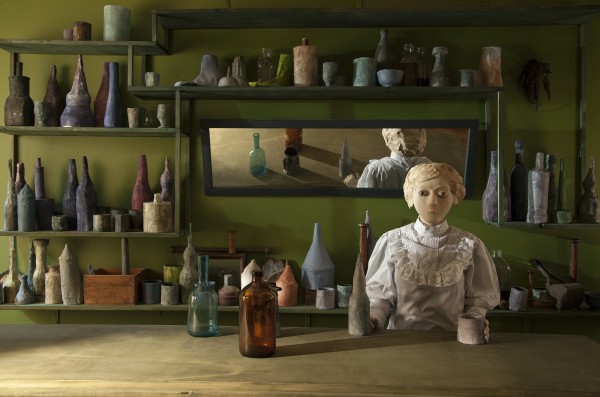
Integrating live actors and puppetry, cinematic lighting techniques and theatrical, two-dimensional settings, Ehrenberg’s video work also bears the imprint of his practice as a painter. Characters’ masks are sculpted of rich impasto surfaces and punctuated by bulging orbs (eyes) of color, while several interior shots, including a view of subtly individuated pottery, register as variations on the carefully observed still life. Further, in its overtly constructed, hand-worked imagery and macabre yet humane tone, The Outskirts recalls both the tactile, animated works of Jan Svankmajer and the evocative, stop-motion narratives of the Brothers Quay. Like those artists, Ehrenberg compels us to relinquish our hold on external “reality” and enter a realm of heightened sensation and visceral experience, a realm in which overt artifice becomes a means of accessing profound depths of feeling. In this way the protagonist’s mask, despite the immobility of its features, exudes a poignant expressivity, while the unblinking eyes increasingly, uncannily attest to a vague yet propulsive yearning.

Notably, following the moody obscurity of the opening sequence, we are subsequently cast into a scene of comparative brightness, one whose degree of illumination is both arresting and ambiguous. Here again, we encounter the solitary protagonist, though he is now revealed in full and framed against the backdrop of a distant, cliff-side town. As he looks out upon his environs through a telescope, the camera adopts a similarly telescopic gaze; thus we gain a closer look at the town in question, wherein sun-bleached adobe structures contrast with anonymous multistory towers and simply constructed houses, an architectural juxtaposition that underscores a persistent sense of geographical, spatial dislocation.

Jonathan Ehrenberg, still from "The Outskirts," video, 12 min. 43 sec.

As the protagonist gazes out upon this landscape, he seems to be looking across not only space but also time; here positioned, quite literally, on the “outskirts” of his destination, he appears as a figure cut adrift, an individual who, like the collage-like environment of the town, exists outside of any specific place or period. This physical and temporal ambiguity is further intensified by the appearance in the scene of two additional male figures, each similarly masked, whose clothing suggests, in turn, medieval monkish garb and the unremarkable, rustic attire of the nineteenth-century farmer. Where—indeed when—are we?

We are, perhaps, everywhere and nowhere, in an eternal present composed of an uncertain past and an unknown future. Caught up in the protagonist’s surreal odyssey, we witness his unfolding journey yet increasingly experience it as our own. As Ehrenberg progressively effaces distinctions between artifice and authenticity, between past and present, we are drawn ever deeper into his vividly imagined world, one whose very inscrutability refracts the uncertain, interwoven forces of inner being and consciousness. Elliptical, quiet, muted yet intense—The Outskirts is nothing less than a delicate, incisive probing of the self.


Jonathan Ehrenberg, The Outskirts, April 5-May 5, Nicelle Beauchene Gallery, New York City

Share