Today from the DS Archives, we’d like to help you start your week off with gusto by revisiting a piece written by Bean Gilsdorf from her weekly column “Help Desk.” For most of us, public speaking can be trying, stressful and intimidating. And when it comes to lecturing about your own work, it can be all the more overwhelming. In her entry “Rock the Lecture” Ms. Gilsdorf gives some sage advice on how to navigate and successfully deliver the almighty Lecture – but her tips can be utilized in many different contexts.
The following article was originally published on November 5, 2012 by Bean Gilsdorf:
Help Desk is an arts-advice column that demystifies practices for artists, writers, curators, collectors, patrons, and the general public. Submit your questions anonymously here. All submissions become the property of Daily Serving. Help Desk is cosponsored by KQED.org.

“You’ve seen the pictures. You’ve read the tweets. New York City looks like a post-apocalyptic wasteland along its waterfront. Among the many things New York City needs right now, clean up is one of them.” If you’re in the NYC area and able to help, Art Fag City has a list of places that need your assistance. Please check it out and lend a hand if you can!
I have to give a lecture on my work to students and faculty in the Fine Arts Department of a good size liberal arts college. I have lectured in the past to smaller audiences and have some Power Point chops so I’m not worried about putting together a decent looking program, what I am worried about is being boring. I, myself have suffered trough many boring lectures (some by artists whose work I admire) and would really love to spare the poor folks at this college from the same fate. I’d like to avoid the moldy old standard “this is a chronology of my output from Grad School to present” but I’m having a hard time coming up with ideas that will engage the audience but still get a decent amount of my work up in front of them. Is it okay to include a few images of work that are not my own in order to discuss some of my influences? Do you have any hints on how to create a dynamic stage presence, assuming the lecture hall isn’t pitch dark? And, lastly, I’ve noticed that some artists’ lectures are a little dry but they shine during the Q and A. I’d like to shine during the Q and A too, in part because it’s the last thing the audience hears and in part because you look really smart if your unscripted responses are cogent. Any tips?
An artist lecture certainly doesn’t have to be boring. The best ones leave the audience energized with a new appreciation of what it means to be an artist in a contemporary community. There are many ways to rock your presentation, and there really isn’t a one-size-fits-all answer, so what follows are some general suggestions that you can tailor to your style and comfort level.
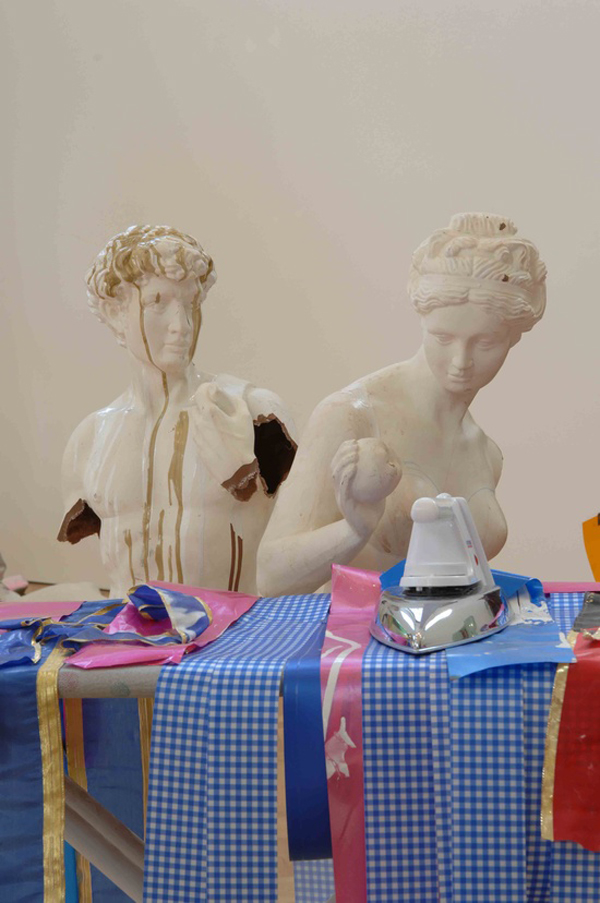
Isa Genzken, “Ground Zero” installation view at Hauser & Wirth London, 2008.
This first tip is non-negotiable: above all other considerations, practice is the key to success. Whether you are a veteran at the microphone or terrified of an audience, practice will make your talk go smoothly, so once you have your PowerPoint slides in order, take the time to run through your images and talk out loud about the work—even to an empty room. Just hearing your own voice will alert you to any gaps or flaws and you can tighten up your lecture considerably by running through it a couple of times before the actual presentation. You can also use these opportunities to time your talk—no matter how good the work is, everyone’s butt starts to hurt at around the 50-minute mark, so don’t go over the time you’ve been allotted.
Another factor to consider is your audience: you’ll want to adjust your talk in keeping with who will be listening. In this case, your information should be mainly geared toward the students, so find out if they are undergrads or grads and speak accordingly. I’m not suggesting that you dumb down your presentation, but if you’re a theory geek and plan to talk about Giorgio Agamben’s state of exception, be prepared to introduce these complex ideas to an audience that may not already be familiar (which, by the way, will lengthen your talking time). No one gets excited about a presentation they don’t understand, so if you know in advance whom your audience is you can customize the information to meet their needs.

Isa Genzken, White Horses, 2008. MDF, mirror foil, tape, spray-paint, colour print on paper, 38 7/8 x 31 3/8 x 3/4 inches
Stage presence can definitely help a lecture along. To begin: stand up straight, smile, look around the room, and look the audience in the eyes. If you’re nervous, learn some breathing techniques that will keep you focused enough to get through the first few minutes—after that, the fight-or-flight mechanism will have died down and you’ll be in the zone. Also, avoid being a cadaver at the podium; during your rehearsals try to practice some natural gestures that you might make, such as holding your hands apart to indicate size or pointing to a particular area in an image. If you are comfortable on stage, you may want to get out from behind the podium a few times, because movement is dynamic and creates energy. Finally, humor is an excellent strategy for livening up a lecture. If there’s a funny point you could make, by all means we in the audience want to hear it.
Read More »