Fan Mail: Kyle Austin Dunn

For this edition of Fan Mail, Kyle Austin Dunn of Sausalito, California has been selected from our worthy reader submissions. Two artists are featured each month—the next one could be you! If you would like to be considered, please submit your website link to info@dailyserving.com with ‘Fan Mail’ in the subject line.

Kyle Austin Dunn, Balled Up Color and Lines, Acrylic and enamel on polystyrene and PVC, 32” x 50” x 16”, 2013.

Kyle Austin Dunn, Balled Up Color and Lines, 2013. Acrylic and enamel on polystyrene and PVC, 32 x 50 x 16 inches

Some of Kyle Austin Dunn’s artworks look sugary and delicious with factory-made colors. He rejects the colors of nature for the neon inventions of man, leaving me curious as to his relationship to the natural world. The paintings seems very California–a feeling of newness and plasticity, and the rainbowed/dayglow color palette and graphic quality is reminiscent of commercial culture, screenprinting, and street art. Dunn says he’s gotten that response before: “more specifically L.A.,” but he’s not sure why exactly. In response to his palette, he says “pure chroma is more abstract than earth tones or more subdued colors, and I’m drawn to that quality of it. It’s enigmatic in addition to being striking.”

Viewing his paintings, I assume the natural world must be uninteresting to him, but he replies, “It may be surprising to hear that the outdoors are my favorite place to be…perhaps it is that I try to avoid reproducing nature in any way because it is never as incredible as the real thing.” I think this is correct. His paintings are not about reproducing reality or real space.

“I think that I enjoy the landscape here as much as anything. Having grown up in a such a flat place, it’s inspiring to be on cliffs that overlook the Pacific, or nearby mountains that offer a view extending hundreds of miles into the distance. The landscape and weather in California change so drastically from place to place, prompting a lot of outdoor exploration for me personally. I’m always itching to see what’s around the corner of a hiking trail or down some unmarked dirt road. …where I live (which is the East Bay right now), there seem to be so many younger artists like myself, which definitely creates a sense of belonging and purpose.”

Read More »

Share

Interviews

Airing Out the D: A Conversation with Caitlin Cunningham

Caitlin Cunningham’s current solo exhibition is on view at sophiajacob in Baltimore, Maryland, through May 25th. The show, informally titled Tan Penis Island, extends from a focused critique of the legacy of modernist painter Paul Gauguin’s exploitation of Tahiti to examine the ramifications of fantastic projection, the economy of colonization, and the production of white masculinity through the exotic Other.

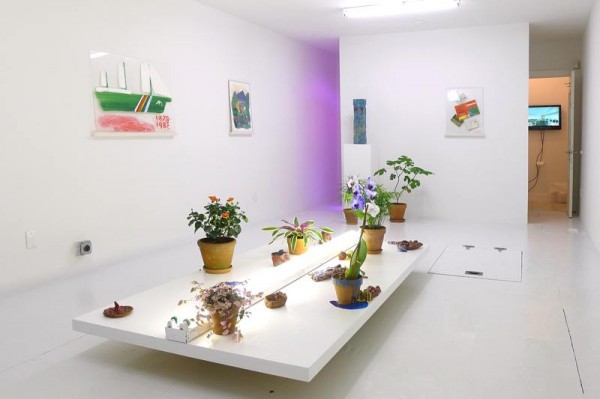
Cunningham integrates live plants and plant materials into her installation, thereby creating a fantasy space where new narratives that afford agency to the exploited subject can be imagined and explored. I sat down with the artist to discuss some of the research behind the work and her opinions about gendered art making, formalist critique, subverting the concept of the Master, and human/plant relations.

Caitlin Cunningham, sophiajacob, 2013. Image courtesy of sophiajacob and the artist.

Elspeth Walker: This show is very involved with story: both seeking to develop its own, and critically investigating old stories that we have become accustomed to. Can you elucidate some of the research underlying the work?

Caitlin Cunningham: When I started looking into Gauguin I was pretty interested in using him as target practice for a lot of my angry energy about misogyny in general and particularly in art history. He may seem like a naively easy target, but there it is…

Besides some fascinating and mostly hideous stories I was reading about Gauguin himself, I came across others related to colonialism and romanticism, and then others more related to the perception of Tahiti that continues to be marketed to those of us in the US. I could go into the stories I was interested in [in] a pretty detailed way, but I’ll try to just list a couple of them with short descriptions.

Read More »

Share

Singapore

New Waves, Korea

A dominant feature of contemporary Asian art has always been the reflection of cultural and historical frameworks within which such works are produced: firmly entrenched in tradition, yet forward-looking thanks to the far-reaching changes – and homogenisation – brought about by the formidable impact of globalisation. Even though artistic production in South Korea seems to follow this trend, it is problematised by the emergence of young artists who juggle ambivalent attitudes towards their inherited legacy with the need to establish practices steered by their individual philosophies and interests.

Kim Kun Ju, Myth 1, 2007 (installation view), mixed media, 180 x 190 x 11 cm, 2007. Image: Courtesy of Taksu gallery.

New Waves, Korea in Taksu gallery is a show that seems to serve as a modest introduction to the broad field of contemporary Korean art, surveying the artistic output of three artists (Kim Kun Ju, Sang Taek Oh and Sung Chul Hong) working across a variety of media to highlight the fundamental issues of urban living such as desire, isolation and re-contextualisation. Kim, Sang and Sung share a common background; they were born in Korea but educated abroad in the West. Even their seemingly disparate artistic visions are perhaps more similar than they seem, championing the thoroughly (and the fashionable) postmodern notions of arbitrariness and disjointed narratives.

Mounted on a bright orange canvas, Kim Kun Ju’s Myth 1 (2007) comprises a myriad of reliefs or cut-outs of familiar shapes layered over each other in order to form a new, unrecognisable entity that hangs in three-dimensional space. As disparate as these elements are, like part-painting and part-sculpture, they coalesce with striking visual impact, a defamiliarised site in which multiple signs converge.

Sang Taek Oh, Closet 23 - 25, 150 x 95 cm each, photographic colour print on canvas, 2012. Image: Courtesy of Taksu gallery.

Read More »

Share

Elsewhere

The World of Julio Le Parc

At 11 p.m. on a Friday night in Paris, I took advantage of the late hours at the Palais de Tokyo. Before entering the Julio Le Parc exhibit, I overheard a conversation that seems to exemplify a standing problem of contemporary art. A visitor answered his phone while looking at a conceptual piece and jokingly described it. It went something like this: “I’m looking at a pile of rubble… No, I don’t know what it means… it’s conceptual.” The visitor went to the plaque looking for some sort of explanation, pondered the piece with a skeptical look, and went on.

For contemporary art enthusiasts this scene is all too common. We are no longer shocked at the pile of rubble in the middle of a white-walled room; in fact we have grown quite accustomed to visiting these exhibits.

The work of Julio Le Parc on view at the Palais de Tokyo is nothing like this. Part of the exhibit Soleil Froid (Cold Sun), this grand assemblage of painting, sculpture and interactive multimedia by the Argentinian optical artist is a whimsical masterpiece. The show is a breath of fresh air and a treat to the senses. We enter the space through a maze of full length mirrors that hang from the ceiling and move with us as we make our way inside. From this entrance to the end, our sights are stimulated with color, pattern, texture, light, movement and sound. Some works are familiar such as Le Parc’s well-known tromp d’oeil black and white paintings of geometric shapes and lines, landmark pieces from the 1950s until today. The space is experimentally curated in an active and participatory way with a focus on the effects of the aesthetic. Viewers lay on a sofa to observe the light installation on the ceiling; some works respond to our movement as we approach them, and the final room invites us to touch, play and even box with Le Parc’s punching bags depicting societal caricatures.

Read More »

Share

Help Desk

Help Desk: Ideal Representation

Help Desk is an arts-advice column that demystifies practices for artists, writers, curators, collectors, patrons, and the general public. Submit your questions anonymously here. All submissions become the property of Daily Serving.

I’ve been meeting with a commercial gallery in my city for some time, and they’ve extended me an offer to come aboard. I’m excited about the idea of professional representation, having a platform to promote myself to a larger audience, and further opportunity for sale of work. I feel strongly about some of the work the gallery represents, but some of it is totally not my style, which is to say, artwork that favors more commercially viable subject matter or style at the cost of exercising any real dynamic or conceptual verve. How much should this influence my decision to join the gallery? I think deep down I’m afraid my work may be negatively evaluated against some of this work in question, and will affect my just-budding career moving forward. How crucial is it that a potential gallery fully affirm your conceptual ideal as an artist?

This is a great question, one which I am definitely not qualified to answer. Accordingly, I sent this query to a half-dozen represented artists and below are the replies I received.

Despite the fact that these artists are speaking from viewpoints all along the career continuum, their answers overlap considerably. They range from mid-career artists with New York and international representation plus several important museum shows, all the way to an artist in a second-tier city who has been represented for less than a year. I vowed to protect the identities of these artists in exchange for their candid replies, but I would like to thank them here for their thoughtful contributions.

-BG

*            *            *

Lothar Hempel, installation view of “Cafe Kaputt” at Gio Marconi Gallery, 2009

This is a legitimate concern, but it’s only one among a number of questions an artist should consider when deciding to work with a gallery. It’s certainly important to feel as though your work and the gallery’s program are in sync, but that consideration exists in a nexus with other issues of equal or greater importance. First and foremost among these might be, do you like and respect the people running the gallery? Do you trust them, feel that they understand your work, and that they are both interested in and capable of promoting it in a way that will advance your career? Do you feel that they understand the business, and have done well for the other artists that they represent? Do you know any of those artists, or talked with them about how they feel their career is doing? Remember that you are entering into a business partnership with these people, possibly for an extended period of time. Do you have a clear sense of what your expectations and theirs are regarding this relationship?

Bear in mind that it’s generally unlikely that you will love all the gallery’s artists. If you like/respect/are excited by at least half the artists represented, that’s probably the best ratio you can hope for. A gallery is essentially a retail store, selling a very rarefied product to a capricious clientele. If the owners of the gallery make all their money solely from the gallery’s sales (as opposed to coming from a lot of money, or generating the bulk of their income from selling on the secondary market) they will almost certainly have to diversify their inventory, especially if they are based in a city without a strong collector base. While it is to be hoped (and should be expected) that a gallery “stands behind” every artist that they represent equally, the reality is also that there are some artists a gallery works with not because the work is especially cutting edge, but because the owners know they can move it and thereby pay their bills. (If you want a window into what this looks like, try watching the movie “Untitled,” which, while far from great, depicts some of these interior art world mechanisms at work). In other words, the presence of some artists will lend credibility and “edginess” to a gallery’s roster, while others may make sure the rent gets paid.

*            *            *

Pay attention to how conceptually aware and involved the gallerists are. If they seem to be supportive of your practice and any risks you might take with your work, that could trump what other more commercial work they might represent to keep the lights on. However, if you feel that they could stifle your drive, or set limits to your work, or get in the way of what makes your art something you feel is conceptually brave and forward thinking, then you should re-evaluate the agreement and possibly very cordially end the conversation. It’s good to see these opportunities as steps toward something greater, and if you are given free reign and a platform of exposure, it could be very beneficial down the road. It is smart to be mindful of these decisions though, because if you find yourself hemmed in and next to work you don’t respect, that can only lead to artistic and professional frustration.

*            *            *
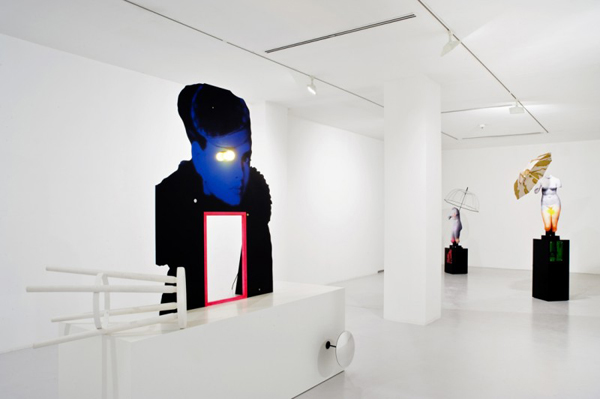
Lothar Hempel, installation view of “Cafe Kaputt” at Gio Marconi Gallery, 2009

This topic has confronted me before—in general it’s a pretty common discussion amongst artists with commercial representation. Generally, galleries have to maintain a roster of artists that differ from each other in order to cater to a range of potential clients. So some artists on the roster may be considered more “commercial” or easily sold than others, or the artists may appear to be diverse and not necessarily relating to each other. But that’s not necessarily a bad thing—I’ve had several gallerists tell me that some of the artists they represent are considered the “bread and butter” ones—the ones that sell well and thus support the ability to show or represent the other artists who are less commercially viable but whose work the gallery wants to support for other reasons. Overall, you just want to make sure that the gallery you work with has a taste that you resonate with in general and that if push comes to shove, they can speak about your work in an enthusiastic way without you having to be there. Perhaps not all the artists in the roster are to your liking, but that is a common situation. If you think the gallery has BAD taste however, then by all means run in the opposite direction.

I have left a gallery before that I felt was not in line with my work, and it took a while to come to that decision because it was a very respectable blue-chip gallery. But in the end I wanted to work with a smaller, perhaps scrappier gallery because I felt their roster better reflected my own concerns of politics and social issues. There are definitely artists in the current gallery’s roster that I don’t care for, but I let that go because I know [the owner] works hard for me and represents me well.

I suggest that artists resolve this issue for themselves by asking several questions:

-Does the gallery you are considering seem to thoughtfully pick their roster of artists, or is it a hit-or-miss affair?

-Can the gallery understand what your work is about and represent it lucidly?

-Can you identify what the gallery’s “taste” is, and understand why they choose their artists?

-Will you cringe or feel embarrassed when asked who your gallery is?

-Do the other artists appear so “left field” that your peers will wonder why you are showing with them?

-Will it confuse clients as to why you are with that gallery?

-Do you feel comfortable showing up to the openings of the other gallery artists to support them and the gallery?

If this is all too much and you don’t feel enthusiastic, then it is best to wait for better representation to come along. If you are working hard and making good work, this is not your only shot at working with a gallery.

*            *            * Read More »

Share

From the Archives

The Girl Chewing Gum, and the Perils of Google

Today from the DS Archives we bring you an article written by Michelle Shultz about British film and video artist John Smith’s most recent work. While Shultz focuses on the compulsion to research one’s online presence, the issue of reserving the rights to personal property that has made it onto the web seems a subject worth considering alone. With the onslaught of online privacy issues, we are faced with the potential subjugation of our work on a daily basis. In the two years that have passed since Shultz discusses “unusual Red Cardigan,” the same problem that this John Smith addresses has become one that the rest can relate to.

The following article was origianally published on December 3, 2011 by Michelle Schultz:

Googling yourself can ultimately be a very dangerous, and addictive, thing to do. And with the automation of Google Alerts, this fundamentally narcissistic activity is even less guilt-ridden – just passively sit back and every tidbit of information about you uploaded into cyberspace is sent straight to your inbox. As I recently discovered, you can often find yourself in unexpected and somewhat cringeworthy contexts – however, John Smith has harnessed this power in his latest exhibition unusual Red cardigan at PEER, London, and compiled an engrossing exploration of digital identification, fanatical tributes and the inherent nature of the remake.

John Smith, The Girl Chewing Gum, 1976, video still. Courtesy of the artist.

The East London artist and filmmaker has developed quite a following – one of his earliest works, The Girl Chewing Gum (1976), is a simple, yet brilliant narrative film that has spawned a host of online imitations and tributes. Smith’s version shows a street corner in Dalston, where an omnipresent voice directs the characters on camera – however it very quickly becomes apparent that the voice-over is postscripted, thereby disrupting the chain of cause and effect, and conflating fact and fiction. Laced with his notorious dry wit and anecdotal eccentricities, Smith destabilises the documentary form through his narration, driving our perception of the events through language, and exposing the conditions which determine how we read an image. The humour implicit in Smith’s films is derived from the unapologetic juxtaposition of what we know, and what he tells us – the pronounced gaps between the two rendered as sarcasm.

John Smith, unusual Red cardigan, installation view at PEER, London, 2011. Photo: Chris Dorley-Brown. 

The assortment of homages and bootlegged versions of The Girl Chewing Gum which Smith has compiled over the years are included here within the exhibition, and inspired the artist to revisit the video himself – if everyone else could remake the video, why shouldn’t Smith do the same? Returning to the same street corner he filmed 35 years earlier, Smith traced his earlier movements to create The Man Phoning Mum (1976/2011). Layering the new footage directly on top of the original, Smith blurs the past and present creating a jarring vision of how drastically things have changed, and yet, how some things still remain the same.

Read More »

Share

New York

Who’s In And Who’s Out at Frieze New York 2013

As a part of our partnership with Huff Post Arts, today we bring you a story written by Rozalia Jovanovic of BLOUIN ARTINFO about Frieze Art Fair in New York.

While Frieze New York has more exhibitors this year than last — around 190 to last year’s 180 — there’s still not enough room for everyone, and competition for entry was fierce. The second edition of the fair sees a reshuffling of galleries, with 60 joining for the first time, including heavyweights Marian Goodman, Peter Blum, and Luhring Augustine. Scads of others — including Friedrich Petzel, Maccarone, David Nolan, Nicole Klagsbrun, Michael Werner, and Experimenter (Calcutta) — dropped out. Whether due to fair exhaustion (“fairtigue”) or to simply not making the cut this time, the turnover is a reflection of the pressures dealers face in today’s art world.

2013-05-10-trithongminh1.jpg
Paul Kasmin will bring Walton Ford’s “Trí Thông Minh,” 2013, to the fair

The fair’s main section offers some 31 new exhibitors, including New Yorkers Paul Kasmin, Murray Guy, and Jack Shainman, as well as Mumbai’s Project 88 and Paris’s Kamel Mennour. “Paul Kasmin Gallery has participated in Frieze London from the beginning, so it was natural to want to continue in New York,” the gallery’s director, Bethanie Brady, said.

Newcomers in the Focus section include New York’s Untitled, and dépendance from Brussels, while first-timers in the Frame section like Simone Subal from New York and Berlin’s Circus will present solo booths by Frank Heath and Sophie Bueno-Boutellier, respectively.

As for the more intriguing question of why galleries didn’t return — there are roughly 40 — the overwhelming explanation is exhaustion from the sheer number of fairs dealers now attend. “We couldn’t do Frieze and then [Art Basel] Hong Kong right afterwards,” said Gordon VeneKlasen, director of Michael Werner Gallery, “so we chose Hong Kong. It’s just not possible for us to do everything in the world.”

For some dealers, the decision was out of their control. “This year, very simply, I was not accepted,” said Nicole Klagsbrun, who applied before deciding a few months ago to close her Chelsea gallery after 30 years in the business.

Though her decision was motivated by chagrin over the “whole system,” which prioritizes fairs over gallery shows, Klagsbrun asserted that galleries need to stay in the art fair game to remain attractive to artists.

For younger galleries, the notion that entry to Frieze New York can make or break them instills a kind of panic. “They’ll get to do it one year, and then they won’t the next year, and they’ll feel like they’ve done something wrong,” said Phil Grauer of Canada Gallery, explaining his peers’ reactions to the fair’s modus operandi, in particular with respect to Frame, a section geared toward emerging galleries, those in business six years or less. “But it’s the fair rolling through the new young meat.”

While the Frame and Focus sections, which cost exhibitors less than the main section, are aimed at newer galleries, Grauer says the divisions have less to do with age than economics. “The main section is first class,” he said comparing it to airline seating. “Focus is business traveler — but it’s pretty much coach. Frame is like you’re running drugs for someone else. They let you in and then they kick you to the curb.”

-Rozalia Jovanovic, BLOUIN ARTINFO on Huff Post Arts & Culture

Share