San Francisco

#EVIDENCE: Anouk Kruithof at Casemore Kirkeby

#EVIDENCE, the current solo exhibition by Dutch-born, Mexico City–based artist Anouk Kruithof at Casemore Kirkeby Gallery, presents a sprawling series of related bodies of work inspired by Larry Sultan and Mike Mandel’s 1977 book, Evidence. Kruithof’s range of photo-based works, made mostly in 2015, do not replicate or repeat Sultan and Mandel’s project, but rather carry it forward through strategies that are carefully calculated to resonate with today’s imaging landscape—a markedly different photographic terrain from the one Mandel and Sultan responded to forty years ago.[1]

Anouk Kruithof. #EVIDENCE; 2017. Exhibition installation. Courtesy of Casemore Kirkeby.

Anouk Kruithof. #EVIDENCE; 2017, installation view. Courtesy of Casemore Kirkeby.

Similarly to Sultan and Mandel, Kruithof has gathered images from various governmental agencies and private institutions—though in this case, directly from their Instagram feeds—and has taken this glut of self-promotional images and altered and manipulated them to create artworks that are as much about what is hidden as what is shown. The resulting bodies of work succeed to varying degrees, and collectively trace a trajectory that evolves from Sultan and Mandel’s original photomontage-based technique into new two- and three-dimensional photographic manipulations. Taken as a whole, the exhibition offers a fascinating glimpse into Kruithof’s fluid artistic practice, and suggests a contemporary relationship to images that is more subjective, idiosyncratic, and opaque than ever before.

Read More »

Share

Singapore

An Atlas of Mirrors: Singapore Biennale 2016

There is no shortage of mirrors and maps in the fifth iteration of the Singapore Biennale. Glass mirrors in Harumi Yukutake’s Paracosmos (2016) curve around the main circular stairwell of the Singapore Art Museum, dazzling the eye as light hits their multiple reflective surfaces. Dozens of mirrors appear in their reflections; dozens more yet, to the power of infinity, show up in the reflections of their reflections. In another room, Map Office’s Desert Islands (2009, 2016) features familiar topographical seascapes, as a hundred square mirrors bear the engravings of islands and their coordinates. Pala Pothupitiye’s Other Map Series (2016) reinscribes and retells Sri Lanka’s past and present in the form of overlapping landscapes, names, and voyages, trapped on static, two-dimensional space that recalls Ptolemy’s maps of Ceylon, while Qiu Zhijie’s One Has to Wander Through All the Outer Worlds to Reach the Innermost Shrine at the End (2016) is an exploration of cartographical history resulting in a conflation of myths, landscapes, and epochs scrawled on paper, glass, and stone.

Harumi Yukutake. Paracosmos, 2016; Glass mirrors, site-specific installation, dimensions variable. Image courtesy of Singapore Art Museum.

Harumi Yukutake. Paracosmos, 2016; glass mirrors; site-specific installation. Courtesy of Singapore Art Museum.

The biennale’s apt but campy title, An Atlas of Mirrors, is an illustration of the many artworks’ disappointingly myopic and literal takes on the exhibition’s moniker—the core theme of which is art’s capability to reflect, inflect, refract, magnify, and project alternative viewpoints onto what is current, traditional, and expected.[1] Through the sheer repetition of motifs, it is impossible to miss the extent to which the curators wish their audiences to be cognizant of the fact that there exists a lexical map of gateways, mirrors, and journeys, on both physical and socioeconomic levels, that needs to be constantly (re)examined, more so now than ever.

Yet An Atlas of Mirrors is also a title that speaks of broad, interlinking possibilities that do not point us in any particularly original direction. If this theme of embracing contemporary realities and mirroring them might appear so extensive as to be confounding, it is only because of the broad structuring of the show into nine conceptual zones—space, time, memory, nature, boundaries, agency, identity, displacement, and absence (each under a curatorial director with overlapping ideas)—that results in a more mystifying than elucidatory experience.

Read More »

Share

Help Desk

Help Desk: Are You Experienced?

Help Desk is where I answer your queries about making, exhibiting, finding, marketing, buying, selling–or any other activity related to contemporary art. Submit your questions anonymously here. All submissions become the property of Daily Serving.

Do you have any advice for an artist seeking an art teaching position? I have an MFA in drawing and work across all mediums. I once led a two-week workshop with college students, but all applications ask for at least two years of post-graduate-school college-level teaching experience. Any ideas how to burrow my way through the crust of the academia?

Bob and Roberta Smith. All schools should be art schools, n.d.

Bob and Roberta Smith. All Schools Should Be Art Schools, n.d.

Thanks for your question. In a recent conversation with a friend, I admitted that in the middle of our current political and humanitarian crisis, it’s hard for me to see the value of writing an arts-advice column—it hardly feels like I’m going to change lives here. But then I was reminded that we all still have to deal with quotidian responsibilities, including finding jobs so that we can support ourselves and others. I hope this advice gives you a useful direction.

Your conundrum is a classic catch-22: How are you supposed to get experience in teaching when all the teaching jobs require prior experience? To find the answer, I reached out to a handful of professors who have recently sat on hiring committees (all requested anonymity). If you’re serious about teaching, here are some strategies they recommend to help you on your way.

Read More »

Share

Interviews

Sarah Crowner: Touch the Tile

From our friends at Guernica, today we bring you an interview with artist Sarah Crowner. Author Elizabeth Karp-Evans and Crowner discuss her show at MASS MoCA (open through February 2017), her art-historical influences, craft, and constructivism. Crowner states, “I think that art history can be a medium that can be manipulated in the same way that a material, like paint or clay, can be.” This article was originally published May 16, 2016.

Sarah Crowner. Beetle in the Leaves, 2016; Installation view.

Sarah Crowner. Beetle in the Leaves, 2016; installation view.

Visual artist Sarah Crowner’s work has been described as many things: lyrical, hard-edge painting, primary abstraction, non-painterly. Curator Gary Carrion-Murayari coined it “Personal Modernism.” She has been declared a painter, a sculptor, and an installation artist during her career, but none of these terms feel comprehensive enough, nor do they do the artist, or her work, justice. Standing in front of Crowner’s abstract sewn paintings or her large-scale tile installations, one is filled with a sense of modernism’s profound influence on her work as well as with her deft ability to harness the energies of the natural world.

This spring, Crowner’s work will appear in two major shows; Beetle in the Leaves, which runs from April 16 through February 2017 at MASS MoCA (Crower’s first museum show in the U.S.) and Plastic Memory, which opened May 13th at Simon Lee gallery in London. Both exhibitions feature the artist’s sewn paintings—cut-up pieces of raw and painted canvas, reconfigured and re-stitched to form a new surface—as well as new tile works, installed both on the floor and hanging from the walls.

Read the full article here.

Share

Shotgun Reviews

Coille Hooven: Tell it by Heart at the Museum of Arts and Design, New York

Shotgun Reviews are an open forum where we invite the international art community to contribute timely, short-format responses to an exhibition or event. If you are interested in submitting a Shotgun Review, please click this link for more information. In this Shotgun Review, Lux Yuting Bai reviews Coille Hooven’s Tell It By Heart at the Museum of Arts and Design, New York.

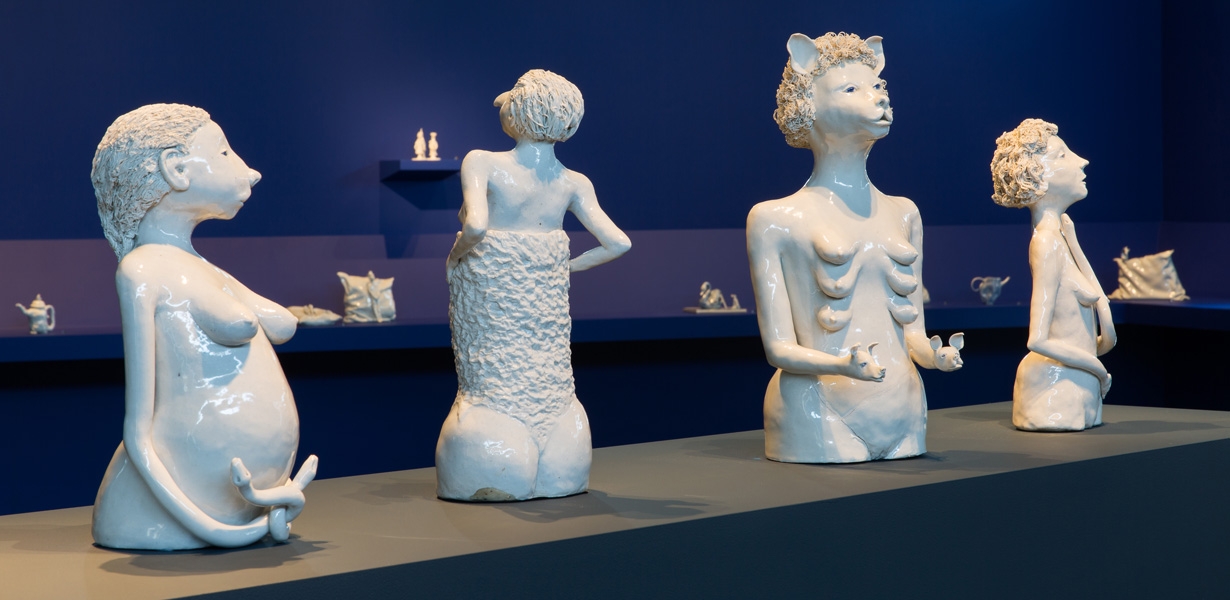
Installation view of Coille Hooven: Tell It By Heart. Photo by Jenna Bascom. Courtesy of the Museum of Arts and Design.

Installation view of Coille Hooven: Tell It By Heart.
Photo by Jenna Bascom. Courtesy of the Museum of Arts and Design.

Focusing on material-based art, the Museum of Arts and Design, New York, presents a range of contemporary works that cross the disciplines of fine art, crafts, and design. Current exhibitions throughout the museum emphasize transformation. Françoise Grossen Selects introduces the many influences that have formed the artist’s vision over the decades; Crochet Coral Reef: Toxic Seas demonstrates how our marine ecosystem has evolved under climate change. Voulkos: The Breakthrough Years showcases the artist’s exploration of clay as an artistic medium. Coille Hooven: Tell it by Heart addresses transformation and feminism, exhibiting fifty-five sculptures that range from vessels to figurative busts. The exhibition not only surveys thirty years of Hooven’s career, but also celebrates the maturity and growth of the female body through a medium connected to domestic life.

Read More »

Share

Fan Mail

Fan Mail: Kyle J. Bauer

The sculptures of Kyle J. Bauer have a gamelike quality, a sense of earnest play rarely seen in work made with such formalist rigor. Drawing from maritime navigation and the idea of façade—both as the decorative facing of a building and as a superficial or false front—for primary inspiration, Bauer mixes bright colors and found materials to produce works that feel vaguely familiar, as if they were objects seen bobbing in the ocean off a childhood coastline. Amid their pleasing surfaces, the pieces retain visual tension; readings of the works often vacillate between fluidity and rigidity, stillness and potential energy, accessibility and impenetrability.

Kyle J. Bauer. Radar, 2015; wood, streamers, paint; 86 in x 22.5 in x 19 in. Courtesy of the Artist.

Kyle J. Bauer. Radar, 2015; wood, streamers, paint; 86 in x 22.5 in x 19 in. Courtesy of the Artist.

Whether they feel still or fluid, or both, Bauer’s pieces convey a strong sense of directionality. Upon looking at Mooring (2013), one might feel as though it were pointing to a specific place to which one might navigate, if only one could understand its symbols. The eye tends to read the piece from left to right, following the graphic black-and-white wavy lines through the mysterious, unyielding brown cube and shooting off along the strong diagonals of the bright orange dowels. Capsule-like porcelain cylinders hang from eyebolts screwed into the cube’s pegboard face, reading at once like cables in a switchboard and anchors or ballast. The effect is of an ongoing translation to which the viewer is not privy; the secrets of Mooring are safely protected by an inscrutable symbolism.

Read More »

Share

Mexico City

La Ciudad Está Allá Afuera: Demolición, Ocupación y Utopía [The City Is Out There: Demolition, Occupation, and Utopia]

If we googled the word “megalopolis,” it is most likely that an image of Mexico City would appear in the search. The capital of Mexico has 9 million inhabitants, and a floating population of almost 2 million people who travel every day from the adjacent suburbs to study, work, and shop. This concentration of humans turns the city into a bustling social and cultural center, as well as a thriving economic node. However, this dynamism also entails a wide variety of problems, including irreversible pollution, poor transportation policies, economic inequality, and high levels of crime. The collective exhibition La Ciudad Está Allá Afuera: Demolición, Ocupación y Utopía [The City Is Out There: Demolition, Occupation, and Utopia], currently on display at the Centro Cultural Universitario Tlatelolco (CCUT), offers a critical commentary on the way this city is inhabited, shared, used, controlled, permanently reinvented, and represented.

Ishmael Randall-Weeks, Pilares [Pillars], 2014; reinforced concrete and carved books. Courtesy of Centro Cultural Universitario Tlatelolco, UNAM. Photo: Tania Puente.

Ishmael Randall-Weeks. Pilares [Pillars], 2014; reinforced concrete and carved books. Courtesy of Centro Cultural Universitario Tlatelolco, UNAM. Photo: Tania Puente.

Curated by twelve members of the National Autonomous University of Mexico’s (UNAM) Curatorial Studies Masters Program, this show, just like the city, refuses to remain static or neatly categorized. Instead, it encourages a constant confrontation of ideas around demolition, occupation, and utopia. These three axes are tightly interwoven, and can be observed simultaneously in the displayed artworks, as well as within the museum’s surroundings. The view from the main gallery’s window is of the Plaza de las Tres Culturas, an emblematic square in the city, where pre-Hispanic ruins meet a colonial church—all of which is framed by the Nonoalco-Tlatelolco residential complex, an utopian architectural project developed by Mexican architect Mario Pani in the mid-’60s.

Read More »

Share