Los Angeles

The Bermuda Triangle of Art

Courtesy of the arts blog Hyperallergic, today we bring you the artwork of William Powhida. You have just a few more hours to catch his solo show “Bill by Bill” at Charlie James Gallery in Los Angeles. If you’re in the area you should definitely make the effort to go: the work is sharp and funny and outspoken in a way that’s rarely seen in a commercial gallery. This review was written by  Carolina A. Miranda and originally published on May 21, 2013. You can also check out Daily Serving’s interview with Powhida from last fall and the PDF catalog of “Bill by Bill.”

William Powhida, Bill by Bill, installation at Charlie James Gallery, April 2013

When Marcel Duchamp submitted his signed urinal to a group exhibition in 1917, he certainly couldn’t have predicted that his decontextualized toilet would represent the dawn of an era in which everything and anything could be “art.” Take some mundane object or action, add word salad — et voilà, you have art. Manipulated photographs aren’t simply manipulated photographs. They are “visual statements that are at once documentary and fictional.”

A painter’s brush strokes don’t come together to form a picture, are textures that “function as proof of past operations.” And a piece of taxidermy isn’t just a stuffed animal. It’s “a state of apparent life premised on actual death.” In the Bermuda Triangle of Art, an object is never an object. It’s a physical vessel with which to deliver heaps of impenetrable prose — prose intended to convince some aspiring patron that the mound of detritus before him is pregnant with meaning (in addition to looking great over the couch).

Read the full article here.

Share

Elsewhere

Pigeon Auction: Suburban Secrets

Driving the bleak stretches of highway to south-western Sydney to see “Pigeon Auction” at the Casula Powerhouse, an arts centre housed in a post-industrial relic between a polluted river and a railway line, I had time to reflect on the curatorial premise for the show. An examination of ‘suburban subcultures’ is fertile ground for contemporary art.  I was intrigued to see how a coherent narrative could emerge from elements as diverse as graffiti and skateboarding, indigenous identity, the raising of chickens and silkworms, punk subculture, and gun clubs. “Pigeon Auction” celebrates the cultural diversity – and sheer eccentricity – of suburban Australia. Curator Toni Bailey saw a sign taped to a power pole which simply said “Pigeon Auction Today,” causing her to think about the substrata of suburbia: all the hobbies and interests, passions and desires which float below the surface; all the secrets behind fences and closed front doors.

Garry Trinh, Our Spot Year Made - Miller, 2008, Digital C type print, 65x47cm each. There are 9 images in this series: Miller, Moorebank, Fairfield, Bondi, Allawah, Castle Hill, Punchbowl, Leichardt, Cabramatta

Garry Trinh’s series of photographs, “Our Spot,” recalls a youthful obsession with his skateboard, travelling hours on public transport to get to skateboard parks in far flung suburbs. He shot  images of long-abandoned skate parks on an old light-leaking camera using expired photographic film, giving the photographs a hallucinogenic, strangely romantic feeling. These are elegies to youth, to that intoxicating mixture of aimlessness and purpose that characterises adolescence. Melbourne artist Tony Garifalakis presents a series of ‘new age’ statements taken from sources such as positive affirmation cards, self-help books and bumper stickers, printed across paper shooting targets. The most memorable of these, printed in a hot pink cursive font across a black balaclava-clad male pointing an assault weapon, reads, “I am a beautiful being of light.” These photographs disrupt the connection between image and text, creating dissonant messages intended to expose deep anxiety and paranoia.

Melbourne-based indigenous photographer Bindi Cole writes an astonishingly confessional blog. Her time in prison, her relationships, her miscarriages, her heartaches and her spirituality; it’s all there, heart well and truly on sleeve. Her series “Not Really Aboriginal” was produced in 2008, the year that the Australian Prime Minister issued a formal apology to members of the ‘Stolen Generation,’ Aboriginal people who as children were forcibly removed from their families and placed in institutions. Cole’s own experiences as a light-skinned Aboriginal woman directly informed this series, in which she plays on the racist traditions of minstrel shows. She presents us with a series of seemingly banal vignettes – a group of people in their lounge room, a couple posed on the banks of a river. In each case they are wearing blackface. They have become the black  ‘other,’ now entirely defined by the colour of their skin, thus confronting our easy assumptions about other human beings and exposing a deep substratum of racism in Australian society.

Read More »

Share

New York

Change Over Time: Richard Misrach at Pace MacGill

California-based photographer Richard Misrach first emerged on the American art scene in the 1970s, praised for his pioneering use of color film and large-scale prints. He spent the next four decades of his career using these techniques to document the fragile relationship between man and the environment, paying special attention to decaying, off-kilter landscapes. His photographs of former nuclear test sites in Nevada and Utah, or the wreckage left in the wake of the 1991 Berkeley-Oakland fire, demonstrate how man interacts with the natural world, alters it and then leaves it behind. By returning to the same locations—the swamps of rural Louisiana, the beaches of Hawaii—Misrach archives our shifting historical memory of these sites, and by photographing them at different times of day or year, he reminds us how deeply fluctuations in the natural world affect our experience of place.

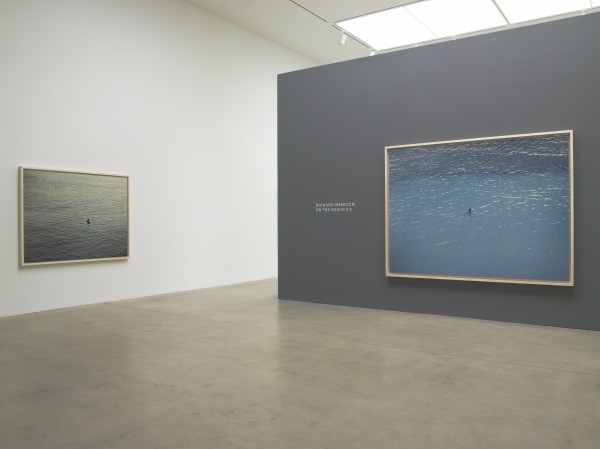
His latest series, “On the Beach 2.0,” is currently on view at the Pace MacGill Gallery in Chelsea. Monumental, exquisitely detailed prints—some up to 7×12 feet—of water, sand and solitary figures, or couples lost in private moments, line the walls. The photos were taken from the eighth story balcony of Misrach’s Honolulu hotel room during his trimonthly visits to the island, where he spent hours sitting, waiting and watching the beach below.

Richard Misrach. “On the Beach 2.0″ installation view. Courtesy of Pace MacGill Gallery (New York).

As the title suggests, this series marks a return to previous subject matter. The original “On the Beach” project, first exhibited at Pace in 2004, was a response to the events of September 11, 2001. In the aftermath of the attacks on the World Trade Center and Pentagon, images of the collisions were omnipresent in the news, and artists, directors and writers soon began producing work that directly addressed the events of that day. Misrach felt unsure how or whether to do so himself. Several weeks after 9/11, he visited Honolulu on vacation and noticed, from his hotel balcony, the unnerving similarity between the ubiquitous images of bodies falling from the burning towers and the untethered bodies of the swimmers floating in the salt water below. The isolation and physical beauty of these lone figures, suspended in space, became a source of fascination for Misrach that endures in his new series.

Yet despite the similar subject matter and composition of the shots, 2.0 is a different body of work, both in intent and presentation. According to Sofia Cordova, Misrach’s Studio Manager, the new series is about waiting and what happens when you do—the strange, small, secret moments that compose life. She mentioned that a major inspiration was Walker Evans’ 1938 series “Many Are Called,” in which Evans used a hidden camera to snap portraits of unsuspecting riders on the New York City subway. Over the course of the project, Evans began to see the subway itself as his studio—an idea that resonated with Misrach. Here, the public space of this balmy Honolulu beach is transformed into the photographer’s studio; his unknowing subjects drift in and out of the frame as he stands watch.

In this way, “On the Beach 2.0” is less overtly political than many of Misrach’s most well-known series. “Cancer Alley” traces the environmental degradation of a stretch of the Mississippi River lined with chemical plants, and his ongoing series “Desert Cantos” catalogues the history of the American West, reflecting on its use as a site for testing nuclear bombs. But his work, with its rich tones and painstaking compositions, is always too beautiful to seem heavy-handed. This new series is not a comment on any particular event or environmental disaster, but, as Misrach remarked in a recent interview with Architectural Digest, more of a metaphysical contemplation on the place of man in nature.

Richard Misrach. Holy Rosary Cemetery and Dow Chemical Corporation. From “Cancer Alley,” 1998. Chromogenic print from digital file. All following images courtesy of Fraenkel Gallery (San Francisco), Pace MacGill Gallery (New York) and Marc Selwyn Fine Art (Los Angeles).

Read More »

Share

Fan Mail

Fan Mail: Yukihiro Kaneuchi

For this edition of Fan Mail, Yukihiro Kaneuchi of Tokyo, Japan has been selected from our worthy reader submissions. Two artists are featured each month—the next one could be you! If you would like to be considered, please submit your website link to info@dailyserving.com with ‘Fan Mail’ in the subject line.

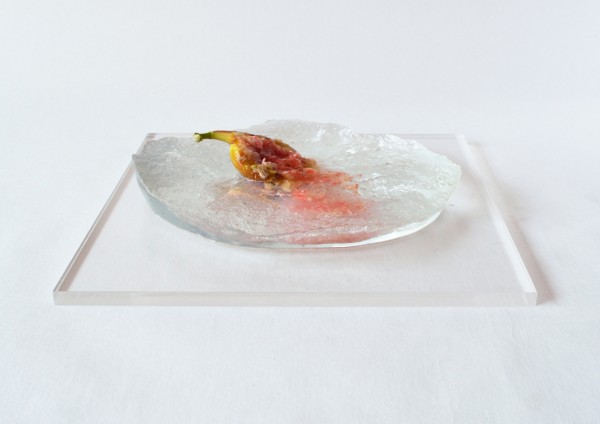
Yukihiro Kaneuchi, "Plate" from "Lamia" series, 2013. Dyed resin and fig.

Born in 1984, Yukihiro Kaneuchi grew up in Fukuoka, on the north shore of Kyushu, the southernmost of Japan’s four major islands. Fukuoka is a large city, larger than Kyoto but also very environmentally friendly, and Kaneuchi describes the place as “sea/forest/mountain.” At any rate, his hometown is not a “crazy city” like Tokyo, and Kaneuchi keeps studios in both places. He acquired the shell, cuttlebone, and fishbone for his new series in Fukuoka where his space is close to the water, but put it together in the capital. It is called “Lamia.”

Yukihiro Kaneuchi, "Knife," "Fork," "Spoon" from series "Lamia," 2013. Organic materials, thread, resin, brass.

Kaneuchi studied design at Tama Art University and graduated in 2008. In 2009, Benetton awarded him a scholarship to do a year’s research at Fabrica, their communications research centre near Venice. “Fabrica,” they say of themselves, “is not a school, advertising agency or university. It is an applied creativity laboratory, a talent incubator, a studio of sorts . . .” Their home base is a 17th century villa rehabilitated by self-taught Japanese architect Tadao Ando, and it was there, working as a product designer, that Kaneuchi says he learned products “can/must” have “criticism and motivation.”

Yukihiro Kaneuchi, "Fork" detail from "Lamia," 2013.

I wrote to Kaneuchi about “Lamia.” The series consists of four pieces, or “products”—a plate, fork, knife, and spoon. When he made them, Kaneuchi was thinking about the essence of a product, which he calls “first intention.” He will mention the oldowan: a hand axe and the earliest stone tool, it is has been around for 2.6 million years. But now the minds and hands that have historically finessed rocks, metals, and animal parts into objects of special use are participants in an “incessant” global production-consumption model. “We need,” Kaneuchi says, “to reconsider the value and role of products to avoid over-saturation, decreasing quality, and negative environmental impacts.”

Read More »

Share

Elsewhere

Rebound: Dissections and Excavations in Book Art

There is no doubt that “the relevance of physical books in our culture is diminishing” according to curator Karen Ann Meyers. Rebound, presented by the College of Charleston‘s Halsey Institute of Contemporary Art, shows five artists who use books to create sculpture. Books provide a mass of free material for these artists. Encyclopedia sets were once functional objects from a different time and culture. These discarded books are given new life.

When I attended the artist’s tour, the five spoke of the narratives of their texts, the translation of the symbolic language to sculpture and image, and compressing the narrative. A book’s structure can be compared to snakes, a river, a labyrinth. These artists break the temporal and spatial barriers of the linear text.

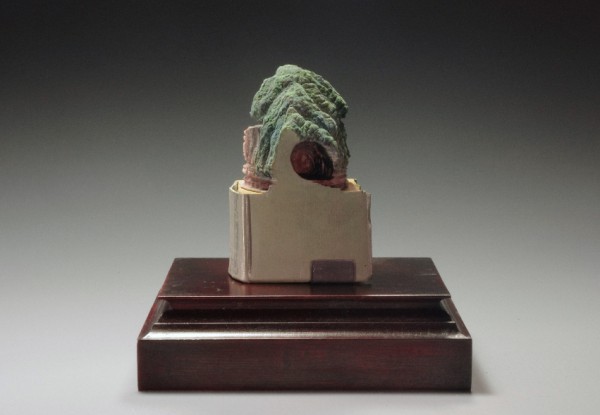
Guy Laramee‘s lush valleys sparkle as we assume the aerial viewpoint looking over verdant landscapes. Within an unreadable text, a cave glitters as though looking into a geode. I imagine mountainous islands, the kind of primitive area imagined in stories of the south seas and exploration of new lands.

Guy Laramee, Mushroom Island, carved book, pigmented ink, gold.

Guy Laramee, Mushroom Island, carved book, pigmented ink, gold.

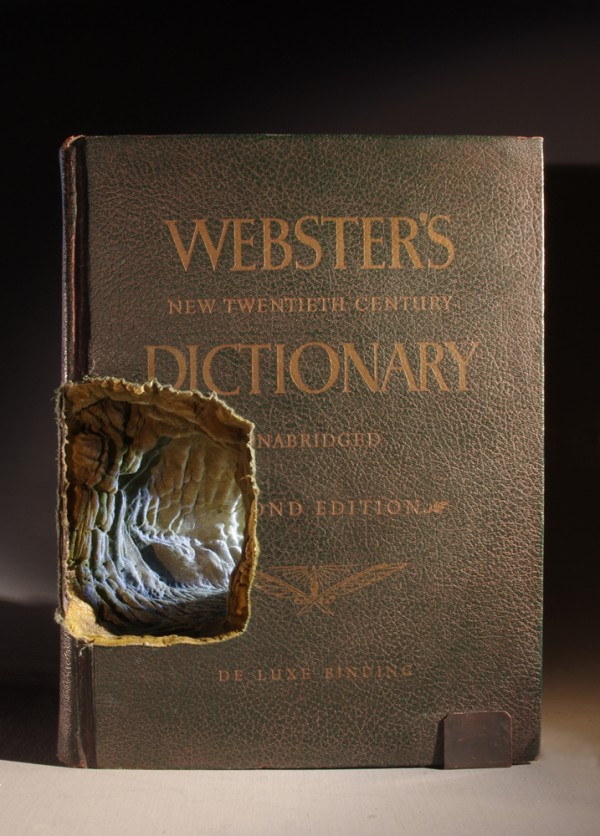
Guy Laramee was born and lives in Montreal. He says, “I still have a hard time considering myself a book artist” because it’s only a portion of his work—he was first a composer then went back to school at 40. “I had the idea of putting a book in the sandblaster.” He dug holes in the books and coated them with shining pigmented ink. When he spoke of his art, he told the story of a people, “after the fall of the Great Wall of America, they find stories of their own culture.” He invents stories to make meaning for these works, so that his projects have purpose, and to delve into the unknown. He names his “Caverna” after Saramago’s latest book and refers to Plato’s allegory. “One gains true knowledge through erosion, not accretion,” the catalog says.

Guy Laramee, The Way Out, carved book, pigmented ink, and lamp.

Guy Laramee, The Way Out, carved book, pigmented ink, and lamp.

Read More »

Share

Los Angeles Hashtags

#Hashtags: The Quantum Leap to Something New, Part I

In the face of economic fluctuations, not to mention the whirlwind of popular taste, how do galleries survive, adapt, evolve, and thrive?

Big Geezers in Culver City, 2008, Ori. Courtesy Flickr / Creative Commons

The popular perception of the contemporary art gallery is one of inaccessibility and elitism.  By and large, the gallery’s reputation is one of isolated sanctity, an entity that sustains itself through a preserved set of conventions and a closed system of values. The walls shall be white, the prices shall be hidden, and the information shall be guarded by inhospitable staff; ideally, the formality of the visitor’s experience obfuscates all cues that suggest it is “art” on display, rather than the chamber and ritual itself. The fastidious effort to highlight the prowess of a gallery’s brand over its actual exhibitions oftentimes conceals the necessity of its inherently commercial aspects.  The sale of art must take place in order for the contemporary or fine art gallery to exist—a seemingly obvious notion that is often obscured behind a defensive shield of ceremoniousness—a behavior that projects the illusion of a higher pedagogical purpose.  However, the conventional art gallery is still subject to the realities of any commercial business model, that is, the inherent fluctuations of a global economy and demand-driven market.  Given this, and the notions of an industry reputably built upon an aristocratic character, how does the structure and purpose of the gallery survive, adapt, evolve, and thrive?  How does the historical trajectory of the gallery model affect its progress moving forward?

The business model of such galleries is based upon a popular “provincial”[1] gallery model first pioneered by New York gallerist Leo Castelli. Fleeing Nazi-occupied Paris, Castelli arrived in the United States along with the advent of Abstract Expressionism, entering a New York bustling with the kind of desperate art creation he had connected with in Europe. Hoping to rescue the American art market from its “impasse” of selling work, Castelli opened his first New York space in his home on February 3, 1957.  He needed no more than a few hours to reorganize his own apartment; emptying the L-shaped living room, Castelli designated his daughter’s bedroom (she was away at Radcliffe) as his showroom. This literal internalization of his gallery practice exemplifies Castelli’s most unique quality, an outward demonstration of his personal investment in the work he showed.

Read More »

Share

From the Archives

Help Desk: The Social Disease

Today From the DS Archives we bring you a piece written by Daily Serving’s new managing editor, Bean Gilsdorf, from her weekly column “Help Desk.” Although only eight months old, the subject matter of her entry “The Social Disease” is still fresh. Featured in the article is work by artist Justin Kemp whose collaborative group Jogging  has a new exhibition “Soon” at the Still House in Brooklyn, on view May 24- June 14.

This article was originally published on September 3, 2012 by Bean Gilsdorf.

Help Desk is an arts-advice column that demystifies practices for artists, writers, curators, collectors, patrons, and the general public. Submit your questions anonymously here. All submissions become the property of Daily Serving. Help Desk is cosponsored by KQED.org.

This week’s column features the smart, funny work of artist Justin Kemp (in particular, I love his adding to the internet project, which was too big to be included here). I found his work on the Rhizome ArtBase,”an online home for works that employ materials such as software, code, websites, moving images, games and browsers towards aesthetic and critical ends.” Check it out!

I have never approached a gallery or reached out to the art world beyond maintaining a basic website because I haven’t had a body of work I felt the least bit thrilled with–until now. Meanwhile, my best friend–a successful radio morning-show guy–spent the wee hours of his recent 40th birthday accusing me of being an ivory-tower artist and insisting that I was insane not to be promoting myself on Facebook and other social media. Any defense I could mount sounded elitist and snobby despite my best intentions. It’s been a few days and I’m still having a hard time articulating my reservations. On the one hand, of course I want vast numbers of people to see my work for its own sake and make of it what they will. On the other hand, I am repulsed by the idea of jumping into the public pool just because all the other lemmings did, naively unconcerned with the ramifications of having their lives irreversibly put on public display, just to play trite ego-games in an environment controlled by big business, monitored by government, and all of it propped up by nuclear-energy-guzzling machines made in places with questionable labor and environmental practices, whence they ultimately return on toxic waste barges.

Leaving my paranoia aside, I also feel that an artist today would do well to cultivate a little mystique. Despite my friend’s imploring to the contrary, I feel that yes, I will indeed be somehow rewarded someday for not succumbing to social media, because I feel that a gallerist wants to be the discoverer of the artist as a diamond in the rough, and how can you “discover” someone who already has 3,000 “likes” or “friends?” Am I an e-prude?

Golly. I can’t tell if you’ve come to the absolute right place or the wrongest of wrong places for an answer. Like you, I’ve eschewed most forms of social networking, and while I’m maybe not quite as paranoid (at least on the good days), I do share some of your concerns about privacy and what you winningly call “ego games.” So my answer might be a little bit preaching-to-the-choir, but I’ll do my best to help you puzzle through your current situation.

Justin Kemp, proclaiming my love at a scenic overlook on top of a mountain, 2010. Tree carving; video on website 1’30”

First, let’s deal with practical matters. If you really want to attempt a defense that doesn’t sound elitist, you could cite the studies on Facebook and anxiety and what it does to your self-esteem. Or you could try a more pragmatic tack by talking about how fast technology turns over (remember MySpace and Friendster?), something that the techno-pundits are already discussing. You could mention that Facebook’s IPO was miserable compared to financial projections, the site is losing users, and co-founder Dustin Moskovitz and board member Peter Thiel are dumping millions of shares of stock from their portfolios—not a good sign. And in case you thought FB was the only villain, Twitter is now going to be spamming everyone’s feed with “promoted tweets” based on their interests. Because nothing in this world is truly free, all social media moves in the direction of targeted advertising, which they accomplish by tracking your data.

But really what you need to do, instead of mounting an airtight defense, is to stop comparing yourself to your friend—and stop letting him compare his situation to yours, because they’re completely different. He has a vested interest in being a part of social media: as a radio-show host, he’s a public figure with a specific message. Radio stations are supported by advertising, which the radio station sells to businesses by telling them how many people will hear their ads. They can increase that number of listeners, and then sell ads for more money, by using social media to market the show. By tweeting his political views or NOM NOM sushi lunch, your friend could be ultimately ensuring that he has a job next month. (Just as I’m sure that my editors are reading this right now and thinking, Yes, darling, get a damned Twitter account already and help us sell some advertising so we can keep on cutting checks for this column. But I digress.)

Justin Kemp, surfing with the sand between my toes (after brian wilson), 2010. Sandbox, Mac Pro, desk and chair in living room

Of course, you are an e-prude, at least by today’s standards. If that makes you feel insufferably bad, you’re either going to have to give it up and get publicly naked on the internet or else cultivate a sense of pride and learn to wear your smug, elitist, aloof moral superiority (because that’s certainly what you’ll be accused of) as a badge of honor. If you opt for the latter, recognize now that you may never get to have a normal conversation about the Internet again. No matter how neutrally you frame it, some people will look upon your lack of social media presence as a negative assessment of their own habits and get defensive and preachy. I spent ten years without a television, and learning that fact never stopped anyone from first heartily vowing that they never really watched TV either, and then following that up by recounting the plot of some idiotic sitcom that they were convinced I would just adore. I expect it’ll be the same with social media—your obvious expression of disinterest won’t make the proselytizers go away, so if you hold your ground just resign yourself to having that chat. But you’re a creative person, right? So surely you can figure out a creative way to get people looking at your work without compromising what you believe in.

Read More »

Share