





Elsewhere

Mexico as Muse

As part of our ongoing relationship with the Los Angeles-based Artillery, today we bring you an article about artists who have been inspired by the landscape and culture of Mexico. The author, Betty Ann Brown, says, “My journey through Mexico has been a journey from consumption to critical thinking.” Mexico as Muse was originally published on April 30, 2013.
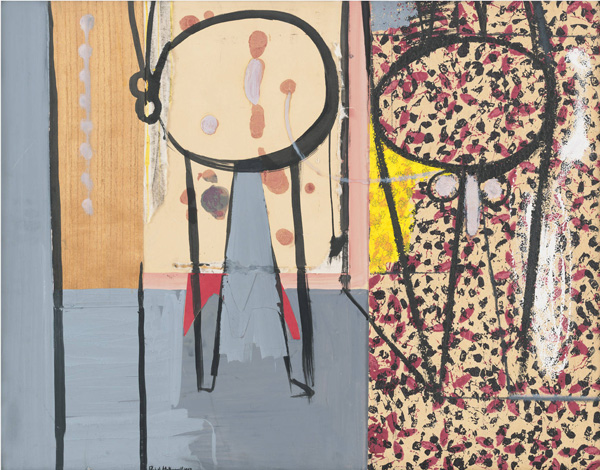
Robert Motherwell. Pancho Villa, Dead and Alive, 1943; cut-and-pasted printed and painted papers, wood veneer, gouache, oil, and ink on board; 28 1/4 x 35 7/8 in.

“Mexico is truly the promised land for abstract art.”
Anni & Josef Albers, 1936

“Mexico is the most surrealist country in the world.”
Andre Breton, 1938

Why Mexico? It was not only that Mexico was nearby and easily accessible to U.S.–based artists, although that was certainly true. And it was not just that Mexico had powerful ancient arts that were alien and mysterious to the Euro-American public, though that was true as well. It was also that Mexico was, in the 1920s, a significant cultural center. As historian Amy Lifson notes in “Art of Influence” from 2010, “[O]ne of the hottest venues in the art world was the Mexican Ministry of Public Education, where Diego Rivera was painting the frescoes that would revive mural painting in the West. Rivera was world-famous, considered one of the three great living artists—the other two being Picasso and Matisse. It took him seven years to paint the cycle, which consisted of 235 panels. Artists, intellectuals, students, and curiosity-seekers from all over came to see the work.” Rivera’s work employed a new stylistic language, combining the European avant-garde with Mexican indigenous traditions. The following is a short survey of artists and the years they were in Mexico, where they were inspired and transformed.

Read the full article here.

Share

Berlin

Maria Lassnig at Capitain Petzel

Maria Lassnig’s current solo exhibition at Capitain Petzel in Berlin takes a quick and investigatory look at her body-awareness paintings. At first glance, Lassnig’s works look crass. She seems to care little for surfaces and even less for her palette: lumpy, grayish figures lie casually upon the surface of the canvas, craftsmanship is squandered, and colors are straight out of the tube. However, at the back of the exhibition, a pair of large format oil paintings done with a more classical rendering expose her skills at multifarious levels.

Maria Lassnig. Maria Lassnig, June 2013, installation view, Capitain Petzel, Berlin. Courtesy of Capitain Petzel.

To my right, a couple sits in naked repose. His face is bronze and she, astride him, is a blotchy rouge; both of their torsos are pale and the rest of their limbs a muddy beige. The female figure holds up a mirror to her male counterpart, who gazes at himself, relaxed, neutral. Her eyes settle on him, a look smug with amour, a satisfied adoration, recalling Bouguereau’s Le Ravissement de Psyche and Currin’s Old Couple, showing the core of intimacy, of looking and being looked at.

Read More »

Share

Elsewhere

Fowl Play: Koen Vanmechelen at ConnerSmith

Today’s domestic chickens are genetically altered far from their original ancestors. With the release of documentaries like the 2006 Fast Food Nation and 2008 Food, Inc., the poultry industry has come under harsh scrutiny in recent years, as the grotesque conditions in chicken farms across the country have been brought to light.  Though this has been a hot topic in the media and popular culture, the art world has largely overlooked the subject of genetically modified food. In his new show Leaving Paradise, Belgian artist Koen Vanmechelen brings the ethical issues of factory farming into the space of the gallery. The show, currently on view at the CONNERSMITH Gallery in Washington D.C., features work from his so-called Cosmopolitan Chicken Project, including sculpture, photography, videos and live chickens in cages.

Koen Vanmechelen, Symbiosis C.C.P, 2011; selective lasersintering (polyamide), wood, stainless steel; 19.75 x 10 x 10 in. Courtesy of CONNERSMITH Gallery.

Upon entering the gallery, I was greeted by the squawking of the birds. In the back of the first gallery, a large wooden cage houses two Red Jungle Fowl chickens, a male and female, and their new offspring. Vanmechelen’s ongoing Cosmopolitan Chicken Project, which he began in 1999, involves interbreeding chickens from different countries in an effort to create “a true cosmopolitan chicken as a symbol for global diversity.” A giant family tree of this breeding experiment spans a wall in the second gallery of the exhibition. He uses the Red Jungle Fowl because it is the ancestor of all modern chickens. In breeding the chickens he seeks to bring them back to their original state of existence, one that is much more healthy and natural than those found in modern poultry processing plants.

Read More »

Share

Fan Mail

Fan Mail: Masur Museum

For this edition of Fan Mail, the Masur Museum of Monroe, Louisiana has been selected from our worthy reader submissions. Two artists are featured each month—the next one could be you! If you would like to be considered, please submit your website link to info@dailyserving.com with ‘Fan Mail’ in the subject line.

For the upcoming exhibition Computer Aided, the Masur Museum is showing works by the artists Keliy Anderson-Staley (AR), Joshua Chambers (LA), Harold Cohen (CA), Craig Damrauer (LA), Hasan Elahi (MD), Jenny Holzer (NY), John Rodriguez (LA), Marni Shindelman & Nate Larson (GA & MD), Jes Schrom & Graham Simpson (LA), and Kate Shannon (OH), in addition to short video loops from well-known artists Mat Collishaw (UK), Damien Hirst (UK), Shepard Fairey (LA), Jenny Holzer (NY), and Bill Viola (CA), purchased online.Jenny Holzer. Sense, undated; still from s[edition] digital limited edition video; edition 106 of 5,000, dimensions variable.  Courtesy of the Artist and s[edition], London.  Pending accession to Permanent Collection of Masur Museum of Art, Monroe, LA.

Jenny Holzer. Sense, n.d.; still from s(edition) digital limited edition video; edition 106 of 5,000, dimensions variable. Courtesy of the Artist and s(edition), London. Pending accession to Permanent Collection of Masur Museum of Art, Monroe, LA.

Computer Aided takes a hard look at hierarchy in contemporary art, considering the Masur Museum’s own position as a small institution in upstate Lousiana. By purchasing videos from s[edition], a company founded two years ago to sell limited-edition digital art, the Masur can exhibit these famed contemporary artists “who are otherwise beyond the Mansur’s means,” says curator Benjamin Hickey.

Since the works have been translated to a new kind of art object to be displayed on the screen and bought online, meaning is inevitably altered. Viewing these fabrications or reductions of esteemed visionaries is strange, as is the case with Hirst, Fairey, and Viola. Holzer and Collishaw seem better suited to this format: Holzer’s slogans move across the screen and feel like the kind of art that makes sense to be distributed as a digital file; Collishaw’s Whispering Weeds (a recreation of Albrecht Durer’s Great Piece of Turf, a watercolor from 1503) is beautiful and loops perfectly.

Mat Collishaw. Whispering Weeds, undated;  still from s[edition] digital limited edition video; edition 129 of 10,000, dimensions variable.  Courtesy of the Artist and s[edition], London.  Pending accession to Permanent Collection of Masur Museum of Art, Monroe, LA.

Mat Collishaw. Whispering Weeds, undated; still from s(edition) digital limited edition video; edition 129 of 10,000, dimensions variable. Courtesy of the Artist and s(edition), London. Pending accession to Permanent Collection of Masur Museum of Art, Monroe, LA.

Read More »

Share

Singapore

Chun Kwang Young: Assemblage

Chun Kwang Young’s Assemblage at Art Plural Gallery is a series of three-dimensional sculptural works wrapped with Korean mulberry paper and assembled within the two-dimensional frame of a canvas. Taking the ubiquitous use of the mulberry paper in Korea—also known as hanji—as a material point of reference, the Assemblage series explores a desolate landscape of depressions, protrusions and coloured spots, all of which seem to reference abstract painting’s visual language of prioritising internal form over pictorial representation.

Chun Kwang Young. Aggregation 07 A135, 2007; mixed media with Korean mulberry paper; 171 x 139 cm. Image courtesy of Michael Culme-Seymour and Art Plural gallery.

Up close, the careful triangle arrangement that is an accumulation of basic units of information yields an uncompromising, ravaged topography that rises and falls within the canvas. In some Aggregates, waves of tightly-packed, forward-leaning triangles pushes uncomfortably against an opposing tide of edges then dip under the onslaught of sunken projectiles and circular masses. In others, the surfaces resemble natural rock formations, showing no particular form. Put together, Chun’s surfaces are abstract, quasi-sculptural spaces in continuous flux or crisis, with the broad, expansive swaths of colour reminiscent of Helen Frankenthaler and the gradients of Jules Olitski—a composite style that is the result of his efforts at reconciling two seeming opposing worldviews: the conservative values of a Korean upbringing and the overwhelmingly secular and material world with which he came into contact when he relocated to Philadelphia to earn his graduate degree in the Fine Arts in the 1970s.

Chun Kwang Young. Aggregation 07 DE146, 2007 (detail); mixed media with Korean mulberry paper; 250 x 205 cm. Image courtesy of Michael Culme-Seymour and Art Plural gallery.

Read More »

Share

PortlandInterviews

The Weird and the Northwest: An Interview with Cynthia Lahti

Cynthia Lahti’s work spans a multitude of mediums, from collage to ceramics, altered books, and painting. Populated by strange or uncanny figures—often children in masks and costumes—her works are odes to the off-kilter. If there’s violence in her mark-making, nearby is always a tender or vulnerable gesture. Tailing her solo exhibition Elsewhere at PDX Contemporary and a residency in Berlin, Cynthia Lahti was also recently named a Hallie Ford Fellow in the Visual Arts. I talked to Lahti at her studio in late May.

Cynthia Lahti. Dorme, 2013; ceramic and paper with watercolor; 8 x 18 x 11 in. Courtesy of the Artist.

Jenna Lechner: You were in Berlin last September?

Cynthia Lahti: I was in Berlin for 11 weeks; it was a ceramics residency. My thing was, I went to a lot of museums—looking at art has always been a huge part of my process; I’d never been in a city that had that many museums.

JL: Was there anything in particular that you wanted to see?

CL: Yeah, I’ve always loved the Northern Renaissance painters—Rogier van der Weyden, Dürer—they seem more psychologically disturbed to me. German Expressionism has always been really important to me too. It was exciting to be there. You know when you’re in a foreign city, any place you’ve never been before, it somehow seeps into the art? Berlin has a darkness and an intensity which comes out in the artwork, and I felt like that fed into my work, which has always had that element. I was happy to come home to Portland, because it does feel…

JL: Lighter?

CL: Oh totally lighter, beyond light.

JL: Was the work at PDX Contemporary all made in Berlin?

CL: Yes. The circus seems to relate to Berlin in this weird way that I haven’t quite figured out. You know the movie Cabaret, with Liza Minnelli? It seems like that in Berlin. There are all those weird, scary, things—the costuming, the performance— it definitely felt like the circus.

JL: Do you have a personal relationship to the circus?

CL: I go to the circus when I can. In the late ‘80s, I remember going to the Ringling Brothers in the [Veterans Memorial] Coliseum. I did see the circus in Russia once, and it was incredible. I really want to see the circuses of the past, which, of course that’s impossible.

JL: What about Portland? We’ve talked about the zeitgeist in Berlin, and being influenced by the culture. You’ve been in Portland for a while—

CL: I grew up here. But I went to RISD for school, so I did leave. I visited my friends on the East Coast when I was on my way to Berlin, and we are really lucky here. In New York, it’s so big, you don’t even have a chance. You at least have a chance here of some sort. It’s a place where people try new ideas.

Read More »

Share

Shotgun Reviews

Roger Shimomura: Minidoka on My Mind

Today we welcome a new feature to Daily Serving: Shotgun Reviews! Shotgun Reviews are an open forum where we invite the international art community to contribute timely, short format responses (250-400 words) to an exhibition or event. If you are interested in submitting a Shotgun Review, please click this link for more information.

Roger Shimomura. Classmates, 2007; acrylic on canvas; 24 x 36 in. Courtesy Sonoma Valley Museum of Art.

Roger Shimomura: Minidoka on My Mind at Sonoma Valley Museum of Art, by Satri Pencak

With the passage of time childhood memories can merge with dreams and stories told by others yet remain very powerful. In this way, Roger Shimomura employs his memories to create powerful visual imagery. The current exhibition at Sonoma Valley Museum of Art features paintings and lithographs representing snippets of Shimomura’s remembrances from the years he was detained as a child in Minidoka, a World War II relocation camp located in Idaho one of many relocation camps for Japanese Americans during that time. Addressing socio-political issues of ethnicity and discrimination, Shimomura brings together visual aspects of Japanese style ukiyo-e prints with western style pop art in his work. This combination points out the vague and uncertain border of where one culture ends and another begins. In the tradition of Lichtenstein, Warhol, and Teraoka, Shimomura captures our attention by depicting visually appealing images through the use of cartoon characters or historical figures. This is particularly evident in a painting titled Classmates. Here, two teenage girls stand together in their nice school dresses. They look so much alike—best friends—smiling, munching on shiny red apples. However, one girl is blond, the other, with black hair, stands behind a barbed wire fence. The message is quite chilling.

Read More »

Share




