San Francisco

Artists Who Confront Violence: An Introduction

As part of our ongoing partnership with KQED Arts, today we bring you an article on activism and the artistic lineage of political criticism, from Goya to Gezi Park. Author Christian L. Frock is also giving a lecture on the same topic at 2 p.m., Saturday, June 29, at the Intersection for the Arts in San Francisco. This article was originally published on  June 27, 2013.

Francisco Goya. The Disasters of War (Plate 39 – heroic feat! With dead men!), 1810-1820; etching.

When examining a history of artistic response to social injustice, across a spectrum of political issues, most key works are propelled by visibility. This is the hybrid condition of art and activism—whereas the art community might debate the value of documentation, especially with live performance, activism necessitates it. Before reproductions, static objects were visible to a limited audience; indeed, the impetus for printmaking was to reach a wide public audience. Photography extended this reach and the Internet has extended it further. The Internet affords us a somewhat, though not entirely democratic public platform by virtue of reach; access to the Internet still reflects a prevailing wealth disparity and, further, such access is ultimately controlled by private enterprise. Despite these limitations, it enables access that is potentially global in scope. This expansive communication potential is a vital resource to artists who confront social inequity to bear witness, to generate dialog and to cultivate change.

Consider here three important historic examples, not just for the issues of their time, but for the examples they set as forms of social record. Also noteworthy is how these works moved through public channels and how they still resonate in today’s society. Each provides critical benchmarks to survey the tactics of politically engaged artists throughout recent history. They are also important models to learn from and build upon moving forward.

Read the full article here.

Share

San Francisco

Shih Chieh Huang at Yerba Buena Center for the Arts

The flickering, multicolored lights of Shih Chieh Huang’s installation Synthetic Seduction, now on view at the Yerba Buena Center for the Arts, reminds me of the cellular and molecular models found in biology classrooms. When I was a student, one of the ways in which I learned about organic forms was by placing mitochondria, lysosomes, and nuclei in their correct locations in these models. Huang also re-creates life with synthetic, mundane materials, but she does so with much more technical and mechanical sophistication. While Huang’s forms may not overtly mimic reality, his work serves as an interpretation of structures operating in concert.

Shih Chieh Huang. Synthetic Seduction, 2013; installation view, Yerba Buena Center for the Arts, San Francisco. Courtesy of the Yerba Buena Center for the Arts. Photo: Dorothy Santos

Synthetic Seduction primarily appeals to our retinal senses and our fascination with technology’s capacity to mimic life. As one enters the dark room of Seduction, glowing lights reveal bags attached to a mechanism that metaphorically blows life into the structures. Visible wires and synthetic materials such as audio cables, water bottles, and plastic bags make up an elegant man-made ecosystem that pulsates, gyrates, and illuminates a way of modeling life through new media. Seeing the soldered components, the viewer is well aware that the structures can easily be broken or dismantled; though the work is robotic and animatronic, it conveys fragility. Huang’s work performs as if it is a representation or prototype of an organism that belongs within our environment. Although this particular installation is not interactive in terms of the viewer directly affecting the work, the placement of the body in space affords the viewer different interactions with the piece. The most compelling aspect of the work entails the soft, muted colors of each sculpture turning my notebook pages to different hues of red, green, blue, and violet. Bottles strategically hung from the ceiling and around the sculptural works contain glowing neon yellow liquid. Watching people walk in and out of the space, it was relatively easy to observe visitors congregating in circles as if to bask in the luminescence. The lights attract while the darkness repels.

Read More »

Share

New York

ICP Triennial: A Different Kind of Order

Shimpei Takeda, Trace #7, Nihonmatsu Castle, 2012. Courtesy the artist

A Different Kind of Order, the International Center of Photography’s Triennial, includes artworks by twenty-eight international artists whose photographs, films, sculptures, video, and mixed-media works focus on the intersection of modern image making and our technologically advanced contemporary culture. The artists bring light to the nuances of our “new” world’s challenges, whether they are newfangled or all too familiar. Moving between the application and denial of technology in the face of globalization and the camera’s own digitized, social self, the exhibition explores the aestheticization and hybridization of new photographic mediums.

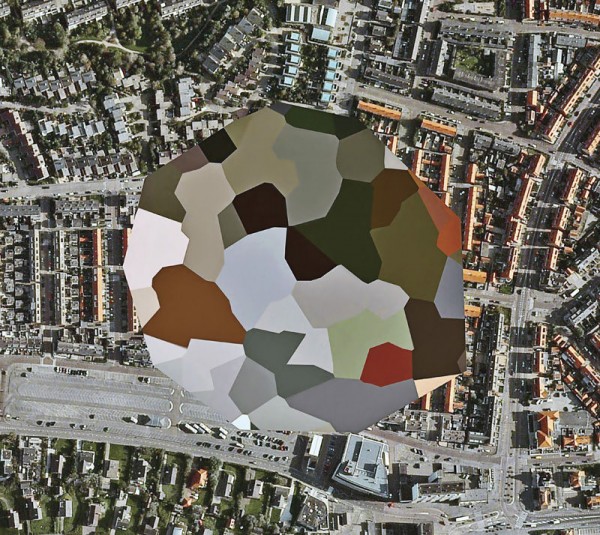
Mishka Henner, Unknown Site, Noordwijk aan Zee, South Holland, 2011. Courtesy the artist

The exhibition’s entryway presents the work of Mishka Henner, whose Dutch Landscapes series touches on these themes. The work at first seems to be a beautiful yet awkward rendering of abstract, digitized forms haphazardly placed atop aerial views of cityscapes. Upon reading the description, the viewer learns that the images are gleaned from online satellite mapping and that the strange blobs are actually an absurdist government attempt to hide sensitive sites from public view. In this case the Dutch authorities demanded that the views of such sites be blurred online by grossly exaggerating the image’s pixelation. The irony, of course, is that the low resolution of the kaleidoscopic forms brings attention to these supposedly hidden locations, creating a kind of failed, aestheticized censorship.

Read More »

Share

Los Angeles

James Turrell: A Retrospective at LACMA

There’s no doubt that you’ll hear much about the work of James Turrell in the coming months. With three major exhibitions—at the Los Angeles County Museum of Art (LACMA), the Museum of Fine Arts, Houston (MFAH), and the Guggenheim in New York—the art world seems primed to talk about nothing else. Given their geographical spread and the fact that all three exhibitions will be open to the public simultaneously from now until late September 2013, one could compare this to the “one city one book” community reading programs that exhort everyone to read and discuss the same novel. However, this undertaking seems less an opportunity to come together than a chance to debate the merits of Turrell’s oeuvre.

James Turrell. Afrum (White), 1966; cross corner projection. Photo: 2013 Museum Associates/LACMA.

There are, of course, many fine qualities to Turrell’s work. The first room of the LACMA exhibition shows three suites of drawings and prints. I noticed that most visitors only gave these a cursory glance before moving on, but I was quite transfixed. Two suites of etchings (seven prints from the First Light Series [1989–90] and eight prints from the Still Light Series [1991]) face each other across the room and demonstrate how the shading in white, gray, and black geometric shapes can produce the illusion of a three-dimensional object on a flat ground. Likewise, the ink and paper Projection Piece Drawings (1970–71) show the artist’s thinking and process in thirty-six precisely executed plans for other spacial apparitions. In the same way that an audience will remain spellbound even after a magician reveals the mechanisms of her tricks, I stood rapt in front of these works; I also came back through the room a second time after seeing the light projections in the galleries beyond. Learning the systems of Turrell’s magic doesn’t detract from the perceptual fun at all; in fact, it heightened my respect for his experimentation and craft.

The galleries beyond showcase a selection of light installations that combine the poetry of simplicity with the excess of spectacle, beginning with Afrum, White (1966). This projection of white light into the corner of a darkened room creates the illusion of a large three-dimensional floating cube that seems to rotate as the viewer walks through space. As a direct manifestation of the prints and plans of the previous room, it is breathtaking—so satisfying it is almost exhilarating—because of the way it so clearly demonstrates Turrell’s process: a voilà moment that rarely exists in museum exhibitions.

Read More »

Share

Hashtags

#Hashtags: The Quantum Leap to Something New, Part II

In the face of economic fluctuations, not to mention the whirlwind of popular taste, how do galleries survive, adapt, evolve, and thrive?

On September 15, 2008, contemporary artist Damien Hirst took an unprecedented risk. Bypassing the normal protocol enforced by his partnering galleries and dealers, Hirst took 223 of his own works to auction at Sotheby’s Auction House (London), resulting in a two-day sale marketed as an ephemeral, high-stakes solo exhibition titled Beautiful Inside My Head. The event was strictly all-ticket and limited to 656 clients, arguably ironic considering this was Hirst’s attempt to “democratize” the sale of his artwork. The high estimate for the combined sales of Hirst’s works was £98 million; by the end of the second evening, the lot had totaled £111.5 million—and represented the peak of the contemporary art market.(1) Simultaneously in New York City, Lehman Brothers was in the process of processing the largest bankruptcy filing in U.S. history— revealing losses of $639 billion, kickstarting what would shortly become the worst economic recession since the Great Depression. In this environment, how would any business—much less the small niche of contemporary art galleries—survive?

Damien Hirst. For the Love of God, 2007; Image courtesy of Aaron Weber and Flickr.com.

Welcome to the Knowledge Age, a term coined by social ecologists John H. Falk and Beverly K. Sheppard. Unlike the Industrial Age, in which mass-manufactured goods led to demand based on a limited set of choices available to a domestic consumer, the Knowledge Age involves highly personalized and globalized services and experiences, as well as new consumer behavior and expectations.  This paradigm shift is as relevant to cultural institutions (like galleries, museums, and nonprofit art spaces) as it is to the commercial marketplace, and it’s defined by three characteristics: a superabundance of international goods that leads to a multitude of options, multiple solutions for product or service customization, and relentless competition due to rapid global communication and information sharing. Any gallery that did survive the recession (and continues to do so) has manipulated Castellian ideologies to incorporate and reflect these characteristics, updating modes of “provincial” collaboration by using new technologies to further expand their network and visibility, and  maintaining a careful balance of physical and digital presences to appeal to new and old collectors alike.

Read More »

Share

Help Desk

Help Desk: Getting Schooled

Help Desk is an arts-advice column that demystifies practices for artists, writers, curators, collectors, patrons, and the general public. Submit your questions anonymously here. All submissions become the property of Daily Serving. Help Desk is cosponsored by KQED.org.

I’m an artist in my mid-twenties who has absolutely no formal education. So far I’ve managed to be fairly happy with small but very meaningful visibility, knowing that art making is about process and that it takes time to find one’s self. But I’m starting to hit a wall when it comes to the growth of my practice, and I’m worried that my lack of “training” might be my problem, so I’m slowly starting to consider going to an art school, with great fear, mainly because I haven’t been in an educational institution for a long time. So my question is: how important do you think education (art school) is in order for someone to be or to become a professional artist? Do you see it as absolutely necessary, or do you think that one can do without?

Rudolf Stingel. Rudolf Stingel, 2013; installation view, Palazzo Grassi, Venice.

I hate to be the bearer of bad news, but you could toil your whole life and make profound work and still remain nearly invisible, so let’s separate the notions of visibility and making. Visibility—that is to say, participating in group exhibitions, exhibiting your work in solo shows, receiving press, and all the ancillary duties that come with and reinforce it (such as giving artist lectures)—has shockingly little to do with art making. Instead, visibility is often correlated with how much money you’re born with, who you know, where you went to school, where you work, and other social factors, but in the long run it is not directly related to the quality or process of your work. This is why Josh Smith is a famous painter.

We also need to set aside the notion of how you become a “professional” artist. There’s a wide range of what can be considered professional, so figure out what it means to you. Does it mean that you make enough sales to support yourself (and possibly a family)? Does it mean that a gallery represents you? Or is it enough to be able to scrawl artist on your tax forms and write off your studio rent and materials? If you can find a copy of Frieze Magazine, Issue 121 from March 2009, read Dan Fox’s beautiful essay A Serious Business: What does it mean to be a professional artist? and explore your assumptions about what makes one a “professional.”[1]

Read More »

Share

Shotgun Reviews

Keith Haring: The Political Line at the Musée d’Art Moderne de la Ville de Paris and Centquatre

Shotgun Reviews are an open forum to which we invite the international art community to contribute timely, short format responses (250–400 words) to an exhibition or event. If you are interested in submitting a Shotgun Review, please follow this link for more information. In this Shotgun Review, Kanika Anand reviews Keith Haring: The Political Line at the Musée d’Art Moderne de la Ville de Paris and Centquatre.

Keith Haring. Unfinished Painting, 1989; acrylic on canvas; 39 x 39 in. (100 x 100 cm). Courtesy of Keith Haring Foundation

Cohosted by Musée d’Art Moderne de la Ville de Paris and Centquatre in Paris, The Political Line is one of the largest retrospectives of Keith Haring’s work. Spanning his career from 1978 to his untimely death in 1990, it comprises over two hundred works on paper and an impressive series of sculptures.

For Haring, making art was a public performance; its outcome was accessible to all and its content was topical. As a tribute to the activism in his art, The Political Line is thematically divided by the recurring subjects he addressed: social justice, excessive state control, abuses of capitalism, racism, religious dogma, the threat of nuclear war, and the vices of mass media. His final campaign, which was for safe sex among gay men, began in 1988 when he was diagnosed with HIV.

Haring’s works are defined by a frantic and impulsive energy that repeats itself in figurative outlines and gestures that loop into one another. These forms create a sense of urgency in the same way that bold or capital letters do when used in text. Universal signs and symbols are placed within a new context, provocatively revitalized by a hard-hitting vigor. A barking dog is humanized as the evil leader of the pack; a crawling baby radiates innocence; snakes and spaceships suggest apocalyptic hell, and green rivers of envy denounce the supremacy of the dollar.

Read More »

Share