San Francisco

Stay Home: Will Rogan at Altman Siegel

As part of our ongoing partnership with Art Practical, today we bring you a review of Will Rogan’s solo exhibition Stay Home, at Altman Siegel, in San Francisco. Until the site’s relaunch in September, Art Practical is producing guest-edited issues featuring seminal reviews that have shaped the way we think about art in the Bay Area over the last four years; this week guest editor Zachary Royer Scholz selected this review because it “sketch[es] some of the unique methodologies and conceptual frameworks that I feel underpin the West Coast’s—and particularly San Francisco’s—artistic production.” This review was written by Patricia Maloney and originally published October 2010.

Will Rogan. Mediums 4 (II), 2010; paper, wood, beeswax; dimensions variable. Courtesy of the Artist and Altman Siegel Gallery, San Francisco.

Will Rogan. Mediums 4 (II), 2010; paper, wood, beeswax; dimensions variable. Courtesy of the Artist and Altman Siegel Gallery, San Francisco

Stay Home, Will Rogan’s current exhibition at Altman Siegel Gallery, tantalizingly suggests the balance that sometimes must be struck between visual information and conceptual intent. The gelatin silver prints and small sculptures on view examine loss and obsolescence and the futile attempt to stem off either over time. They create a careful correspondence between photography’s presumed capacity to preserve and a magician’s feigned control over the material world—his ability to make an object disappear at will. The exhibition itself is an exercise in illusion—a reverse sleight of hand in which we are presented with absence and must conjure what is missing.

Read the full article here.

Share

Elsewhere

My Money at Fredric Snitzer Gallery

Once a month, Miami’s Wynwood art district receives a massive influx of visitors for its Second Saturday Art Walk. Normally vacant lots are used for overpriced parking, and the usually quiet streets become gridlocked with expensive cars and bustling crowds of people. Amidst the monthly chaos, a few galleries tucked away in the neighborhood enjoy the increase in visitors, who take in the art on the galleries’ walls. It was in this setting, a special night co-opted by commercial interests, that Fredric Snitzer Gallery opened My Money, a small group show comprising painting, sculpture, and photography.

My Money, installation view, Snitzer Gallery, Miami. (from left to right) Eric Palgon. Untitled, 2012; oil on canvas; 84 x 76 inches. Sarah Lassise. Untitled, 2013; polymer wax and clay; variable dimensions. Peter Holzhauer. Girl, 2013; gelatin silver print; edition 1 of 6; 21 7/8 x 17 1/2 inches. All works courtesy the artists and Fredric Snitzer Gallery.

My Money, installation view, Snitzer Gallery, Miami. (from left to right) Eric Palgon. Untitled, 2012; oil on canvas; 84 x 76 inches. Sarah Lassise. Untitled, 2013; polymer wax and clay; variable dimensions. Peter Holzhauer. Girl, 2013; gelatin silver print; edition 1 of 6; 21 7/8 x 17 1/2 inches. All works courtesy the artists and Fredric Snitzer Gallery.

Organized by painter Eric Palgon, the show contains three truly disparate bodies of work by three distinct artists: installed along with two of Palgon’s large, vividly colored canvases are black-and-white photographs by Peter Holzhauer and a small group of ceramic sculptures by Sarah Lassise. At first glance, the works seem disconnected from each other—Palgon’s oversize paintings dwarf Lassise’s minuscule sculptures, while the crispness of Holzhauer’s images is distinct from the other works. However, what links them is that they are all archetypes of essential art forms that are similarly dated and employ traditional methods of production.

The loud part of an otherwise subdued show, Palgon’s paintings demand the viewer’s attention with their scale, vivid colors, and hastily produced appearance. Using a large brush, Palgon overlaps seemingly brazen gestures until the entire canvas is covered. Certainly, there are references to the history of modernist painting, with traces of dripping paint and a flattening of the picture plane; Palgon’s expressive painting style parses abstraction à la Willem de Kooning and Sam Francis, among others.

Read More »

Share

New York

Money Down: David Jelinek at Andrew Edlin Gallery

Three years ago, artist David Jelinek and his wife decided to get a divorce. That very weekend, a car slammed into him as he attempted to hail a cab. He flew ten feet into the air and spent ten days in a trauma unit at Bellevue Hospital. He lost all hearing in his right ear as well as a large amount of spinal fluid.

But trauma breeds recovery and recovery breeds hope. As Jelinek healed—as sound began to return to his ear and the breaks in his skull began to stitch themselves together—he latched onto the few joys he could find. He began to appreciate the shape of a cloud forming and the feel of water. As he explained in a recent e-mail interview with Daily Serving, “hope comes in many forms, and sometimes it appears on the cusp of losing it.”

David Jelinek. Money Down, 2013. Discarded lottery tickets; dimensions variable. Courtesy of the artist and Andrew Edlin Gallery.

David Jelinek. Money Down, 2013. Discarded lottery tickets; dimensions variable. Courtesy of the artist and Andrew Edlin Gallery

For Jelinek it came in the form of lottery tickets. He noticed a discarded ticket on the ground and was struck by the juxtaposition of the scratched-off silver numbers with the neon cardstock. He picked it up, stuck it into his back pocket, and began a collection of lottery tickets that would eventually fill three suitcases.

This collection birthed Money Down, currently on view at the Andrew Edlin Gallery in Chelsea. The installation features tens of thousands of dollars in discarded tickets, scattered across the gallery floor. They pile upon themselves, a raucous mess of pinks, greens, blues, and yellows. Some promise wins of over $100 million, others as little as $20. In the front room of the gallery, a single television screen hangs above a multicolored pile of tickets. It plays a Quick Pick stream, a live lottery feed that bleats out in bodegas throughout New York City, siren-like and unrelenting.

Read More »

Share

Interviews

Deeply Concentric: An Interview with Yael Kanarek

Yael Kanarek is interested in the signs and systems that we use to quantify and communicate knowledge, specifically words and numbers. She focuses on the spaces where meaning is conveyed or lost as it passes through cultural and disciplinary frameworks, while her work fluctuates between painting, sculpture, and time-based interactivity. She has exhibited at The Drawing Center and in the 2002 Whitney Biennial and has received numerous awards, including a Rockefeller New Media Fellowship and an Eyebeam Honorary Fellowship. Kanarek is also the founder of Upgrade! International, a rhizomatic platform for dialogue between media artists that takes place in numerous cities around the world. Yael Kanarek: High Performance Gear was on view at Bitforms Gallery, New York, from April 18 to May 25, 2013.

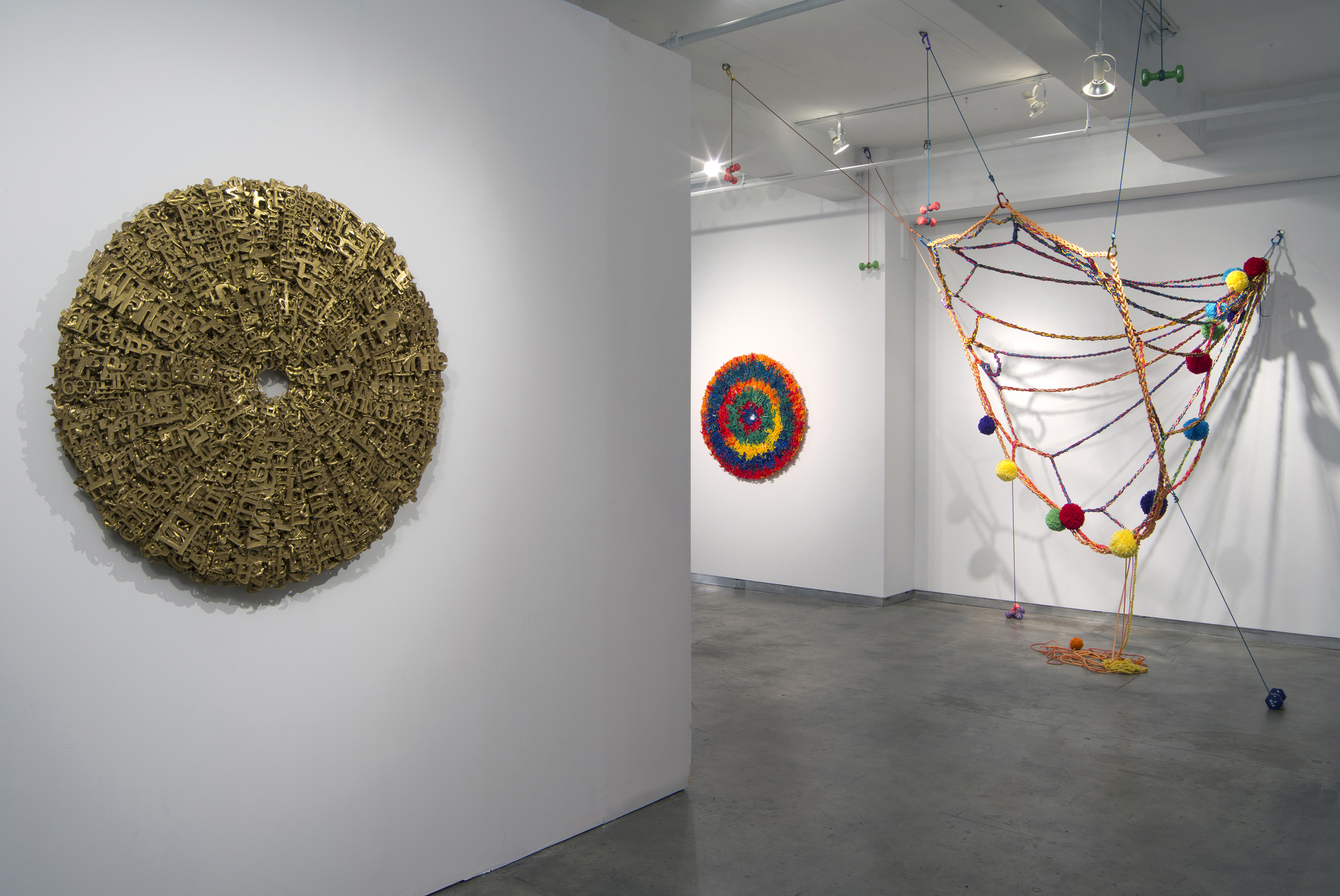
Yael Kanarek. Installation view (l-r): Sanctify Thyself No. 1; Deeply Concentric; Perpetual Dream Catcher; all 2013. Photo by John Berens. Image courtesy bitforms gallery nyc.

Yael Kanarek. Installation view (left to right): Sanctify Thyself No. 1; Deeply Concentric; Perpetual Dream Catcher; all 2013. Courtesy of bitforms gallery nyc, Photo: John Berens

Anuradha Vikram: How does this show’s body of work and concept evolve from your previous works that combine multiple languages toward a single concept or meaning? Do they relate to your history of working with technology, language, and systems?

Yael Kanarek: The evolution is that now we are networked nodes, on top of the individual or psychological self or the construction of the “I.” Our self has expanded and experiences another self on the other side of the globe immediately. This is new—we were always connected but we couldn’t feel it, and now it affects us. When my mom in Israel likes my Instagram images several times a day, I can feel her presence. Our imagination now is encompassing many more people; when something happens somewhere else, we experience it in our bodies. This is radical. That’s why I have been drawn to working with multiple languages. Words are the lineage of trade and exchange. When you follow the etymology of words, from orange, you get to naranj in Sanskrit. At the same time, the text of all these works, in many colors, only says white. All the shades of color appear on a spectrum between black and white, between light and darkness. Read More »

Share

Elsewhere

LUXUS Magazine at Wrocław Contemporary Museum

The art scene in Wrocław, Poland, seems especially taken with collectives at the moment. While the Awangarda Gallery recently brought in work by Russian group Chto Delat, this city has its own rich history of collectives tied heavily to tumultuous sociopolitical events of the past. The groups Orange Alternative and LUXUS developed concurrently out of the revolutionary 1980s—spurred on by student protests and the Solidarity resistance movement—with a mutual understanding that developed into a loose affiliation.

LUXUS. Tu Wolno Kochać Się, 2013; mixed media, LUXUS Magazine; Photo: Michal Wisniowski.

LUXUS. Tu Wolno Kochać Się, 2013; mixed media, LUXUS Magazine; Photo: Michal Wisniowski

Encoding actual protest actions, the Orange Alternative sought to turn resistance into a symbolic narrative and thereby circumvent the communist regime’s policing and military countermeasures. It confronted the political situation head on, and in this way, it differentiates itself from LUXUS. The latter continues to virtualize a kind of reactionary reality against the failures of the state and of ideology and against the avant-garde. It operated in opposition to existing art movements such as Conceptualism and Abstract Expressionism—somewhat belated arrivals to the Eastern Bloc perhaps—but also became an early vehicle of capitalist critique in a place where capitalist activity was still limited.

LUXUS. Hydro-electric Installation, 2013; mixed media, LUXUS Magazine; Photo: Michal Wisniowski.

Jerzy Kosałka. Instalacja wodno-elektryczna (Hydro-electric Installation), 1993; Photo: Michal Wisniowski

Under the weight of its historical context, the LUXUS collective is currently involved in a multipart exhibition inside a massive air-raid bunker. The towering concrete cylinder is now home, albeit temporarily, to the Wrocław Contemporary Museum and is the site of a collection of LUXUS artifacts. The LUXUS Magazine exhibition serves as an archive housed inside the safety of the museum and is poised for some potential, not-so-theoretical future crisis.

Read More »

Share

Help Desk

Help Desk: Have Art, Will Travel

Help Desk is an arts-advice column that demystifies practices for artists, writers, curators, collectors, patrons, and the general public. Submit your questions anonymously here. All submissions become the property of Daily Serving. Help Desk is co-sponsored by KQED.org.

Help Desk Leader

When is it a good investment to travel for your work? Recently I sold my largest piece yet to a collector out of my studio in Berlin while I was working there. I don’t have an extensive sales record and mostly subsist on grants, fundraising, and a day job. The collector is someone I have just met, but I feel that he has a good understanding of my work and has expressed interest in advocating my work to his friends and professional contacts, i.e., hosting dinners in his home to show the work and putting me in touch with dealers he works with.

I returned to the States shortly after selling the piece but since then have been invited to participate in a group show at a commercial gallery in Berlin that will coincide with an art fair there. I plan to put my work in the show, but I am conflicted over whether or not I should travel for the openings. It’s important to me to maintain good contact with this collector and gallerist, yet it is expensive to fly to Europe to do so. However, part of me thinks this expense is in some ways an investment in what I do and therefore I should do it. I have the money to do it, but it would be very expensive to me. What are your thoughts?

Nina Katchadourian. Flight Log, 2010–12; single-channel video, dimensions variable

Nina Katchadourian. Flight Log, 2010–12; single-channel video, dimensions variable

Personally, I love to travel and can’t think of a better way to spend my money, so I’m biased in favor of your going. That said, I think it’s unwise to wipe out your savings or max out your credit cards. What you need is a cost-benefit analysis and a plan to work this scenario in your favor. Start with the cost part: look up the airfare for the dates that you’d be in Berlin and factor in your other transportation costs (bus, metro, taxi). Now add the money that you’d spend on a hotel (if you need one) and three meals a day. Depending on how long you’re going to stay and what kind of lifestyle you have, you’ll probably want to pad your total with another $100+ for taxes and miscellaneous stuff, in case you forget to pack socks or your favorite rash cream. Take that running total and add another sum: your lost wages for the time that you’re gone. Now you’ve got a fairly accurate figure of what it will cost you to go. How can you offset those costs? Well, as you’ve mentioned, you might see future benefits in increased sales, exposure to other collectors in Berlin, and contact with dealers. But given the vagaries of the art market, these are all hard to weigh with any certainty. Let’s consider some of your other options for at least breaking even if not truly coming out ahead—cue RuPaul’s Supermodel (You Better Work).

Read More »

Share

Shotgun Reviews

Ara Peterson: Wavepacks at Ratio 3

Shotgun Reviews are an open forum where we invite the international art community to contribute timely, short-format responses (250–400 words) to an exhibition or event. If you are interested in submitting a Shotgun Review, please click this link for more information. In this Shotgun Review, Grace Momota reviews Ara Peterson’s Wavepacks at Ratio 3 in San Francisco.

Ara Peterson. Untitled, 2013; wood and acrylic paint, 40 x 68 x 4 inches.

Ara Peterson. Untitled, 2013; wood and acrylic paint, 40 x 68 x 4 inches.

While walking the most congested streets of the Mission District, one would never think to find a four-thousand-square-foot art gallery. Ratio 3 is situated behind a pair of inconspicuous small matte black doors, but inside the space is staggeringly large. Currently on display is Ara Peterson’s Wavepacks, which truly changed my perspective on contemporary art. His innovative sculptures turn basic, rigid material into undulating wavelike imagery. Thin strips of wood, each hand-painted in vibrant contrasting colors, are molded into arched 3-D wave shapes. The wall-relief sculptures follow the patterns of transverse waves, some mathematically laid out so that the amplitudes of each are an exact distance from each other. The pieces may seem geometric from afar, but in examining them more closely, the sculptures give off the sensation of fluidic, malleable material, similar to the effects of an optical illusion.

Read More »

Share