Elsewhere

Collages Meditate on the Female Psyche

As part of our ongoing partnership with Beautiful/Decay, today we bring you the work of artist Flore Kunst. Kunst lives in and works in Lyon, France, and states that her collages “seem to emerge by chance.” The article was written by  and originally published on August 9, 2013.Flore Kunst. Pise-up, n.d.; paper collage.

Mixing an admiration for John Baldessari with her own childhood memories of cutting/altering magazines with her mother, Flore Kunst creates captivating collages from vintage postcards and magazines, while sprinkling a few contemporary clippings throughout. A graduate of Emile Cohl School, Kunst has an eye for intriguing detail and clean lines. However, it’s her creative visual juxtapositions that truly capture our attention most, allowing us to meditate on the female form and its signifiers from era to erathe ways it can clash and confuse even the most contemporary culture and its psyche.

Read the full article here.

Share

Fan Mail

Fan Mail: Alexander Rosenberg

In 1776 Benjamin Franklin was a celebrity in France. In a series of portraits made during that year, Franklin was depicted wearing a fur hat, the same chapeau that French philosopher Jean-Jacques Rousseau was known for wearing. According to the French, this made Franklin an enlightened thinker, like Rousseau. In his painting A Momentary Enlightenment (2010), Philadelphia artist Alexander Rosenberg depicts himself in the same hat. However, there is a surveillance camera behind one eye of the portrait that sends a live feed to a surveillance monitor on the opposite side of the room. On top of the monitor sits the same fur hat. And so, in looking at the painting, the viewer and Rosenberg wear the hat to become, for a moment, enlightened. This type of provisional (and at times, confounding) offering is emblematic of Rosenberg’s body of work.

Alexander Rosenberg. Rosenberg / Rousseau, 2008; digital image; dimensions variable. Courtesy of the artist.

Alexander Rosenberg. Rosenberg / Rousseau, 2008; digital image; dimensions variable. Courtesy of the artist.

In order to satisfy his need to deeply investigate the world around him, Rosenberg works across many mediums. However, all of his work comes from a very specific studio practice, and the artist notes: “I do work with a wide variety of materials and processes, but my approach to all of them comes from a rigorous studio practice rooted in a single material, glass. I’ve become a multidisciplinary artist, and I think it is important to note that I am really only an expert in one field. It is with that narrow area of expertise that I am able to enter into a larger conversation with other disciplines.”

Alexander Rosenberg. A Momentary Enlightenment, 2010. Oil painting on stretched canvas, surveillance camera, black and white security monitor, fur hat; dimensions variable. Courtesy of the artist.

Alexander Rosenberg. A Momentary Enlightenment, 2010. Oil painting on stretched canvas, surveillance camera, black and white security monitor, fur hat; dimensions variable. Courtesy of the artist.

Read More »

Share

Los Angeles

Rogue Wave 2013 at L.A. Louver

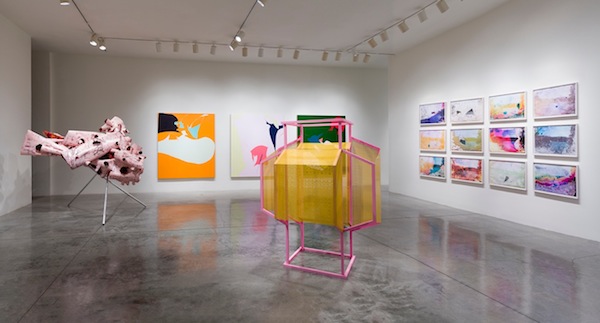
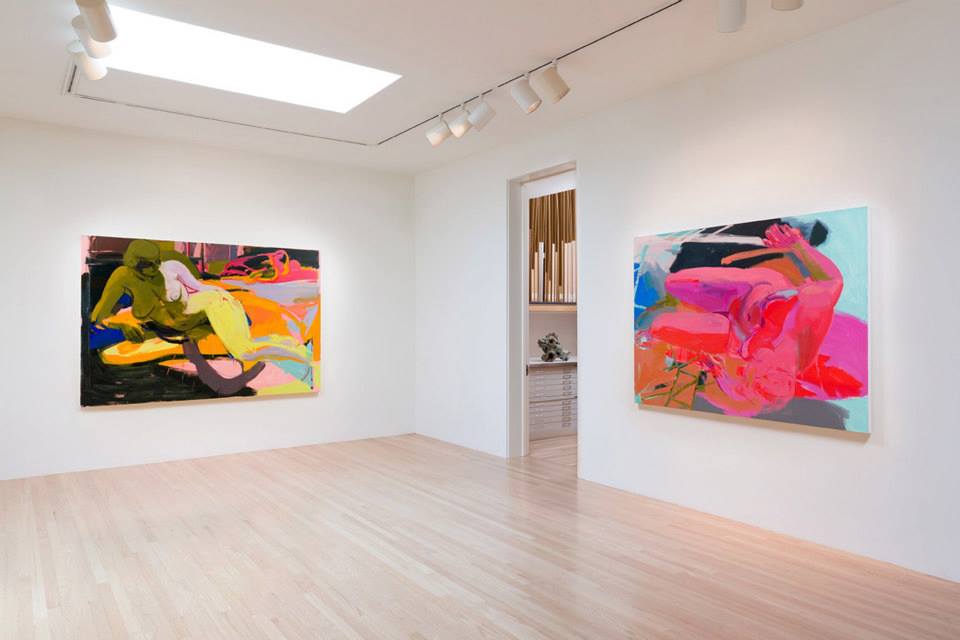
Installation View, Rogue Wave, 2013. Courtesy of LA Louver.

Installation View, Rogue Wave, 2013. Courtesy of L.A. Louver

It’s July in Los Angeles, and as every hokey reality television show portrays, the beach beckons. I pass barefoot teenagers hustling toward the Venice promenade, Boogie boards in tow, and a motley crew of sand-encrusted terriers out for a midday stroll. My hands are already sticky from the brined air as I reach for the door of L.A. Louver—a gallery that has been situated in this coastal borough since 1975 but that still prioritizes the production of exhibitions reflective of industry sea change. The Rogue Wave series is the hallmark of the gallery’s investment in currents beyond those of the water, aiming to tease out the trends, techniques, and aesthetics of art made in Los Angeles at present. Now in its fifth installment, Rogue Wave 2013 features fifteen local artists—an ambitious survey curated by Chief Preparator Christopher Pate and Founding Director Peter Goulds—who are diverse in media but comparable in their collective interest in a process-driven practice. From painterly abstraction to durational photography, the vast majority of works in Rogue Wave 2013 substantiate the claim that Los Angeles houses an ever-rising tide of emerging talent.

Installation view, Rogue Wave, 2013. Courtesy of LA Louver.

Installation view, Rogue Wave, 2013. Courtesy of L.A. Louver

Arguably, not all of the featured artists in the exhibition are expressly rogue, but it is this intersection of nascent and esteemed careers that gives Rogue Wave its significance. Recent MFA graduates are placed in conversation with artists collected by dozens of public institutions, yet commonalities in both concept and process can easily be extrapolated: forbearance is at risk, instant gratification is fruitless, and social cognizance is not synonymous with unedited dissemination. We can all agree that our ideas about time are becoming increasingly disparate as technology and globalism march forward, a concern manifested through the equally diverse paintings, drawings, installations, photographs, and sculptures installed throughout the gallery’s exhibition space. Though each artist in the exhibition affords a valuable contribution to this analysis, I found particular resonance with the work from five particular artists: Sarah AwadMatthew BrandtAsad FaulwellOwen Kydd, and Eric Yahnker.

Read More »

Share

Elsewhere

A Day for Detroit

Art Practical and Daily Serving are proud to jointly participate alongside other art media in heralding A Day for Detroit. Seven writers from both publications have each selected a work from the collection of the Detroit Institute of Arts (DIA), a treasure trove that could inconceivably be sacrificed if Detroit’s emergency manager forces a sale of the collection to alleviate some of the city’s staggering debt. We present the works here along with commentary by the writers on why their selections resonated for them. In doing so, we invite our readers to imagine the magnitude of what would be squandered should the sale occur: not only the work but also a source of immense civic pride. Both residents and visitors to Detroit can attest to the means by which art has coalesced some neighborhoods and revitalized others. How might it contribute to the city’s recovery? We can begin by considering the DIA’s collection: its breadth and the wealth of experience it bestows on its audience. After surveying our writers’ selections, we encourage you to delve deeper into what the DIA has to offer and to add your voice to those who support it. —PM

Mike Kelley. Carnival Time, 1990; acrylic on masonite; 84 x 208 x 2 3/8 in. Image courtesy the Detroit Institute of Arts, Detroit, MI.

Mike Kelley. Carnival Time, 1990; acrylic on masonite; 84 x 208 x 2 3/8 in. Image courtesy the Detroit Institute of Arts

Catlin MooreMuch like his afflicted hometown of Detroit, Mike Kelley was well acquainted with the pageantry of politics and premature demise. His work oftentimes alluded to the bureaucratic tomfoolery running rampant under the American big top. Today, his Carnival Time (1990) feels eerily apropos in the DIA’s collection, as the skewered heads of crooked politicians are coupled with the mercenary icons of big business, a voracious sow, and composite figures of the dissenting Motor City punk scene.

Read More »

Share

Elsewhere

Homecoming! Committee’s Post Communiqué at the Dallas Museum of Art

The contrast between established arts institutions and alternative spaces is often stark—different areas of town, different audiences in attendance, different coverage (if any) from very different publications. Artforum has a ten-page spread on the latest from Martin Kippenberger, while the arts and culture section of a local blog has two hundred words on an emerging artist. But the rare moments when the two worlds collide with synergy powerful enough to influence both are instantly recognizable. Crashing through the barriers with the force of a football team, the thirteen-member collective Homecoming! Committee made its debut in the experimental exhibition Available Space, at the Dallas Museum of Art.

Homecoming! Committee. ARTFORUM, 1963 (2013); Modified magazine pages and paper; 10.5 x 10.5 x .5 inches. Courtesy of Homecoming! Committee "archives."

Homecoming! Committee. ARTFORUM, 1963 (2013); Modified magazine pages and paper; 10 1/2 x 10 1/2 x 1/2  in. Courtesy of Homecoming! Committee “archives”

Available Space is a month-long initiative that aims to highlight contemporary practices in North Texas. The area has a history: giants of contemporary art like Robert Irwin (creating the site-specific Portal Park Piece [1981]) and Robert Smithson (commissioned for a topographical project with the Dallas/Fort Worth airport) have engaged in brief love affairs with the landscape. Until now, Dallas’s legacy has been closely bound to big names making temporary marks while on a temporary stay. The artists in Available Space, though, are all homegrown—and Homecoming! Committee’s presence is by far the most magnetic.

Read More »

Share

Hashtags

#Hashtags: Proximity and Migration

#institutions #representation #access #sustainability #visibility #regionalism #globalism

Two shows at San Francisco museums this past July proposed to reconcile gaps between local and global concerns. For Proximities I: What Time Is It There? at the Asian Art Museum, guest curator Glen Helfand asked a group of Bay Area artists to consider the concept of Asia from the perspective of the culturally uninitiated. Migrating Identities, at Yerba Buena Center for the Arts, curated by Director of Visual Arts Betti-Sue Hertz, assembles a group of artists with international lineages to address migration, displacement, and hybridity from a global perspective. At first glance, these shows would seem to offer a necessary and long overdue rejoinder to San Francisco’s navel-gazing reputation. Instead, each show’s attempt at a global scope serves to reinforce regional biases with respect to the city and the larger world.

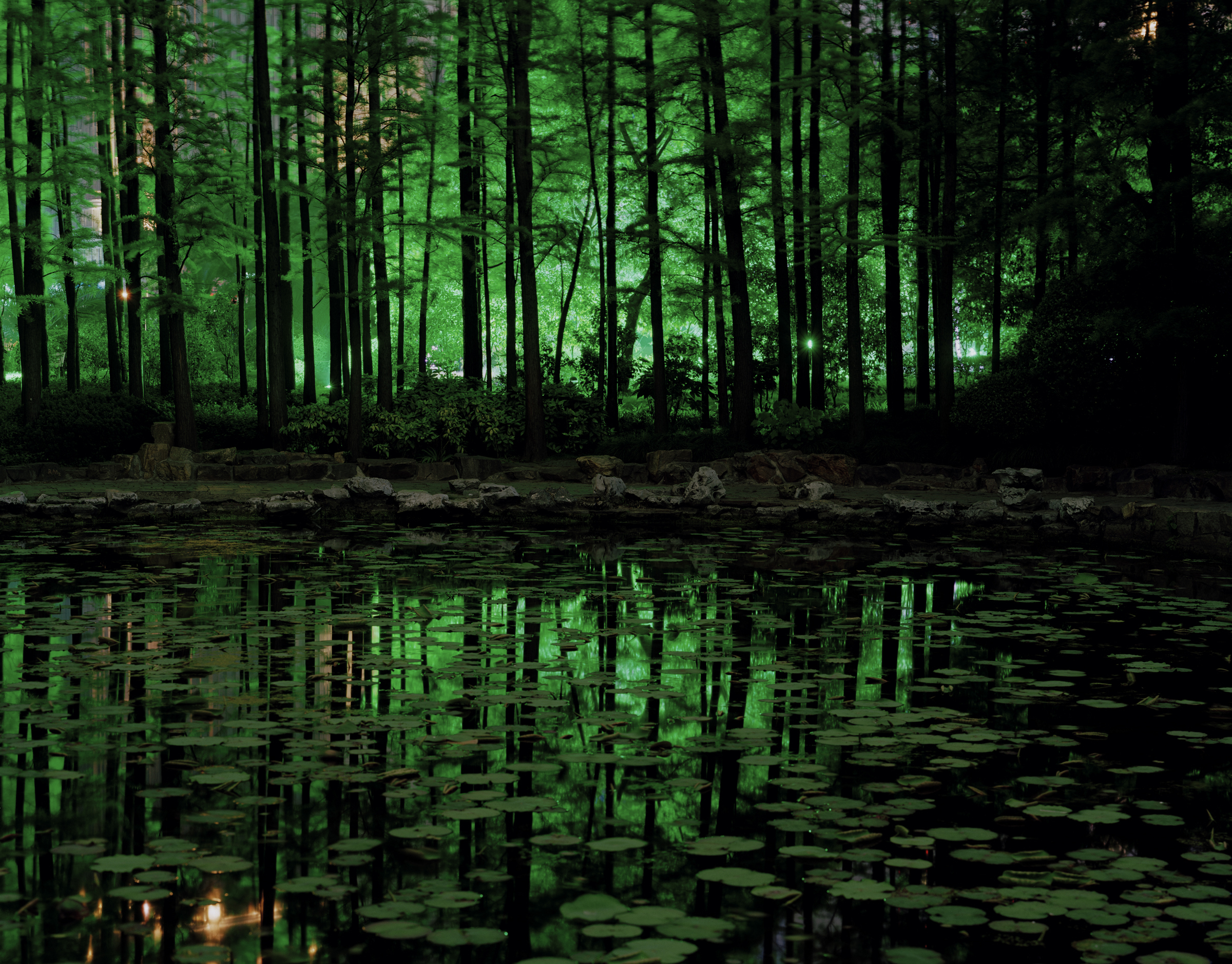
Lisa K. Blatt. People’s Park, Shanghai, China, May 23, 2007 9:35 pm, 2007. Photograph, mounted on aluminum. © 2007 Lisa K. Blatt. From Proximities I at the Asian Art Museum.

Lisa K. Blatt. People’s Park, Shanghai, China, May 23, 2007 9:35 pm, 2007. Photograph, mounted on aluminum. © 2007 Lisa K. Blatt. From Proximities I at the Asian Art Museum

Proximities I is the first of three scheduled exhibitions of contemporary art at the Asian Art Museum that propose to address Asia as contemporaneous to the West. Given that the museum has historically treated Asia as an ancient and static place from which to import timeless artifacts and wisdom and that the museum’s contemporary art programming has been sporadic, the Proximities series represents genuine progress. Still, the show suffers from a lack of focus, which may be inevitable when a group of artists are selected to tackle a vague concept about which they understand little. Helfand, an independent curator and educator, articulates the theme as “focus[ing] on place, in particular dreamlike visions of distant landscapes inspired by Asia’s creative influence. With rich color; a range of materials; and literary, historical, and natural references, the works evoke ideas of travel, escape, celebration, and nostalgia for places we may or may not actually have been.” [Exhibition wall text] Participating artists Elisheva Biernoff, Lisa K. Blatt, Ala Ebtekar, Andrew Witrak, Tucker Nichols, Larry Sultan, and James Gobel have varying degrees of familiarity with specific Asian cultures. Many of the artworks, particularly those by Biernoff, Blatt, Ebtekar, Nichols, and Sultan, are visually interesting and well executed.

Read More »

Share

From the Archives

I love you Jet Li

Today we bring you a From the DS Archives post entitled “I love you Jet Li.” In it, author Catherine Wagley discusses love, heartbreak, and a video by the artist Jaco Bouwer. Bouwer is part of the new group exhibition [Working Title] 2013now on view through August 19 at Goodman Gallery in Johannesburg, South Africa. The following article was originally published on July 2, 2010, as a part of the weekly column “L.A. Expanded,” by Catherine Wagley.

L.A. Expanded: Notes from the West Coast

Jaco Bouwer. I Love You Jet Li, 2005; film still

On Jekyll Island, the beaches are nearly rock free and, at this time of year, ocean swimming feels like bathing in a warm tub during an understated earthquake; the waves roll gently but unpredictably. I spent the third week of June on Jekyll, a resort destination located on the North Atlantic, halfway between Savannah and Jackson. I was vacationing with my aunt and grandmother—the same grandmother who called Terry Southern a brooder and often says she could have married Jasper Johns if only he’d preferred women. The second night of our trip, a small storm broke out. We had seen white chairs and reception tents set up on the beach in anticipation of two weekend weddings and, as the three of us sat on our balcony watching the rain pass and drinking the heavy-handed martinis my grandmother prepared, we wondered if either bride had cried when she saw the clouds move in.

Read More »

Share