San Francisco

SFMOMA Is On the Go: Five Reasons to Track It Down

As part of our ongoing partnership with KQED, today we bring you a look at how SFMOMA is continuing to produce exhibitions and events even though the museum will be closed until 2016. While there’s no denying that this is a hardship for San Francisco’s art community, it’s also an opportunity for SFMOMA to become a more flexible institution that works beyond the boundaries of its own physical space. Indeed, it is taking up the challenge of what a museum can be and do. This article was written by Michele Carlson and originally published on August 22, 2013.

Jeremy Blake. Century 21 (video still), from the Winchester trilogy, 2002–4; Collection of SFMOMA.

Jeremy Blake. Century 21 (video still), from the Winchester trilogy, 2002–4; Collection of SFMOMA

SFMOMA’s doors may have closed, but nothing about the museum is departed. In fact, it’s quite the opposite. The $610 million renovation and expansion plan will double the museum’s current size, in part, to accommodate the new acquisition of Doris and Donald Fisher’s private collection of more than 1,100 works. SFMOMA won’t reopen again until 2016, which begs the question, where will all that art go?

Instead of hiding their extensive collection in storage, around 29,000 works of art, SFMOMA is partnering with a plethora of outside cultural institutions and cities, along with a substantially beefed-up digital component, to launch an aggressive campaign to keep SFMOMA alive for its loyalists. In all certainty, by closing its doors, SFMOMA is more open and accessible than ever. Here are five things to look forward to:

Read the full article here.

Share

Elsewhere

Animal Dreams: A Conversation with Melissa Miller

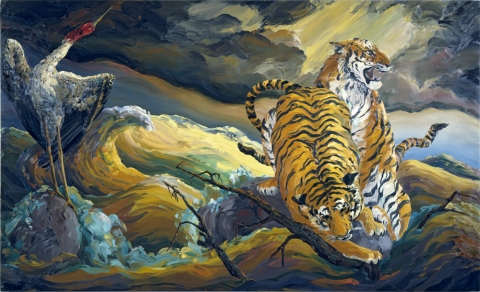
Texas-based artist Melissa Miller is widely known for her expressionistic paintings that use animals as metaphors for human dramas and dilemmas. Her recent works focus on the many ways humans are altering animal habitats and behavior. Miller’s work will be featured in a solo exhibition at the Talley Dunn Gallery, in Dallas, in January 2014, and in a group show at the Martin Museum of Art, at Baylor University in Waco, Texas, in May 2014.

Melissa Miller. Flood, 1983; oil on linen; 59 x 95 in. Courtesy of the Artist.

Melissa Miller. Flood, 1983; oil on linen; 59 x 95 in. Courtesy of the Artist

Robin Tung: The animals in your paintings take part in cultural myths (Flood [1983] and The Ark [1986]), fables, fictional and humorous narratives (Clowns [1983]), and masquerades (Lioness in Zebra Skin [1985]). What inspired these different themes and configurations?

Melissa Miller: With Flood and The Ark, I was doing a series of paintings set within a context of pending disasters. For me these narratives were metaphors for the human illusion of control over our lives and futures. Humans react as as if we are immune to twists of fate, sudden disaster, associations, illness, disability, or decisions made by others. Having lived my life experiencing Texas hurricanes, droughts, floods, fires, and tornadoes, I thought weather seemed a likely metaphor for unpredictable intrusion.

Occasionally I pull subject matter directly from newspapers, books, the internet, or art history. Clowns resulted in part from seeing Uccello’s Rout of San Romano (1438–40) face to face and simultaneously discovering the Japanese Choju Giga Scrolls. The paintings of animals dressed in each others’ skins (Lioness in Zebra Skin) came from an interest in depicting acts of deception. Both paintings are an example of depicting animals in positions beyond their anatomical possibilities. That’s about as cartoonish as I’ve ever ventured.

Read More »

Share

New York

The Dark Side of Mickey Mouse: Llyn Foulkes at the New Museum

Llyn Foulkes ranks among that rare cadre of artists for whom fame is an optional extra. Over the course of his fifty-year career, the Los Angeles–based multimedia artist and musician has experienced periods of success—for his monumental Pop-influenced paintings of rocks and, decades later, for his zany, large-scale narrative tableaux. But much of his work has been met with silence from critics and buyers, allowing Foulkes an enduring reputation as an underappreciated art world outsider. The artist’s retrospective at the New Museum, a traveling exhibition organized by the curators of Los Angeles’s Hammer Museum, positions him squarely in the canon of acclaimed American artists. Yet Foulkes, now seventy-eight, remains stubbornly opposed to the pitfalls and pretensions of the gallery and museum circuit. He is a product of the midcentury American West—a cynical, eccentric figure intent on skewering our national pop culture, political institutions, and military might in equal measure.

Llyn Foulkes. The Lost Frontier, 1997–2005; mixed media; 87 x 96 x 8 in. Courtesy of the artist and the New Museum

Llyn Foulkes. The Lost Frontier, 1997–2005; mixed media; 87 x 96 x 8 in. Courtesy of the artist and The New Museum

The retrospective, which features over one hundred works, is organized chronologically. Starting with the earth-toned, textural paintings he made in the 1950s, after serving two years with the army in postwar Germany, the exhibition charts each step in Foulkes’s artistic evolution. One room is devoted to his brief flirtation with Pop Art, another to his disturbingly blood-soaked portraits from the 1970s and ’80s, several more to the vibrant mixed-media tableaux for which he is best known. Critics are quick to label Foulkes’s work as erratic and impossible to categorize, yet his sensibility and iconography remain strikingly similar throughout his career. This irreverence and consistent visual vocabulary allow Foulkes to transcend any given media; his drawings, paintings, and installation pieces all feel distinctly like him.

As it turns out, I unknowingly went through the exhibition backward—a happy accident that helped me see the commonalities among Foulkes’s works. His art is heavily influenced by the years he spent in the army and in Los Angeles, and, above all, by that paradigmatic symbol of American culture, Mickey Mouse. The artist himself is the centerpiece of many of his strongest pieces. Using the narrow lens of himself and his family, Foulkes creates bizarre, textural, eye-catching works that speak to the violent hypocrisies of American history.

Read More »

Share

Elsewhere

BUSTER SIMPSON // SURVEYOR at the Frye Museum of Art

The artist’s hand is evident from the moment you walk into BUSTER SIMPSON // SURVEYOR, the first comprehensive survey of the Seattle-based artist’s forty-year career, now on view at the Frye Museum of Art. Simpson has chiseled the exhibition title’s two parallel lines into the gallery wall (on which the rest of the title is painted), like a giant trail marker or series of bite marks. The resulting debris has been left on the floor below.

Buster Simpson.

Buster Simpson. The Crow’s Nest, 1980; photo-documentation of the agitprop performance. Courtesy of Hearst Newspapers LLC/Seattlepi.com. Photo: John Holmberg

It is a fitting opening gesture for an exhibition in which Simpson is less passive subject than instigator and agent. The pieces collected here—from documentation of agitprop actions and installation-based pieces to sculptures made from reclaimed materials—make clear he views these roles as endemic to being an artist. There is a workmanlike quality to Simpson’s approach, something underscored by SURVEYOR’s hand-drafted wall texts (which a local sign maker was commissioned to execute) and reflected in his preference to describe his output simply as “projects.”

Read More »

Share

Elsewhere

Cripplewood at the Venice Biennale

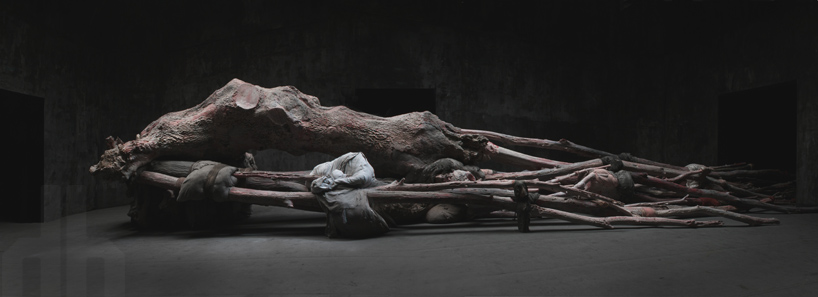
It takes a moment for my eyes to adjust. It’s dim and dank in here, despite the warmth of the Venetian summer. A long, gnarled mass lies sprawled across the length of the floor; in the gloom of the pavilion its flesh seems luminous. In places, its limbs are bound with rags. Sometimes they rest on threadbare cushions. It’s a fallen tree, but it seems like a body.

Berlinde De Bruyckere: Kreupelhout – Cripplewood, 2012 – 2013 wax, epoxy, iron, textile, rope, paint, gypsum, roofing image © mirjam devriendt

Berlinde De Bruyckere. Kreupelhout–Cripplewood, 2012–13; wax, epoxy, iron, textile, rope, paint, gypsum, roofing; 368 7/8 x 394 1/2 x 663 3/4 in. Courtesy of the Artist and S.M.A.K., the Museum of Contemporary Art, Ghent. Photo: Mirjam Pevriendt

Berlinde de Bruyckere’s Cripplewood (2012–13) occupies the Belgian Pavillion of the Venice Biennale like a dead weight. For much of her career, the artist has used wax to form misshapen, tortured bodies that are the antithesis of the heroic bodies of classical art. These cadaverous, tragic figures are at once hyperrealistic and impossibly contrived; composed of absences, often lacking heads, they also appear to have been deprived of innards and bones. They are marked by the touch of real bodies; De Bruyckere makes casts of body parts that she reworks and combines in assemblages that connote the presence of a real body whilst presenting incontrovertible evidence of its absence.

De Bruyckere robs monumental sculpture of its grandeur through the unsettling material of wax, a gummy, fleshy substitute for the traditional materials of sculpture—bronze and marble—and the inglorious, recycled furnishings that her figures squat upon or drape across. The uncanny effect of De Bruyckere’s waxes is considerable; they inspire horror and pity in the viewer, who is confronted by an object that suggests the disquieting presence of a corpse. This waxen residue appears to be the substance of a history of atrocity, a monument to a mute, traumatic past that trespasses on the present, unsummoned.

Read More »

Share

Help Desk

Help Desk: Pressure to Review

Help Desk is an arts-advice column that demystifies practices for artists, writers, curators, collectors, patrons, and the general public. Submit your questions anonymously here. All submissions become the property of Daily Serving. Help Desk is co-sponsored by KQED.org.

Help Desk Leader

I’m a new arts administrator, and I live in [a mid-size city]. Through my four years of art school here and my job, I know many artists who live in this city. I started writing art reviews last year, and all of a sudden I’m feeling pressure to write about my friends’ work. It’s not like they are asking me directly, but hints have been dropped. I have no problem reviewing work that I think is good, but the problem is that there are some people whom I like very much, but I don’t think their work is that great. How do I get out of reviewing the work that I don’t like without losing my friends?

This is a sticky situation indeed. You want to write about the artwork that you enjoy, but you also want to support the people you love; unfortunately, sometimes there’s not much overlap between these two groups in the big Venn Diagram of Life. Let’s review some of the ways you can negotiate this minefield without blowing up your friendships.

Ken Price. Liquid Rock, 2004; Acrylic and ink on paper; 17 3⁄4 x 13 7/8 in. Courtesy Matthew Marks Gallery

Ken Price. Liquid Rock, 2004; Acrylic and ink on paper; 17 3⁄4 x 13 7/8 in. Courtesy Matthew Marks Gallery

First, there’s the “it’s out of my hands” tactic, which is my personal favorite because someone else gets to play Bad Cop. If you’re publishing reviews, you ought to see if there’s an editorial policy already in place at the blog/newspaper/magazine(s) with whom you are working. The policy will spell out what you’re allowed to write about and what you’re not, and if you haven’t been presented with one yet, it can’t hurt to ask. Many editorial policies state that a writer cannot review the work of an artist with whom she has a personal relationship. Admittedly, this kind of thing is a double-edged sword: it removes all responsibility for not being able to review friends’ bad exhibitions, but it also eliminates the possibility of reviewing friends’ work that is good. The important thing is that your hands are tied; in either case, all you have to do is shrug and say, “It’s too bad I can’t write about this show.” End of story.

Read More »

Share

Shotgun Reviews

Eugene Isabey: Fishing Village at the Legion of Honor

Shotgun Reviews are an open forum where we invite the international art community to contribute timely, short-format responses (250–400 words) to an exhibition or event. If you are interested in submitting a Shotgun Review, please click this link for more information. 

This week’s Shotgun Review was written by Irene Gerenrot, who participated in Art Practical’s March 2012 Art Smarts writing workshop for middle-school students, produced in conjunction with 826 Valencia and Catharine Clark Gallery, San Francisco. You can read her review Skull of Santo Guerro (III) on Art Practical.

Caption: Eugene Isabey. Fishing Village, 1854–55; oil on canvas; 53.7 x 35.43 in. Collection of the Art Museum at the University of Kentucky. Courtesy of the Athenaeum.

Caption: Eugene Isabey. Fishing Village, 1854–55; oil on canvas; 53.7 x 35.43 in. Collection of the Art Museum at the University of Kentucky. Courtesy of the Athenaeum


Fishing Village (1854–55), by Eugene Isabey, stands out from the rest of the paintings in the Legion of Honor’s Impressionists on the Water exhibition, on view through October 13, 2013.  Most of the paintings depict water in a very neat fashion and as being calm, as though all rivers are ideal for kayaking and God created lakes only for races, fanfares, and general fun. Fishing Village illustrates the down-to-earth life of an average nineteenth-century fishing village: poor, difficult, busy, dirty, alive, and boisterous.

My eye first lit upon a bright spray of sea foam, then traveled down with the dirty brown water to the boats, docked and rocking. It continued on to the people working, the shoddy houses, a brown hill painted with thinner brushstrokes for the grass, and the murky sky.

Read More »

Share