Los Angeles

Paintings That Explore Classical and Contemporary Myth

As part of our ongoing partnership with Beautiful/Decay, today we bring you the paintings of Laura Krifka. Krifka lives and works in Ventura, California, and will have a solo exhibition at CB1 Gallery, in Los Angeles, in 2014. The article was written by Stacey Dacheux and originally published on August 20, 2013.

Laura Krifka. Bridal Sacrifice, 2013; oil on canvas, 36 x 48 in.

Laura Krifka. Bridal Sacrifice, 2013; oil on canvas, 36 x 48 in.

Laura Krifka’s work feels both classical and contemporary—a collection of myths that transcend time, stuck on the spin cycle from one era to the next. There is a soft religious quality in each face as he or she slowly responds to pending doom, lurking out of view. Such off -stage suspense feels exactly this way—theatrical.

Read the full article here.

Share

Fan Mail

Fan Mail: Tara Sellios

The still life is an artistic form that has captured the interest of Pieter Aertsen, Pieter Claesz, Diego Velázquez, Eugène Delacroix, and Giorgio Morandi, to name just a few. Boston-based artist Tara Sellios has also delved deeply into the construction of the still life and the ideas often associated with it—life, death, the question of permanence, and the intricate use of symbolism. What makes Sellios’s work different from that of past masters is her combination of material and medium.

Tara Sellios. Untitled No. 2 (from the series Impulses), 2012; digital C-prints; 50 x 120 in. Courtesy of the artist.

Tara Sellios. Untitled No. 2 (from the series Impulses), 2012; digital C-prints; 50 x 120 in. Courtesy of the artist

Sellios uses photography—not painting—to make her work, capturing age-old still-life materials—eggs, glasses, fish, vegetables, and silver plates. Of her impetus to work with this genre, Sellios says, “Death has always possessed a significant presence within the history of art, ranging from altarpieces to the work of the Dutch still-life painters. Manifesting melancholic themes with beauty and precision, as these artists did, results in an image that is seductive, forcing the viewer to look, despite its apparent grotesque and morbid nature.”

Read More »

Share

Toronto

No Dull Affairs at Onsite OCAD

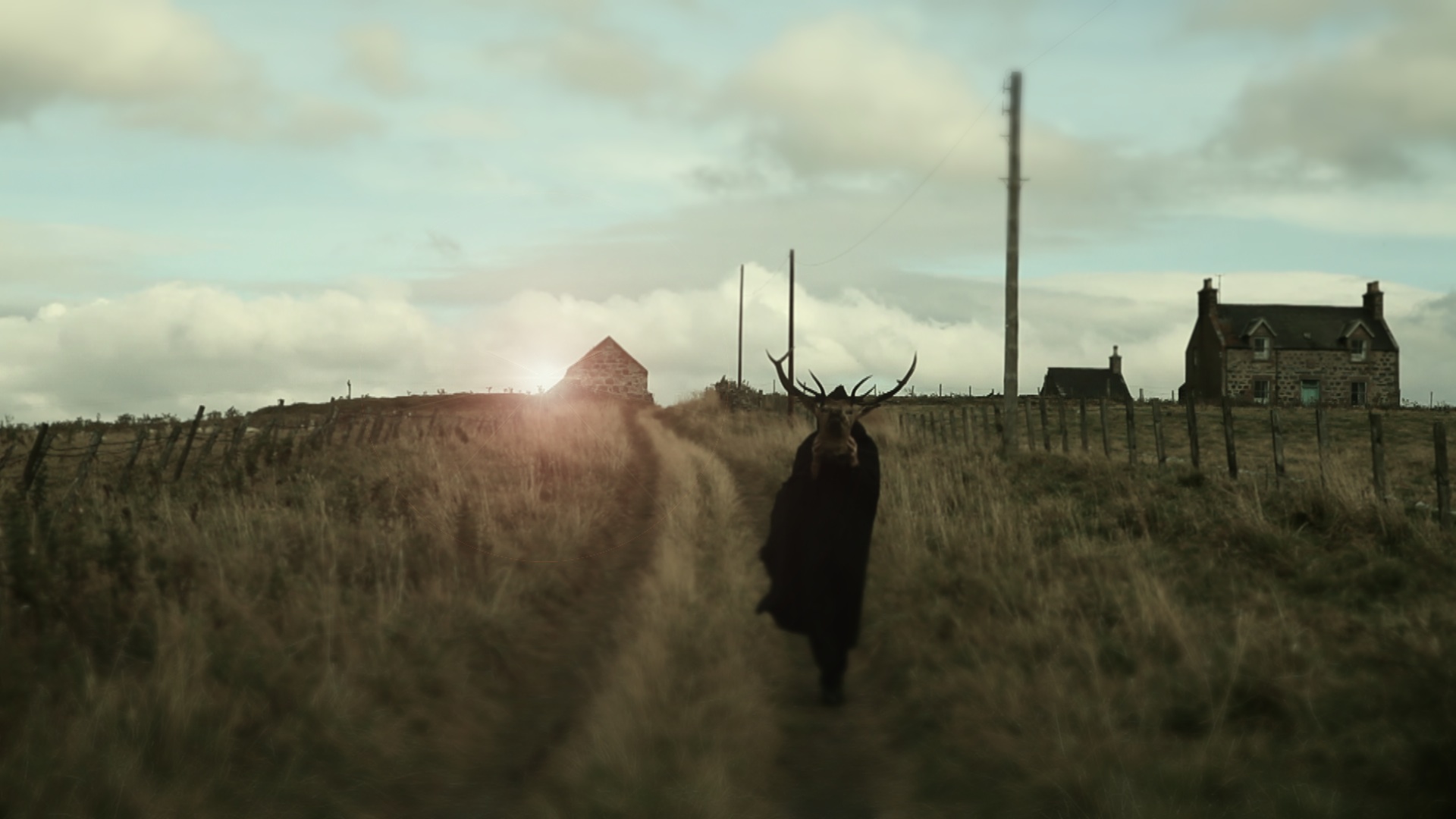
Ontario College of Art & Design’s professional gallery space, Onsite [at] OCAD U, is raw and industrial. Its warehouse-like ambiance is enhanced by the cinder block walls, industrial piping crisscrossing the ceiling, and bank of floor-to-ceiling windows facing the street. These features present a number of restrictions when mounting an exhibition, a challenge for artists and curators in this unconventional gallery setting. In No Dull Affairs, the current exhibition there curated by Lisa Deanne Smith, each artist experiments with the concept of site specificity in a way that complements their individual aesthetics and bodies of work. While Jillian McDonald’s video Valley of the Deer (2012) responds heavily to the landscape and cultural mythology of Dufftown, Scotland, the site of her 2012 Glenfiddich International Artist’s residency, Karen Lofgren and Vanessa Maltese respond directly to the gallery’s architectural elements.

Jillian McDonald, "Valley of the Deer", 2013

Jillian McDonald, Valley of the Deer, 2012. High-definition video still courtesy of Onsite [at] OCAD U

McDonald’s video installation Valley of the Deer (2012) is a lush, dense narrative. The saturated colors and digital effects give the vast Scottish landscapes something of a tilt-shift effect due to variations in focus and depth of field. As a result, some of the scenery resembles model landscapes, an effect heightened by the appearance of surreal figures (locals from Dufftown and workers from the Glenfiddich whiskey distillery, who sway back and forth while wearing various animal masks, taxidermied heads, and skulls). McDonald created the costumes and masks on site in response to the landscape and incorporated local folklore into the piece, primarily relating to the mythological stag featured in Glenfiddich’s iconic logo. The title of the piece also relates to Glenfiddich and the rural Scottish location; the translation of Glenfiddich from Gaelic to English is “valley of the deer.”

Read More »

Share

Interviews

Performance in Context: Interview with Liz Magic Laser

Though I can’t remember the first time I saw Liz Magic Laser‘s work (and yes, it’s her given name), I was entranced by this video of her commission for the 2013 Armory Show in New York. So much artwork these days looks like it was made by committee, so why not explicitly use the methodology of a focus group to create the work for the commission? It’s one of those simple but brilliant maneuvers that defines Laser’s practice. This year, Laser was also presented with the Southern Exposure (SoEx) Off-Site Graue Award, “an opportunity to…develop and present an ambitious public art project in the San Francisco Bay Area.” Laser came to San Francisco earlier this month to work on The Living Newspaper, a series that uses performance as a way investigate and embody the daily news, which Jerry Saltz called, “a fantastic cracking of the news-cycle codes.” I caught up with Laser on the first day of her tenure at SoEx.

Liz Magic Laser. Interior view, Forever & Today, Inc.’s Studio On The Street program with Liz Magic Laser, artist-in-residence, working in studio, 2012. Courtesy of the artist and Forever & Today, Inc.

Liz Magic Laser. Forever & Today, Inc.’s Studio On the Street program with Liz Magic Laser, artist in residence, working in studio, 2012. Courtesy of the artist and Forever & Today, Inc.

Bean Gilsdorf: Let’s talk about the project that brings you to San Francisco. What was the inspiration for The Living Newspaper: Extra Extra (2013)?

Liz Magic Laser: The concept of the living newspaper came through the research materials that all the Performa commission artists received in 2011. In one essay I found a footnote that mentioned a “living newspaper,” and I started to look up more information on it, although there’s not a lot available. I found this Soviet theater troupe called the Blue Blouse group, and they used it as a method for spreading the news to the masses, who were largely illiterate. They were connected with an association of journalists, and they did street theater and stage productions. A number of other people have also claimed the living newspaper as their concept, including J. L. Moreno, who initiated psychodrama, and Augusto Boal, a Brazilian theater maker.

Read More »

Share

London

Aquatopia at Nottingham Contemporary

It has been a big year for Nottingham Contemporary. After receiving a boost of notoriety by way of Mark Leckey’s The Universal Addressability of Dumb Things, the recently rechristened museum and its director, Alex Farquharson, immediately launched their most ambitious curatorial project to date: a traveling exhibition titled Aquatopia. Organized with partner institution Tate St. Ives, the exhibition comprises more than 150 artworks as well as performances, lectures, and screenings, all organized around the imaginative worlds of the ocean depths.

Alex Bag and Ethan Kramer, Le Cruel et Curieux Vie du la Salmonellapod, 2000; (video still); 11:48 min.

Alex Bag and Ethan Kramer, Le Cruel et Curieux Vie du la Salmonellapod, 2000; (video still); 11:48 min.

With artworks cutting across history and displayed in groups of abstract logic, Aquatopia could be described as a conceptual survey; it explores its theme from diverse historical angles and artistic perspectives. Here, the ocean is a filter, a site for interpretation, a toolbox of images and relations, and a stage for the sexual, spiritual, scientific, and narrative imagination. Firmly framed in the fantastic, artworks and objects are relieved of their descriptive duties and instead evidence their author’s fears, dreams, and wonderment. The brilliant antique copper diving helmet, the set of biological scientific etchings, the eighteenth-century map—each inspires new associations beyond their original purpose.

Contemporary works seem in their element. Located in a handsome video cluster, Le Cruel et Curieux Vie du la Salmonellapod (2000), by Alex Bag and Ethan Kramer, is a double riff on the nature documentary format and the fantastic violence of romance (in the dreamed-up world of the disgusting, hilariously chimeric Salmonellapod), playing this subjectivity to amazing ends. Ashley Bickerton’s nylon-equipped Orange Shark (2008) is perfectly fits the exhibition, as does Spartacus Chetwynd’s squidlike fabric construction. Shimabuku’s Then, I decided to give a tour of Tokyo to the octopus from Akashi (2000)—one of my favorite artworks in any circumstance—exactly captures Aquatopia’s double exposure of the ocean as both unfathomable phenomenon and site for personal experience. Nearby, Herbert James Draper’s A Water Baby (1895) leaps out of its circular frame, absurd and absolute in its sea-foam sentimentality.

Read More »

Share

Hashtags

#Hashtags: On the Political in Art

#race #class #access #commerce #representation #empowerment #codeswitching

As the values of the contemporary art elite veer ever farther toward commerce, art with a social justice conscience is rallying in New York—arguably the center of the global art market. This summer, three prominent artists known for their political consciences have been drawing attention for thoughtful, research-heavy projects. In Chelsea, Hank Willis Thomas and the team of William Powhida and Jade Townsend have brought discussions of race and class to a gallery scene where such concerns are often absent. Farther afield, Thomas Hirshhorn entices art audiences to venture to the South Bronx with his Gramsci Monument (2013), sponsored by Dia Art Foundation, at the Forest Houses public housing complex.

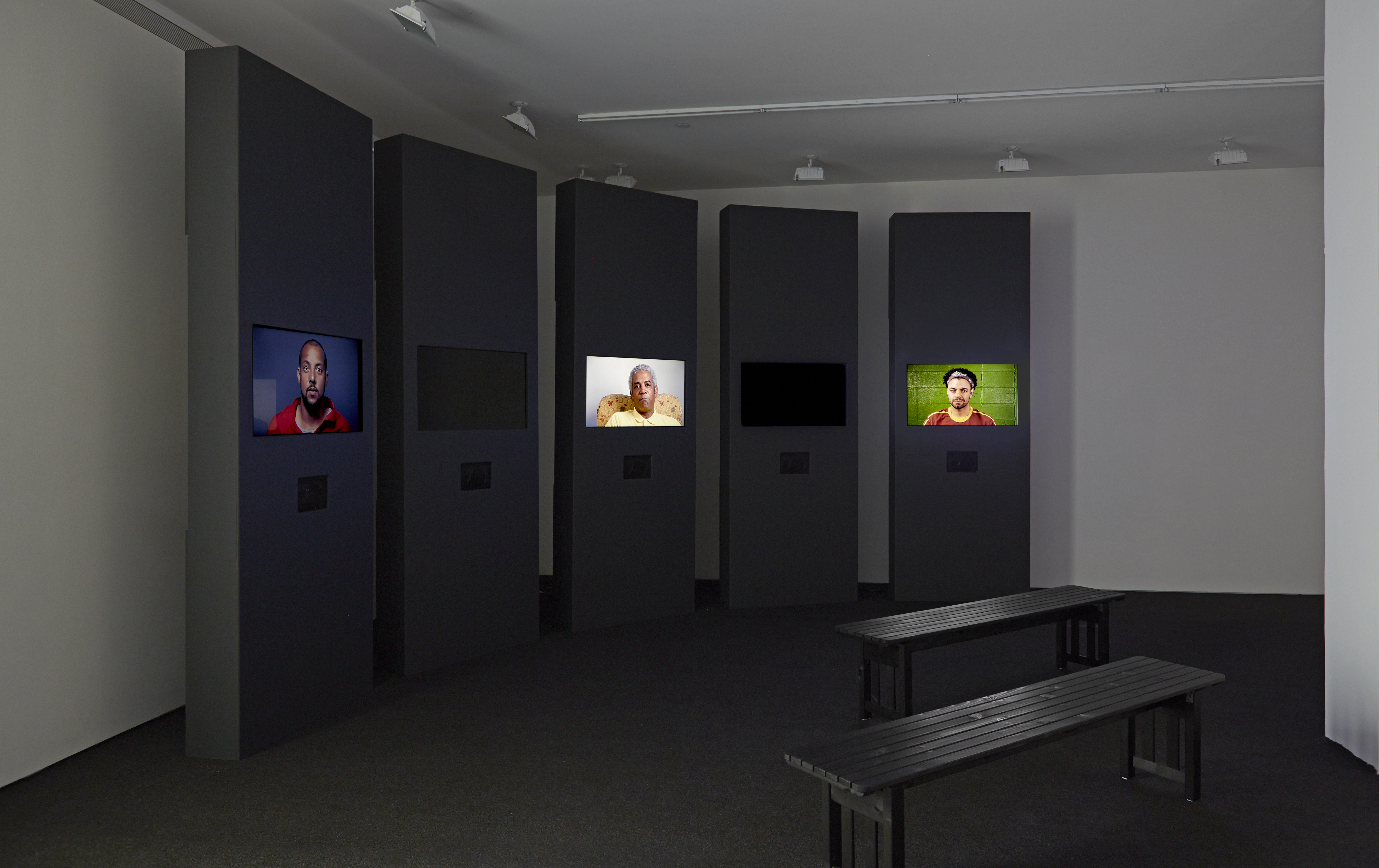
Hank Willis Thomas, Chris Johnson, Bayeté Ross-Smith, and Kamal Sinclair. Question Bridge: Black Males, 2012. Interactive video installation. Photo courtesy of Jack Shainman Gallery, New York.

Hank Willis Thomas, Chris Johnson, Bayeté Ross-Smith, and Kamal Sinclair. Question Bridge: Black Males, 2012. Interactive video installation. Photo courtesy of Jack Shainman Gallery, New York

Thomas continues to mine the history of photography’s depictions of black men in America with his current show at Jack Shainman. His solo photographic and assemblage works, on view in the front gallery, appropriate nineteenth-century photographs and African American quilt patterns as frameworks for commentary on the performance of race and the necessity of code-switching as a strategy of resistance to assimilation. The work is political in content but not in its execution, existing as fairly traditional objects for collection and consumption. More radical is the back gallery’s installation, Question Bridge: Black Males (2012), a collaborative work by Thomas, Chris Johnson, Bayeté Ross-Smith, and Kamal Sinclair. Building on the idea that implicit bias is fed by lack of familiarityQuestion Bridge is formulated as a testimonial document. Over 150 black men were interviewed for the project, asked to respond to questions posed by one another addressing masculinity, discrimination, opportunity, love, ego, family, and other loaded topics. The men range in age from late teens to octogenarians and in occupation from professors to performers to gang members. Some testify from the classroom or pulpit, others from behind bars. Some are self-aware, while others adopt a defensive posture. Their dialogue, framed as internal to a community too often viewed externally, is made transparent to us but does not include us. As a viewer, I was engrossed in the individual expressions of these men. I felt a responsibility to see and recognize each one, though that proved difficult to accomplish as the work’s duration exceeds three hours.

Read More »

Share

From the Archives

Back to School

In honor of the time of year and the general nervousness, excitement, and relief that come with the advent of the regular school year, this week we bring you a post written by Bean Gilsdorf entitled “Back to School,” from her weekly Help Desk column for DS. Her advice to the student behind the question “What to do before I graduate?” is sage: take advantage of all that you can. Meet teachers, take elective classes, review old work. Use the resources you have, and you will be better prepared when you graduate. Her advice can go for just about anyone, though, so take heed and as the French say, “profitez-en!” The following article was originally published on August 20, 2012.

I am currently attending art school on the East Coast to receive a BFA in painting. I will be a junior this coming year and feel that things have really started to pick up. The first half of my undergraduate education has gone fairly well. Foundation year was rigorous, and last year I explored a lot within my own work. I have multiple on-campus jobs and am beginning to feel good about my contact and personal relationships with the faculty. Besides my own personal goals to read a lot and really hit the ground running in the studio, I was wondering if you had any advice on what I can do to make the most out of my remaining two years in undergrad? Specific class topics? Outside experiences? Maybe taking advantage of the close vicinity to Boston and New York? Any advice would be great.

I’m glad to hear that you feel good about how things are going in general. Art school can be tough and competitive, but it sounds like you’re on an even keel and ready to work on your next steps. It’s been a long time now since I was an undergrad, but in order to answer your question I spent some time thinking about the beneficial things I did—and the things I wish I had done—when I was in school. Below are some ideas for you to consider, divided into the three categories of career, artwork, and personal development.

Barry McGee, Untitled #29, 2002. Paint (mixed media) on wood panels, 96 x 144 in.

Career: I like that you have on-campus jobs and are cultivating good relationships with faculty. When you graduate, you’re going to run into a lot of people who will say, “Oh, you went to RISD? Do you know Professor X?” and it may be helpful if you’re able to say, “Yes.” Make sure that you get at least a little face time with all of the people in your own department.

Also, spend some time talking to teachers in other departments, because it’s easy to become conceptually isolated in the echo chamber of a particular department. You can figure out which people you want to contact by listening carefully when your friends discuss their classes and instructors. Who is a good teacher? Who gives good feedback? Who is friendly and generous? You want these people in your life, if for no other reason than they will create good energy and positive vibes for your practice (and I can say that with a straight face, because I live in California). If you hear of someone really phenomenal, ask for a studio visit. Inviting people from other departments to your studio will expand your understanding and your practice, which will serve you well after graduation. After all, there are no media-specific departments in real life. When you’re done with school, you’re going to have to contend with the entirety of contemporary art, not just contemporary painting.

Read More »

Share