Los Angeles

Staggering Works: Beatriz da Costa at Laguna Art Museum

As part of our ongoing partnership with Artillery, today we bring you author Seth Hawkins‘s report on the Laguna Art Museum’s exhibition ex·pose: Beatriz da Costa, a posthumous retrospective of the artist’s work. Only thirty-eight years old at the time of her death last year, da Costa was an artist who, in Hawkins’s words, was “brave enough, strong enough and inspired enough to allow us to view the most intimate of battles, in a beautiful, memorable, and artistic way.” This article was originally published on September 3, 2013. 

Beatriz da Costa. Dying for the Other, 2011–12; three-channel video installation, 12 min.; presentation at Eyebeam, Art and Technology Center, New York, NY, 2011

Beatriz da Costa. Dying for the Other, 2011–12; three-channel video installation, 12 min.; presentation at Eyebeam, Art and Technology Center, New York, NY, 2011

From the light, airy and playful feelings of the Laguna Art Musem’s Faux Real exhibition on the main floor, the atmosphere of ex·pose: Beatriz da Costa shifts into dark, moving, and intense as one descends into the museum’s dark basement.

Da Costa’s Dying for the Other (2011–12) is a three-channel video installation dealing with the artist’s lifelong battle with cancer, with the show occurring not even twelve months after her passing—a timely and haunting exhibition of her last creation.

Beatriz da Costa made work that refused genre classification—seamlessly transitioning between contemporary art, science, engineering, and politics—in many cases working in collaboration with forerunning art/technology groups such as Critical Art Ensemble, Free Range Grains, GenTerra, and Preemptive Media. Born in 1974 and raised in Germany, da Costa attended Carnegie Mellon University, eventually moving on to teach in the Studio Art, Electrical Engineering and Computer Science Departments at UC Irvine.

Read the full article here.

Share

San Francisco

Yang Fudong: Estranged Paradise at Berkeley Art Museum

Walking into the large, darkened space of Yang Fudong’s The Fifth Night (Rehearsal) (2010) at the Berkeley Art Museum’s Yang Fudong: Estranged Paradise, Works 1993–2013, the viewer is greeted by seven large black-and-white projections on three walls. In each projection, characters perform simple actions: two men carry suitcases down the street; a woman in a floral dress wanders pensively, her silk scarf fluttering. Superimposed on some shots are the wireframe and readout from the camera’s monitor, so the viewer is presented with not only the action in each shot but also the meta-image of a more technical aspect of the filming process. Though the characters are clearly transfixed by their environment, their inner motivations are never revealed and their actions never resolve into anything akin to a plot. What’s important is that the physical structure of the projections around the room forces the viewer into the role of co-director, where she makes edits simply by turning her head to focus on a different view, or even by blinking.

Yang Fudong. The Fifth Night (Rehearsal), 2010; seven channel 35mm film transferred to HD; black and white, sound; 52:09 min. Music: Jin Wang

Yang Fudong. The Fifth Night (Rehearsal), 2010; seven-channel 35mm film transferred to HD; black and white, sound; 52:09 min. Music: Jin Wang

One can guess from this arrangement that Yang’s work investigates the structural nature of film and the process of building a narrative while simultaneously commenting on modern Chinese society and postCultural Revolution anxieties. However, the joy of Yang’s work is visceral as well as intellectual; I felt a rush of pure pleasure at being greeted by this cinematic immersion, with its rich, nostalgic black and white, and its lovely atmospheric drifting. The film, video, photography, and print works in this mid-career retrospective are layered with political and cultural significance, and they are utterly captivating.

Read More »

Share

Elsewhere

Messy Love: Bob Snead at Isaac Delgado Fine Art Gallery

Bedfellows, Bob Snead’s exhibition at Isaac Delgado Fine Arts Gallery, is a study of the intimate and quotidian moments in the life of a family. Staring at the computer, folding laundry, sleeping in a chair—these paintings and digital drawings depict friends and family members in poses of recess. All together, Bedfellows is an experiential narrative that, in the words of John Updike, “give[s] the mundane its beautiful due.”

Bob Snead. Taylor & Kentridge, 2013; oil on panel, 20 x 32 in. Courtesy of the artist, Photo: Bob Snead

Bob Snead. Taylor & Kentridge, 2013; oil on panel, 20 x 32 in. Courtesy of the artist, Photo: Bob Snead

A fitting New Orleans aphorism hung above Bob Snead’s new home in 2010, a sign reading Keep It Real—Barber & Beauty Shop. After two years living on the road in Transit Antenna, a bus that housed a community-based artist residency, Snead and his family settled into a new household, which is the stage for the Bedfellows series. In Clean Laundry II (2013), Snead paints his wife asleep on the couch in a pile of laundry. She seems to have lost her body in the folds of fabric. The tumultuous palette of colors confirms the laborious task of Snead family laundry. Blankets and laundry overflow the picture plane throughout this series. Laundry seems to be a metaphor for a Sisyphean punishment, an eternity of effort and unending wash.

Read More »

Share

Elsewhere

Installation Art Reverses Production and Consumption Process

As part of our ongoing partnership with Beautiful/Decay, today we bring you the installation work of artist Ni Haifeng. For the better part of the last decade, Ni has been working with concepts of manufacturing and production, illustrating, in the words of curator and scholar Pauline J. Yao, “the symbolic systems that govern the movement of certain goods across international borders.” This article was written by Danny Olda and originally published on September 3, 2013.

Ni Haifeng. Para-production, 2008–12; textile shreds, sewing machines; work in progress, variable size

Ni Haifeng. Para-production, 2008–12; textile shreds, sewing machines; work in progress, variable size

In his giant installation art/performance Para-Production (2008–12), artist Ni Haifeng reverses the common global process of production. A massive movement of commodities takes place each day often beginning in China, the country of Ni Haifeng’s birth. Many companies defer production of their goods to this country, goods that are often then exported for consumption in the Western world. In Para-Production, however, a large room is filled with loose garments and sewing machines. Gallery visitors are invited to work to sew these items together. In a way, the installation becomes a performance of labor―people who are often the consumers of Chinese-made products instead produce a product for a Chinese artist.

Read the full article here.

Share

New York

Shifting Spaces: Here Is Where We Jump at El Museo de Barrio

The title of El Museo del Barrio’s biennial exhibit Here Is Where We Jump refers to one of Aesop’s Fables, “The Braggart.” In the tale, a man boasts of an extraordinary jump he once made in Rhodes. He claims witnesses will attest to the jump if the listeners ever visit his home country. Eventually, someone challenges the man to reproduce the jump, saying, “Jump here, jump now. Here is where you jump.” Through its title, the exhibition places emphasis on the “now,” focusing on ongoing artistic production rather than finished product—a start with no end. Showcasing works from artists of varied backgrounds who live and work in New York City, La Bienal seeks to gain an understanding of the conditions in which “artistic communities produce, present, and think through art in the city.

But take a look at the museum’s mission statement. According to this text, the museum endeavors to “enhance the sense of identity, self-esteem and self-knowledge of the Caribbean and Latin American peoples” through art. Because of this ethos, no piece is identity-free. Many call attention to a liminal space, as the title suggests, but they suspend themselves in the space between cultures and countries. Production and the artistic process fall to the wayside.

16_Ignacio_Gonzalez-Lang

Ignacio González-Lang, Khinatown, 2011, Knighthawk KKK robe, white cotton thread, body form, iridium lens, prosthetic eyes, plastic crate base, 78 x 48 x 48 in.


Take Ignacio González-Lang’s Khinatown (2011). A black fabric sculpture takes the form of a robe worn by a security officer for the Ku Klux Klan. White stitches weave themselves throughout the sculpture, making the black costume appear gray. A group of undocumented workers from New York’s Chinatown embroidered the robe. Words in English and Chinese dot both the bottom of the outfit and the sash. The stitches number around half a million, representing the significant number of undocumented workers in New York City alone. In literally stitching together two disparate communities, González-Lang treats identity as both fluid and contradictory, a costume to be thrown on or off at will.

Read More »

Share

Help Desk

Help Desk: Art Fairs Everywhere

Help Desk is an arts-advice column that demystifies practices for artists, writers, curators, collectors, patrons, and the general public. Submit your questions anonymously here. All submissions become the property of Daily Serving. Help Desk is co-sponsored by KQED.org. This column was originally published on August 27, 2012. 

Help Desk Leader

I may be in an enviable position, but it is a sticky one nonetheless. I’m getting to the position where I may be represented by multiple galleries that want to show my work at art fairs. With the rise of the art fair as a way of selling and promoting artists, how might I go about deciding which gallery will show my work at a fair? In the instance where you are just showing in galleries it seems easy because you can schedule shows apart in the calendar year and set work aside for each gallery, but if the same galleries start showing up at fairs, it gets tricky. Is this something I have to negotiate, or would I just tell them to talk it out?

Congratulations! To answer your query, I turned to some experts who have the inside scoop on art fairs. Gallerist Nathan Bowser in Portland, Oregon, agrees that your predicament (if it can really be called such) is a good one to have. “This artist has a very exciting problem and should be commended for actively thinking about the best way to balance these many positive elements of his or her career. Communication is key to any business relationship, so avoid the ‘let the galleries duke it out’ approach (this is a great way to alienate your allies). This is YOUR career, so it is quite important that you remain an active voice in these important choices. How and where your art is displayed directly affects who sees it and what they take away from that experience. Though it may be one of the least interesting aspects of an artist’s work, staying involved in your career planning can be one of the biggest determining factors of your success.”

Jordan Tate. New Work #100, 2009; 3-channel slide projection; Courtesy of the artist

Jordan Tate. New Work #100, 2009; three-channel slide projection; Courtesy of the artist

Edward Winkleman, my other go-to man on the art fair scene, had some detailed insight into how your issue might play out. As the Director of Winkleman Gallery in New York, he’s had a lot of experience with fairs, including ARCO, Art Chicago, Pulse, Year 06, Aqua, and NADA: “It’s not at all unusual for an artist to have work in the booths of multiple galleries at an art fair. Usually those galleries are in different cities, so there’s not much confusion about who represents them where, but you’ll occasionally also find work by the same artist in booths of galleries from the same city (generally as a plan worked out mutually by artist and respective galleries, but not always). For example, say Gallery A represents Artist X and Gallery B owns some of Artist X’s work outright. Even if Gallery A and Gallery B are in the same city (and even if Artist X and Gallery A might object), Gallery B can indeed present the work at the art fair of their choice because it’s their property. Of course they might damage their relationship with Artist X (assuming they still have one), but they are in the business of selling art, so….”

Read More »

Share

From the Archives

Heaven Is a Place Where Nothing Ever Happens

Today in From the DS Archives, we bring you an article by Michelle Shultz on the Folkestone Triennial, a public art project that took over the artist-luring town of Folkestone, England, in both 2008 and 2011. The triennial called for artists to “respond in a perceptive way to the unique geographic and demographic qualities of the area.” Similarly, the Bergen Assembly, a multidisciplinary project produced by fifty international artists, has taken over the town of Bergen, Norway. Instead of being the inspiration for the project, however, Bergen is being used as the physical setting for a contemporary interpretation of a sci-fi novel by brothers Arkady and Boris Strugatsky. The first edition of the project, named “Monday Begins on Saturday,” after the title of the novel, opened yesterday. The following article, “Heaven Is a Place Where Nothing Ever Happens,” was originally published July 9, 2011.

In the aftermath of the manic, dizzying opening of the Venice Biennale, it is refreshing to see an alternative model for an international exhibition on the coast of England—a project, that much like its place, embodies the understated, the poetic, and the site specific, a welcome breath of fresh air that is in contrast to the global displays of power battling it out at the site of the Giardini.

Folkestone is one of those seaside towns that is both idyllic and sleepy—the kind of place you run away from London to in order to escape the chaos and urban imprisonment. With the coast of France visible from it on a clear day, it is becoming a place of refuge for many in the artistic community, who eagerly embrace the one-hour commute from London for a bit of serene escapism. But this somnolent town is stirring—the Folkestone Triennial is reinvigorating the town with a perceptive, engaging, and meaningful project, an ambitious public program that aspires to reach beyond geographical boundaries.

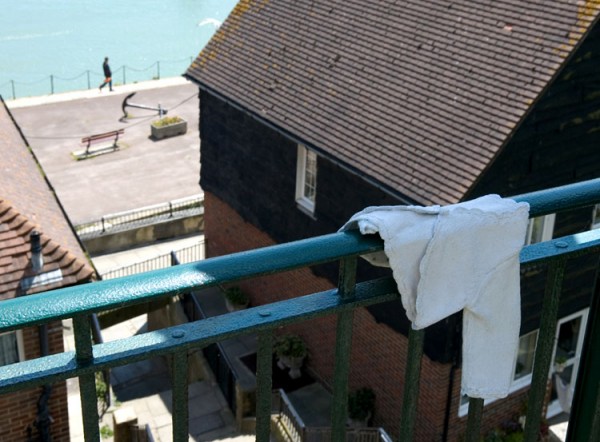
Tracey Emin. Jacket (from Baby Things), 2008. Photo: Thierry Bal

The Folkestone Triennial, curated by Andrea Schlieker, is unlike many overshadowed peripheral exhibitions in that it attracts internationally renowned artists who respond in a perceptive way to the unique geographic and demographic qualities of the area. With permanent works and temporary installations, the Folkestone Triennial animates the town, engaging with both the fleeting international audience passing through and the permanent local community.

Read More »

Share